Drive Team Excellence with SAP ERP Planning & Manufacturing Corporate Training

SAP ERP Planning & Manufacturing encompasses the modules within the SAP Enterprise Resource Planning (ERP) system that focus on optimizing and managing manufacturing and planning processes. It plays a crucial role in enhancing operational efficiencies within organizations, especially through streamlining production and supply chain management. The advanced tools for demand forecasting and sales and operations planning provided by SAP ERP aid in achieving more accurate production schedules that align closely with market demands. SAP ERP Planning & Manufacturing training is essential for organizations that optimize manufacturing and planning processes using sophisticated ERP solutions.

The SAP ERP Planning & Manufacturing instructor-led training course provided by Edstellar can be customized to meet team requirements. The virtual/onsite SAP ERP Planning & Manufacturing training course led by expert trainers enhances productivity and efficiency, as employees are better equipped to handle the complexities of SAP ERP in their daily roles.

Get Customized Expert-led Training for Your Teams
Customized Training Delivery
Scale Your Training: Small to Large Teams
In-person Onsite, Live Virtual or Hybrid Training Modes
Plan from 2000+ Industry-ready Training Programs
Experience Hands-On Learning from Industry Experts
Delivery Capability Across 100+ Countries & 10+ Languages
""""

Skills Your Employees Will Gain

These are the core, hands-on capabilities your team builds during the program.

  • MRP Proficiency
    Mrp Proficiency refers to the ability to effectively use material requirements planning systems to manage inventory and production schedules. this skill is important for supply chain managers and production planners, as it ensures optimal resource allocation, reduces costs, and enhances efficiency in manufacturing processes.
  • Production Scheduling
    Production Scheduling is the process of planning and organizing manufacturing activities to optimize efficiency and meet deadlines. This skill is important for roles in operations management, as it ensures timely delivery, resource allocation, and minimizes downtime, ultimately enhancing productivity and profitability.
  • Inventory Management
    Inventory Management is the process of overseeing stock levels, orders, and storage. this skill is important for roles in supply chain, retail, and logistics to optimize efficiency and reduce costs.
  • Demand Forecasting
    Demand Forecasting is the process of predicting future customer demand for products or services. this skill is important for roles in supply chain management, sales, and inventory control, as it helps optimize resources, reduce costs, and enhance customer satisfaction.
  • Process Optimization
    Process Optimization is the practice of enhancing workflows to improve efficiency and reduce costs. This skill is important for roles in operations, manufacturing, and project management, as it drives productivity and quality.
  • Data Analysis
    Data Analysis is the process of inspecting, cleansing, and modeling data to discover useful information. This skill is important for roles like data scientist and business analyst, as it drives informed decision-making and strategy development.

What Your Team Will Achieve After This Training

  • Analyze master data for effective supply chain planning, including vendors, inventory, and production resources
  • Develop a flexible sales and operations plan considering demand and supply fluctuations
  • Implement demand management strategies using forecasting, safety stock, and production scheduling
  • Run Material Requirements Planning (MRP) to determine material needs and generate procurement proposals
  • Create long-term planning scenarios and assess resource requirements based on market trends
  • Manage production orders including configurations, scheduling, material staging, and performance evaluation
  • Execute process orders for batch production, considering quality checks and deviations
  • Apply Kanban principles to manage work-in-process and improve production agility

Topics & Program Outline

The curriculum is organized into focused modules built by industry experts and delivered virtually or on-premise. Interactive sessions reflect the evolving demands of the workplace, keeping the learning both relevant and practical.

  1. Drafting supply chain planning
    • Understanding the scope and objectives of supply chain planning
    • Identifying key components and their roles in the supply chain
    • Overview of planning strategies and methodologies
  1. Reviewing supply chain master data
    • Overview of master data in supply chain management
    • Managing vendor and supplier data
    • Inventory and warehouse management data considerations
  2. Reviewing production master data
    • Defining production resources and their attributes
    • Setting up work centers and routings
    • Importance of BOM (Bill of Materials) in production planning
  1. Drafting flexible planning
    • Fundamentals of flexible planning
    • Configuring planning hierarchies and time buckets
    • Adapting to changes in demand and supply
  2. Executing standard Sales and Operations Planning
    • Preparing data for S&OP
    • Running simulation and what-if analyses
    • Collaboration across departments
  3. Releasing a standard Sales and Operations Plan
    • Approval processes for S&OP
    • Integrating S&OP with execution systems
    • Monitoring and adjusting the plan
  1. Setting up a demand program
    • Forecasting methods and their applications
    • Integrating market intelligence and sales input
    • Demand aggregation and disaggregation techniques
  2. Planning Make-to-Stock production
    • Determining safety stock levels
    • Scheduling production orders
    • Balancing inventory costs with service levels
  3. Planning Make-to-Order production
    • Order entry and processing
    • Customizing products to meet specific demands
    • Coordination between sales, production, and logistics
  4. Checking product availability
    • Real-time inventory checks
    • Managing reservations and allocations
    • Enhancing customer satisfaction through reliable delivery promises
  1. Drafting MRP procedures
    • Setting up MRP views in material master
    • Defining MRP groups and their parameters
    • Periodic versus continuous planning
  2. Planning material requirements
    • Running MRP calculations
    • Managing procurement proposals
    • Handling exceptions and shortages
  3. Interpreting the results of material requirements planning
    • Analyzing MRP lists and stock/requirements lists
    • Prioritizing actions based on MRP results
    • Continuous improvement in MRP processes
  1. Creating a long-term planning scenario
    • Defining planning horizons and scenarios
    • Assessing capacity and resource requirements
    • Integrating financial planning
  2. Executing long-term planning
    • Running simulations for different scenarios
    • Decision-making based on long-term forecasts
    • Updating long-term plans based on market trends
  1. Distinguishing production types
    • Comparison of discrete, process, and repetitive manufacturing
    • Selecting appropriate production types based on product characteristics
    • Impact of production type selection on operations and cost
  1. Drafting production orders
    • Understanding order types and their configurations
    • Setting parameters for order release and scheduling
    • Documenting production specifications
  2. Creating production orders
    • Generating orders manually and automatically
    • Integrating orders with MRP and demand management
    • Customizing orders for special requirements
  3. Releasing production orders
    • Authorization processes for order release
    • Sequencing and dispatching orders to the shop floor
    • Communication and documentation for production
  4. Executing material staging for production orders
    • Planning and controlling the supply of materials
    • Just-in-Time (JIT) and Just-in-Sequence (JIS) techniques
    • Using automated systems for material staging
  5. Executing confirmation and goods receipt for production orders
    • Recording production progress and completion
    • Managing quality checks and inspections
    • Handling goods receipt and inventory updates
  6. Evaluating production orders
    • Analyzing performance against standards
    • Identifying bottlenecks and areas for improvement
    • Reporting and feedback mechanisms
  1. Drafting process orders
    • Characteristics and setup of process orders
    • Differences from production orders in configuration and handling
    • Role of process orders in batch management
  2. Creating and interpreting process orders
    • Procedures for creating and editing process orders
    • Critical factors in process order management
    • Reading and understanding process order documents
  3. Executing process orders
    • Steps in the execution of process orders
    • Coordination among production, quality management, and warehouse
    • Handling deviations and unexpected issues
  4. Using additional functions with process orders
    • Incorporating safety and environmental regulations
    • Integration with maintenance and asset management
    • Advanced automation and digitalization techniques
  1. Drafting repetitive manufacturing
    • Setting up environments for repetitive manufacturing
    • Planning cycles and repetitive schedules
    • Continuous flow manufacturing concepts
  2. Preparing repetitive manufacturing
    • Aligning material supply with production needs
    • Implementing lean manufacturing principles
    • Training and empowering the workforce
  3. Planning line loading in repetitive manufacturing
    • Optimizing line configurations for maximum efficiency
    • Balancing lines to eliminate bottlenecks
    • Using software tools for line balancing
  4. Using material staging and confirmation
    • Scheduling material delivery to production lines
    • Confirming production as it occurs
    • Linking material usage with production output
  5. Integrating costing, controlling, and reporting
    • Calculating production costs in real-time
    • Controlling production expenses and variances
    • Generating production reports for management review
  1. Drafting kanban
    • Principles of Kanban and its implementation
    • Setting up Kanban boards and cards
    • Integrating Kanban with ERP systems
  2. Using kanban in production
    • Applying Kanban to manage Work-in-Process (WIP)
    • Enhancing agility and responsiveness in production
    • Continuous improvement and Kaizen initiatives

Who Should Attend?

This program suits professionals at many levels across the organization, including:

  • Production Planners
  • Supply Chain Coordinators
  • ERP Specialists
  • Material Planners
  • Inventory Coordinators
  • Supply Chain Analysts
  • Production Controllers
  • Procurement Specialists
  • Inventory Analysts
  • Quality Assurance Specialists
  • Operations Coordinators
  • Managers

What are the Prerequisites?

Employees with a basic understanding of SAP ERP System and familiarity with supply chain and manufacturing concepts can take up the SAP ERP Planning & Manufacturing training course.

Request a Quote for your Corporate Training Requirements

Valid number

Delivering Training for Organizations across 100 Countries and 10+ Languages

Choose the Format That Fits Your Team

We design training your teams actually engage with, and deliver it the way that suits you best. Through a vetted global trainer network, Edstellar runs sessions in 10+ languages with consistent quality anywhere.

Virtual SAP ERP Planning & Manufacturing Training

Virtual / online: expert-led live sessions delivered anywhere, with consistency and easy scheduling.

We deliver anywhere worldwide
Standardized content for consistent outcomes
Join from own workspace, no travel
We scale to large groups across sites
Interactive tools keep remote learners engaged
On-site SAP ERP Planning & Manufacturing Training

On-site (in-house): immersive, instructor-led learning at your office.

Our trainers run face-to-face at your office
We tailor setup/content to your workplace and tools
Group exercises drive collaboration
Live demos +  hands-on practice
Direct trainer access to clarify doubts
Off-site SAP ERP Planning & Manufacturing Training

Off-site: focused, instructor-led group learning away from everyday workplace distractions.

We host your teams at a venue of your preferred choice
Built-in group activities for bonding
Full uninterrupted schedule for focus/retention
Boosts morale and signals commitment

Get a Proposal Shaped to Your Needs

Need pricing for onsite, offsite, or virtual delivery? Get a proposal tailored to your team's needs.

Request a Group Training Quote
""
How Many Team Members Need Training?
Please select an option or fill in the custom field.
"'

Is Your Corporate Training Requirement Only for SAP ERP Planning & Manufacturing ?

Please select at least one course.
""
Add the List of Training Workshops
search icon

      Please select the course

      No. of Courses selected: 0

      Clear

      Upload a CSV

      Send us your Training Requirements in 3 Easy steps

      1. 1
      2. 2
        Add the required training workshops
      3. 3
        Upload to get a quick quote or email it to contact@edstellar.com

      ""

      Looking for a Complete Package?

      Looking for a one-time pricing option for all your annual training requirements?

      View Corporate Training Packages
      ""
      Select the Option that Best Describes Your Corporate Training Requirement

      Please select an option or choose from the recurring options.
      ""
      Verify and Submit Your Request

      Review Your Corporate Training Selection Summary

      Training Program: SAP ERP Planning & Manufacturing Training

      1. No of Team Members

      2. Selected Training Preference

      3. Selected Recurring Sessions

      1

      Review your Requirements

      Training Workshops Selected :


        Excel
        File has been
        successfully uploaded.
        Fill the form to submit
 your details
        Submit Your Professional Contact Information
        Valid number
        We've received your enquiry. Our team will be in touch soon.
        Oops! Something went wrong while submitting the form.
        Starter
        120 licences

        Tailor-Made Trainee Licenses with Our Exclusive Training Packages!

        View Package

        64 hours of group training (includes VILT/In-person On-site)

        Tailored for SMBs

        Growth
        320 licences

        Tailor-Made Trainee Licenses with Our Exclusive Training Packages!

        View Package

        160 hours of group training (includes VILT/In-person On-site)

        Ideal for growing SMBs

        Enterprise
        800 licences

        Tailor-Made Trainee Licenses with Our Exclusive Training Packages!

        View Package

        400 hours of group training (includes VILT/In-person On-site)

        Designed for large corporations

        Custom
        Unlimited licenses

        Tailor-Made Trainee Licenses with Our Exclusive Training Packages!

        View Package

        Unlimited duration

        Designed for large corporations

        What Sets Edstellar Apart

        Experienced Trainers

        Our trainers are drawn from a vetted global network and bring years of industry expertise, keeping every session practical and impactful.

        Proven Quality

        With a strong global track record, Edstellar is known for quality and engaging delivery.

        Industry-Relevant Curriculum

        Our programs are built by experts to match the demands of today's industry.

        Fully Customizable

        Every program can be tailored to your organization's goals.

        Comprehensive Support

        We provide pre- and post-session support for a complete learning experience.

        Global Multi-Location & Multilingual Training Delivery

        We deliver in multiple languages to support diverse global teams.

        Hear from Organizations We've Trained

        "Attending the SAP ERP Planning & Manufacturing training was transformational for my professional development. As a Functional Consultant, the deep dive into advanced methodologies gave me the confidence to tackle complex challenges coverage of hands-on exercises were immediately applicable to my work. I've been able to drive meaningful innovation and improvement within my department. This course has become foundational to my continued success.”

        Anthony King

        Functional Consultant,

        Production Management Systems Firm

        "The SAP ERP Planning & Manufacturing training enhanced my ability to architect and implement sophisticated operational excellence strategies. Understanding industry best practices through intensive real-world case studies exercises professional services initiatives. We delivered a high-visibility enterprise project two months ahead of schedule. The detailed exploration of interactive labs provided methodologies I leverage in every engagement.”

        Sebastian Popescu

        Manufacturing Consultant,

        Manufacturing Execution Platform

        "The SAP ERP Planning & Manufacturing training gave our team advanced practical applications expertise that revolutionized our professional expertise approach. As a Supply Chain Manager, understanding expert-led workshops and hands-on across our entire portfolio. Our team's capability maturity level increased by three full stages within six months. This training has become foundational to our team's strategic capabilities and continued growth.”

        Tamer Fahim

        Supply Chain Manager,

        Smart Manufacturing Solutions Provider

        “Edstellar’s IT & Technical training programs have been instrumental in strengthening our engineering teams and building future-ready capabilities. The hands-on approach, practical cloud scenarios, and expert guidance helped our teams improve technical depth, problem-solving skills, and execution across multiple projects. We’re excited to extend more of these impactful programs to other business units.”

        Aditi Rao

        L&D Head,

        A Global Technology Company

        Recognition That Motivates Your Team

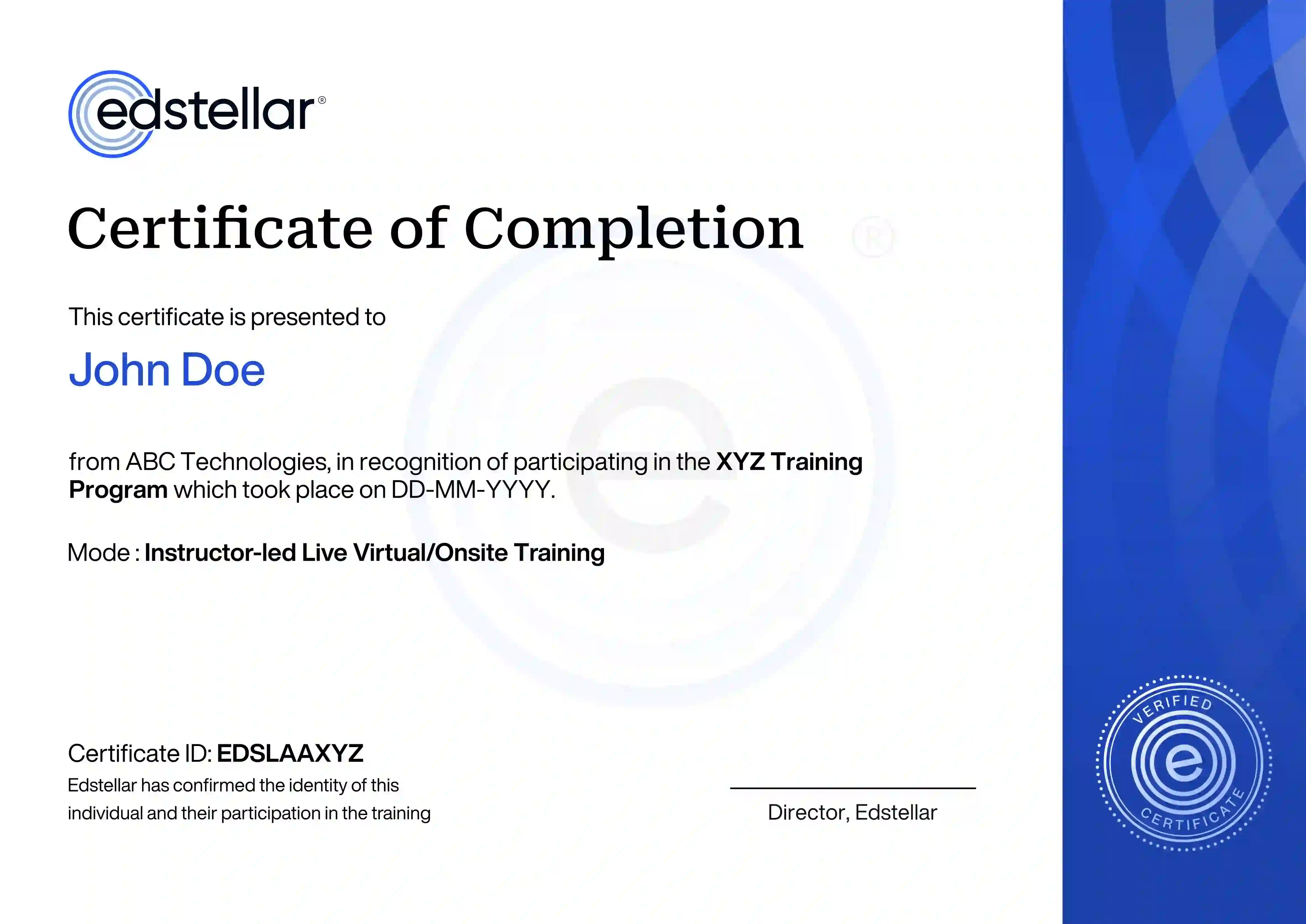
        Upon successful completion of the training course offered by Edstellar, employees receive a course completion certificate, symbolizing their dedication to ongoing learning and professional development.

        This certificate validates the employee's acquired skills and is a powerful motivator, inspiring them to enhance their expertise further and contribute effectively to organizational success.

        Recognition That Motivates Your Team
        Other Related Corporate Training Courses