Drive Team Excellence with SAP Supply Chain Management (SCM) Corporate Training

Empower your teams with expert-led on-site, off-site, and virtual SAP Supply Chain Management (SCM) Training through Edstellar, a premier corporate training provider for organizations globally. Designed to meet your specific training needs, this group training program ensures your team is primed to drive your business goals. Help your employees build lasting capabilities that translate into real performance gains.

SAP Supply Chain Management (SCM) is a solution that integrates and optimizes various supply chain processes, such as procurement, production planning, inventory management, and logistics. It is essential for organizations to implement SAP SCM to enhance operational efficiency, reduce costs, and improve overall supply chain performance, enabling them to respond quickly to market changes and customer demands. SAP Supply Chain Management (SCM) training course equips employees with the skills to manage and streamline these processes effectively, ensuring the organization can leverage the full potential of this powerful tool.

Edstellar's instructor-led SAP Supply Chain Management (SCM) training course is delivered by industry experts with years of experience. The course offers virtual/onsite training options and a customizable curriculum that covers practical aspects to ensure employees gain hands-on experience.

Get Customized Expert-led Training for Your Teams
Customized Training Delivery
Scale Your Training: Small to Large Teams
In-person Onsite, Live Virtual or Hybrid Training Modes
Plan from 2000+ Industry-ready Training Programs
Experience Hands-On Learning from Industry Experts
Delivery Capability Across 100+ Countries & 10+ Languages
""""

Key Skills Employees Gain from instructor-led SAP Supply Chain Management (SCM) Training

SAP Supply Chain Management (SCM) skills corporate training will enable teams to effectively apply their learnings at work.

  • Inventory Management
    Inventory Management is the process of overseeing stock levels, orders, and storage. this skill is important for roles in supply chain, retail, and logistics to optimize efficiency and reduce costs.
  • Demand Planning
    Demand Planning is the process of forecasting customer demand to ensure product availability while minimizing excess inventory. This skill is important for supply chain managers, as it optimizes resources and enhances customer satisfaction.
  • Warehouse Management
    Warehouse Management involves overseeing storage, inventory control, and logistics. This skill is important for optimizing operations, reducing costs, and ensuring timely deliveries.
  • Production Planning
    Production Planning is the process of organizing and scheduling manufacturing activities to optimize efficiency and resource use. This skill is important for roles in manufacturing, supply chain management, and operations, as it ensures timely delivery, cost control, and quality assurance.
  • Supplier Relationship Management
    Supplier Relationship Management is the strategic approach to managing interactions with suppliers. This skill is important for procurement roles to ensure quality, cost efficiency, and innovation.
  • Supply Chain Analytics
    Supply Chain Analytics involves using data analysis to optimize supply chain operations. This skill is important for roles like supply chain managers and analysts to enhance efficiency, reduce costs, and improve decision-making.

Key Learning Outcomes of SAP Supply Chain Management (SCM) Training Workshop for Employees

Upon completing Edstellar’s SAP Supply Chain Management (SCM) workshop, employees will gain valuable, job-relevant insights and develop the confidence to apply their learning effectively in the professional environment.

  • Analyze inventory levels to ensure adequate stock without overproduction
  • Develop effective procurement strategies that align with organizational goals
  • Apply supply chain management principles to optimize operational efficiency
  • Implement logistics solutions to enhance delivery performance and customer satisfaction
  • Evaluate supplier performance and manage relationships to ensure quality and reliability

Key Benefits of the SAP Supply Chain Management (SCM) Group Training

Attending our SAP Supply Chain Management (SCM) group training classes provides your team with a powerful opportunity to build skills, boost confidence, and develop a deeper understanding of the concepts that matter most. The collaborative learning environment fosters knowledge sharing and enables employees to translate insights into actionable work outcomes.

  • Learn to optimize supply chain processes to enhance operational efficiency
  • Explore logistics and distribution strategies to improve delivery performance
  • Develop skills in procurement and production planning to align with business objectives
  • Develop the ability to implement and manage SAP SCM solutions in real-world scenarios
  • Learn to utilize advanced analytics for better decision-making in supply chain management

Topics and Outline of SAP Supply Chain Management (SCM) Training

Our virtual and on-premise SAP Supply Chain Management (SCM) training curriculum is structured into focused modules developed by industry experts. This training for organizations provides an interactive learning experience that addresses the evolving demands of the workplace, making it both relevant and practical.

  1. PIR creation
    • Understanding PIR (Planned Independent Requirements)
    • Steps to create PIR in SAP SCM
    • Assigning PIR to relevant materials and locations
    • Configuring PIR profiles
  2. PIR consumption
    • Consumption logic for PIRs
    • Tracking PIR consumption in the planning cycle
    • Adjusting PIR based on consumption patterns
    • Reporting on PIR consumption
  1. Planned order creation/purchase requisition creation
    • Creating planned orders in SAP SCM
    • Generating purchase requisitions from planned orders
    • Assigning materials to planned orders
    • Reviewing and approving planned orders
  2. Planned order conversion
    • Converting planned orders to production orders
    • Managing purchase orders from planned orders
    • Monitoring order conversion status
    • Handling exceptions during order conversion
  1. Order creation
    • Creating production orders in SAP SCM
    • Setting up order parameters and specifications
    • Assigning resources and materials to orders
  2. Order release
    • Releasing production orders for execution
    • Reviewing order readiness and prerequisites
    • Managing release strategies and workflows
  3. Goods issue
    • Posting goods issue for production orders
    • Handling inventory updates for goods issue
    • Tracking goods issue transactions
  4. Order confirmation
    • Confirming production order completion
    • Recording production output and yields
    • Managing partial and final confirmations
  5. Goods receipt
    • Posting goods receipts for production orders
    • Updating inventory with received goods
    • Handling quality inspections and approvals
  6. Order closure
    • Closing completed production orders
    • Archiving and documenting order details
    • Reviewing order closure reports and metrics
  1. Generating and activating integration models
    • Creating integration models in SAP SCM
    • Activating and validating integration models
    • Assigning data sources and targets
  2. Monitoring and error handling tools for integrating SAP R/3 and SAP SCM
    • Using monitoring tools for integration
    • Identifying and resolving integration errors
    • Setting up alerts and notifications for integration issues
  3. Incremental transfers for master data changes
    • Configuring incremental data transfers
    • Managing changes in master data
    • Ensuring data consistency across systems
  4. Organizing integration models
    • Structuring integration models for efficiency
    • Managing versions and updates of integration models
    • Documenting integration model configurations
  1. Locations in SAP SCM
    • Defining and managing locations
    • Assigning location attributes and hierarchies
    • Integrating location data with other modules
  2. Material masters in SAP SCM
    • Creating and managing material master records
    • Assigning material attributes and classifications
    • Integrating material data with other modules
  3. Resources in SAP SCM
    • Defining and managing resources
    • Assigning resource attributes and capacities
    • Integrating resource data with production planning
  4. Production Process Models (PPM)
    • Creating production process models
    • Assigning operations and sequences to PPMs
    • Managing PPM versions and updates
  5. Production Data Structure (PDS)
    • Defining production data structures
    • Assigning components and resources to PDS
    • Integrating PDS with production planning
  6. Purchasing information records
    • Creating and managing purchasing information records
    • Assigning vendor and material data
    • Integrating purchasing data with procurement processes
  7. Transportation lanes
    • Defining transportation lanes
    • Assigning routes and carriers to lanes
    • Integrating transportation data with logistics
  8. Master recipes and the PPM
    • Creating master recipes
    • Assigning components and operations to recipes
    • Managing recipe versions and updates
  1. Models
    • Creating supply chain models
    • Defining model parameters and constraints
    • Managing model versions and updates
  2. Versions in SAP SCM
    • Creating and managing model versions
    • Comparing and analyzing model versions
    • Integrating model versions with planning processes
  3. Modeling with the supply chain engineer
    • Using the supply chain engineer tool
    • Defining and simulating supply chain scenarios
    • Analyzing and optimizing supply chain models
  1. Setting up transactional data transfer
    • Configuring data transfer settings
    • Mapping data fields for transfer
    • Validating and testing data transfer processes
  2. Generating and activating integration models
    • Creating and activating transactional data integration models
    • Monitoring data transfer status
    • Handling errors and exceptions during data transfer
  1. Planning object structure
    • Defining planning object structures
    • Assigning attributes and hierarchies to planning objects
    • Integrating planning objects with demand planning
  2. Characteristic value combinations
    • Creating characteristic value combinations
    • Assigning values to plan objects
    • Managing value combinations for planning accuracy
  3. Planning areas
    • Defining and managing planning areas
    • Assigning data sources to planning areas
    • Integrating planning areas with other modules
  4. Product interchangeability
    • Configuring product interchangeability settings
    • Managing interchangeable products in planning
    • Analyzing the impact of product interchangeability
  5. Proportional factors
    • Defining proportional factors for planning
    • Assigning factors to planning objects
    • Using proportional factors in demand planning
  6. Version management
    • Creating and managing planning versions
    • Comparing and analyzing planning versions
    • Integrating planning versions with demand planning
  1. Creating planning books and data views
    • Designing planning books in SAP SCM
    • Defining data views for planning books
    • Integrating planning books with demand planning
  2. Macros
    • Creating and managing macros for planning
    • Assigning macros to planning books and data views
    • Using macros to automate planning tasks
  1. Navigation in the interactive planning table
    • Navigating the interactive planning table
    • Customizing table views and layouts
    • Using interactive features for planning analysis
  2. Additional features of the interactive planning table
    • Exploring advanced interactive planning features
    • Using simulation and scenario analysis tools
    • Integrating interactive planning with other modules
  1. Executing a univariate forecast
    • Setting up univariate forecast models
    • Running univariate forecast simulations
    • Analyzing forecast results and accuracy
  2. Composite forecast
    • Creating composite forecast models
    • Combining multiple forecast techniques
    • Analyzing and comparing composite forecasts
  3. Consensus-based forecasting
    • Setting up consensus-based forecasting
    • Gathering and integrating consensus inputs
    • Analyzing and validating consensus forecasts
  4. Forecast alert profile
    • Creating and managing forecast alert profiles
    • Setting alert thresholds and criteria
    • Monitoring forecast alerts and actions
  5. Lifecycle planning
    • Defining lifecycle planning parameters
    • Managing product lifecycle stages in planning
    • Integrating lifecycle planning with demand forecasting
  6. Promotion planning
    • Setting up promotion planning models
    • Integrating promotions with demand forecasts
    • Analyzing the impact of promotions on demand
  7. Info cubes
    • Creating and managing info cubes for forecasting
    • Assigning data sources to info cubes
    • Analyzing forecast data using info cubes
  1. Working with master data
    • Managing master data in SAP SCM
    • Integrating master data with supply network planning
    • Analyzing master data for planning accuracy
  2. APO product master
    • Creating and managing APO product master records
    • Assigning product attributes and classifications
    • Integrating product master data with planning
  3. APO resource master
    • Creating and managing APO resource master records
    • Assigning resource attributes and capacities
    • Integrating resource master data with planning
  4. Introducing the production process model
    • Defining production process models in APO
    • Assigning components and operations to models
    • Integrating process models with supply network planning
  5. Introducing quota arrangements
    • Setting up quota arrangements for planning
    • Assigning quotas to suppliers and resources
    • Integrating quota arrangements with planning processes
  6. Transactional data used in supply network planning
    • Managing transactional data in SNP
    • Integrating transactional data with master data
    • Analyzing transactional data for planning accuracy
  1. Planning areas
    • Defining and managing SNP planning areas
    • Assigning data sources to planning areas
    • Integrating planning areas with supply network planning
  2. Planning books
    • Creating and managing SNP planning books
    • Defining data views for planning books
    • Integrating planning books with demand planning
  3. Macros and alerts
    • Creating and managing SNP macros
    • Setting up alerts for SNP planning
    • Integrating macros and alerts with planning processes
  4. Navigation in the planning table
    • Navigating the SNP planning table
    • Customizing table views and layouts
    • Using interactive features for SNP planning
  5. Introducing quota arrangements
    • Setting up quota arrangements in SNP
    • Assigning quotas to suppliers and resources
    • Integrating quota arrangements with SNP planning
  6. Transactional data used in supply network planning
    • Managing transactional data in SNP
    • Integrating transactional data with master data
    • Analyzing transactional data for SNP accuracy
  1. SNP heuristic run
    • Setting up and running SNP heuristic
    • Analyzing heuristic results and accuracy
    • Adjusting heuristic parameters for optimization
  2. Capacity check and leveling
    • Configuring capacity checks for SNP
    • Running capacity leveling simulations
    • Analyzing and adjusting capacity plans
  3. Planning supplier constraints using the SNP heuristic
    • Defining supplier constraints in SNP
    • Integrating constraints with heuristic runs
    • Analyzing the impact of constraints on planning
  4. SNP heuristic scheduling
    • Setting up heuristic scheduling parameters
    • Running and analyzing heuristic schedules
    • Adjusting schedules for optimal planning
  5. Hierarchical planning
    • Defining hierarchical planning structures
    • Integrating hierarchical planning with SNP
    • Analyzing hierarchical planning results
  1. CTM process
    • Understanding the CTM process in SNP
    • Setting up CTM parameters and constraints
    • Running and analyzing CTM simulations
  2. Alternative PPMs in CTM
    • Defining alternative PPMs for CTM
    • Integrating alternative PPMs with CTM runs
    • Analyzing the impact of alternative PPMs on planning
  1. Understanding interchangeability concepts
    • Defining interchangeability in SAP SCM
    • Setting up interchangeable products
    • Managing interchangeability in planning
  1. Safety stock calculation
    • Defining safety stock parameters
    • Calculating safety stock levels
    • Integrating safety stock with planning processes
  1. Deployment planning
    • Setting up deployment planning parameters
    • Running and analyzing deployment plans
    • Integrating deployment with supply network planning
  2. Transport load builder
    • Configuring the transport load builder
    • Generating and optimizing transport loads
    • Integrating transport loads with logistics planning
  1. Optimization techniques
    • Understanding optimization in SAP SCM
    • Setting up optimization parameters
    • Running and analyzing optimization scenarios

Who Can Take the SAP Supply Chain Management (SCM) Training Course

The SAP Supply Chain Management (SCM) training program can also be taken by professionals at various levels in the organization.

  • Supply Chain Analysts
  • Inventory Planners
  • Procurement Specialists
  • Material Planners
  • Logistics Coordinators
  • Warehouse Supervisors
  • Production Planners
  • Operations Managers
  • Supply Chain Managers
  • Logistics Managers
  • SAP SCM Analysts
  • Demand Planners

Prerequisites for SAP Supply Chain Management (SCM) Training

Employees with a basic understanding of supply chain processes and familiarity with SAP systems can take the SAP Supply Chain Management (SCM) training course.

Request a Quote for your Corporate Training Requirements

Valid number

Delivering Training for Organizations across 100 Countries and 10+ Languages

Corporate Group Training Delivery Modes
for SAP Supply Chain Management (SCM) Training

At Edstellar, we understand the importance of impactful and engaging training for employees. As a leading SAP Supply Chain Management (SCM) training provider, we ensure the training is more interactive by offering Face-to-Face onsite/in-house or virtual/online sessions for companies. This approach has proven to be effective, outcome-oriented, and produces a well-rounded training experience for your teams.

 Virtual trainig

Edstellar's SAP Supply Chain Management (SCM) virtual/online training sessions bring expert-led, high-quality training to your teams anywhere, ensuring consistency and seamless integration into their schedules.

With global reach, your employees can get trained from various locations
The consistent training quality ensures uniform learning outcomes
Participants can attend training in their own space without the need for traveling
Organizations can scale learning by accommodating large groups of participants
Interactive tools can be used to enhance learning engagement
 On-site trainig

Edstellar's SAP Supply Chain Management (SCM) inhouse training delivers immersive and insightful learning experiences right in the comfort of your office.

Higher engagement and better learning experience through face-to-face interaction
Workplace environment can be tailored to learning requirements
Team collaboration and knowledge sharing improves training effectiveness
Demonstration of processes for hands-on learning and better understanding
Participants can get their doubts clarified and gain valuable insights through direct interaction
 Off-site trainig

Edstellar's SAP Supply Chain Management (SCM) offsite group training offer a unique opportunity for teams to immerse themselves in focused and dynamic learning environments away from their usual workplace distractions.

Distraction-free environment improves learning engagement
Team bonding can be improved through activities
Dedicated schedule for training away from office set up can improve learning effectiveness
Boosts employee morale and reflects organization's commitment to employee development

Explore Our Customized Pricing Package
for
SAP Supply Chain Management (SCM) Corporate Training

Looking for pricing details for onsite, offsite, or virtual instructor-led SAP Supply Chain Management (SCM) training? Get a customized proposal tailored to your team’s specific needs.

Request a Group Training Quote
""
How Many Team Members Need Training?
Please select an option or fill in the custom field.
"'

Is Your Corporate Training Requirement Only for SAP Supply Chain Management (SCM) ?

Please select at least one course.
""
Add the List of Training Workshops
search icon

      Please select the course

      No. of Courses selected: 0

      Clear

      Upload a CSV

      Send us your Training Requirements in 3 Easy steps

      1. 1
      2. 2
        Add the required training workshops
      3. 3
        Upload to get a quick quote or email it to contact@edstellar.com

      ""

      Looking for a Complete Package?

      Looking for a one-time pricing option for all your annual training requirements?

      View Corporate Training Packages
      ""
      Select the Option that Best Describes Your Corporate Training Requirement

      Please select an option or choose from the recurring options.
      ""
      Verify and Submit Your Request

      Review Your Corporate Training Selection Summary

      Training Program: SAP Supply Chain Management (SCM) Training

      1. No of Team Members

      2. Selected Training Preference

      3. Selected Recurring Sessions

      1

      Review your Requirements

      Training Workshops Selected :


        Excel
        File has been
        successfully uploaded.
        Fill the form to submit
 your details
        Submit Your Professional Contact Information
        Valid number
        We've received your enquiry. Our team will be in touch soon.
        Oops! Something went wrong while submitting the form.
        Starter
        120 licences

        Tailor-Made Trainee Licenses with Our Exclusive Training Packages!

        View Package

        64 hours of group training (includes VILT/In-person On-site)

        Tailored for SMBs

        Growth
        320 licences

        Tailor-Made Trainee Licenses with Our Exclusive Training Packages!

        View Package

        160 hours of group training (includes VILT/In-person On-site)

        Ideal for growing SMBs

        Enterprise
        800 licences

        Tailor-Made Trainee Licenses with Our Exclusive Training Packages!

        View Package

        400 hours of group training (includes VILT/In-person On-site)

        Designed for large corporations

        Custom
        Unlimited licenses

        Tailor-Made Trainee Licenses with Our Exclusive Training Packages!

        View Package

        Unlimited duration

        Designed for large corporations

        Edstellar: Your Go-to SAP Supply Chain Management (SCM) Training Company

        Experienced Trainers

        Our trainers bring years of industry expertise to ensure the training is practical and impactful.

        Quality Training

        With a strong track record of delivering training worldwide, Edstellar maintains its reputation for its quality and training engagement.

        Industry-Relevant Curriculum

        Our course is designed by experts and is tailored to meet the demands of the current industry.

        Customizable Training

        Our course can be customized to meet the unique needs and goals of your organization.

        Comprehensive Support

        We provide pre and post training support to your organization to ensure a complete learning experience.

        Multilingual Training Capabilities

        We offer training in multiple languages to cater to diverse and global teams.

        Testimonials

        What Our Clients Say

        We pride ourselves on delivering exceptional training solutions. Here's what our clients have to say about their experiences with Edstellar.

        "The SAP Supply Chain Management (SCM) course revolutionized how I approach my daily responsibilities. As a Principal Analytics Architect, understanding advanced methodologies was essential, and this training real-world experience. I've successfully implemented these advanced techniques in production environments with measurable impact. The instructor's insights on expert-led workshops have proven instrumental in my professional advancement.”

        Arnold Gilbert

        Principal Analytics Architect,

        SCM Software Platform

        "This SAP Supply Chain Management (SCM) course equipped me with comprehensive strategic frameworks expertise that I've seamlessly integrated into our organizational practice. The hands-on modules covering real-world case studies I now confidently design solutions that consistently deliver measurable business results. We've reduced implementation timelines by 45% on comparable projects, validating the immediate impact of this training program.”

        Patrick Kelly

        Senior Business Intelligence Developer,

        Logistics Solutions Provider

        "As a Senior Data Platform Engineer leading technical mastery operations, the SAP Supply Chain Management (SCM) training provided our team with essential industry best practices expertise at scale. The comprehensive our complete operational footprint. Our team has automated eighteen critical business processes, reducing manual effort by 70%. This course has proven invaluable for driving our organizational transformation and sustained excellence.”

        Fadil Osman

        Senior Data Platform Engineer,

        Supply Chain Management Platform

        “Edstellar’s IT & Technical training programs have been instrumental in strengthening our engineering teams and building future-ready capabilities. The hands-on approach, practical cloud scenarios, and expert guidance helped our teams improve technical depth, problem-solving skills, and execution across multiple projects. We’re excited to extend more of these impactful programs to other business units.”

        Aditi Rao

        L&D Head,

        A Global Technology Company

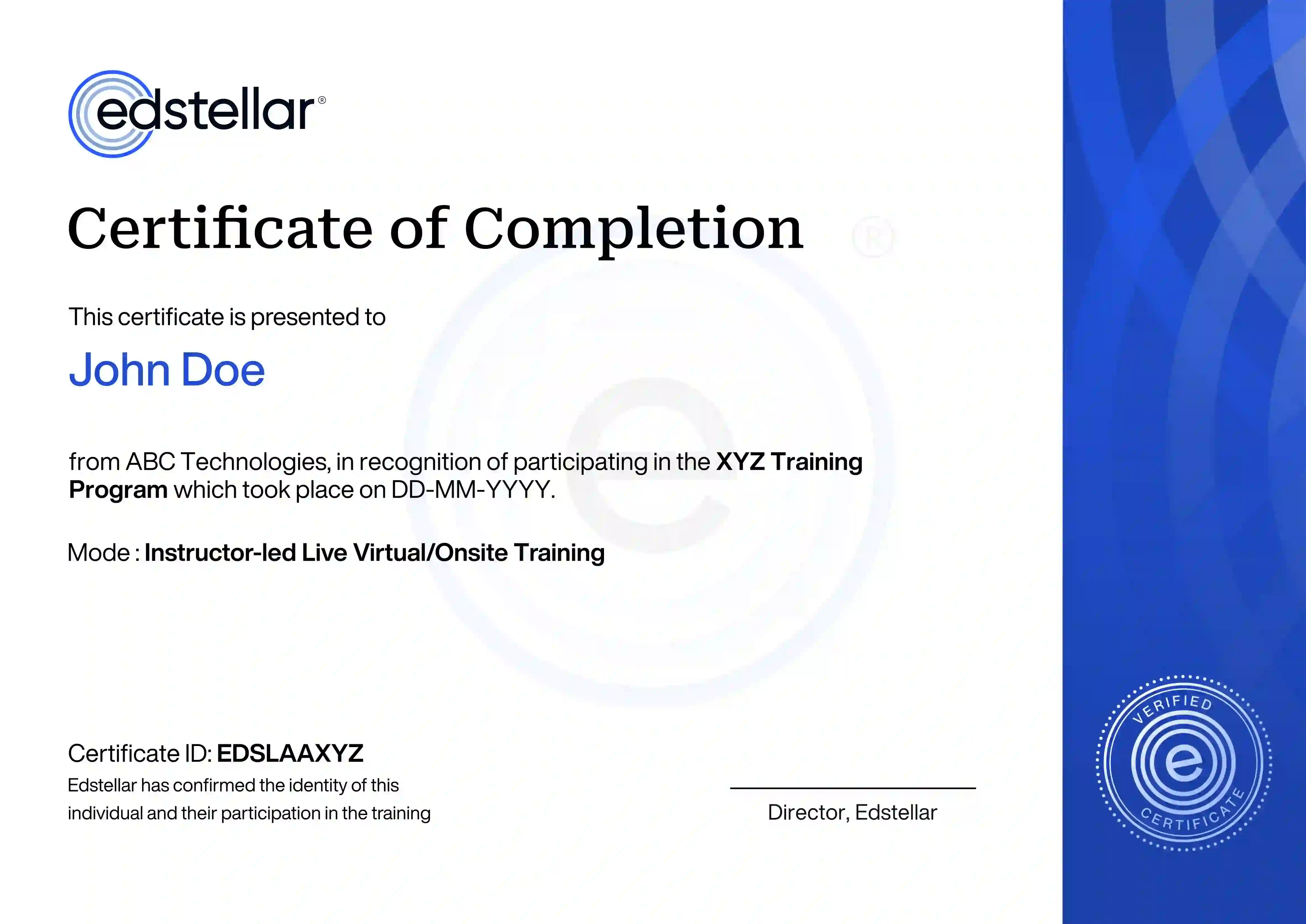
        Get Your Team Members Recognized with Edstellar’s Course Certificate

        Upon successful completion of the training course offered by Edstellar, employees receive a course completion certificate, symbolizing their dedication to ongoing learning and professional development.

        This certificate validates the employee's acquired skills and is a powerful motivator, inspiring them to enhance their expertise further and contribute effectively to organizational success.

        Certificate of Excellence

        We have Expert Trainers to Meet Your SAP Supply Chain Management (SCM) Training Needs

        The instructor-led training is conducted by certified trainers with extensive expertise in the field. Participants will benefit from the instructor's vast knowledge, gaining valuable insights and practical skills essential for success in Access practices.

        Other Related Corporate Training Courses