Corporate Oracle Cloud Infrastructure Security Professional Training Course
Edstellar's instructor-led Oracle Cloud Infrastructure Security Professional training course empowers teams with cloud security skills to achieve data protection and compliance for the organization. The course equips employees to protect organizational data and respond to security incidents, enhancing their overall security posture.
(Virtual / On-site / Off-site)
Available Languages
English, Español, 普通话, Deutsch, العربية, Português, हिंदी, Français, 日本語 and Italiano
Drive Team Excellence with Oracle Cloud Infrastructure Security Professional Corporate Training
Oracle Cloud Infrastructure Security is a suite of tools and services designed to protect cloud environments on Oracle Cloud Infrastructure, ensuring data security, compliance, and threat detection. The course covers advanced security techniques, zero trust principles, identity and access management, policy enforcement, and utilizing OCI's security tools for monitoring. Oracle Cloud Infrastructure Security Professional training course is essential for organizations to ensure their cloud deployments are secure and compliant with regulatory standards. It provides the necessary skills to protect organizational data from internal and external threats, manage access controls, and respond effectively to security incidents, enhancing security posture and minimizing risks.
Edstellar's instructor-led Oracle Cloud Infrastructure Security Professional training course offers virtual/onsite training sessions led by industry experts with years of domain expertise. The training includes expert practical sessions, a customizable curriculum tailored to organizational needs, and a focus on real-world applications.

Skills Your Employees Will Gain
These are the core, hands-on capabilities your team builds during the program.
- Cloud SecurityCloud Security involves protecting data, applications, and infrastructures in cloud environments. This skill is important for IT professionals to safeguard sensitive information and ensure compliance.
- Identity ManagementIdentity Management is the process of managing user identities and access rights within an organization. This skill is important for IT security roles to protect sensitive data and ensure compliance.
- Access ControlAccess Control is the practice of regulating who can view or use resources in a computing environment. This skill is important for IT security roles to protect sensitive data and ensure compliance.
- Incident ResponseIncident Response is the ability to quickly identify, manage, and mitigate security incidents. This skill is important for cybersecurity roles, ensuring swift recovery and minimizing damage.
- Threat DetectionThreat Detection is the ability to identify potential security risks and vulnerabilities in systems. This skill is important for cybersecurity roles, ensuring proactive defense against attacks.
- Security MonitoringSecurity Monitoring is the continuous observation of systems and networks to detect and respond to threats. This skill is important for cybersecurity roles, ensuring proactive defense against breaches.
What Your Team Will Achieve After This Training
- Develop strategies to maintain compliance with relevant regulations and prepare for audits
- Implement incident response plans to handle security breaches and ensure quick recovery effectively
- Apply encryption, key management, and data masking techniques to protect sensitive data both at rest and in transit
- Create security policies and procedures tailored to your organization's needs, ensuring compliance with industry standards and regulatory requirements
- Utilize automation tools and scripts to streamline security operations, enhance incident response, and maintain continuous compliance within the Oracle Cloud Infrastructure
Topics & Program Outline
The curriculum is organized into focused modules built by industry experts and delivered virtually or on-premise. Interactive sessions reflect the evolving demands of the workplace, keeping the learning both relevant and practical.
- Shared security responsibility model
- Understanding the division of security responsibilities between the cloud provider and the customer
- Exploring the implications of shared responsibility in various cloud service models
- Zero trust security
- Introducing the principles and components of a zero-trust security model
- Implementing zero-trust security practices in cloud environments
- Evaluating the benefits and challenges of adopting zero trust
- Security services introduction
- Overview of key security services offered by Oracle Cloud Infrastructure
- Understanding how these services integrate with existing security frameworks
- Benefits of using OCI security services for comprehensive protection
- Security design and controls
- Designing secure architectures for cloud deployments
- Implementing security controls
- Assessing and mitigating security risks through proactive design
- IAM
- Introduction to Identity and Access Management (IAM) concepts
- Importance of IAM in cloud security
- Overview of Oracle Cloud Infrastructure IAM features
- AuthN
- Understanding authentication mechanisms
- Implementing strong authentication methods in OCI
- Ensuring secure access through robust authentication protocols
- AuthZ
- Understanding authorization and access control
- Configuring authorization policies in OCI
- Managing permissions and roles effectively
- Common policies
- Defining common IAM policies for cloud environments
- Implementing and managing policies in OCI
- Compartments
- Introduction to compartments in OCI
- Benefits of using compartments for resource organization
- Policy inheritance and attachment for compartments
- Understanding policy inheritance in OCI
- Attaching policies to compartments effectively
- Managing hierarchical policies
- Organization management
- Overview of organizational structures in OCI
- Managing multi-account environments
- Conditional policies
- Introduction to conditional policies in OCI
- Creating and managing conditional policies
- Advanced policies
- Exploring advanced IAM policies
- Configuring complex access controls
- Tag-based access control
- Introduction to tag-based access control
- Implementing tag-based policies in OCI
- Benefits and use cases of tag-based access control
- Dynamic groups
- Understanding dynamic groups in OCI
- Creating and managing dynamic groups
- IAM federation
- Introduction to IAM federation concepts
- Configuring federation with external identity providers
- Benefits of IAM federation for enterprise environments
- Understanding sign-in options
- Overview of sign-in options for OCI
- Configuring and managing sign-in methods
- VCN intro
- Introduction to Virtual Cloud Networks (VCNs)
- Key components and features of VCNs
- Setting up and managing VCNs in OCI
- Security lists and NSG
- Understanding security lists and network security groups (NSG)
- Configuring security rules for VCNs
- VCN connectivity
- Overview of VCN connectivity options
- Configuring secure VCN connectivity
- Managing VCN peering and routing
- VPN connect
- Introduction to VPN Connect
- Configuring and managing VPN connections
- Ensuring secure remote access through VPN
- FastConnect
- Understanding FastConnect for dedicated connectivity
- Setting up FastConnect connections
- Benefits of using FastConnect for high-performance networking
- Load balancer concepts
- Introduction to load balancing concepts
- Key features and benefits of load balancers
- Understanding load balancer architecture
- Public and private load balancers
- Differences between public and private load balancers
- Configuring and managing load balancers in OCI
- Load balancer policies, health checks
- Overview of load balancer policies
- Configuring health checks for load balancers
- Ensuring high availability through effective load balancing
- Load balancer - SSL handling
- Introduction to SSL handling in load balancers
- Configuring SSL termination and passthrough
- OCI network firewall
- Overview of OCI network firewall features
- Configuring and managing network firewalls
- Network firewall policy
- Understanding network firewall policies
- Creating and managing firewall rules
- Ensuring network security through effective policies
- Shielded instances
- Introduction to shielded instances
- Benefits of using shielded instances for enhanced security
- Configuring and managing shielded instances
- Bastion host
- Understanding bastion hosts and their role in security
- Setting up and managing bastion hosts in OCI
- OS management intro
- Overview of OS management features in OCI
- Configuring and managing OS updates
- Ensuring OS security through effective management
- Dedicated VM hosts
- Introduction to dedicated VM hosts
- Benefits of using dedicated VM hosts for security and performance
- Configuring and managing dedicated VM hosts
- Vulnerability scanning
- Understanding vulnerability scanning concepts
- Configuring and managing vulnerability scans in OCI
- Object storage security
- Introduction to object storage security
- Configuring access controls for object storage
- Ensuring data protection in object storage
- Managing access and authentication
- Overview of access and authentication for storage
- Implementing strong authentication methods
- File storage (refresher)
- Refreshing key concepts of file storage
- Configuring and managing file storage in OCI
- Ensuring data security in file storage
- File storage security
- Understanding file storage security features
- Managing file storage access controls
- Database security
- Introduction to database security principles
- Configuring database security features in OCI
- ADB security
- Overview of Autonomous Database (ADB) security
- Configuring security settings for ADB
- Ensuring data protection in autonomous databases
- Introduction to Data Safe
- Understanding Oracle Data Safe
- Key features and benefits of Data Safe
- Configuring Data Safe in OCI
- Oracle Data Safe in OCI
- Integrating Oracle Data Safe with OCI
- Managing Data Safe configurations
- Oracle Data Safe - Security assessment
- Conducting security assessments with Data Safe
- Analyzing security assessment results
- Implementing recommendations for improved security
- Oracle Data Safe - Data discovery
- Understanding data discovery features in Data Safe
- Configuring data discovery scans
- Using data discovery to enhance security
- Oracle Data Safe - Data masking
- Introduction to data masking concepts
- Configuring data masking policies in Data Safe
- Benefits of data masking for data protection
- Oracle Data Safe - Architecture
- Overview of Oracle Data Safe architecture
- Key components and integration points
- Oracle Data Safe - Target database connectivity
- Understanding target database connectivity in Data Safe
- Configuring and managing database connections
- Ensuring secure connectivity for data-safe operations
- Encryption basics
- Introduction to encryption principles
- Understanding encryption methods and algorithms
- Importance of encryption for data protection
- Vault introduction
- Overview of OCI Vault features
- Setting up and managing OCI Vault
- Benefits of using OCI Vault for key management
- Import and export keys
- Understanding key import and export processes
- Configuring key management operations in OCI Vault
- OCI services integration with vault
- Integrating OCI Vault with other OCI services
- Configuring service-specific key management settings
- Ensuring seamless key management across services
- Backup and replicate vaults and keys
- Overview of backup and replication features
- Configuring backup and replication for vaults and keys
- Vault secrets
- Introduction to vault secrets management
- Configuring and managing secrets in OCI Vault
- Benefits of using secrets for application security
- OCI WAF
- Understanding Oracle Cloud Infrastructure web application firewall
- Configuring and managing WAF for web applications
- WAF concept
- Overview of web application firewall concepts
- Benefits of using WAF for application security
- Implementing WAF in Oracle Cloud Infrastructure
- What is cloud security posture management?
- Introducing cloud security posture management
- Importance of posture management in cloud security
- Key features of OCI cloud security posture management
- Cloud Guard - Introduction
- Overview of Oracle Cloud Guard
- Key benefits and features of Cloud Guard
- Implementing Cloud Guard in Oracle Cloud Infrastructure
- Cloud Guard - Concepts
- Understanding the core concepts of Cloud Guard
- Configuring and managing Cloud Guard
- Cloud Guard problems
- Identifying and addressing common issues with Cloud Guard
- Troubleshooting Cloud Guard configurations
- Cloud Guard detector recipes
- Introduction to detector recipes in Cloud Guard
- Creating and managing detector recipes
- Using detector recipes to enhance security
- Cloud Guard responder recipes
- Overview of responder recipes in Cloud Guard
- Configuring and managing responder recipes
- Cloud Guard notifications
- Setting up notifications for Cloud Guard
- Configuring notification settings
- OCI threat intelligence service
- Introduction to OCI threat intelligence service
- Benefits of using threat intelligence for cloud security
- Integrating threat intelligence with Cloud Guard
- Cloud Guard threat detector
- Understanding the threat detector feature in Cloud Guard
- Configuring and using threat detectors
- Managing security operations
- Overview of security operations management in OCI
- Key components of effective security operations
- Monitoring
- Introduction to monitoring in Oracle Cloud Infrastructure
- Configuring and managing monitoring tools
- Logging
- Overview of logging services in OCI
- Setting up and managing logging configurations
- Ingesting logs for analytics
- Understanding log ingestion processes
- Configuring log ingestion for analytics
- Using log analytics for security insights
- Insights with logging analytics
- Introduction to logging analytics in OCI
- Configuring and using logging analytics tools
- Audit
- Overview of auditing in Oracle Cloud Infrastructure
- Configuring and managing audit settings
- Monitoring – Intro to notification service
- Introduction to the notification service in OCI
- Configuring notification settings
- Using notifications for effective monitoring
- Event service
- Understanding the event service in OCI
- Configuring and managing event settings
Who Should Attend?
This program suits professionals at many levels across the organization, including:
- Cloud Security Engineers
- IT Security Specialists
- Cloud Administrators
- Infrastructure Engineers
- IT Analysts
- Security Architects
- System Administrators
- DevOps Engineers
- Network Security Engineers
- Cloud Engineers
- IT Support Specialists
- Managers
What are the Prerequisites?
Employees with a basic understanding of OCI architecture and services, including Security and IAM, cloud computing technology, and proficiency in cloud security and risk management, can take the Oracle Cloud Infrastructure Security Professional training course.
Choose the Format That Fits Your Team
We design training your teams actually engage with, and deliver it the way that suits you best. Through a vetted global trainer network, Edstellar runs sessions in 10+ languages with consistent quality anywhere.


.webp)
Virtual / online: expert-led live sessions delivered anywhere, with consistency and easy scheduling.
.webp)
On-site (in-house): immersive, instructor-led learning at your office.
.webp)
Off-site: focused, instructor-led group learning away from everyday workplace distractions.
Get a Proposal Shaped to Your Needs
Need pricing for onsite, offsite, or virtual delivery? Get a proposal tailored to your team's needs.
64 hours of group training (includes VILT/In-person On-site)
Tailored for SMBs
Tailor-Made Trainee Licenses with Our Exclusive Training Packages!
160 hours of group training (includes VILT/In-person On-site)
Ideal for growing SMBs
Tailor-Made Trainee Licenses with Our Exclusive Training Packages!
400 hours of group training (includes VILT/In-person On-site)
Designed for large corporations
Tailor-Made Trainee Licenses with Our Exclusive Training Packages!
Unlimited duration
Designed for large corporations
What Sets Edstellar Apart
Experienced Trainers
Our trainers are drawn from a vetted global network and bring years of industry expertise, keeping every session practical and impactful.
Proven Quality
With a strong global track record, Edstellar is known for quality and engaging delivery.
Industry-Relevant Curriculum
Our programs are built by experts to match the demands of today's industry.
Fully Customizable
Every program can be tailored to your organization's goals.
Comprehensive Support
We provide pre- and post-session support for a complete learning experience.
Global Multi-Location & Multilingual Training Delivery
We deliver in multiple languages to support diverse global teams.
Hear from Organizations We've Trained
"The Oracle Cloud Infrastructure Security Professional course revolutionized how I approach my daily responsibilities. As a Lead Cybersecurity Analyst, understanding advanced methodologies was essential, and this training real-world experience. My productivity and technical capabilities have increased dramatically since applying these concepts. The instructor's insights on interactive labs have proven instrumental in my professional advancement.”
Neil Bradley
Lead Cybersecurity Analyst,
Enterprise Security Solutions Company
"The Oracle Cloud Infrastructure Security Professional training provided critical insights into strategic frameworks that enhanced my consulting capabilities. As a Lead Security Auditor, I now leverage hands-on exercises exercises on practical simulations prepared me perfectly for real-world client scenarios. Our project success rate and profitability increased dramatically within the quarter, demonstrating immediate value from this investment.”
Felix Larsson
Lead Security Auditor,
Threat Detection Services Firm
"As a Senior Security Architect overseeing strategic implementation initiatives, the Oracle Cloud Infrastructure Security Professional training significantly elevated our team's capabilities. The course expertly covered industry effectiveness. We reduced operational costs by 40% while simultaneously improving service quality standards. Our department has achieved remarkable improvements, demonstrating this course's lasting organizational impact.”
Narayanan James
Senior Security Architect,
Cybersecurity Solutions Provider
“Edstellar’s IT & Technical training programs have been instrumental in strengthening our engineering teams and building future-ready capabilities. The hands-on approach, practical cloud scenarios, and expert guidance helped our teams improve technical depth, problem-solving skills, and execution across multiple projects. We’re excited to extend more of these impactful programs to other business units.”
Aditi Rao
L&D Head,
A Global Technology Company
Recognition That Motivates Your Team
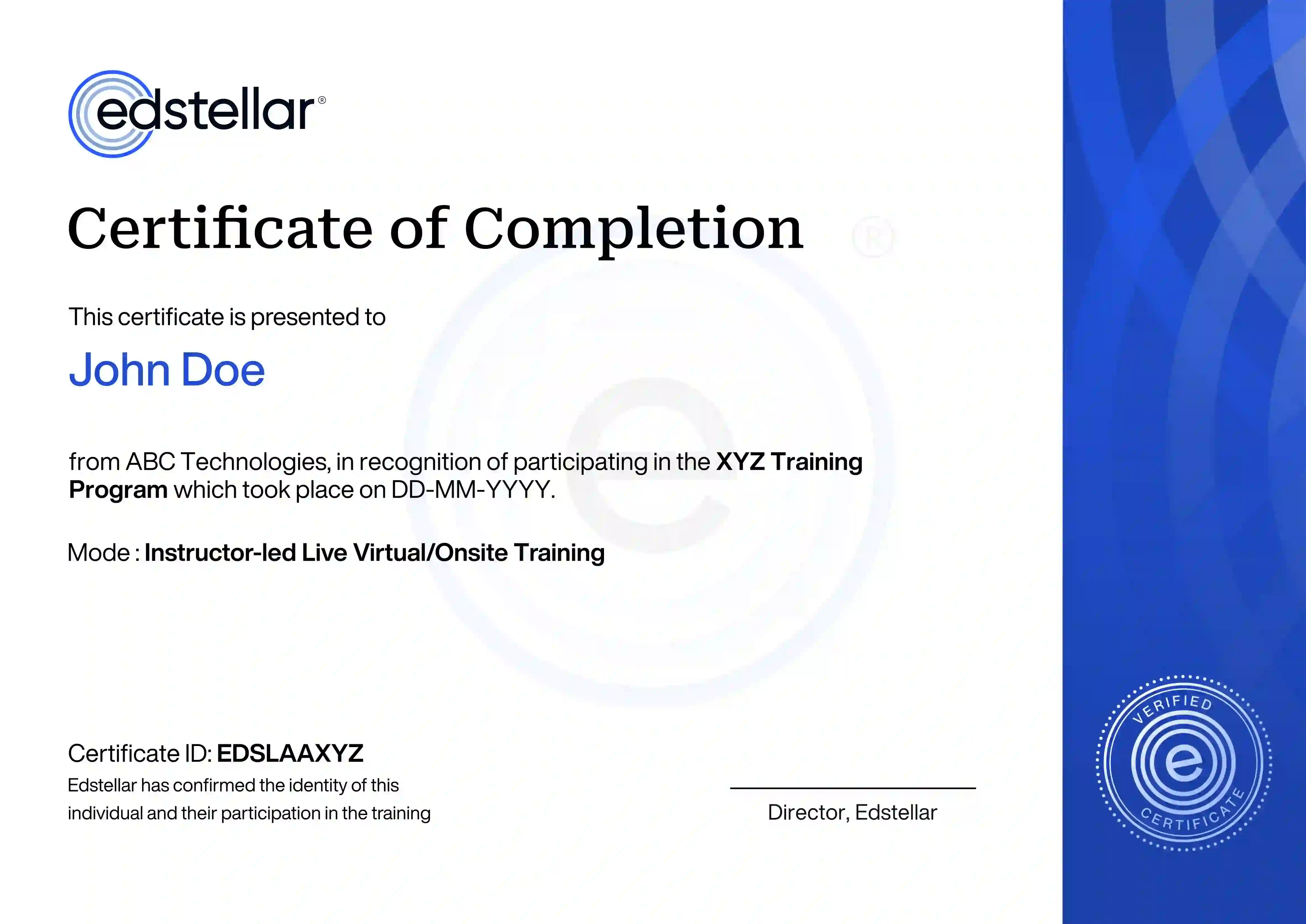
Upon successful completion of the training course offered by Edstellar, employees receive a course completion certificate, symbolizing their dedication to ongoing learning and professional development.
This certificate validates the employee's acquired skills and is a powerful motivator, inspiring them to enhance their expertise further and contribute effectively to organizational success.


Other Related Corporate Training Courses
Explore More Courses
Edstellar is a one-stop instructor-led corporate training and coaching solution that addresses organizational upskilling and talent transformation needs globally.
Marketing Excellence
Operational Excellence
Finance Excellence
HR Excellence
IT Excellence
Customer Service
Leadership Excellence
Quality Management
Software
How it WorksFAQ'sCorporate Training
CatalogStellar AI
Skill MatrixHRMS Integration
Who we ServeCEO RetreatsPricingTraining DeliveryPartner with Edstellar
CareersContact us