Drive Team Excellence with Supply Chain Decision Making Corporate Training

Empower your teams with expert-led on-site, off-site, and virtual Supply Chain Decision Making Training through Edstellar, a premier corporate training provider for organizations globally. Designed to meet your specific training needs, this group training program ensures your team is primed to drive your business goals. Help your employees build lasting capabilities that translate into real performance gains.

Effective supply chain decision making is essential for organizations seeking to optimize costs, reduce risk, and maintain operational resilience in a rapidly changing global environment. This training covers demand forecasting, supplier management, inventory optimization, risk assessment, sustainability, and data-driven analytics that enable supply chain professionals to make confident, high-impact decisions across the entire supply chain lifecycle.

Edstellar's Supply Chain Decision Making Instructor-led course offers virtual/onsite training options designed to meet the practical needs of supply chain, operations, and procurement teams. Through hands-on case studies, decision simulations, and collaborative exercises, participants develop the analytical and strategic skills needed to drive measurable improvements in supply chain performance and organizational agility.

Get Customized Expert-led Training for Your Teams
Customized Training Delivery
Scale Your Training: Small to Large Teams
In-person Onsite, Live Virtual or Hybrid Training Modes
Plan from 2000+ Industry-ready Training Programs
Experience Hands-On Learning from Industry Experts
Delivery Capability Across 100+ Countries & 10+ Languages
""""

Key Skills Employees Gain from Instructor-led Supply Chain Decision Making Training

Supply Chain Decision Making skills corporate training will enable teams to effectively apply their learnings at work.

  • Demand Forecasting and Planning
  • Supplier Selection and Evaluation
  • Inventory Optimization
  • Supply Chain Risk Management
  • Cost-Benefit Analysis
  • Data-Driven Decision Making
  • Supply Chain Performance Measurement

Key Learning Outcomes of Supply Chain Decision Making Training Workshop

Upon completing Edstellar’s Supply Chain Decision Making workshop, employees will gain valuable, job-relevant insights and develop the confidence to apply their learning effectively in the professional environment.

  • Master data-driven decision frameworks for optimizing procurement, inventory, and logistics operations
  • Develop demand forecasting and supply planning skills to reduce stockouts and excess inventory
  • Build supplier evaluation and selection capabilities that strengthen supply chain reliability
  • Apply risk management strategies to identify, assess, and respond to supply chain disruptions
  • Gain proficiency in cost-benefit analysis and financial decision-making for supply chain operations
  • Learn performance measurement techniques to continuously improve supply chain efficiency and resilience

Key Benefits of the Supply Chain Decision Making Group Training

Attending our Supply Chain Decision Making group training classes provides your team with a powerful opportunity to build skills, boost confidence, and develop a deeper understanding of the concepts that matter most. The collaborative learning environment fosters knowledge sharing and enables employees to translate insights into actionable work outcomes.

  • Instructor-led Supply Chain Decision Making training delivered onsite or virtually for corporate teams
  • Covers data-driven decision frameworks across procurement, inventory, and logistics functions
  • Practical modules on demand forecasting, supplier evaluation, and cost-benefit analysis
  • Hands-on exercises using real-world supply chain scenarios and case studies
  • Risk management and disruption response strategies for global supply chain environments
  • Sustainability and ethical sourcing decision-making frameworks included
  • Technology and analytics tools for data-driven supply chain optimization
  • Performance measurement and continuous improvement techniques for supply chain teams
  • Cross-functional collaboration strategies for aligned supply chain decision-making
  • Flexible scheduling with dedicated Edstellar support throughout the training engagement

Topics and Outline of Supply Chain Decision Making Training

Our virtual and on-premise Supply Chain Decision Making training curriculum is structured into focused modules developed by industry experts. This training for organizations provides an interactive learning experience that addresses the evolving demands of the workplace, making it both relevant and practical.

  1. Foundations of Supply Chain Management
    • Overview of supply chain components and their interdependencies
    • Strategic, tactical, and operational decision levels in supply chains
    • The impact of supply chain decisions on business performance and costs
    • Current trends shaping supply chain decision-making globally
  2. Decision-Making Frameworks for Supply Chains
    • Key decision frameworks used in supply chain management
    • Analytical versus intuitive approaches to supply chain decisions
    • The role of data, experience, and judgment in supply chain choices
    • Aligning supply chain decisions with organizational strategy
  3. Understanding Supply Chain Trade-Offs
    • Cost-service trade-offs in supply chain optimization
    • Balancing efficiency and resilience in supply chain design
    • Trade-off analysis tools for supply chain managers
    • Short-term versus long-term supply chain decision impacts
  4. Stakeholder Mapping in Supply Chain Decisions
    • Identifying key stakeholders in supply chain decision processes
    • Managing competing priorities among internal and external stakeholders
    • Cross-functional collaboration for aligned supply chain decisions
    • Communication strategies for supply chain decision outcomes
  5. Supply Chain Performance Metrics Overview
    • Key performance indicators for supply chain decision quality
    • SCOR model and its application to supply chain measurement
    • Linking supply chain KPIs to business outcomes
    • Establishing baselines for continuous improvement measurement
  6. Emerging Challenges in Supply Chain Decision Making
    • Geopolitical and macroeconomic factors affecting supply chain decisions
    • Digital transformation and its impact on supply chain management
    • Sustainability pressures and regulatory compliance in supply chains
    • Managing decision complexity in multi-tier supply chain networks
  1. Principles of Demand Forecasting
    • Types of demand: independent, dependent, and derived demand
    • Quantitative and qualitative forecasting methods
    • Forecasting accuracy metrics: MAE, MAPE, and RMSE
    • Building a demand forecasting process for supply chain teams
  2. Statistical Forecasting Techniques
    • Moving average and exponential smoothing methods
    • Trend and seasonality decomposition in demand data
    • Regression-based demand forecasting approaches
    • Selecting appropriate statistical methods for different demand patterns
  3. Demand Sensing and Real-Time Data Integration
    • Using point-of-sale and real-time market data for demand sensing
    • Integrating external signals: weather, promotions, and economic indicators
    • Machine learning applications in demand forecasting
    • Improving forecast responsiveness in volatile demand environments
  4. Sales and Operations Planning (S&OP)
    • Overview of the S&OP process and its decision-making role
    • Aligning demand plans with supply capacity and financial objectives
    • Cross-functional S&OP meetings and consensus planning
    • Escalation protocols for unresolved S&OP decisions
  5. Demand Uncertainty and Buffer Strategies
    • Measuring and managing demand uncertainty in supply chains
    • Safety stock calculation and buffer planning decisions
    • Postponement and product flexibility strategies for demand variability
    • Scenario planning for demand shock and market disruption
  6. Improving Forecast Accuracy and Process Maturity
    • Root cause analysis for forecast errors and bias
    • Building collaborative forecasting with customers and partners
    • Forecast review cadences and governance processes
    • Roadmap for advancing demand planning maturity in organizations
  1. Strategic Sourcing Fundamentals
    • Overview of strategic sourcing and its role in supply chain performance
    • Total cost of ownership analysis for procurement decisions
    • Make-versus-buy decision frameworks and analysis
    • Procurement strategy alignment with organizational objectives
  2. Supplier Evaluation and Selection Criteria
    • Defining supplier evaluation criteria: quality, cost, delivery, and risk
    • Weighted scoring models for objective supplier comparison
    • Supplier capability assessment and qualification processes
    • Building a preferred supplier list for critical supply categories
  3. Supplier Risk Assessment and Due Diligence
    • Types of supplier risk: financial, operational, geopolitical, and reputational
    • Conducting supplier financial health and stability assessments
    • Ethical and compliance due diligence in supplier selection
    • Developing supplier risk mitigation and contingency strategies
  4. Supplier Relationship Management
    • Segmenting suppliers by strategic importance and spend category
    • Building collaborative and value-added supplier relationships
    • Supplier performance management systems and review cadences
    • Conflict resolution and renegotiation in supplier relationships
  5. Contract Negotiation and Decision Making
    • Principles of effective contract negotiation in procurement
    • Key contract terms: pricing, SLAs, flexibility, and risk allocation
    • Multi-criteria decision analysis in procurement negotiations
    • Managing contract changes and supplier performance disputes
  6. Single Versus Multi-Sourcing Strategy Decisions
    • Trade-offs between single-source and multi-source procurement strategies
    • Dual and multi-sourcing for risk mitigation and resilience
    • Near-shoring and re-shoring decisions in global supply chains
    • Supplier diversification planning for business continuity
  1. Inventory Management Fundamentals
    • Types of inventory and their roles in supply chain management
    • Inventory costs: holding, ordering, and stockout costs
    • The bullwhip effect and its impact on inventory decisions
    • ABC analysis for inventory segmentation and prioritization
  2. Inventory Replenishment Models
    • Economic Order Quantity (EOQ) model and its applications
    • Reorder point and safety stock calculation methods
    • Periodic versus continuous review replenishment systems
    • Vendor-managed inventory and consignment stock models
  3. Inventory Optimization Strategies
    • Lean inventory principles: just-in-time and pull-based systems
    • Multi-echelon inventory optimization for complex supply networks
    • Inventory pooling and risk-pooling strategies
    • Using optimization software for inventory decision support
  4. Managing Slow-Moving and Obsolete Inventory
    • Identifying and classifying slow-moving and obsolete stock
    • Decision frameworks for excess inventory disposition
    • Prevention strategies for inventory obsolescence
    • Financial impact analysis of inventory write-offs and markdowns
  5. Technology for Inventory Decision Support
    • ERP and WMS systems for inventory visibility and control
    • RFID and IoT applications in real-time inventory tracking
    • AI and machine learning for predictive inventory management
    • Digital twin applications for inventory scenario modeling
  6. Inventory KPIs and Performance Management
    • Key inventory metrics: turns, days of supply, and fill rate
    • Setting inventory performance targets and benchmarks
    • Root cause analysis for inventory performance gaps
    • Building a continuous improvement culture for inventory management
  1. Supply Chain Risk Identification and Categorization
    • Types of supply chain risk: operational, strategic, financial, and external
    • Risk mapping and categorization across the supply chain network
    • Identifying single points of failure in supply chain design
    • Supply chain vulnerability assessment methodologies
  2. Quantitative and Qualitative Risk Assessment
    • Probability and impact analysis for supply chain risk events
    • Risk heat maps and risk registers for supply chain management
    • Monte Carlo simulation for supply chain risk quantification
    • Value-at-risk models for supply chain financial exposure
  3. Supply Chain Disruption Response Strategies
    • Designing risk response plans: avoidance, mitigation, and contingency
    • Business continuity planning for critical supply chain functions
    • Alternative sourcing and logistics contingency activation
    • Decision frameworks for rapid supply chain disruption response
  4. Building Supply Chain Resilience
    • The concept of supply chain resilience and its key dimensions
    • Flexibility, redundancy, and agility strategies for resilient supply chains
    • Supplier diversification and geographic risk distribution
    • Testing supply chain resilience through scenario planning and drills
  5. Supply Chain Visibility and Early Warning Systems
    • The role of end-to-end supply chain visibility in risk management
    • Technology platforms for real-time supply chain risk monitoring
    • Early warning indicators and trigger-based escalation protocols
    • Collaborative risk monitoring with suppliers and logistics partners
  6. Post-Disruption Review and Continuous Improvement
    • Conducting post-disruption reviews to assess response effectiveness
    • Root cause analysis for supply chain failure events
    • Updating risk management plans based on disruption lessons
    • Measuring resilience improvement over time using defined KPIs
  1. Data Analytics in Supply Chain Decision Making
    • Types of supply chain analytics: descriptive, predictive, and prescriptive
    • Building a data-driven culture within supply chain organizations
    • Key supply chain data sources and integration strategies
    • Overcoming data quality challenges in supply chain analytics
  2. Supply Chain Technology Landscape
    • Overview of ERP, TMS, WMS, and advanced planning systems
    • Cloud-based supply chain platforms and their decision-support capabilities
    • IoT and sensor technology for supply chain visibility
    • Evaluating and selecting supply chain technology investments
  3. Artificial Intelligence and Machine Learning in Supply Chains
    • AI applications in demand forecasting and inventory optimization
    • Machine learning for supplier risk assessment and anomaly detection
    • Prescriptive analytics for automated supply chain decision support
    • Challenges and limitations of AI in supply chain decision making
  4. Supply Chain Digital Twin and Simulation
    • Concept and architecture of a supply chain digital twin
    • Using simulation for scenario analysis and decision testing
    • Stress testing supply chain decisions in a virtual environment
    • Integrating digital twin insights into operational planning cycles
  5. Decision Support Systems and Dashboards
    • Designing effective supply chain decision support dashboards
    • Real-time KPI monitoring and exception management systems
    • Alerts and automated notifications for supply chain decision triggers
    • Building role-specific dashboards for supply chain managers
  6. Implementing Data-Driven Decision Processes
    • Change management for technology adoption in supply chain teams
    • Building data literacy and analytical skills in supply chain professionals
    • Governance frameworks for data-driven supply chain decisions
    • Measuring ROI from supply chain technology and analytics investments
  1. Sustainability in Supply Chain Management
    • The business case for sustainable supply chain practices
    • Environmental, social, and governance (ESG) factors in supply chain decisions
    • Frameworks for sustainable supply chain management
    • Regulatory requirements and reporting standards for supply chain sustainability
  2. Carbon Footprint and Emissions Reduction
    • Measuring supply chain carbon footprint across Scope 1, 2, and 3 emissions
    • Decision frameworks for reducing supply chain carbon impact
    • Low-carbon logistics and transportation mode selection
    • Setting and tracking supply chain emissions reduction targets
  3. Ethical Sourcing and Human Rights in Supply Chains
    • Principles of ethical sourcing and responsible procurement
    • Human rights due diligence in global supply chain decisions
    • Supplier code of conduct development and enforcement
    • Responding to ethical violations in the supplier base
  4. Circular Economy and Reverse Logistics Decisions
    • Circular economy principles applied to supply chain design
    • Reverse logistics strategy: returns, refurbishment, and recycling
    • Extended producer responsibility and end-of-life product decisions
    • Economic and reputational benefits of circular supply chain models
  5. Sustainable Supplier Development and Collaboration
    • Engaging and developing suppliers on sustainability performance
    • Sustainability criteria in supplier scorecards and selection
    • Collaborative sustainability initiatives with key supply chain partners
    • Certifications and standards: Fair Trade, ISO 14001, and SA8000
  6. Measuring and Reporting Sustainability Performance
    • Key sustainability KPIs for supply chain functions
    • GRI and CDP reporting frameworks for supply chain sustainability
    • Building a sustainability data collection and reporting process
    • Communicating supply chain sustainability progress to stakeholders
  1. Supply Chain Crisis Triggers and Early Detection
    • Types of supply chain crises: natural disasters, supplier failures, and demand shocks
    • Early warning signal identification and monitoring protocols
    • Crisis severity classification for escalation and response
    • Building a supply chain crisis detection and reporting system
  2. Rapid Decision Making During Supply Chain Disruptions
    • Decision frameworks for rapid supply chain disruption response
    • Escalation protocols and crisis decision-making authority
    • Speed versus accuracy trade-offs in supply chain crisis decisions
    • Cross-functional war room approach to supply chain crisis management
  3. Contingency Planning and Backup Supply Strategies
    • Developing contingency plans for critical supply categories
    • Activating pre-approved backup suppliers and logistics routes
    • Emergency inventory deployment and demand prioritization
    • Customer and stakeholder communication during supply disruptions
  4. Supply Chain Crisis Communication and Coordination
    • Internal communication protocols for supply chain crisis events
    • External communication with customers, regulators, and the media
    • Managing supplier and logistics partner communication in disruptions
    • Transparency and trust-building during supply chain crises
  5. Recovery Planning and Supply Chain Stabilization
    • Phases of supply chain recovery: stabilization, normalization, and improvement
    • Prioritizing recovery actions based on customer and business impact
    • Restoring supplier relationships and rebuilding supply capacity
    • Tracking recovery milestones and communicating progress
  6. Post-Crisis Review and Resilience Building
    • Conducting thorough post-crisis reviews and after-action analysis
    • Identifying supply chain vulnerabilities exposed by the crisis
    • Updating contingency plans and resilience investments post-crisis
    • Embedding crisis lessons into supply chain standard operating procedures
  1. Financial Foundations for Supply Chain Decisions
    • Key financial concepts relevant to supply chain management
    • Understanding working capital and its relationship to supply chain choices
    • P&L impact of supply chain decisions across functions
    • Aligning supply chain financial decisions with organizational targets
  2. Total Cost of Ownership Analysis
    • Components of total cost of ownership in supply chain decisions
    • Building comprehensive TCO models for procurement and logistics
    • Hidden cost identification in supply chain TCO analysis
    • Using TCO to compare sourcing, make-versus-buy, and logistics options
  3. Capital Investment Decisions in Supply Chain
    • ROI and NPV analysis for supply chain capital investments
    • Payback period and break-even analysis for supply chain projects
    • Build-versus-buy-versus-lease decision frameworks
    • Prioritizing supply chain investment opportunities under budget constraints
  4. Cost Reduction and Efficiency Improvement
    • Identifying cost reduction opportunities across the supply chain
    • Lean principles and waste elimination in supply chain processes
    • Benchmarking supply chain costs against industry standards
    • Sustainable cost reduction without sacrificing resilience or quality
  5. Financial Risk Management in Supply Chains
    • Currency and commodity price risk in global supply chain decisions
    • Hedging strategies for supply chain financial exposures
    • Payment terms and trade finance optimization decisions
    • Financial risk assessment for supplier and logistics contracts
  6. Building the Business Case for Supply Chain Investments
    • Structuring a compelling business case for supply chain initiatives
    • Quantifying benefits: cost savings, risk reduction, and service improvement
    • Presenting supply chain investment proposals to senior leadership
    • Post-investment review and benefits realization tracking
  1. Supply Chain Performance Measurement Frameworks
    • SCOR model: plan, source, make, deliver, return, and enable
    • Balanced scorecard applied to supply chain performance
    • Designing a comprehensive supply chain KPI dashboard
    • Linking supply chain KPIs to strategic business outcomes
  2. Key Supply Chain Performance Indicators
    • On-time delivery, order fill rate, and perfect order rate
    • Inventory turns, days sales of inventory, and cash-to-cash cycle time
    • Supply chain cost as a percentage of revenue
    • Supplier performance scorecard metrics and targets
  3. Root Cause Analysis for Supply Chain Performance Gaps
    • Applying the 5 Whys and Fishbone Diagram to supply chain problems
    • Data-driven diagnosis of supply chain performance failures
    • Cross-functional root cause analysis for complex supply chain issues
    • Prioritizing corrective actions based on impact and feasibility
  4. Lean and Six Sigma in Supply Chain Improvement
    • Lean principles applied to supply chain waste elimination
    • Six Sigma DMAIC methodology for supply chain process improvement
    • Value stream mapping for supply chain process analysis
    • Sustaining supply chain improvements through standardization
  5. Benchmarking and Competitive Analysis
    • Types of benchmarking: internal, competitive, and functional
    • Sources of supply chain benchmarking data and best practices
    • Using benchmarking insights to set improvement targets
    • Building a continuous benchmarking process for supply chain teams
  6. Building a Culture of Supply Chain Continuous Improvement
    • Embedding continuous improvement into supply chain team practices
    • Kaizen events and rapid improvement workshops for supply chain
    • Engaging frontline supply chain teams in improvement initiatives
    • Measuring and communicating continuous improvement results

Who Can Take the Supply Chain Decision Making Training Course

The Supply Chain Decision Making training program can also be taken by professionals at various levels in the organization.

  • Supply Chain and Logistics Managers
  • Procurement and Sourcing Professionals
  • Operations and Planning Managers
  • Inventory Control and Warehouse Managers
  • Business Analysts and Data Analysts in Supply Chain
  • Senior Managers and Executives Overseeing Supply Chain Functions

Prerequisites for Supply Chain Decision Making Training

Professionals should have basic experience in supply chain, operations, or procurement functions to take the Supply Chain Decision Making training course.

Request a Quote for your Corporate Training Requirements

Valid number

Delivering Training for Organizations across 100 Countries and 10+ Languages

Corporate Group Training Delivery Modes
for Supply Chain Decision Making Training

At Edstellar, we understand the importance of impactful and engaging training for employees. As a leading Supply Chain Decision Making training provider, we ensure the training is more interactive by offering Face-to-Face onsite/in-house or virtual/online sessions for companies. This approach has proven to be effective, outcome-oriented, and produces a well-rounded training experience for your teams.

Virtual Supply Chain Decision Making Training

Edstellar's Supply Chain Decision Making virtual/online training sessions bring expert-led, high-quality training to your teams anywhere, ensuring consistency and seamless integration into their schedules.

With global reach, your employees can get trained from various locations
The consistent training quality ensures uniform learning outcomes
Participants can attend training in their own space without the need for traveling
Organizations can scale learning by accommodating large groups of participants
Interactive tools can be used to enhance learning engagement
On-site Supply Chain Decision Making Training

Edstellar's Supply Chain Decision Making inhouse face to face instructor-led training delivers immersive and insightful learning experiences right in the comfort of your office.

Higher engagement and better learning experience through face-to-face interaction
Workplace environment can be tailored to learning requirements
Team collaboration and knowledge sharing improves training effectiveness
Demonstration of processes for hands-on learning and better understanding
Participants can get their doubts clarified and gain valuable insights through direct interaction
Off-site Supply Chain Decision Making Training

Edstellar's Supply Chain Decision Making offsite face-to-face instructor-led group training offer a unique opportunity for teams to immerse themselves in focused and dynamic learning environments away from their usual workplace distractions.

Distraction-free environment improves learning engagement
Team bonding can be improved through activities
Dedicated schedule for training away from office set up can improve learning effectiveness
Boosts employee morale and reflects organization's commitment to employee development

Explore Our Customized Pricing Package
for
Supply Chain Decision Making Corporate Training

Looking for pricing details for onsite, offsite, or virtual instructor-led Supply Chain Decision Making training? Get a customized proposal tailored to your team’s specific needs.

Request a Group Training Quote
""
How Many Team Members Need Training?
Please select an option or fill in the custom field.
"'

Is Your Corporate Training Requirement Only for Supply Chain Decision Making?

Please select at least one course.
""
Add the List of Training Workshops
search icon

      Please select the course

      No. of Courses selected: 0

      Clear

      Upload a CSV

      Send us your Training Requirements in 3 Easy steps

      1. 1
      2. 2
        Add the required training workshops
      3. 3
        Upload to get a quick quote or email it to contact@edstellar.com

      ""

      Looking for a Complete Package?

      Looking for a one-time pricing option for all your annual training requirements?

      View Corporate Training Packages
      ""
      Select the Option that Best Describes Your Corporate Training Requirement

      Please select an option or choose from the recurring options.
      ""
      Verify and Submit Your Request

      Review Your Corporate Training Selection Summary

      Training Program: Supply Chain Decision Making Training

      1. No of Team Members

      2. Selected Training Preference

      3. Selected Recurring Sessions

      1

      Review your Requirements

      Training Workshops Selected :


        Excel
        File has been
        successfully uploaded.
        Fill the form to submit
 your details
        Submit Your Professional Contact Information
        Valid number
        We've received your enquiry. Our team will be in touch soon.
        Oops! Something went wrong while submitting the form.
        Starter
        120 licences

        Tailor-Made Trainee Licenses with Our Exclusive Training Packages!

        View Package

        64 hours of group training (includes VILT/In-person On-site)

        Tailored for SMBs

        Growth
        320 licences

        Tailor-Made Trainee Licenses with Our Exclusive Training Packages!

        View Package

        160 hours of group training (includes VILT/In-person On-site)

        Ideal for growing SMBs

        Enterprise
        800 licences

        Tailor-Made Trainee Licenses with Our Exclusive Training Packages!

        View Package

        400 hours of group training (includes VILT/In-person On-site)

        Designed for large corporations

        Custom
        Unlimited licenses

        Tailor-Made Trainee Licenses with Our Exclusive Training Packages!

        View Package

        Unlimited duration

        Designed for large corporations

        Edstellar: Your Go-to Supply Chain Decision Making Training Company

        Experienced Trainers

        Our trainers bring years of industry expertise to ensure the training is practical and impactful.

        Quality Training

        With a strong track record of delivering training worldwide, Edstellar maintains its reputation for its quality and training engagement.

        Industry-Relevant Curriculum

        Our course is designed by experts and is tailored to meet the demands of the current industry.

        Customizable Training

        Our course can be customized to meet the unique needs and goals of your organization.

        Comprehensive Support

        We provide pre and post training support to your organization to ensure a complete learning experience.

        Multilingual Training Capabilities

        We offer training in multiple languages to cater to diverse and global teams.

        Testimonials

        What Our Clients Say

        We pride ourselves on delivering exceptional training solutions. Here's what our clients have to say about their experiences with Edstellar.

        "Edstellar's virtual Supply Chain Decision Making training transformed how our procurement and operations teams approach decisions. Following the program, our supplier evaluation process became 40% faster, our inventory holding costs dropped by 18%, and our team gained a common framework for cross-functional supply chain decisions. The demand forecasting and risk management modules were particularly impactful."

        Ramesh Anand

        VP of Supply Chain,

        A Leading FMCG Multinational

        "The onsite Supply Chain Decision Making training by Edstellar gave our global logistics and procurement teams a shared decision language. The trainers worked through real industry scenarios and our teams left with actionable frameworks. Within six months we reduced supply disruption response time by 30% and improved our on-time delivery rate from 82% to 94%."

        Sunita Krishnamurthy

        Global Supply Chain Director,

        A Multinational Industrial Corporation

        "We ran our entire supply chain leadership team through Edstellar's intensive Supply Chain Decision Making program at an off-site location, and the results were exceptional. The cohort-based immersive format built strong alignment across procurement, logistics, and planning functions. Post-training, our supply chain cost as a percentage of revenue improved by 2.3 points within one financial year."

        Vikram Iyer

        Chief Supply Chain Officer,

        A Global Retail and Distribution Group

        "Edstellar's Management training programs have greatly improved our teams' ability to lead with clarity, confidence, and operational efficiency. The sessions combine practical leadership frameworks, real-world case studies, and hands-on exercises that strengthen decision-making, cross-functional collaboration, and execution excellence across departments, driving measurable improvements in overall business performance."

        Meera Rao

        HR & L&D Head,

        A Global Services Company

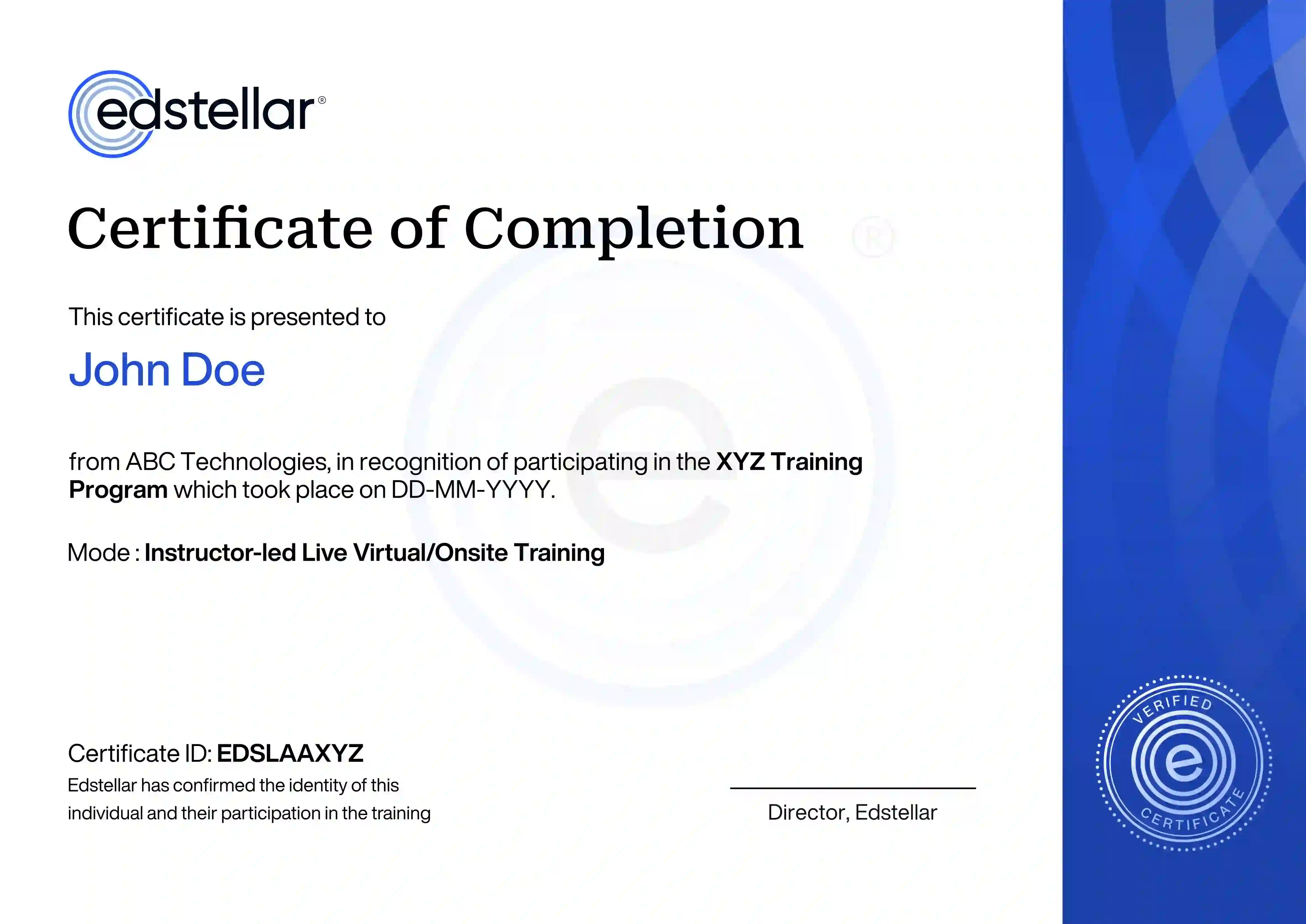
        Get Your Team Members Recognized with Edstellar’s Course Certificate

        Upon successful completion of the training course offered by Edstellar, employees receive a course completion certificate, symbolizing their dedication to ongoing learning and professional development.

        This certificate validates the employee's acquired skills and is a powerful motivator, inspiring them to enhance their expertise further and contribute effectively to organizational success.

        Certificate of Excellence

        Other Related Corporate Training Courses