
Team Effectiveness Assessment Services
Help teams build trust, alignment and results.
Edstellar runs team effectiveness assessments for intact teams, leadership teams and project teams. Edstellar’s own Polaris team diagnostic, The Five Behaviors Team Development and CliftonStrengths Team Grid show how a team works today, and facilitated sessions turn that insight into trust, healthy debate and shared commitment.
Leadership teamsOnsite / virtual / hybrid20+ industriesIndustries we serveTechnology, healthcare, financial services, manufacturing, retail, energy and more100+ locationsGlobal deliveryGlobal delivery across APAC, the Middle East, Europe, North America and India
13,650+
Assessments
300+
Clients
20+
Industries
ISO 9001 & 27001
Certified
Ready to help your teams work better together?
Trusted by teams at
















A clear picture of how your team works together.
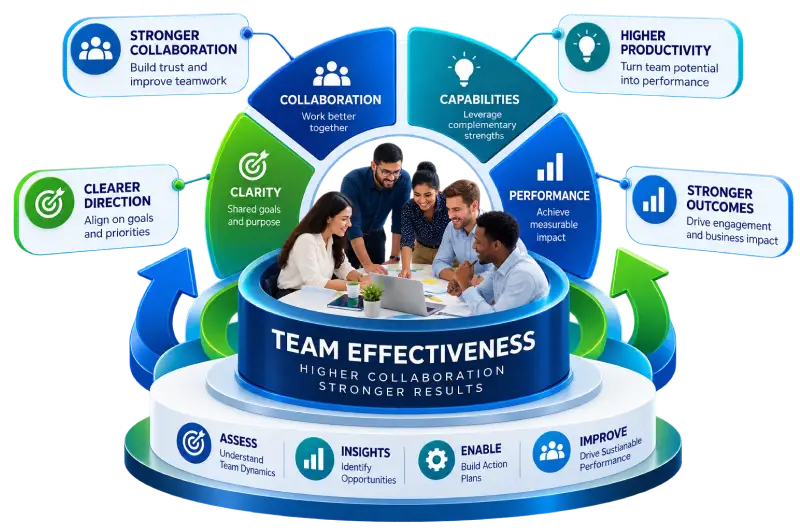
A team effectiveness assessment looks at how a team works as a whole, from trust and alignment to decisions and results. Edstellar combines team diagnostics with facilitated sessions, around four principles.
The whole team, not just individuals
The team is assessed as a unit, with every member’s view counted.
Several perspectives
The sponsor’s view before the session and the team’s in-room pulse show where views match and where they differ.
A facilitated conversation
Results are explored together in a structured session, not just sent as a report.
Agreements and follow-up
The team leaves with clear agreements and a plan, and checks its progress over time.
Edstellar team assessments that build high-performing teams.
Edstellar’s team effectiveness assessments give teams and their leaders a shared, honest picture of how they work, so team development and team building focus on what will lift team performance and collaboration most.
Stronger trust
Team members understand each other better and build the trust and team cohesion that open teamwork depends on.
Productive debate
Teams learn to disagree about ideas openly and constructively, and still commit to one decision.
Aligned priorities
Teams agree on what matters most, who decides what and how they will work together.
Clear accountability
Shared commitments make it easier for team members to hold each other to agreed standards.
A faster start for new teams
New, merged and project teams agree on goals, roles and ways of working from the outset.
Progress the team can see
Follow-up sessions and reassessment show how the team has grown over time.
Proven team effectiveness tools, chosen for each team.
Edstellar combines its own Polaris team diagnostic with validated team tools from leading publishers, choosing the right tool for each team and the moment it is in.
Where Edstellar team effectiveness assessment fits in the employee lifecycle
- Intact teams
- Leadership teams
- Project teams
- Cross-functional groups
- Campus & pre-hire
- Hiring decisions
- Onboarding (applies)
- Individual development
- First-time managers (applies)
- Promotion & succession
- Leadership & coaching
- Team & culture (applies)
- Safety & compliance
Get a recommended team program for your team.
An Edstellar specialist will match diagnostics to your team and its goals.
Assess your team effectiveness maturity against the essentials.
A quick check of how well your teams work today, from trust and alignment to follow-through.
- A personalized readiness tier, from Foundation to High-performing.
- A clear view of where your team is strong, and where it strains.
- The first moves to make before your next team offsite.
Edstellar team effectiveness services, end to end.
From team diagnostics to follow-up coaching, Edstellar covers every part of a team effectiveness program.
Team diagnostics
Assess the team with Polaris, The Five Behaviors Team Development or CliftonStrengths Team Grid, chosen for the team and its goals.
Diagnostics chosen for each team
You get:Team profile
Facilitated team sessions
Experienced facilitators guide the team through its results and help it agree on what to change.
Insight the whole team owns
You get:Facilitated session and team agreements
Leadership team alignment
Help leadership teams agree on priorities, decision rights and how they work together.
Aligned at the top
You get:Leadership team charter
Trust and conflict sessions
Build trust and turn disagreement into productive debate, with practical tools the team uses every day.
Disagreement that builds trust
You get:Trust and conflict agreements
New and merged team launches
Give new, merged and project teams a strong start, with shared goals, roles and ways of working.
A strong start together
You get:Team launch plan
Team coaching and follow-up
Follow-up sessions and team coaching keep agreements alive and track progress over time.
Progress the team can see
You get:Progress review
Polaris, Edstellar’s own team diagnostic.
Polaris diagnoses a team across six dimensions: trust, alignment, communication, decision making, leadership and performance. It combines the sponsor’s view before the session with an in-room pulse during it.
- Use cases
- Team offsitesConflict resolutionNew or merged teams
- Audience
- Intact teams, Leadership teams, Project teams
The Edstellar team effectiveness process.
Edstellar runs team effectiveness assessments in six steps, from scope to review. Most teams reach their facilitated session within about four weeks of kickoff.
Scope
Week 1
Agree with the sponsor on the team, its goals and what success looks like.
YOU GET
Team brief
Design
Weeks 1 to 2
Choose the diagnostics and design the facilitated session.
YOU GET
Session plan
Assess
Weeks 2 to 3
Team members complete the online team effectiveness survey, and the sponsor shares their view.
YOU GET
Team profile
Debrief
Weeks 3 to 4
A facilitated session explores the results, with an in-room pulse to test what the team sees.
YOU GET
Shared team picture and agreements
Develop
Following weeks
The team acts on its agreements, with follow-up sessions and team coaching.
YOU GET
Team action plan in use
Review
Ongoing
The team reassesses to see what has changed and refresh its plan.
YOU GET
Progress review
Ready-to-use outputs for every decision.
Every Edstellar team effectiveness assessment ends with outputs the team can read quickly and act on right away.
Team members
A shared picture
Team profile
How the team works across each dimension, and where views differ.
Step 3: AssessIndividual insight
Each person’s strengths or style, and what it brings to the team.
Step 3: AssessTeam leaders and sponsors
Clear priorities
Team agreements and charter
Agreed ways of working, decision rights and commitments.
Step 4: DebriefTeam action plan
Practical priorities with owners and timelines.
Step 4: DebriefHR and L&D
Progress you can track
Team coaching plan
Focus areas for follow-up sessions and team coaching.
Step 5: DevelopProgress review
What has changed since the session and where to focus next.
Step 6: ReviewBuild a team that works at its best.
Scope your team effectiveness program with an Edstellar specialist.
Why choose Edstellar for team effectiveness assessment.
Edstellar assesses the whole team with the right diagnostic, facilitates every results session, and connects the insight to team coaching and OD work, so better teamwork lasts.
Assessment to development, one partner
Insight turns into action, because the team that assesses your teams also delivers the coaching, training and OD work that follows.
The difference
Many test providers stop at the report. Edstellar connects it to development.
Runs on the Capability Intelligence Platform
You always know who is ready and where the gaps sit, with a live picture of verified skills between assessment cycles.
The difference
Your skills data stays live, not frozen in a PDF.
Expert interpretation, every time
Experienced facilitators read every team profile in context and explore it with the team, so people understand and act on their results.
The difference
Insight people act on, not a score they guess at.
Certified assessors, wherever your people are
Team assessments and facilitated sessions run online, in person or blended across 100+ locations, including team offsites.
The difference
The same standard in every country you assess.
A proven method, not improvisation
Every engagement runs the same six steps, from scope to review, with diagnostics chosen for the team at hand.
The difference
A repeatable system, not a bespoke experiment each time.
The right diagnostic for every team
Edstellar is not tied to a single test publisher, so each team gets the diagnostic that fits it best, including Edstellar’s own Polaris.
The difference
The diagnostic fits the team, not the other way round.
Trusted across industries and regions
Fortune 500 clients served worldwide
Team effectiveness assessment FAQs.
A team effectiveness assessment, sometimes run as a team effectiveness survey, looks at how a team works as a whole, including trust, alignment, collaboration, communication, decision making, leadership and performance. Edstellar combines team diagnostics with facilitated sessions, so the team agrees on what to change and acts on it.
Polaris is Edstellar's own team diagnostic. It assesses a team across six dimensions: trust, alignment, communication, decision making, leadership and performance, combining the sponsor's view before the session with an in-room pulse during it.
Depending on the team and its goals, Edstellar uses Polaris, The Five Behaviors Team Development, Gallup's CliftonStrengths Team Grid, Everything DiSC Workplace and FIRO-B.
The Five Behaviors Team Development, based on Patrick Lencioni's model, looks at trust, conflict, commitment, accountability and results, the building blocks of team cohesion. Edstellar uses it for team workshops, team building and ongoing team programs, with a facilitated debrief.
Intact teams, leadership teams, project teams, and new or merged teams benefit most, especially when a team is going through change, preparing for an offsite or working through conflict.
An experienced facilitator walks the team through its results, uses an in-room pulse to test what the team sees, and guides the conversation toward clear agreements and a practical action plan.
Team results are reported at team level, and how individual responses are shared is agreed with the sponsor at scoping, so team members can answer openly.
Yes. Tools such as FIRO-B and The Five Behaviors help teams understand the team dynamics that drive disagreement and turn it into productive debate, with agreements the team commits to.
Most teams reach their facilitated session within about four weeks of kickoff. Follow-up sessions and team coaching then run over the following weeks, depending on the program.
Data is collected only for the agreed purpose, access is limited to agreed stakeholders, and reports are shared under the confidentiality terms set at scoping. Edstellar holds ISO/IEC 27001:2022 certification for information security management.
Cost depends on the size and number of teams, the diagnostics used, and how many facilitated sessions and coaching follow-ups you need. Edstellar scopes each program before quoting, so you pay only for what your teams require.
Talk through your questions with an Edstellar assessment specialist.
Ask us directlyPlan your team effectiveness assessment with Edstellar.
Tell Edstellar about the team you want to develop. A specialist replies within one business day with a scoped response, no automated sales sequence.