
Assessment & Development Center Services
See how people perform before you decide.
Edstellar designs and runs assessment and development centers in person, as a virtual assessment center or in a hybrid format. Realistic exercises, psychometric tools and trained assessors show how people actually work, so promotion, succession and development decisions rest on observed evidence.
Promotion & successionOnsite / virtual / hybrid20+ industriesIndustries we serveTechnology, healthcare, financial services, manufacturing, retail, energy and more100+ countriesGlobal deliveryGlobal delivery across APAC, the Middle East, Europe, North America and India
13,650+
Assessments
300+
Clients
20+
Industries
ISO 9001 & 27001
Certified
Ready to make your biggest talent decisions on observed evidence?
Trusted by teams at
















Many exercises, many observers, one fair decision.
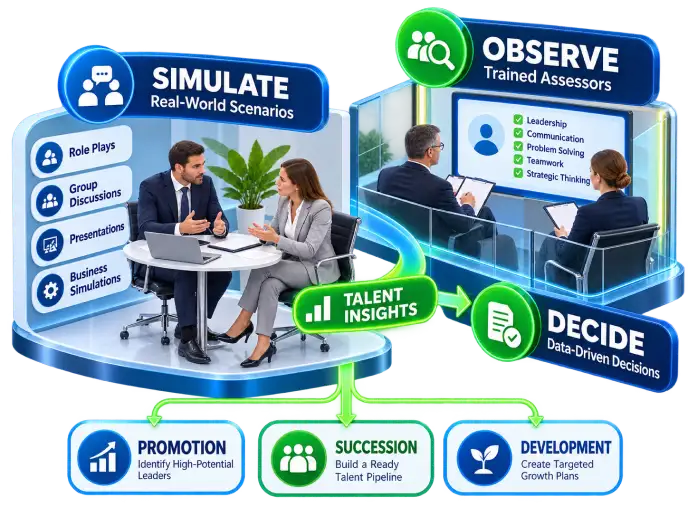
An assessment center and a development center use the same method: several realistic assessment center exercises, observed by trained assessors against clear competencies, with every competency seen in at least two different exercises, by at least two assessors. An assessment center informs a decision; a development center builds a growth plan. Edstellar designs both around four principles.
Realistic exercises
In-tray exercises, role plays, group discussions, presentations and business simulations mirror the real challenges of the role.
Clear competencies
Job analysis and your competency framework set the five to eight competencies that matter most at the target level, and each one is observed at least twice.
Trained assessors
Assessors observe, record, classify and evaluate behavior consistently, using shared rating scales.
An integration session
In the wash-up session, assessors compare notes and agree every rating on the evidence, not on impressions.
Edstellar assessment and development centers that turn performance into clear decisions.
Edstellar's assessment and development center services give leaders and HR the strongest evidence available for high-stakes talent decisions, so promotion, succession, hiring and leadership development all build on observed behavior.
See real behavior, not just answers
Realistic exercises show how people actually plan, decide, influence and lead, alongside psychometric assessments.
Promote with confidence
Assess readiness for the next level before the promotion or leadership hiring decision, so new leaders start strong.
Build a stronger succession bench
Identify high-potential employees and ready-now successors with evidence several assessors agree on, for confident succession planning.
Richer development feedback
Development centers give each participant detailed feedback, high-potential insight and a clear growth plan.
Fair, consistent and defensible
Multiple exercises, trained assessors and structured integration reduce bias and give every decision a documented rationale.
In person, virtual or hybrid
Run centers on site, as a virtual or online assessment center or in a hybrid format, so cohorts across locations follow one rating standard.
Proven center tools, chosen for each decision.
Edstellar combines realistic exercises with validated psychometric and leadership tools from leading publishers, choosing reliable instruments for the type of center and the decision each one supports.
Where Edstellar assessment and development centers fit in the employee lifecycle
- Managers
- Leaders
- High potentials
- Campus & pre-hire
- Hiring decisions (applies)
- Onboarding
- Individual development
- First-time managers
- Promotion & succession (applies)
- Leadership & coaching (applies)
- Team & culture
- Safety & compliance
Get a recommended center design for your roles.
An Edstellar specialist will match exercises and tools to your roles and decisions.
Inside an Edstellar assessment and development center.
Realistic assessment center exercises, a competency matrix that observes every competency at least twice, and three formats that fit how your people work.
In-tray exercise
A day's emails, reports and requests to prioritize and act on under time pressure.
Reveals: Planning, prioritizing, decision making
Role play
A meeting with a trained role player: a struggling team member, an unhappy client, a negotiation.
Reveals: Influence, coaching, handling conflict
Case study analysis
Business information to analyze, ending in a written or spoken recommendation.
Reveals: Analysis, commercial judgment, strategy
Group discussion
A group tackles a shared problem with no appointed leader.
Reveals: Collaboration, influence, emerging leadership
Presentation
A plan or recommendation presented to a panel, followed by challenging questions.
Reveals: Communication, structure, composure
Fact-finding exercise
Partial information to start, then questions to a resource person to reach a decision.
Reveals: Inquiry, information gathering, decisiveness
Business simulation
A simulated unit run over several rounds as market conditions change.
Reveals: Strategic thinking, adaptability, results focus
Competency-based interview
Structured questions on past behavior, probing each target competency in turn.
Reveals: Track record, self-awareness
Each competency is observed in at least two different exercises, by at least two assessors. One strong or weak moment never decides a rating. A typical leadership center looks like this.
Example matrix for a leadership center. The real matrix is built from your competency framework.
In person
At your site or a venue, with role players and assessors in the room.
Best for: Centers where presence and group dynamics matter most
Virtual
Exercises run online with live role players, remote assessors and secure document sharing.
Best for: Global and distributed cohorts
Hybrid
Some participants or assessors in the room, others online, on one shared schedule and one rating standard.
Best for: Cohorts that combine on-site and remote participants
Assess your center design maturity against the essentials.
A quick check of how well you run assessment and development centers today, from competencies to feedback.
- A personalized readiness tier, from Foundation to Decision-ready.
- A clear view of where your center design is strong, and where it is weak.
- The first moves to make before your next center.
Edstellar assessment and development center services, end to end.
From the competency matrix to participant feedback, Edstellar covers every part of an assessment or development center.
Competency and center design
Define the competencies for each role and build the matrix that maps every competency to at least two exercises.
Competencies mapped to exercises
You get:Center design and assessment matrix
Exercise design and simulation
Design realistic exercises and business simulations that mirror the role, from in-tray tasks to role plays.
Exercises chosen for each role
You get:Role-relevant exercise set
Virtual assessment centers
Run the full center online with live role players, remote assessors and secure document sharing, or combine on-site and online participants in a hybrid center.
One rating standard in every format
You get:Virtual center experience
Assessor training and calibration
Train Edstellar assessors, and your own managers if you wish, to observe, record, classify and evaluate behavior, and calibrate them on practice recordings before the day.
Consistent ratings from every assessor
You get:Calibrated assessor panel
Integration and decisions
Lead the wash-up session where assessors compare notes and agree every rating on the evidence across exercises, not on impressions.
Every rating reflects the full picture
You get:Integrated ratings and recommendations
Feedback and development plans
Give each participant feedback and a report, give leaders the group view, and turn the findings into development plans.
Every participant leaves with next steps
You get:Feedback reports and development plans
The Edstellar 5A cultural transformation methodology.
Our five-step cultural transformation method, from business strategy to a culture your people live every day, measured over time.
Define the target role
Week 1
Job analysis sets the five to eight competencies that matter most at the target level.
YOU GET
Competency model for the target role
Design the exercises
Weeks 1 to 2
Exercises are built or adapted to your business context, and every competency is mapped to at least two of them.
YOU GET
Center design and assessment matrix
Train the assessors
3–5 weeks
Edstellar assessors, and your own managers if you wish, are trained and calibrated on practice recordings before the day.
YOU GET
Calibrated assessor panel
Run the center
6–12 weeks
Participants rotate through the exercises while assessors observe, record, classify and evaluate what they actually do.
YOU GET
Observed evidence
Integrate the evidence
Weeks 4 to 5
In the wash-up session, assessors compare notes and agree every rating on the evidence, not on impressions.
YOU GET
Integrated ratings
Feed back and plan
Weeks 5 to 6
Each participant receives feedback and a report, leaders receive the group view, and findings become development plans.
YOU GET
Reports, group view and development plans
Ready-to-use outputs for every decision.
Every Edstellar center ends with assessment center reports and outputs that people can read quickly and act on right away.
Participants and coaches
Feedback that builds growth
Competency-by-competency report
Every competency rated, with the observed evidence from each exercise.
Step 6: Feed backIndividual development plan
A development plan for every participant, agreed in the feedback session.
Step 6: Feed backDecision panels
Confident, defensible decisions
Readiness rating
A readiness rating for each target role, agreed in the wash-up session.
Step 5: IntegrateNine-box placement
Each participant placed on the nine-box grid against performance data.
Step 6: Feed backHR and L&D
A center you can reuse
Group heatmap
Strengths and gaps across the whole cohort, competency by competency.
Step 6: Feed backAssessment matrix and exercises
A tested center design, ready to run again.
Step 2: DesignDesign a center you can rely on.
Scope your assessment or development center with an Edstellar specialist.
Why Edstellar is your cultural transformation consulting solutions provider.
The rare partner for culture consulting that defines your target culture and shifts it, keeps your culture gaps in view, and proves the impact in behaviors, engagement and results.
Assessment to development, one partner
Center results turn into action, because the team that runs your center also maps every result to programs, coaching or OD work.
The difference
Many center providers stop at the ratings. Edstellar connects it to development.
Runs on the Capability Intelligence Platform
You always know who is ready and where the gaps sit, with a live picture of verified skills between assessment cycles.
The difference
Your skills data stays live, not frozen in a PDF.
Trained assessors, every time
Assessors are trained and calibrated before every center, and integrate evidence together, so ratings are consistent and fair.
The difference
Ratings several assessors agree on, not one opinion.
Certified assessors, wherever your people are
Centers run in person, virtually or blended across 100+ locations, with exercises adapted to each region.
The difference
The same standard in every country you assess.
A proven method, not improvisation
Every center runs the same six steps, from scope to review, with exercises and tools chosen for the decision at hand.
The difference
A repeatable system, not a bespoke experiment each time.
The right tools for every center
Edstellar is not tied to a single publisher, so each center combines the exercises and tools that fit the role best.
The difference
The center fits the role, not the other way round.
Trusted across industries and regions
Fortune 500 clients served worldwide
Assessment and development center FAQs.
An assessment center is a structured process in which participants complete several realistic exercises, such as in-tray tasks, role plays, group discussions and presentations, while trained assessors observe and rate their behavior against clear competencies. It gives strong, observed evidence for hiring, promotion and succession decisions.
Both use the same method of realistic exercises and trained assessors. An assessment center is run to inform a decision, such as leadership hiring, promotion or succession planning, and its results go to a decision panel. A development center is run to help participants grow, so detailed feedback goes to the participant first and the main output is a leadership development plan.
Edstellar centers draw on in-tray exercises, role plays, case study analysis, group discussions, presentations, fact-finding exercises, business simulations and competency-based interviews. Each exercise reveals different competencies, for example an in-tray exercise shows planning and prioritizing, and a role play shows influence and coaching. Exercises are chosen and adapted to your business context.
Yes. Edstellar runs virtual assessment centers, also called online assessment centers, with online exercises, live role players, remote assessors and secure document sharing, using platforms such as Virtual Assessment Center and VirtualAC from Talogy. Hybrid centers are also available, with some participants or assessors in the room and others online, on one shared schedule and one rating standard.
Depending on the decision, Edstellar adds psychometric assessments such as Talogy Caliper, Hogan and Saville Wave in assessment centers, and Talogy InView Leadership, Diamond Leadership, Talogy 360 and EIP3 in development centers.
Assessors are Edstellar practitioners and, if you wish, your own managers. Every assessor is trained to observe, record, classify and evaluate behavior, and is calibrated on practice recordings before the day.
Each competency is observed in at least two different exercises, by at least two assessors, so one strong or weak moment never decides a rating. Ratings use shared scales, and assessors agree every rating on the evidence in a structured wash-up session. Results are also reviewed for adverse impact between groups, so decisions stay fair and defensible.
The time participants spend in the center depends on the number of exercises and is agreed at scoping, in person or virtually. A typical engagement takes about six weeks from scoping to development plans.
Each participant receives feedback and a competency-by-competency report, and leaders receive the group view, including a cohort heatmap, readiness ratings and nine-box placement. For a development center, detailed feedback goes to the participant first and forms the basis of their development plan.
Center data is collected only for the agreed purpose, access is limited to agreed stakeholders, and reports are shared under the confidentiality terms set at scoping. Edstellar holds ISO/IEC 27001:2022 certification for information security management.
Cost depends on the number of participants, the exercises and tools used, whether the center runs in person or virtually, the number of assessors and how much feedback and development planning you need. Edstellar scopes each center before quoting, so you pay only for what your decision requires.
Talk through your questions with an Edstellar assessment specialist.
Ask us directlyPlan your assessment or development center with Edstellar.
Tell Edstellar the roles and decisions you want observed evidence for. A specialist replies within one business day with a scoped response, no automated sales sequence.