10 Most In-Demand Skills in Poland for 2026

.svg "edstellar")

Poland's labour market is defined by a structural paradox: record-low unemployment coexisting with deepening talent shortages across both digital and operational sectors. The Ministry of Family, Labour and Social Policy's Occupational Barometer 2025 identified 23 deficit occupations nationally, spanning construction trades, transport, healthcare, and IT. Meanwhile, Pracuj.pl's Specialist Job Market 2025 report recorded continued growth in IT applications and employer demand, with cybersecurity, AI, and software development roles consistently among the hardest to fill. Poland's position as Central Europe's largest economy and the EU's fastest-growing tech hub makes these shortages a strategic concern for every organisation operating in the country.
What makes Poland's skills challenge distinctive is the emergence of two parallel labour markets. The first is a high-value digital economy centred on Warsaw, Krakow, and Wroclaw, where technology companies, business services centres, and financial institutions compete for cybersecurity analysts, AI engineers, and cloud architects at salaries that rival Western European benchmarks. The second is an operational economy spanning construction sites, hospitals, logistics corridors, and manufacturing floors, where deficit occupations in nursing, welding, heavy vehicle driving, and construction trades persist year after year despite government intervention. These two markets require fundamentally different training strategies, funding mechanisms, and talent pipeline approaches.
This guide draws on data from the Ministry of Family, Labour and Social Policy, the Occupational Barometer, Statistics Poland, the Ministry of Development and Technology, the National Cybersecurity Centre (NCC-PL), ABSL Poland, Pracuj.pl, and No Fluff Jobs to identify the ten skills shaping Poland's employment market in 2025 and 2026. Whether you are building corporate training programmes for software teams, developing healthcare workforce capacity, or upskilling operational staff in logistics and manufacturing, this research provides an evidence-based roadmap for workforce development in Poland.
Every ranking in this guide is backed by data from Polish government ministries, EU-aligned institutions, industry bodies, and hiring platforms. We weighted Poland-specific sources because the country's unique combination of EU digital transformation funding, a dual digital-operational skills gap, and Central Europe's largest technology workforce makes global benchmarks insufficient. Here is where the numbers come from.
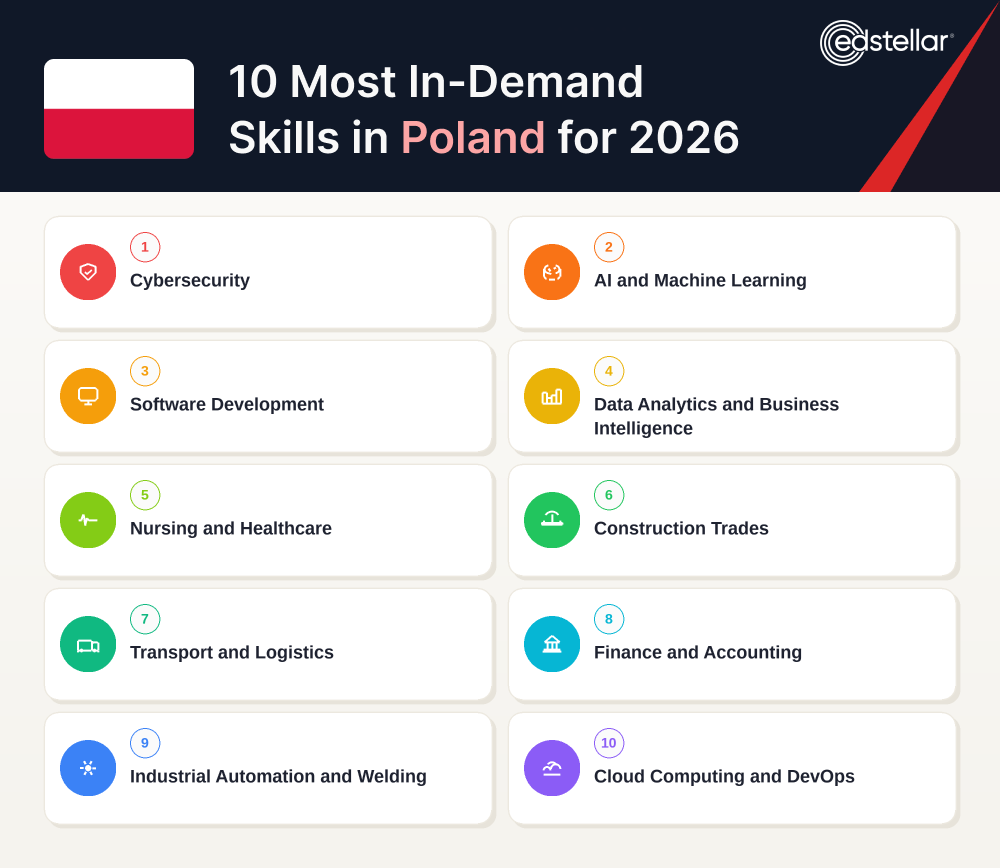
Poland's skills shortage list reflects the convergence of EU digital transformation mandates, PLN 792 million in government-backed SME digitalisation funding, a business services sector employing over 430,000 professionals, and persistent operational deficits in construction, healthcare, transport, and manufacturing. The 10 skills below cover the roles where hiring pressure is highest in 2025 and 2026.

Poland's cybersecurity talent gap has reached critical levels as three EU regulatory frameworks converge simultaneously: the NIS2 Directive mandating security standards for critical infrastructure operators, the Digital Operational Resilience Act (DORA) imposing cybersecurity requirements on financial institutions, and the Cyber Resilience Act establishing security standards for connected products. The National Cybersecurity Centre (NCC-PL) hosted the Digital Skills Summit specifically to address the competency challenges these regulations create for Polish organisations, highlighting a workforce gap that spans both specialist security roles and general cybersecurity awareness across the broader IT workforce.
Poland's position as Central Europe's largest business services hub amplifies the challenge. With over 1,800 service centres handling sensitive financial, healthcare, and corporate data for multinational clients, every centre requires security operations capability that meets both EU regulatory standards and client-mandated security frameworks. The banking and financial services sector faces the most immediate pressure from DORA compliance timelines. Energy and utilities companies must meet NIS2 requirements while managing increasingly complex operational technology environments. The government sector itself is undergoing rapid digitalisation, creating new attack surfaces that require trained defenders.
Cybersecurity professionals in Poland command some of the highest salaries in the technology sector, with No Fluff Jobs reporting senior security engineers and architects earning PLN 25,000 to 35,000 monthly (gross) on B2B contracts. The combination of regulatory deadlines, expanding attack surfaces, and insufficient domestic supply makes cybersecurity the single most difficult technology role to fill in Poland. For organisations operating in Poland, upskilling existing IT professionals through structured certification programmes (CISSP, CEH, CompTIA Security+, ISO/IEC 27001) offers a faster path to compliance than competing for external candidates in a market where qualified professionals are scarce across the entire EU.
Financial Services, Business Services/SSC, Government, Energy/Utilities, Healthcare

Poland's AI market is growing rapidly, driven by the convergence of EU-funded digitalisation programmes, a strong mathematics and computer science university pipeline, and demand from both the domestic technology sector and multinational business services centres. The Ministry of Development and Technology's PLN 792 million Digital Transformation Fund explicitly targets AI adoption among SMEs, while Poland's largest technology companies and financial institutions are building internal AI teams to support everything from fraud detection and credit scoring to supply chain optimisation and customer service automation.
The business services sector is a particularly significant driver of AI demand. As Poland's 1,800+ centres evolve from transactional processing to analytics-driven Global Business Services models, the ability to deploy machine learning for process automation, predictive analytics, and intelligent document processing becomes a core operational requirement. Warsaw and Krakow host the largest concentrations of AI talent, with companies including Google, Samsung R&D, and Allegro operating significant AI research and engineering teams. Poland's gaming industry, anchored by CD Projekt Red and Techland, applies AI and machine learning to procedural content generation, NPC behaviour, and quality assurance automation.
AI and machine learning engineers in Poland earn PLN 20,000 to 32,000 monthly (gross) on B2B contracts according to No Fluff Jobs, representing a significant premium over standard software development roles. Deep learning frameworks (TensorFlow, PyTorch), natural language processing for multilingual service centre applications, and generative AI tools are the most requested competencies. For organisations in Poland, AI capability is transitioning from a competitive advantage to an operational necessity as business services clients increasingly expect AI-augmented delivery and Polish companies compete globally for technology talent.
Technology, Financial Services, Business Services/SSC, Gaming, Manufacturing
“The demand for IT professionals in Poland continues to outpace supply, particularly in cybersecurity and artificial intelligence. Companies that invest in continuous upskilling and create clear career development paths for their technology teams will have a significant competitive advantage in attracting and retaining the talent they need.”



Poland has established itself as one of Europe's leading software development hubs, with an estimated 300,000+ IT professionals and a technology sector that contributes over 8% of GDP. Pracuj.pl's 2025 data confirmed continued growth in IT job postings and application volumes, while No Fluff Jobs reported that software development roles consistently account for the largest share of technology vacancies. Poland's universities produce approximately 15,000 IT graduates annually, but employer demand continues to exceed domestic supply, particularly for senior and specialist developers with experience in cloud-native architectures, microservices, and modern frameworks.
The business services sector is the largest single employer of software developers in Poland, with centres operated by companies including JP Morgan, Goldman Sachs, UBS, Shell, and McKinsey requiring full-stack developers, backend engineers, and DevOps specialists for client-facing technology platforms. Poland's domestic technology companies, including Allegro (e-commerce), CD Projekt Red (gaming), and a growing fintech ecosystem, compete with international employers for the same talent pool. The government's digitalisation agenda, including e-government services and public administration modernisation, adds further demand. Java, Python, JavaScript/TypeScript, and Go are the most requested languages across Polish job postings.
Software developers in Poland earn PLN 15,000 to 28,000 monthly (gross) on B2B contracts, with senior architects and principal engineers exceeding PLN 35,000 according to No Fluff Jobs salary data. The combination of competitive salaries, a strong engineering culture, proximity to Western European time zones, and EU membership makes Poland attractive for both domestic career building and international remote work. For organisations in Poland, software development capability underpins every digital transformation initiative, from business services modernisation and fintech product development to e-commerce platform engineering and government digitalisation.
Business Services/SSC, Technology, Financial Services, Gaming, E-commerce

Poland's business services sector employs over 430,000 professionals across more than 1,800 centres, and ABSL Poland's 2025 report documented the sector's accelerating evolution from transactional processing to analytics-driven Global Business Services models. This transformation is creating sustained demand for data analysts, business intelligence specialists, and decision support professionals who can extract actionable insights from the massive datasets generated by multinational operations. Financial services centres build risk models and regulatory reporting dashboards, manufacturing operations require production analytics for quality improvement, and e-commerce companies need customer behaviour modelling and marketing analytics.
Beyond the business services sector, Poland's broader economy is generating growing demand for data literacy. The government's digitalisation agenda requires analytics capability across public administration. The healthcare sector needs data professionals to support electronic health record systems and population health analysis. The logistics and transport industry uses route optimisation and demand forecasting models. Poland's universities are responding with expanded data science and analytics programmes, but the gap between graduate output and employer demand remains significant, particularly for professionals who combine technical skills with domain knowledge in finance, healthcare, or manufacturing.
Data analysts in Poland earn PLN 10,000 to 20,000 monthly (gross), with senior data engineers and analytics leads reaching PLN 22,000 to 30,000 according to Pracuj.pl and No Fluff Jobs. Power BI, Tableau, SQL, Python, and R are the most requested tools across Polish data analytics job postings. For organisations operating business services centres or planning to scale Polish operations, data analytics training directly enables the transition from cost-centre outsourcing to higher-margin GBS models that deliver strategic value to global clients.
Business Services/SSC, Financial Services, E-commerce, Manufacturing, Healthcare

Poland's healthcare workforce crisis is among the most severe in the European Union. The Occupational Barometer 2025 classified nurses and midwives as deficit occupations across virtually every voivodeship, reflecting a national shortage that has persisted for over a decade and is worsening as the existing workforce ages. Poland has one of the lowest nurse-to-population ratios in the EU, and the average age of registered nurses is among the highest, meaning that retirements will accelerate the shortage in the coming years without a significant increase in training capacity and graduate retention.
The challenge extends beyond nursing. Doctors, paramedics, physiotherapists, and specialist medical technicians all appear on deficit occupation lists across multiple regions. Poland's ageing population is increasing demand for geriatric care, chronic disease management, and palliative services at the same time that the healthcare workforce is shrinking. Emigration to higher-paying Western European markets, particularly Germany and the United Kingdom, compounds the domestic supply problem. The government has implemented salary increases for healthcare workers and expanded nursing education capacity, but these measures have not yet closed the gap between demand and supply.
Healthcare salaries in Poland have improved significantly following government intervention, with registered nurses earning PLN 6,000 to 10,000 monthly (gross) depending on specialisation and experience. Specialist nurses in intensive care, anaesthesiology, and emergency medicine command premium rates. For healthcare organisations in Poland, the workforce challenge requires both retention strategies and capability building in digital health technologies, including electronic patient records, telemedicine platforms, and AI-assisted diagnostics, that can partially offset staffing shortfalls by improving the productivity of existing clinical staff.
Hospital Systems, Primary Care, Elderly Care, Telemedicine/eHealth, Pharmaceutical

Construction trades represent one of Poland's most persistent and widespread deficit occupation categories. The Occupational Barometer 2025 classified bricklayers, roofers, concrete workers, carpenters, plumbers, electricians, and general construction workers as shortage occupations across the majority of Poland's 16 voivodeships. Poland's construction sector is simultaneously delivering EU-funded infrastructure projects, residential housing programmes, commercial real estate developments, and industrial facility construction, creating demand that consistently exceeds the domestic workforce's capacity to supply.
The sector's workforce challenge is compounded by demographic factors. Poland's construction workforce skews older than the national average, with retirements outpacing new entrants to skilled trades. The vocational education system has historically struggled to attract young people into construction careers, and competition from higher-paying Western European construction markets draws experienced tradespeople abroad. Ukraine has been a significant source of construction labour, but geopolitical factors and competition from other EU countries for Ukrainian workers have introduced uncertainty into this supply channel. Statistics Poland's Q4 2025 data confirmed that construction remains among the sectors with the highest unfilled vacancy rates.
Construction trade salaries in Poland have risen significantly in response to labour shortages, with experienced specialists earning PLN 7,000 to 14,000 monthly (gross) depending on trade, certification level, and project complexity. Electricians and plumbers with specialist certifications command premium rates. For organisations in Poland's construction sector, investment in apprenticeship programmes, vocational training partnerships, and upskilling existing workers in modern construction methods, building information modelling (BIM), and green construction techniques offers the most sustainable path to addressing a shortage that external recruitment alone cannot solve.
Residential Construction, Commercial Real Estate, Infrastructure, Industrial Facilities

Poland is the largest road freight transport market in the European Union, and the Occupational Barometer 2025 classified heavy vehicle drivers, warehouse workers, and logistics specialists as deficit occupations across multiple voivodeships. Poland's central geographic position makes it the primary logistics corridor connecting Western Europe with Central and Eastern European markets, and the country's transport sector employs hundreds of thousands of workers across road haulage, warehousing, rail logistics, and intermodal operations. The persistent driver shortage is a structural challenge driven by an ageing workforce, demanding working conditions, and competition from Western European haulage companies offering higher pay.
Beyond traditional road transport, Poland's logistics sector is undergoing significant modernisation. E-commerce growth is driving demand for last-mile delivery infrastructure, automated warehouse operations, and supply chain management technology. Amazon, Zalando, Allegro, and InPost operate major logistics networks across Poland, requiring workers who combine physical operational skills with digital competencies in warehouse management systems, route optimisation software, and inventory automation tools. The government's investment in rail infrastructure and intermodal transport hubs is creating additional demand for logistics planners and rail operations specialists.
Heavy vehicle drivers in Poland earn PLN 7,000 to 12,000 monthly (gross), with international long-haul drivers commanding higher rates. Logistics managers and supply chain specialists earn PLN 10,000 to 18,000 depending on company size and operational complexity. For organisations in Poland's transport and logistics sector, the challenge is twofold: filling immediate operational vacancies in driving and warehousing roles while simultaneously building the digital logistics capabilities that modern supply chain operations require. Training programmes that combine operational skills with technology competencies offer the best return on investment in a sector where automation will reshape, but not eliminate, the need for skilled workers.
Road Freight/Haulage, E-commerce Logistics, Warehousing, Intermodal Transport
“Poland's digital economy is growing faster than the supply of qualified professionals to support it. The organisations that will succeed are those that treat digital skills development not as a one-time training event, but as a continuous capability-building process embedded in their business strategy.”


Poland is one of Europe's largest hubs for finance and accounting shared services, with ABSL Poland reporting that financial process outsourcing remains the single largest function across the country's 1,800+ business services centres. Global banks, insurance companies, and multinational corporations operate finance and accounting centres in Warsaw, Krakow, Wroclaw, Lodz, and Katowice, employing tens of thousands of professionals in roles spanning accounts payable and receivable, financial planning and analysis, management reporting, tax compliance, and audit support. The sector's evolution from transactional processing to strategic finance functions is creating demand for professionals who combine accounting expertise with technology skills.
Poland's domestic financial services sector adds further demand. The banking industry, insurance companies, and a growing fintech ecosystem all require finance professionals with regulatory knowledge spanning Polish GAAP, IFRS, and EU regulatory frameworks. The Krajowy System e-Faktur (KSeF) electronic invoicing mandate is creating immediate demand for professionals who understand both the technical and compliance dimensions of digital tax administration. The convergence of finance and technology means that the most competitive candidates are those who combine traditional accounting qualifications (ACCA, CIMA, CPA) with proficiency in ERP systems (SAP, Oracle), data analytics tools, and automation platforms.
Finance and accounting professionals in Poland earn PLN 8,000 to 16,000 monthly (gross) for mid-level roles, with senior financial controllers and FP&A managers reaching PLN 18,000 to 25,000 according to Hays Poland and Pracuj.pl salary data. The combination of strong English-language proficiency, EU regulatory alignment, and competitive labour costs compared to Western Europe continues to attract multinational finance operations to Poland. For organisations operating finance centres, training programmes that bridge the gap between traditional accounting competencies and modern digital finance tools deliver the highest return on investment.
Business Services/SSC, Banking, Insurance, Fintech, Multinational Corporations

Poland's manufacturing sector is the country's largest industrial employer, and the Occupational Barometer 2025 classified welders, CNC operators, industrial mechanics, and automation technicians as deficit occupations across multiple voivodeships. Poland's automotive industry, anchored by plants operated by Volkswagen, Fiat/Stellantis, Opel, Toyota, and a dense network of tier-1 and tier-2 suppliers, requires skilled welders and automation technicians at volumes that the vocational education system cannot currently produce. The food processing, metals, and chemical manufacturing sectors add further demand for industrial skills.
The Industry 4.0 transition is reshaping the skills profile of Poland's manufacturing workforce. Companies are investing in robotic welding systems, PLC-controlled production lines, CNC machining centres, and IoT-enabled quality monitoring, creating demand for technicians who combine traditional trade skills with digital competencies. Siemens TIA Portal, Fanuc robotics, and Allen-Bradley PLC programming are among the most requested automation competencies. The EU's Green Deal and Poland's energy transition are driving additional demand for welders and fabricators in renewable energy infrastructure, including wind turbine assembly and solar mounting structure production.
Welders with specialist certifications (EN ISO 9606, pressure vessel welding) earn PLN 7,000 to 13,000 monthly (gross), while industrial automation engineers command PLN 10,000 to 18,000 according to Pracuj.pl and industry salary surveys. For manufacturing organisations in Poland, the combination of an ageing trade workforce, insufficient vocational training output, and the increasing complexity of automated production systems makes internal upskilling programmes essential. Companies that invest in training existing operators to work alongside robotic systems and digital production tools will build the workforce flexibility that modern manufacturing requires.
Automotive Manufacturing, Metals and Fabrication, Food Processing, Renewable Energy Infrastructure

Cloud computing is the operational backbone of Poland's digital economy, and No Fluff Jobs' 2025/2026 report confirmed that cloud architecture and DevOps engineering roles command significant salary premiums over standard software development positions. Poland's 1,800+ business services centres are migrating workloads from on-premises infrastructure to AWS, Azure, and GCP environments, financial institutions are modernising core banking platforms on cloud infrastructure, and the government's digitalisation agenda requires cloud-first public administration services. Google, Microsoft, and AWS have all invested in Polish cloud region infrastructure, reflecting confidence in the country's growing cloud services market.
The Ministry of Development and Technology's PLN 792 million Digital Transformation Fund explicitly supports cloud adoption among SMEs, creating a new wave of demand for cloud migration specialists, infrastructure architects, and managed service professionals who can help smaller organisations modernise their technology stacks. Kubernetes, Terraform, Docker, and CI/CD pipeline automation are the most requested DevOps competencies across Polish job postings. The convergence of cloud computing with cybersecurity (cloud security) and AI (cloud-based ML platforms) means that cloud professionals increasingly need cross-domain expertise.
Cloud architects and senior DevOps engineers in Poland earn PLN 22,000 to 35,000 monthly (gross) on B2B contracts, with AWS and Azure certifications carrying documented salary premiums according to No Fluff Jobs. The combination of strong technical education, competitive compensation relative to Western Europe, and growing cloud infrastructure investment makes Poland an increasingly significant cloud talent market. For organisations in Poland, cloud computing capability is not a standalone technology function but the enabling platform for cybersecurity, AI, data analytics, and business services modernisation across every sector.
Business Services/SSC, Technology, Financial Services, Government, Telecommunications
“Poland has the talent base and the educational infrastructure to become a global leader in digital services. What we need now is a coordinated effort between industry, government, and academia to scale the pipeline of qualified professionals in cloud computing, cybersecurity, and software engineering to match the pace of demand.”


Living and Working in Poland: EURES guide covering careers, job market conditions, and practical tips for professionals considering Poland.
Poland's skills demand is shaped by the geographic distribution of its technology hubs, business services centres, manufacturing corridors, and healthcare infrastructure. Understanding these regional patterns helps corporate L&D teams and HR managers target training investments where they will have the greatest impact.
Warsaw dominates Poland's technology, financial services, and government sectors, hosting the largest concentration of business services centres alongside the country's fintech ecosystem and major banks. Krakow is Poland's second-largest technology hub, with a strong gaming industry (CD Projekt, Techland studios), Google's engineering office, and a deep university talent pipeline from Jagiellonian University and AGH. Wrocław combines technology and business services with a significant automotive and manufacturing presence, anchored by companies including Nokia, IBM, and Credit Suisse.
The Tri-City (Gdańsk, Gdynia, Sopot) leverages its maritime and logistics heritage alongside a growing technology sector. Silesia is Poland's traditional industrial heartland, where mining and heavy manufacturing are transitioning toward automotive, green energy, and advanced manufacturing. Poznań balances business services operations with manufacturing and logistics, benefiting from its position on the Berlin-Warsaw transport corridor. For organisations planning multi-site operations, aligning training programmes with these regional demand patterns ensures that upskilling investments match actual hiring needs across Poland's geographically diverse economy.
Pete Ford is a corporate training specialist with over 15 years of experience in training methodologies, employee engagement, and performance improvement. He has a proven track record of developing and implementing effective training programs that enhance employee skills and productivity.
#On-site #Virtual #GroupTraining #Customized
Explore 2000+ industry ready instructor-led training programs.

Create dynamic leaders and cohesive teams. Learn more now!


Do a quick Skill gap analysis with Edstellar’s Free Skill Matrix tool

Unlock premium resources, tools, and frameworks designed for HR and learning professionals. Our L&D Hub gives you everything needed to elevate your organization's training approach.
Access L&D Hub Resources.svg)
.svg)
.svg)
.svg)

.svg)


.svg "Click Here to Follow on Medium")
.svg)


