10 Must-Have Skills for a Scrum Master in 2026
.webp)
.svg "edstellar")

The role of the Scrum Master has evolved far beyond simply facilitating stand-ups and sprint planning. As organizations navigate an increasingly complex landscape marked by technological disruption, remote work dynamics, and rapidly shifting market conditions, the Scrum Master has emerged as a strategic enabler of organizational agility and team performance. The competencies required to excel in this role now extend into leadership, technology literacy, and strategic thinking, areas that were once considered peripheral to the traditional Scrum Master mandate.
“Being a Scrum Master is more than simply running ceremonies; it requires adopting a completely different approach to leadership."


According to the World Economic Forum Future of Jobs Report 2025, 39% of existing skill sets will be transformed or become outdated between 2025 and 2030. This transformation affects every professional domain, but it holds particular significance for Scrum Masters who serve as the connective tissue between strategy and execution within agile organizations. The accelerating pace of change demands that Scrum Masters not only maintain mastery of core facilitation techniques but also cultivate a broader portfolio of capabilities that address emerging organizational challenges.
The modern Scrum Master operates at the intersection of people, process, and technology. They must balance the human elements of coaching and conflict resolution with technical awareness of AI-driven tools and data analytics. They navigate organizational politics while maintaining servant leadership principles. They champion continuous improvement while managing stakeholder expectations across multiple organizational layers. This multifaceted role requires a sophisticated skill set that adapts to the unique pressures of 2026’s business environment.
This article examines ten essential competencies that define Scrum Master excellence in today's environment. These skills reflect both the enduring fundamentals of agile practice and the emerging demands of digital-first, globally distributed work environments. For organizations investing in agile transformation and professionals seeking to future-proof their careers, understanding these capabilities provides a roadmap for sustainable success in an unpredictable landscape.
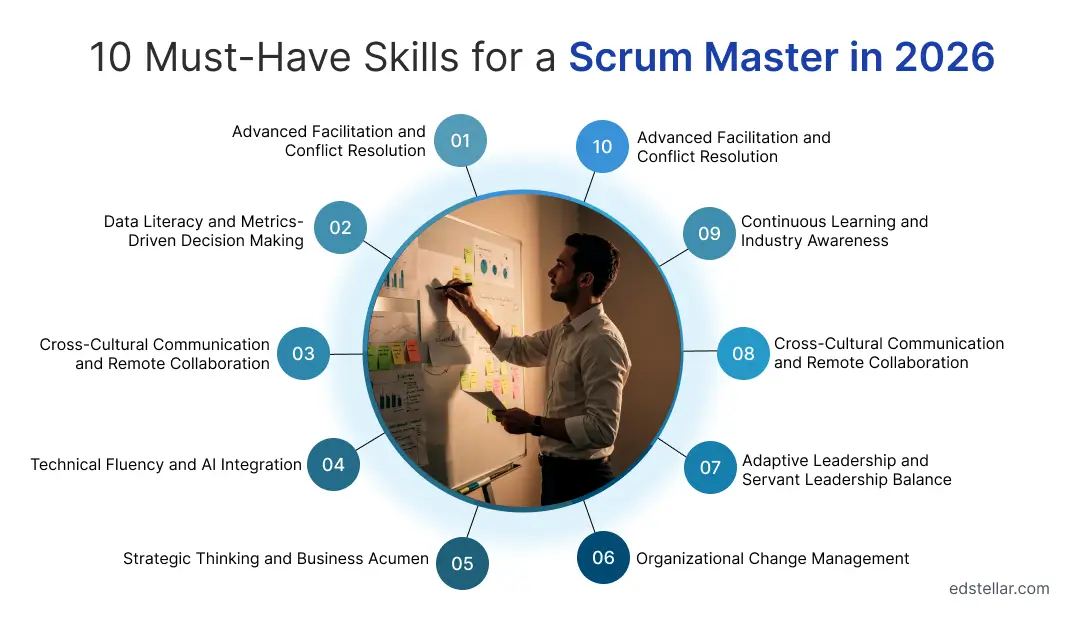
Facilitation remains the cornerstone of Scrum Master effectiveness, but its nature has evolved considerably. Today’s Scrum Masters must navigate hybrid and fully remote environments where traditional facilitation techniques prove insufficient. The ability to design engaging virtual ceremonies, manage diverse communication styles across cultures and time zones, and maintain psychological safety in digital spaces has become non-negotiable.
Beyond basic meeting management, advanced facilitation involves sensing team dynamics in real time and adjusting approaches accordingly. Effective Scrum Masters recognize when a retrospective format has become stale and introduce alternative frameworks, such as Lean Coffee or Solution-Focused techniques. They identify when a sprint planning session requires deeper product clarification versus when the team needs space for technical design discussions.
Conflict resolution capabilities have grown equally sophisticated. Modern Scrum Masters encounter conflicts that extend beyond interpersonal friction to include technological disagreements, architectural debates, and competing priorities across distributed teams. The skill lies not in eliminating conflict but in transforming it into productive dialogue that surfaces underlying assumptions and drives better decision-making. This requires emotional intelligence, pattern recognition, and the courage to address difficult conversations that others might avoid.
Organizations implementing Agile training recognize that facilitation excellence differentiates high-performing teams from those that merely follow agile rituals. Scrum Masters who master this competency create environments where diverse perspectives emerge, psychological safety flourishes, and teams consistently deliver exceptional outcomes through collaborative problem-solving.
The contemporary Scrum Master must be fluent in quantitative analysis and data interpretation. While agile principles emphasize working software over comprehensive documentation, the realities of modern business demand that Scrum Masters articulate team performance, identify opportunities for improvement, and justify resource allocation using data-driven insights.
This competency extends beyond tracking velocity and burn-down charts. Sophisticated Scrum Masters analyze cycle time distributions to identify process bottlenecks, examine defect patterns to uncover quality issues, and correlate team health metrics with delivery outcomes. They understand statistical concepts like variance and trend analysis, enabling them to distinguish signal from noise in performance data.
Data literacy also encompasses the ability to select appropriate metrics for different contexts. A Scrum Master working with a product innovation team measures different indicators than one supporting an operational maintenance team. The skill involves knowing when traditional agile metrics prove inadequate and designing custom measurements that capture what truly matters for specific business objectives.
Furthermore, effective Scrum Masters translate complex data into compelling narratives that resonate with stakeholders at all organizational levels. They present insights visually, contextualize findings within broader business goals, and connect quantitative observations to qualitative team experiences. This bridge between numbers and narrative enables informed decision-making across the organization while maintaining transparency about team capacity and constraints.
Technical skills and process knowledge provide the foundation for Scrum Master effectiveness, but emotional intelligence determines the ceiling of impact. The ability to recognize, understand, and respond appropriately to emotional undercurrents within teams sets transformational leaders apart from competent practitioners.
Emotional intelligence manifests in multiple dimensions. Self-awareness enables Scrum Masters to recognize their own triggers, biases, and emotional responses, preventing these personal factors from clouding professional judgment. Self-regulation helps them maintain composure in high-pressure situations, modeling the calm persistence teams need during challenging sprints or periods of organizational turbulence.
Social awareness, particularly empathy, enables Scrum Masters to sense unspoken team dynamics. They notice when a quiet team member has withdrawn, recognize when apparent agreement masks underlying concerns, and detect when team enthusiasm has shifted to burnout. This perceptiveness creates opportunities for early intervention, preventing small issues from escalating into significant problems.
Relationship management skills enable Scrum Masters to leverage emotional intelligence to drive positive outcomes. They build trust by consistently demonstrating care for team members' well-being. They inspire motivation by connecting daily work to a meaningful purpose. They navigate difficult feedback conversations with honesty tempered by compassion. Organizations exploring emotional intelligence in leadership understand that these capabilities directly correlate with team retention, engagement, and sustained performance.
While Scrum Masters need not be software engineers, technical fluency has become essential for credibility and effectiveness. Understanding architectural patterns, development workflows, and technological constraints enables more informed facilitation and better support for technical discussions within development teams.
The rapid advancement of artificial intelligence introduces new dimensions to this technical fluency requirement. According to a Gartner survey from October 2024, 85% of learning and development leaders agree that skills development needs will surge over the next three years, driven by AI and digital trends. Scrum Masters must understand how AI tools integrate into development workflows, what capabilities they provide, and where human judgment remains irreplaceable.
This technical awareness extends to understanding DevOps practices, continuous integration and deployment pipelines, and automated testing frameworks. Scrum Masters who grasp these technical concepts can better identify impediments, facilitate productive technical discussions, and help teams optimize their development processes.
Moreover, technical fluency enables Scrum Masters to evaluate and advocate for tools that enhance team productivity. Whether assessing project management platforms like those covered in Scrum with JIRA training or exploring AI-powered development assistants, technically literate Scrum Masters make informed recommendations that balance team preferences with organizational standards and genuine productivity gains.
The most effective Scrum Masters think beyond sprint boundaries to understand how team delivery connects to organizational strategy. This business acumen transforms the role from tactical facilitator to strategic partner, enabling Scrum Masters to guide teams toward work that generates genuine business value rather than merely completing assigned tasks.
Strategic thinking manifests in the ability to articulate how agile practices support broader business objectives. Scrum Masters with this competency explain to executives how iterative delivery reduces market risk, demonstrate how continuous improvement enhances competitive positioning, and quantify how agile practices accelerate time-to-value for critical initiatives.
This skill also involves understanding the competitive landscape, market trends, and industry dynamics that shape product strategy. When Scrum Masters grasp these external factors, they ask better questions during refinement sessions, challenge assumptions about feature priorities, and help product owners make more informed trade-off decisions.
Business acumen enables Scrum Masters to speak the language of different organizational stakeholders. They discuss customer acquisition costs with marketing leaders, debate the impact of technical debt with engineering directors, and explore regulatory compliance with legal teams. This fluency across business domains positions Scrum Masters as credible organizational leaders rather than narrowly focused process specialists.
Scrum Masters frequently serve as change agents within organizations undergoing agile transformation. This responsibility requires sophisticated change-management capabilities that extend beyond training teams on Scrum ceremonies. Effective organizational change requires understanding resistance patterns, designing transition strategies, and building coalitions of support across hierarchical boundaries.
Change management competency begins with recognizing that organizational transformation occurs through people, not processes. Scrum Masters skilled in this domain identify influencers within various departments, understand stakeholder concerns, and craft communication strategies that address both rational objections and emotional resistance to change.
This skill encompasses the ability to diagnose organizational culture and adapt agile implementation approaches accordingly. A command-and-control culture requires different change strategies than a consensus-driven environment. Scrum Masters who assess cultural readiness and design contextually appropriate interventions achieve far greater success than those who apply generic playbooks regardless of organizational context.
Furthermore, effective change agents recognize that transformation proceeds through stages: awareness, adoption, and institutionalization. They design different interventions for each phase, celebrating early wins to build momentum, supporting struggling teams without abandoning core principles, and gradually shifting organizational systems to reinforce new behaviors until they become embedded in standard practice.
The Scrum Master role embodies a sophisticated leadership paradox: serving the team while simultaneously challenging them to achieve higher performance. This balance between servant leadership and adaptive leadership represents one of the most nuanced capabilities in the modern Scrum Master skill set.
Servant leadership emphasizes removing impediments, protecting teams from organizational dysfunction, and creating conditions for them to thrive. Scrum Masters practicing this approach prioritize team needs, listen actively, and demonstrate genuine care for individual growth and collective success. They operate with humility, acknowledging that teams possess the technical expertise while they contribute process facilitation and organizational navigation.
However, pure servant leadership is insufficient when teams face complex adaptive challenges that require fundamental shifts in mindset or behavior. Adaptive leadership calls for Scrum Masters to create productive discomfort that drives growth. This might involve surfacing difficult truths about team performance, challenging comfortable patterns that limit potential, or pushing back on requests that would compromise agile principles.
The agile leadership training that organizations provide increasingly focuses on developing this nuanced balance. Effective Scrum Masters recognize when to remove obstacles versus when to coach teams through solving their own problems. They know when to protect teams from organizational pressure versus when to transparently communicate constraints that require team adaptation. This sophisticated judgment separates adequate Scrum Masters from exceptional ones.
Global distribution has transformed from a competitive advantage to an operational necessity for most technology organizations. Scrum Masters now routinely work with teams spanning multiple continents, time zones, and cultural contexts. Excellence in cross-cultural communication and remote collaboration has evolved from nice-to-have to a mission-critical capability.
Cross-cultural competency extends beyond avoiding obvious cultural faux pas to understanding how different cultures approach hierarchy, direct communication, decision-making, and time orientation. A Scrum Master working with team members from high-context cultures must adjust their communication style when facilitating discussions with colleagues from low-context backgrounds. Recognizing these differences prevents misunderstandings and enables inclusive participation.
Remote collaboration skills encompass both technical proficiency with digital tools and a nuanced understanding of the challenges of remote work. Effective Scrum Masters design virtual ceremonies that combat video fatigue, create opportunities for informal connection that replicate office interactions, and establish communication protocols that prevent information silos in distributed environments.
This competency also includes recognizing when synchronous collaboration adds value and when asynchronous approaches are more efficient. Teams spanning extreme time zones cannot maintain the always-available model of colocated work. Scrum Masters who master distributed collaboration optimize for asynchronous handoffs, design documentation practices that enable continuity, and create intentional overlap periods for critical collaborative work.
The agile landscape continues to evolve, with new frameworks, practices, and research emerging regularly. Scrum Masters committed to excellence embrace continuous learning not as occasional professional development but as a fundamental professional identity. This growth mindset ensures they remain relevant as both practices and business contexts transform.
Continuous learning manifests through multiple channels. Effective Scrum Masters participate in communities of practice, attend conferences, pursue advanced certifications, and engage with thought leaders through social media and professional networks. They experiment with emerging practices in low-risk contexts before introducing them to their teams. They read widely across agile methodologies, psychology, systems thinking, and business strategy to develop integrative perspectives.
Industry awareness extends beyond agile practices to encompass sector-specific trends that shape team dynamics. A Scrum Master supporting fintech teams must grasp regulatory changes affecting financial services. One working in healthcare needs to be aware of interoperability standards and compliance requirements. This domain knowledge enables more relevant coaching and better anticipation of challenges teams will face.
According to the SHRM State of the Workplace Report from January 2024, 37% of organizations plan to increase investment in training and development, making it the most common investment area. Organizations that recognize this trend create learning cultures in which Scrum Masters model continuous improvement through their own ongoing development, inspiring teams to pursue similar growth trajectories.
Scrum Masters operate within complex organizational ecosystems where they must drive outcomes without direct authority over most stakeholders. This reality demands sophisticated stakeholder management and influence capabilities that enable them to shape decisions, secure resources, and advocate for teams across hierarchical and organizational boundaries.
Effective stakeholder management begins with mapping the influence network surrounding teams. Scrum Masters identify who holds decision-making authority, who exerts informal influence, who controls resources, and who might resist changes proposed by teams. This mapping enables strategic engagement that builds coalitions and preemptively addresses concerns before they become blockers.
Influence without authority requires building credibility through consistent delivery, demonstrating business impact, and establishing trusted relationships over time. Scrum Masters who master this skill frame the team's needs around stakeholder priorities, present data to substantiate requests, and create win-win scenarios in which supporting the team advances stakeholder objectives.
This competency also encompasses managing up effectively, educating leadership on agile principles, setting appropriate expectations for team capacity, and transparently communicating successes and challenges. Organizations that invest in building collaborative teams recognize that Scrum Masters serve as crucial translators between operational delivery and strategic leadership, requiring diplomatic skills to bridge these often-disconnected organizational levels.
While this article examines each skill discretely, Scrum Master excellence emerges from integrating these competencies into a coherent professional identity. Emotional intelligence enhances facilitation. Technical fluency strengthens credibility during stakeholder management. Strategic thinking informs change management priorities. The most effective Scrum Masters develop complementary skills that reinforce one another, creating capabilities far greater than the sum of individual competencies.
The World Economic Forum Future of Jobs Report 2025 reveals that 85% of employers surveyed plan to prioritize upskilling their workforce. Organizations committed to agile excellence recognize that investing in Scrum Master development generates multiplicative returns through improved team performance, higher employee engagement, and more successful delivery outcomes.
Aspiring and practicing Scrum Masters should approach skill development strategically. Conduct honest self-assessments identifying current strengths and development opportunities. Seek feedback from teams, peers, and leaders about areas requiring growth. Create deliberate practice plans that systematically build capabilities over time rather than expecting immediate mastery. Engage mentors who demonstrate excellence in areas you wish to develop. Most importantly, recognize that skill development is a continuous journey, not a destination; the learning never truly ends.
The Scrum Master role in 2026 demands far more than process adherence and ceremony facilitation. It requires a sophisticated blend of interpersonal excellence, technical awareness, strategic insight, and adaptive leadership. Organizations that recognize this complexity invest in comprehensive development programs that cultivate these multifaceted capabilities within their agile practitioners.
For individual Scrum Masters, the competencies outlined in this article provide a roadmap for sustained relevance and career growth. The professionals who thrive in the coming years will be those who embrace continuous learning, develop diverse skill portfolios, and adapt their practice to emerging business contexts. The role continues evolving, but the fundamental mission remains constant, enabling teams to deliver exceptional value through collaborative, iterative approaches that respond to change rather than resist it.
The organizations that succeed in turbulent markets will be those with Scrum Masters who embody these ten capabilities, professionals who combine deep agile expertise with broad business acumen, who balance servant leadership with courageous challenge, and who continuously evolve their practice in response to changing demands. For those willing to invest in this comprehensive skill development, the Scrum Master role offers an endlessly engaging career at the forefront of organizational transformation.
#On-site #Virtual #GroupTraining #Customized

Turn Your Training Programs Into Revenue Drivers.
Schedule a ConsultationExplore 2000+ industry ready instructor-led training programs.

Create dynamic leaders and cohesive teams. Learn more now!

Do a quick Skill gap analysis with Edstellar’s Free Skill Matrix tool

Unlock premium resources, tools, and frameworks designed for HR and learning professionals. Our L&D Hub gives you everything needed to elevate your organization's training approach.
Access L&D Hub Resources.svg)
.svg)
.svg)
.svg)

.svg)


.svg "Click Here to Follow on Medium")
.svg)


