

Internal talent mobility has shifted from an HR program to an enterprise operating capability. Leaders are being asked to redeploy talent faster than they can recruit it, while employees increasingly judge employers by the clarity and credibility of internal growth pathways. The limiting factor is rarely intent; it is visibility.
Many organizations still cannot answer two basic questions with confidence: “What skills do we have today?” and “Which adjacent skills can fill tomorrow’s work?”
Skill mapping closes that visibility gap. Done well, it creates a shared language for workforce planning, career architecture, learning investment, and internal hiring decisions. It also changes how work gets staffed: away from job-title matching and toward demonstrated capability, readiness, and adjacency.
The urgency is structural. The World Economic Forum estimates that, on average, 44% of a worker’s skills will need to be updated.
This article presents five enterprise-style case studies that show how internal talent mobility becomes scalable when skill mapping serves as the backbone of talent decisions. Each case highlights decisions, governance, and measurement, because Internal Talent Mobility is not a platform rollout; it is a system design problem.
What Internal Talent Mobility, Powered by Skill Mapping Truly Signifies
Internal talent mobility is the movement of employees across roles, functions, projects, or geographies inside the organization. Skill mapping is the process of capturing, standardizing, and maintaining a structured view of workforce skills at the individual, team, and enterprise levels. When the two are connected, mobility decisions are driven by evidence rather than informal networks, subjective “fit,” or stale job descriptions.
Skill mapping is not the same as producing a taxonomy and stopping there. It becomes valuable when it enables three operational moves.
First, it makes skills searchable and comparable across business units. A consistent framework reduces translation errors between job families (“data analyst” in one division may be “insights associate” in another) and creates a functioning internal labor market.
Second, it enables adjacency-based redeployment. Instead of waiting for “perfect matches,” organizations can identify “close enough” talent and close gaps with targeted learning and structured transition support.
Third, it creates accountability for development. Skill mapping gives managers a concrete way to discuss readiness, progression, and investment, not as abstract “potential,” but as measurable capability shifts over time.
A practical starting point is building an assessment backbone that captures skills and proficiency in a standardized way, such as a skill matrix.
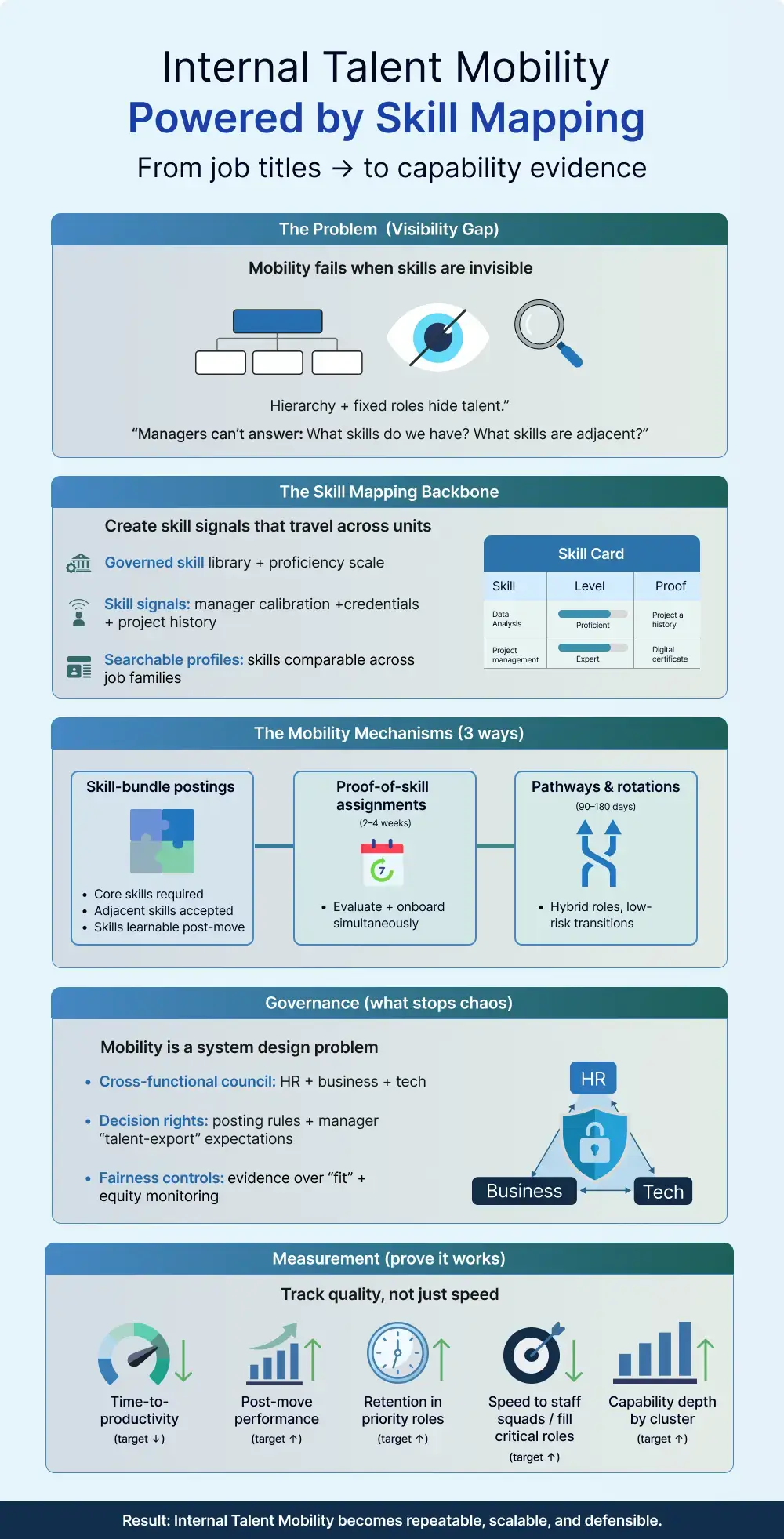
Why Internal Talent Mobility is now a CEO-level lever
Internal talent mobility was once framed mainly in terms of engagement and retention. Those outcomes still matter, but the enterprise rationale has expanded to include capacity, resilience, and value delivery.
Mobility is Now a Supply-side Strategy for Growth
Across sectors, demand volatility and digitization create skill spikes that external hiring cannot solve quickly enough. The U.S. labor market outlook reinforces why internal supply matters: BLS projects total employment will grow 4.0% from 2023 to 2033, adding 6.7 million jobs. That trajectory suggests competition for capability will remain persistent, which elevates internal redeployment capacity from “HR initiative” to “operating model requirement.”
Career Growth Credibility is a Retention Constraint
Organizations can invest in learning, but if employees cannot translate learning into opportunity, the system breaks at the last mile. Gartner reports that only 46% of employees feel supported trying to grow their careers at their organization. Skill mapping serves as the bridge between learning and movement by connecting capability profiles to real roles, projects, and pathways.
Mobility Fixes Misallocation, Not Just Vacancies
Even strong organizations often have talent in the wrong places, doing the wrong work, at the wrong time. McKinsey notes that between 20% and 30% of critical roles aren’t filled by the most appropriate people. Skill mapping makes that misallocation visible, enabling leaders to redeploy talent to the highest-value work rather than defaulting to external recruiting.
Upskilling and Reskilling Have Become Explicit Enterprise Priorities
SHRM’s research indicates 53% of organizations made upskilling/reskilling the current workforce a top priority for 2024. Skill mapping gives this priority operational meaning: it identifies which skills matter, where gaps exist, and which internal moves become feasible with targeted development.
Skills-first Approaches Reinforce Retention Signals
LinkedIn’s talent research shows companies have nearly a 7% higher retention rate at the 3-year mark with employees who have learned skills on the job. The strategic implication is not “more training.” The implication is “training linked to opportunity,” because internal talent mobility is one of the most reliable mechanisms for using, validating, and rewarding skills.
The operating system behind skill‑mapped mobility
Across industries, scalable internal talent mobility tends to share four design layers:
- Skill Architecture: a governed skill library with proficiency definitions and role mapping.
- Skill Signals: multiple evidence sources (manager calibration, self-assessments, project history, credentials, learning completions).
- Opportunity Marketplace: roles, gigs, stretch assignments, rotations, described in skill terms rather than only responsibilities.
- Decision Rights and Incentives: internal posting rules, talent-sharing expectations, and escalation pathways to prevent manager hoarding.
Many organizations sharpen this architecture by distinguishing between skills (task capability) and competencies (broader behaviors). That difference affects calibration, assessment, and promotion decisions, which is why aligning definitions early reduces friction later. A useful reference point is the skill matrix vs the competency matrix.
Case Study 1: Bank Skills‑Based Moves for Risk & Compliance
Business Trigger
A global bank faced two simultaneous pressures: regulatory scrutiny (requiring stronger control functions) and digital transformation (requiring analytics and automation capability). External hiring was expensive and slow, but internal talent mobility was constrained by rigid job families and inconsistent role language across business units.
Skill Mapping Method
The bank created a cross-functional skills council (Risk, Technology, HR) and defined a skill framework for three clusters: risk analytics, regulatory reporting, and process automation. Instead of mapping every job, the bank mapped critical work first, starting with the roles most exposed to compliance change and the feeder roles with the closest adjacency.
Skill profiles were assembled through manager calibration sessions (to reduce inflated self-ratings), credential data, and project participation records. The council also defined a shared proficiency scale so that “intermediate” meant the same thing across business units.
Mobility Mechanism
The bank rebuilt internal postings into “skill bundles”: core skills required, adjacent skills accepted, and skills that could be learned post-move. Hiring managers were trained to assess capability evidence, and candidates could submit skill profiles rather than rely solely on title progression.
The bank also introduced short “proof-of-skill” assignments (two to four weeks) that served both as evaluations and onboarding. This reduced risk for the receiving manager while giving employees a fairer path to demonstrate readiness.
What Changed
Compliance modernization stopped being treated primarily as a hiring problem and began being treated as a deployment problem: which internal groups have adjacent analytical capabilities that can be redeployed with minimal risk? The bank uncovered overlooked pools, operations analysts, internal audit associates, and finance reporting specialists, whose work already required pattern recognition, reconciliation discipline, and high-stakes accuracy.
How Outcomes Were Measured
Rather than tracking only internal fill rate, leaders tracked time-to-productivity, post-move performance, and retention within priority risk roles. These metrics created confidence that mobility decisions were improving quality, not just speed.
Case Study 2: Manufacturing Plant Talent to Digital Roles
Business Trigger
A multinational manufacturer needed to scale predictive maintenance, production analytics, and digital quality management across plants. The organization had strong frontline expertise but lacked sufficient digital capability, and external hiring could not meet the required scale.
Skill Mapping Method
The manufacturer started with a practical question: which frontline roles already contain skills adjacent to digital operations work? They mapped process knowledge, root-cause analysis, equipment familiarity, and statistical reasoning in a structured “capability passport” that reflected real workflows, not just job descriptions.
Crucially, the mapping included “proof points” for proficiency. For example, a maintenance technician could demonstrate a higher level of analytical capability by successfully isolating faults, producing high-quality documentation, and preventing recurring issues, thereby turning tacit expertise into a standardized signal.
Mobility Mechanism
Instead of moving people directly into new jobs, the company created a pathway with three components: baseline skill assessment, targeted learning, and a rotation into a digital operations squad. They also created hybrid roles (50% legacy responsibilities, 50% digital projects) for 90–180 days, preventing sudden capacity loss at the plant level.
The talent model treated internal talent mobility as risk-managed change: people could transition gradually, build confidence, and show measurable impact before the move became permanent.
What Changed
Readiness conversations shifted from tenure-based assumptions to capability-based evidence: can the employee interpret equipment data, standardize a process, and translate tacit knowledge into repeatable work instructions? Managers were given a common rubric so that development conversations were consistent across plants and shifts.
How Outcomes Were Measured
Leaders tracked pathway completion, internal placements into digital roles, and capability depth by plant cluster. They also monitored whether digital initiatives were reducing downtime or quality variance to demonstrate that mobility was improving business outcomes, not just career outcomes.
Case Study 3: SaaS Project Gigs as a Mobility Engine
Business Trigger
A high-growth SaaS company faced constant shifts in product priorities and needed to assemble squads quickly. Talent allocation depended too much on leadership relationships and informal knowledge of “who can do what,” resulting in overloaded visible performers and underutilized hidden talent.
Skill Mapping Method
The company built lightweight skill profiles for product, engineering, customer success, and data functions, focusing on a small set of “squad skills” such as discovery, instrumentation, solution architecture, experimentation design, and stakeholder alignment. Employees updated profiles quarterly, and managers validated changes for consistency.
Skill mapping was treated as a product: minimal fields, high usability, and a clear linkage to staffing decisions. The company prioritized skills that were repeatedly needed for roadmap execution, not skills that looked good in a directory.
Mobility Mechanism
Projects became the primary vehicle for mobility. Every initiative posted an internal “gig brief” listing the required skills, the expected time commitment, and skills participants could build. Employees could bid for gigs, and staffing decisions were made based on skill match and development intent, not only availability.
The company also implemented a rule that high-growth initiatives had to include at least one participant from outside the immediate function. That forced cross-functional skill mixing and prevented squads from becoming closed networks.
What Changed
Work allocation shifted from headcount negotiation to capability assembly. Managers began planning squads by asking: “What skills does the outcome require?” rather than “Which team owns this work?” As a result, mobility became embedded in delivery rather than competing with delivery.
How Outcomes Were Measured
Leaders tracked speed to staff squads, participation rates by function, and subsequent role movement after gig participation. The measurement focus was on whether gigs were creating repeatable pathways into new roles and whether capability coverage was improving for strategic skill clusters.
A structured approach like this aligns closely with the mobility disciplines described in talent mobility frameworks.
Case Study 4: Retail Frontline to Corporate Pathways
Business Trigger
A global retailer struggled with frontline churn and could not fill certain corporate support roles fast enough. Employees perceived corporate roles as opaque, and store managers lacked tools to coach realistic pathways.
Skill Mapping Method
The retailer mapped frontline skills that translate into corporate work: customer problem-solving, inventory reasoning, scheduling, conflict resolution, and process adherence. Skill mapping became a translation system from “frontline language” to “corporate role language.”
Skill evidence included manager validations, performance outcomes, and structured examples (process improvements, peer coaching, escalation handling). The objective was to replace “I think they could do it” with “Here is what they have already done that maps to this role.”
Mobility Mechanism
The retailer introduced bridge roles and bridge projects (short assignments in regional ops support, training coordination, and inventory analytics) that reduced risk and created credibility for movement.
Job postings were rewritten to state which frontline experiences count as equivalent skill evidence, lowering psychological barriers and increasing perceived fairness. Employees could see how to qualify, and managers could coach using a shared playbook.
What Changed
The organization shifted from “frontline vs corporate” as a hard divide to “skills pathways” as a continuum, supported by quarterly career conversations grounded in skill evidence. The manager role moved from gatekeeper to sponsor, because the pathway design made exporting talent an expected outcome rather than a perceived loss.
How Outcomes Were Measured
Leaders tracked employee participation in the pathway, internal placements, and retention of employees who entered the bridge program. They also monitored participation equity across locations to ensure internal talent mobility did not become a privilege concentrated in a few high-visibility stores.
Case Study 5: Healthcare Skills‑Led Redeployment at Scale
Business Trigger
A multi-site healthcare system faced shortages in specialized roles and operational stress in high-demand units. External hiring could not keep pace, and leaders needed a resilient staffing model that could respond to demand shifts without increasing burnout.
Skill Mapping Method
The healthcare system built a skills-based plan across clinical support and administrative functions, mapping clusters such as care coordination, patient communication, scheduling optimization, compliance documentation, and service recovery. Skills coverage was reviewed quarterly at each site to identify deployment risk.
The program treated skill mapping as workforce planning infrastructure rather than HR documentation. If the skill coverage was thin in a critical unit, leaders could spot it early and address it through cross-training and controlled rotations.
Mobility Mechanism
The organization created controlled mobility pathways supported by cross-training, short rotations, and mentorship. Skill mapping identified partial readiness and clarified what support was required before transition, ensuring mobility did not compromise safety or service quality.
What Changed
Staffing decisions increasingly moved from requisitions to capability readiness, enabling leaders to see where internal talent could be redeployed safely and where bench strength needed to be built. Over time, the healthcare system moved toward a skills‑based organization mindset, where work design and staffing decisions relied more on capabilities than on rigid role boundaries.
How Outcomes Were Measured
The system tracked skill coverage for critical functions by site, by rotation completion, and by staffing stability in high-demand units. Leaders also monitored workload indicators to ensure mobility reduced pressure rather than redistributed it.
Cross‑Case Patterns Leaders Can Apply Immediately
The consistent lesson across the five cases is that internal talent mobility scales when skill mapping becomes operational and trusted, not merely documented.
1. Start With Critical Work, Not the Entire Enterprise
Mapping every job first slows progress and dilutes stakeholder attention. The strongest programs began by mapping roles and workstreams with urgent business pressure and high adjacency potential.
2. Build Decision‑Grade Skill Data, Not Perfect Skill Data
Leaders do not need perfect profiles; they need sufficient confidence to place people, fund development, and reduce redeployment risk. That confidence comes from calibration, proficiency definitions, and refresh cadence.
3. Reduce Mobility Risk With Structured Transitions
Bridge roles, gigs, hybrid rotations, and proof-of-skill assignments lower the cost of being wrong and make managers more willing to release talent.
4. Incentives Determine Whether Mobility Becomes Real
Internal posting rules are not enough. Successful organizations reward leaders who develop and export talent, and they normalize mobility as part of operational excellence.
5. Connect Learning to Opportunity
Mobility is where skills become visible and rewarded, which is why learning investments translate into retention and capability only when pathways are real and accessible.
If you need a standardized approach for capturing skills and proficiency signals across teams before scaling into pathways, assessing employee skills using a skill matrix is a strong operational starting point.
Conclusion
Internal talent mobility does not scale on intent alone. It scales when organizations make skills visible, comparable, and actionable, so roles, projects, and pathways are staffed with evidence rather than assumptions. The five cases show the same operating truth: skill mapping works when it is tied to governance, incentives, and low-risk transition design, such as gigs, bridge roles, and hybrid rotations.
As skill disruption accelerates, Internal talent mobility becomes a core operating capability rather than a standalone HR program. If you want faster redeployment, clearer career credibility, and more resilient workforce planning, start by building a skills foundation that is calibrated, updated, and used in real decisions. For support in operationalizing skill-based internal talent mobility, explore Edstellar.