.svg "edstellar")

Anaconda Ecosystem for Data Scientists Corporate Training Program for Employees
Edstellar's instructor-led Anaconda Ecosystem for Data Scientists training equips your teams to manage Python environments with conda, work productively in Anaconda Navigator and Jupyter, and build reproducible data science and machine learning workflows, customized to your stack and delivered onsite or virtually.

(Virtual / On-site / Off-site)
.svg)
Equip Your Data Science Teams to Build Faster with Anaconda
Anaconda is the leading free, open-source distribution of Python and R for data science. It bundles the conda package and environment manager, Anaconda Navigator, Jupyter, and hundreds of pre-built data science libraries such as NumPy, pandas, scikit-learn, and Matplotlib into one reliable platform. The Anaconda Ecosystem for Data Scientists is the practice of using that toolchain end to end, creating isolated environments, managing packages, exploring data in notebooks, and building reproducible analysis and machine learning workflows. As organizations standardize how teams build and ship data science, the ability to manage environments and dependencies cleanly is what separates fragile, one-off scripts from reliable, shareable work.
As organizations scale data science and demand reproducible, trustworthy results, this program helps your teams set up, manage, and share Anaconda environments and workflows across real projects. Empower your people with expert-led on-site, off-site, and virtual sessions delivered by Edstellar, a premier corporate training provider serving organizations worldwide in-person and virtually across popular languages. Built around your goals, the program turns Anaconda ecosystem skills into lasting capabilities that lift performance across your data science, analytics, and machine learning teams.
By the end of the program, your team can spin up clean, reproducible environments in minutes, manage packages and dependencies without conflicts, and move from exploratory notebooks to shareable, production-ready data science workflows. The result is faster project setup, fewer 'it works on my machine' failures, and a consistent, governable data science practice across the organization.
.svg)

- Install and navigate Anaconda Distribution, Anaconda Navigator, and the conda command line with confidence.
- Create, manage, and share isolated conda environments to keep projects reproducible and conflict-free.
- Install, update, and pin packages from conda, conda-forge, and pip without breaking dependencies.
- Explore, clean, and analyze data in Jupyter notebooks using the core PyData stack (NumPy, pandas, Matplotlib).
- Build and evaluate machine learning models with scikit-learn inside reproducible Anaconda environments.
- Package, document, and share environments and workflows so analyses run reliably across the whole team.
- Getting Started with Anaconda
- What Anaconda is: distribution, conda, Navigator, and the PyData ecosystem
- Installing Anaconda Distribution and Miniconda, and when to choose each
- Navigating Anaconda Navigator and the conda command line
- conda vs pip: how the tools differ and how they work together
- Channels, conda-forge, and trusted package sources
- Managing Environments and Packages
- Creating, activating, and removing isolated conda environments
- Installing, updating, removing, and pinning packages and versions
- Resolving dependency conflicts and using environment specifications
- Exporting and recreating environments with environment.yml
- Reproducibility best practices for team-wide consistency
- Analyzing Data in Notebooks
- Launching and organizing Jupyter Notebook and JupyterLab from Anaconda
- Data manipulation and analysis with NumPy and pandas
- Cleaning, transforming, and aggregating real datasets
- Visualizing results with Matplotlib and Seaborn
- Notebook workflow, documentation, and good practice
- Building and Evaluating Models
- The data science workflow inside Anaconda, from data to model
- Building, training, and evaluating models with scikit-learn
- Feature preparation, pipelines, and validation
- Managing ML dependencies and environments for repeatable results
- Introduction to scaling work with the broader PyData tools
- Delivering Data Science at Scale
- Structuring projects for collaboration and version control
- Sharing environments and notebooks across the team
- Exporting results and integrating with reporting and BI tools
- Packaging and deploying data science workflows from Anaconda
- Governance, security, and an end-to-end data science project
- Data Scientists
- Data Analysts
- Machine Learning Engineers
- AI Researchers
- Data Engineers
- Quantitative Analysts
- Bioinformaticians
- Statisticians
- Econometricians
- Computational Scientists
- Research Scientists
- Managers
Participants should be comfortable with basic programming concepts and have some familiarity with Python, along with an understanding of fundamental data concepts such as tables, rows, and columns. No prior experience with Anaconda, conda, or Jupyter is required, a working knowledge of Python basics is enough to get the most from the Anaconda Ecosystem for Data Scientists training.


.webp "Virtual Anaconda Ecosystem for Data Scientists Training")
.webp "On-site Anaconda Ecosystem for Data Scientists Training")
.webp "Off-site Anaconda Ecosystem for Data Scientists Training")
64 hours of group training (includes VILT/In-person On-site)
Tailored for SMBs
160 hours of group training (includes VILT/In-person On-site)
Ideal for growing SMBs
Tailor-Made Trainee Licenses with Our Exclusive Training Packages!
400 hours of group training (includes VILT/In-person On-site)
Designed for large corporations
Tailor-Made Trainee Licenses with Our Exclusive Training Packages!
Unlimited duration
Designed for large corporations
Experienced Trainers
Our trainers are drawn from a vetted global network and bring years of industry expertise, keeping every session practical and impactful.
Proven Quality
With a strong global track record, Edstellar is known for quality and engaging delivery.
Industry-Relevant Curriculum
Our programs are built by experts to match the demands of today's industry.
Fully Customizable
Every program can be tailored to your organization's goals.
Comprehensive Support
We provide pre- and post-session support for a complete learning experience.
Global Multi-Location & Multilingual Training Delivery
We deliver in multiple languages to support diverse global teams.
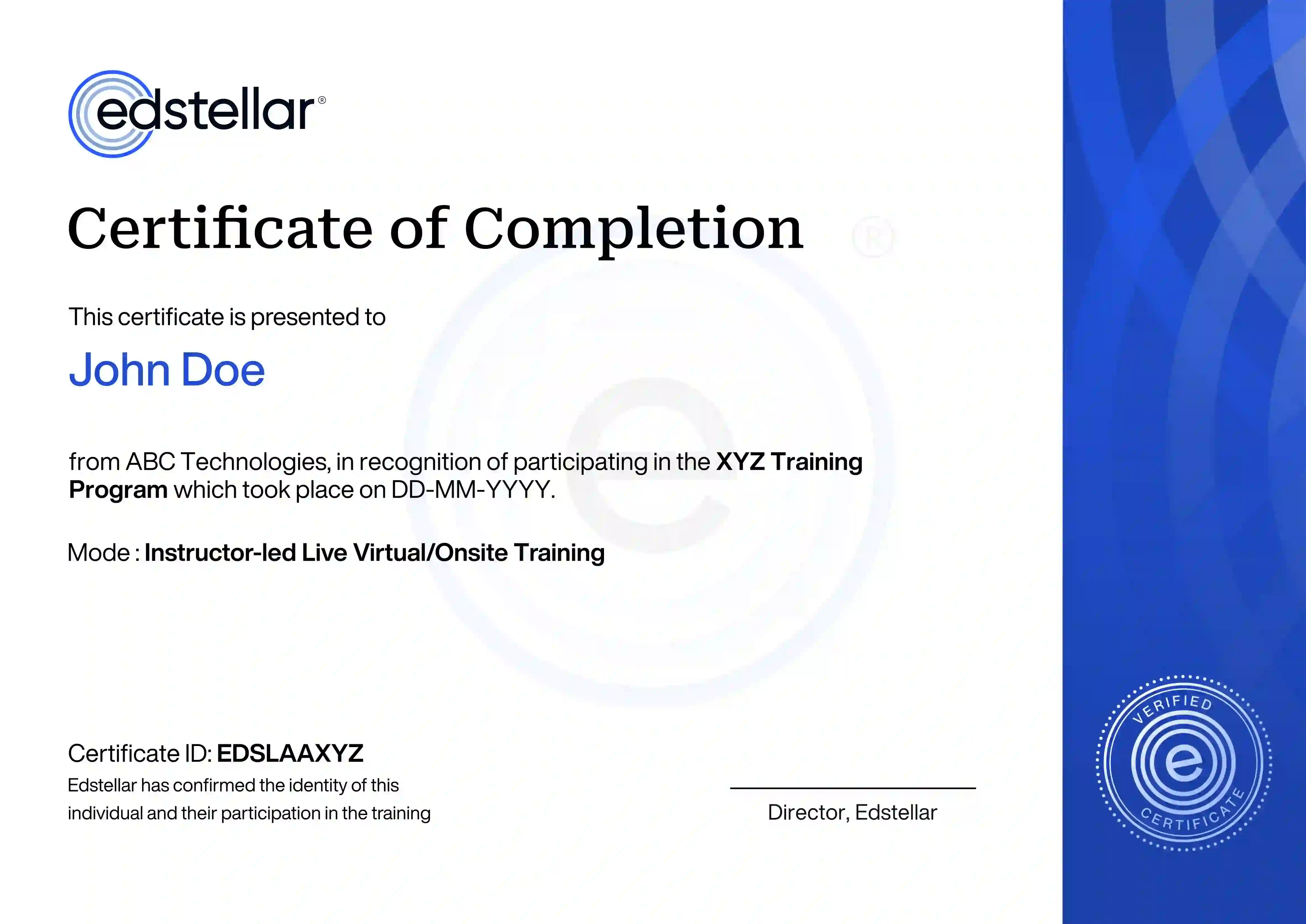
Recognition That Motivates Your Team

Frequently Asked Questions
Explore More Courses


.svg)
.svg)
.svg)

.svg)