Corporate F5 Configuring BIG - IP AFM: Advanced Firewall Manager Training Course
Edstellar's instructor-led F5 Configuring BIG-IP AFM: Advanced Firewall Manager training course equips teams with security management skills to enhance network security and efficiency. The course empowers employees to configure, manage, and optimize the AFM) on F5 BIG-IP systems to protect their network infrastructure against complex threats.
(Virtual / On-site / Off-site)
Available Languages
English, Español, 普通话, Deutsch, العربية, Português, हिंदी, Français, 日本語 and Italiano
Drive Team Excellence with F5 Configuring BIG - IP AFM: Advanced Firewall Manager Corporate Training
Empower your teams with expert-led on-site, off-site, and virtual F5 Configuring BIG - IP AFM: Advanced Firewall Manager Training through Edstellar, a premier corporate training provider for organizations globally. Designed to meet your specific training needs, this group training program ensures your team is primed to drive your business goals. Help your employees build lasting capabilities that translate into real performance gains.
F5 Configuring BIG-IP AFM: Advanced Firewall Manager is a technology that enables organizations to deploy advanced firewall capabilities, such as intrusion prevention, DDoS protection, and traffic filtering, using F5's BIG-IP platform. It's essential for organizations to ensure the security and integrity of their networks by implementing robust firewall solutions like AFM, which can dynamically adapt to evolving threats and protect against cyber attacks. F5 Configuring BIG-IP AFM training course equips employees with the knowledge and skills needed to effectively configure, manage, and optimize the Advanced Firewall Manager within F5's BIG-IP platform, empowering them to enhance their organization's network security posture.
Edstellar's instructor-led F5 Configuring BIG-IP AFM: Advanced Firewall Manager training course offers virtual/onsite training sessions tailored to modern organizations' dynamic needs. The course is tailored with a custom curriculum focusing on practical, real-world applications, ensuring employees gain hands-on experience. The course includes advanced skill assessment tools and a competency matrix, further enriching the learning experience.

Key Skills Employees Gain from instructor-led F5 Configuring BIG - IP AFM: Advanced Firewall Manager Training
F5 Configuring BIG-IP AFM: Advanced Firewall Manager skills corporate training will enable teams to effectively apply their learnings at work.
- Firewall PoliciesFirewall Policies are rules that govern network traffic, ensuring security by allowing or blocking data. This skill is important for cybersecurity roles to protect systems from threats.
- Traffic InspectionTraffic Inspection involves monitoring and assessing vehicle flow, safety compliance, and road conditions. This skill is important for traffic management roles to ensure public safety and efficient transportation systems.
- Network SecurityNetwork Security involves protecting computer networks from intrusions, attacks, and unauthorized access. This skill is important for IT professionals to safeguard sensitive data and ensure system integrity.
- DDoS ProtectionDDoS Protection is the ability to implement strategies and technologies to defend against distributed denial of service attacks. This skill is important for cybersecurity roles, ensuring system availability and safeguarding organizational assets from disruptions.
- Threat MitigationThreat Mitigation is the process of identifying, assessing, and reducing risks to protect assets and ensure safety. This skill is important for cybersecurity roles, as it safeguards systems from breaches.
- Application SecurityApplication Security involves protecting applications from threats throughout their lifecycle. This skill is important for developers and security professionals to safeguard sensitive data and maintain user trust.
Key Learning Outcomes of F5 Configuring BIG - IP AFM: Advanced Firewall Manager Training Workshop for Employees
Upon completing Edstellar’s F5 Configuring BIG - IP AFM: Advanced Firewall Manager workshop, employees will gain valuable, job-relevant insights and develop the confidence to apply their learning effectively in the professional environment.
- Apply advanced firewall policies and configurations to fortify network defenses against cyber threats
- Analyze network traffic patterns to detect and mitigate security vulnerabilities proactively
- Develop customized security policies tailored to organizational requirements for precise threat protection
- Optimize application delivery by implementing AFM's performance-enhancing features to ensure seamless user experience
- Implement advanced threat detection and mitigation strategies to safeguard critical assets from evolving cyber threats
Key Benefits of the F5 Configuring BIG - IP AFM: Advanced Firewall Manager Group Training
Attending our F5 Configuring BIG - IP AFM: Advanced Firewall Manager group training classes provides your team with a powerful opportunity to build skills, boost confidence, and develop a deeper understanding of the concepts that matter most. The collaborative learning environment fosters knowledge sharing and enables employees to translate insights into actionable work outcomes.
- Learn advanced techniques for configuring and optimizing F5's BIG-IP AFM, enhancing your expertise in network security management
- Equip yourself with practical skills to deploy and manage AFM effectively, strengthening your ability to protect organizational assets against cyber threats
- Develop proficiency in troubleshooting network security issues, empowering you to maintain operational continuity and minimize downtime
- Explore AFM's advanced features for threat mitigation, gaining insights into proactive defense strategies and threat intelligence integration
- Learn to adapt AFM configurations to evolving cyber threats and organizational requirements, ensuring adaptive network security
Topics and Outline of F5 Configuring BIG - IP AFM: Advanced Firewall Manager Training
Our virtual and on-premise F5 Configuring BIG - IP AFM: Advanced Firewall Manager training curriculum is structured into focused modules developed by industry experts. This training for organizations provides an interactive learning experience that addresses the evolving demands of the workplace, making it both relevant and practical.
- Introducing the BIG-IP system
- Features and benefits
- System components overview
- Initially setting up the BIG-IP system
- Hardware requirements
- Initial configuration steps
- Archiving the BIG-IP system configuration
- Importance of configuration archiving
- Steps to archive configurations
- Leveraging F5 support resources and tools
- Accessing F5 support
- Useful F5 tools for management and troubleshooting
- AFM overview
- Introduction to AFM and its capabilities
- Key features and applications
- AFM availability
- Understanding availability options
- Configuring high availability
- AFM and the BIG-IP security menu
- Navigating the security menu
- Customizing security settings
- AFM firewalls
- Introduction to AFM firewall capabilities
- Configuring firewall settings
- Contexts
- Understanding contexts within AFM
- Modes
- Overview of firewall modes
- How to select and switch modes
- Packet processing
- Basics of packet processing in AFM
- Advanced packet processing features
- Rules and direction
- Creating rules based on traffic direction
- Importance of rule direction in security policies
- Rules, contexts, and processing
- Integration of rules with contexts
- Optimizing packet processing with context-aware rules
- Inline rule editor
- Utilizing the inline rule editor for real-time modifications
- Benefits of inline editing for firewall management
- Configuring network firewall
- Step-by-step configuration guide
- Network firewall rules and policies
- Establishing comprehensive rules and policies
- Policy enforcement and management
- Network firewall rule creation
- Techniques for effective rule creation
- Tools and aids for rule definition
- Identifying traffic by region with geolocation
- Leveraging geolocation for security and control
- Setting up geolocation-based rules
- Identifying redundant and conflicting rules
- Tools for detecting rule conflicts
- Strategies to resolve redundancies
- Identifying stale rules
- How to find and update stale rules
- Importance of maintaining current rules
- Prebuilding firewall rules with lists and schedules
- Using lists and schedules to manage rules
- Efficiency gains from prebuilding rules
- Rule lists
- Creating and managing rule lists
- Examples of effective rule lists
- Address lists
- Configuring and utilizing address lists
- Integration with network firewall rules
- Port lists
- Setting up port lists
- Schedules
- Implementing schedules for rule application
- Benefits of time-based rule management
- Network firewall policies
- Designing effective firewall policies
- Policy deployment and oversight
- Policy status and management
- Monitoring policy status
- Tools for policy management
- Other rule actions
- Overview of additional rule actions available
- Customizing rule actions for specialized needs
- Redirecting traffic with send to virtual
- How to redirect traffic using virtual addresses
- Checking rule processing with packet tester
- Using packet tester to validate rule processing
- Diagnostics and troubleshooting with packet tester
- Examining connections with flow inspector
- Using flow inspector to view active connections
- Analytical benefits of flow inspector
- Event logs
- Types of event logs available in BIG-IP
- Configuring and accessing event logs
- Logging profiles
- Creating and customizing logging profiles
- Applying logging profiles to different traffic types
- Limiting log messages with log throttling
- Implementing log throttling to manage log volume
- Enabling logging in firewall rules
- How to enable and configure logging for specific firewall rules
- Utilizing logging for security monitoring and troubleshooting
- BIG-IP logging mechanisms
- Overview of the logging mechanisms within BIG-IP
- How these mechanisms enhance system monitoring
- Log publisher
- Role of the log publisher in the BIG-IP system
- Setting up and managing log publishers
- Log destination
- Configuring log destinations to manage log data
- Different types of log destinations supported by BIG-IP
- Logging global rule events
- Importance of logging global rule events
- Configuration steps to capture global rule events
- Log configuration changes
- Monitoring and logging configuration changes for audit and compliance
- Tools and techniques for tracking changes
- QKView and log files
- Utilizing QKView for diagnostics and troubleshooting
- Managing and analyzing log files generated by BIG-IP
- SNMP MIB
- Understanding SNMP Management Information Base (MIB) in BIG-IP
- Configuring SNMP MIB for external monitoring tools
- SNMP traps
- Configuring SNMP traps for event notification
- Overview
- Introduction to IP Intelligence features in BIG-IP
- Benefits and use cases of IP Intelligence
- IP Intelligence policy
- Creating and managing IP Intelligence policies
- Policy components and their functionalities
- Feature 1: Dynamic white and blacklists
- Implementing dynamic lists for enhanced security
- Configuring and updating white and blacklists in real-time
- Blacklist categories
- Overview of available blacklist categories
- Customizing blacklist categories according to security needs
- Feed lists
- Integrating external intelligence feeds into BIG-IP
- Managing and updating feed lists
- Applying an IP Intelligence policy
- Steps to apply and enforce IP Intelligence policies
- IP Intelligence log profile
- Configuring log profiles for IP Intelligence events
- Analyzing logs for security insights
- IP Intelligence reporting
- Generating reports based on IP Intelligence data
- Customizing reports to track specific metrics
- Troubleshooting IP Intelligence lists
- Identifying and resolving issues with IP Intelligence lists
- Tools and techniques for effective troubleshooting
- Feature 2: IP Intelligence database
- Overview of the IP Intelligence database
- Importance of maintaining an up-to-date database
- Licensing
- Understanding licensing requirements for IP Intelligence features
- Managing licenses for optimal functionality
- Installation
- Installing IP Intelligence capabilities on BIG-IP
- Key considerations during installation
- Linking the database to the IP Intelligence policy
- Techniques to link the database effectively to policies
- Ensuring seamless integration for real-time security enforcement
- Troubleshooting
- Common issues in IP Intelligence and how to fix them
- Utilizing BIG-IP tools for troubleshooting
- IP Intelligence iRule
- Creating and applying iRules for IP Intelligence
- Examples of iRules to enhance IP Intelligence functionality
- Denial of service and DoS protection overview
- Understanding DoS threats and BIG-IP's protection mechanisms
- Types of DoS attacks and protection strategies
- Device DoS protection
- Features of device-level DoS protection
- Configuring device settings for optimal security
- Configuring device DoS protection
- Step-by-step guide to setting up DoS protection
- Variant 1 DoS vectors
- Description and handling of Variant 1 DoS attack vectors
- Mitigation techniques specific to these vectors
- Variant 2 DoS vectors
- Identifying and defending against Variant 2 vectors
- Configuration adjustments for enhanced protection
- Automatic configuration or automatic thresholds
- Using automation to manage DoS protection thresholds
- Benefits and limitations of automated configurations
- Variant 3 DoS vectors
- Challenges with Variant 3 vectors
- Strategies for effective mitigation
- Device DoS profiles
- Creating and managing DoS profiles on devices
- Tailoring profiles to specific network environments
- DoS protection profile
- Comprehensive guide to setting up DoS protection profiles
- Integration of profiles with overall security policies
- Dynamic signatures
- Role of dynamic signatures in DoS protection
- Configuring and updating dynamic signatures
- Dynamic signatures configuration
- Techniques for effective dynamic signature configuration
- Troubleshooting common issues
- DoS iRules
- Utilizing iRules for specialized DoS response strategies
- Examples of iRules implementations for DoS scenarios
- AFM reporting facilities overview
- Introduction to reporting capabilities within AFM
- Understanding the types of reports available
- Examining the status of particular AFM features
- Methods for monitoring specific AFM features
- Tools and techniques for detailed status checks
- Exporting the data
- How to export data from AFM for external use
- Formats and protocols supported
- Managing the reporting settings
- Configuration options for report generation
- Customizing settings to suit organizational needs
- Scheduling reports
- Setting up automated report schedules
- Troubleshooting scheduled reports
- Identifying and resolving issues with report scheduling
- Common pitfalls and how to avoid them
- Examining AFM status at high level
- High-level insights into AFM performance and security status
- Analytical tools and dashboards
- Mini reporting windows (widgets)
- Creating and using widgets for quick status overviews
- Customizing widgets to display key information
- Building custom widgets
- Step-by-step guide to designing bespoke widgets
- Integration of widgets with existing reporting frameworks
- Deleting and restoring widgets
- Managing widget lifecycle, including deletion and restoration
- Dashboards
- Designing and utilizing dashboards for comprehensive reporting
- Customization and personalization of dashboard elements
- Bypassing DoS checks with white lists
- Understanding the use of white lists to exempt traffic from DoS checks
- Configuring white list settings
- Configuring DoS white lists
- Steps to set up and manage white lists
- TMSH options
- Utilizing TMSH commands for white list configuration
- Advanced TMSH options for DoS settings
- Per profile whitelist address list
- Creating and applying address lists per DoS profile
- Techniques for managing complex address configurations
- Isolating bad clients with sweep flood
- Identifying and isolating clients involved in sweep flood attacks
- Implementing protective measures against sweep floods
- Configuring sweep flood
- Detailed steps to configure defenses against sweep flood attacks
- Tuning parameters for optimal protection
- Overview
- Introduction to the IP shun feature and its applications
- Benefits of using IP shun in network security
- Manual configuration
- How to manually configure the IP shun settings
- Considerations for manual shun configurations
- Dynamic configuration
- Setting up dynamic IP shun responses
- Integration with other security systems
- IP Intelligence policy
- Linking IP shun features with IP Intelligence policies
- Strategies for cohesive policy enforcement
- TMSH options
- Using TMSH for IP shun configuration and management
- Advanced techniques and commands
- Troubleshooting
- Common issues with IP shun and solutions
- Diagnostic tools and methods
- Extending the shun feature
- Advanced applications of the shun feature
- Custom extensions and modifications
- Route this traffic to nowhere - Remotely triggered black hole
- Implementing and managing remotely triggered black holes
- Route this traffic for further processing - Scrubber
- Directing malicious traffic to a scrubbing center
- Configuring traffic routes for enhanced processing and analysis
- Filtering DNS traffic with DNS firewall
- Techniques for filtering DNS requests and responses
- Customizing filters to address specific threats
- Configuring DNS firewall
- Steps to set up and tune a DNS firewall
- Integration with existing network security frameworks
- DNS query types
- Understanding different DNS query types and their implications
- Handling queries effectively within the firewall
- DNS opcode types
- Identifying various DNS opcodes and their roles
- Configuring firewall rules based on opcode types
- Logging DNS firewall events
- Strategies for logging and monitoring DNS firewall activity
- Utilizing logs for forensic and diagnostic purposes
- Troubleshooting
- Resolving common issues with DNS firewall configurations
- Tools and tips for effective DNS firewall management
- Overview
- Introduction to DNS-based Denial of Service attacks
- Understanding the impact on network infrastructure
- DNS DoS
- Types of DNS DoS attacks and their characteristics
- Mitigation strategies and protective measures
- Configuring DNS DoS
- Step-by-step guide to configuring defenses against DNS DoS
- DoS protection profile
- Creating and applying DoS protection profiles specific to DNS
- Tailoring profiles to mitigate DNS threats effectively
- Device DoS and DNS
- Integrating device-level DoS protection with DNS security measures
- Enhancing DNS resilience through advanced device configurations
- Session Initiation Protocol (SIP)
- Overview of SIP and its importance in network communications
- Common vulnerabilities associated with SIP
- Transactions and dialogs
- Understanding SIP transactions and dialogs
- Role of these elements in SIP security
- SIP DoS configuration
- Configuring protections against SIP-specific DoS attacks
- Customizing settings for various SIP scenarios
- DoS protection profile
- Implementing DoS protection profiles for SIP traffic
- Adjusting profiles according to network needs
- Device DoS and SIP
- Coordinating device-level DoS protections with SIP operations
- Techniques for comprehensive SIP security management
- Overview
- Defining port misuse and its implications for network security
- Identifying common types of port misuse
- Port misuse and service policies
- Strategies for combating port misuse
- Developing and enforcing service policies
- Building a port misuse policy
- Guidelines for crafting effective port misuse policies
- Attaching a service policy
- Procedures for attaching service policies to network devices
- Creating a log profile
- Designing log profiles to monitor and record port misuse incidents
- Analyzing log data to refine security measures
- Overview
- Introduction to iRules and their role in network firewall configurations
- Benefits of using iRules for customized traffic management
- iRule events
- Key events that can trigger iRules within the firewall context
- Examples of event-driven rule actions
- Configuration
- Step-by-step process for configuring iRules
- Tips for optimizing iRule performance and effectiveness
- When to use iRules
- Scenarios where iRules offer significant advantages
- Guidelines for deciding when to implement iRules
Who Can Take the F5 Configuring BIG - IP AFM: Advanced Firewall Manager Training Course
The F5 Configuring BIG - IP AFM: Advanced Firewall Manager training program can also be taken by professionals at various levels in the organization.
- Network Engineers
- Security Engineers
- System Administrators
- IT Specialists
- Network Administrators
- Infrastructure Engineers
- Cloud Engineers
- Data Center Engineers
- Network Security Engineers
- Security Analysts
- IT Support Engineers
- Managers
Prerequisites for F5 Configuring BIG - IP AFM: Advanced Firewall Manager Training
Employees with a basic understanding of OSI model encapsulation, routing and switching, Ethernet and ARP, TCP/IP concepts, IP addressing and subnetting, NAT and private IP addressing, default gateway, network firewalls, LAN vs. WAN can take the F5 Configuring BIG-IP AFM: Advanced Firewall Manager training course.
Corporate Group Training Delivery Modes
for F5 Configuring BIG - IP AFM: Advanced Firewall Manager Training
At Edstellar, we understand the importance of impactful and engaging training for employees. As a leading F5 Configuring BIG - IP AFM: Advanced Firewall Manager training provider, we ensure the training is more interactive by offering Face-to-Face onsite/in-house or virtual/online sessions for companies. This approach has proven to be effective, outcome-oriented, and produces a well-rounded training experience for your teams.
.webp)
Edstellar's F5 Configuring BIG - IP AFM: Advanced Firewall Manager virtual/online training sessions bring expert-led, high-quality training to your teams anywhere, ensuring consistency and seamless integration into their schedules.
.webp)
Edstellar's F5 Configuring BIG - IP AFM: Advanced Firewall Manager inhouse training delivers immersive and insightful learning experiences right in the comfort of your office.
.webp)
Edstellar's F5 Configuring BIG - IP AFM: Advanced Firewall Manager offsite group training offer a unique opportunity for teams to immerse themselves in focused and dynamic learning environments away from their usual workplace distractions.
Explore Our Customized Pricing Package
for
F5 Configuring BIG - IP AFM: Advanced Firewall Manager Corporate Training
Looking for pricing details for onsite, offsite, or virtual instructor-led F5 Configuring BIG - IP AFM: Advanced Firewall Manager training? Get a customized proposal tailored to your team’s specific needs.
64 hours of group training (includes VILT/In-person On-site)
Tailored for SMBs
Tailor-Made Trainee Licenses with Our Exclusive Training Packages!
160 hours of group training (includes VILT/In-person On-site)
Ideal for growing SMBs
Tailor-Made Trainee Licenses with Our Exclusive Training Packages!
400 hours of group training (includes VILT/In-person On-site)
Designed for large corporations
Tailor-Made Trainee Licenses with Our Exclusive Training Packages!
Unlimited duration
Designed for large corporations
Edstellar: Your Go-to F5 Configuring BIG - IP AFM: Advanced Firewall Manager Training Company
Experienced Trainers
Our trainers bring years of industry expertise to ensure the training is practical and impactful.
Quality Training
With a strong track record of delivering training worldwide, Edstellar maintains its reputation for its quality and training engagement.
Industry-Relevant Curriculum
Our course is designed by experts and is tailored to meet the demands of the current industry.
Customizable Training
Our course can be customized to meet the unique needs and goals of your organization.
Comprehensive Support
We provide pre and post training support to your organization to ensure a complete learning experience.
Multilingual Training Capabilities
We offer training in multiple languages to cater to diverse and global teams.
What Our Clients Say
We pride ourselves on delivering exceptional training solutions. Here's what our clients have to say about their experiences with Edstellar.
"The F5 Configuring BIG - IP AFM: Advanced Firewall Manager training provided me with comprehensive capabilities that elevated my expertise. As a Security Operations Engineer, I needed to understand advanced interactive labs gave me hands-on experience with industry best practices. I've successfully implemented these advanced techniques in production environments with measurable impact. Highly recommend for anyone serious about this field.”
Sarah Marshall
Security Operations Engineer,
Global Technology Solutions Provider
"This F5 Configuring BIG - IP AFM: Advanced Firewall Manager course equipped me with comprehensive industry best practices expertise that I've seamlessly integrated into our enterprise practice. The hands-on modules I now confidently design solutions that consistently deliver measurable business results. We delivered a high-visibility enterprise project two months ahead of schedule, validating the immediate impact of this training program.”
Antonio Russo
Security Architect,
Digital Innovation Platform
"This F5 Configuring BIG - IP AFM: Advanced Firewall Manager course provided our team with comprehensive practical applications capabilities we immediately put into practice. As a Cloud Security Engineer that significantly enhanced our delivery capacity. We completed our comprehensive digital transformation initiative significantly ahead of schedule. The training fundamentally improved our team's performance metrics and overall efficiency.”
Qadim Zaki
Cloud Security Engineer,
Technology Consulting Services Company
“Edstellar’s IT & Technical training programs have been instrumental in strengthening our engineering teams and building future-ready capabilities. The hands-on approach, practical cloud scenarios, and expert guidance helped our teams improve technical depth, problem-solving skills, and execution across multiple projects. We’re excited to extend more of these impactful programs to other business units.”
Aditi Rao
L&D Head,
A Global Technology Company
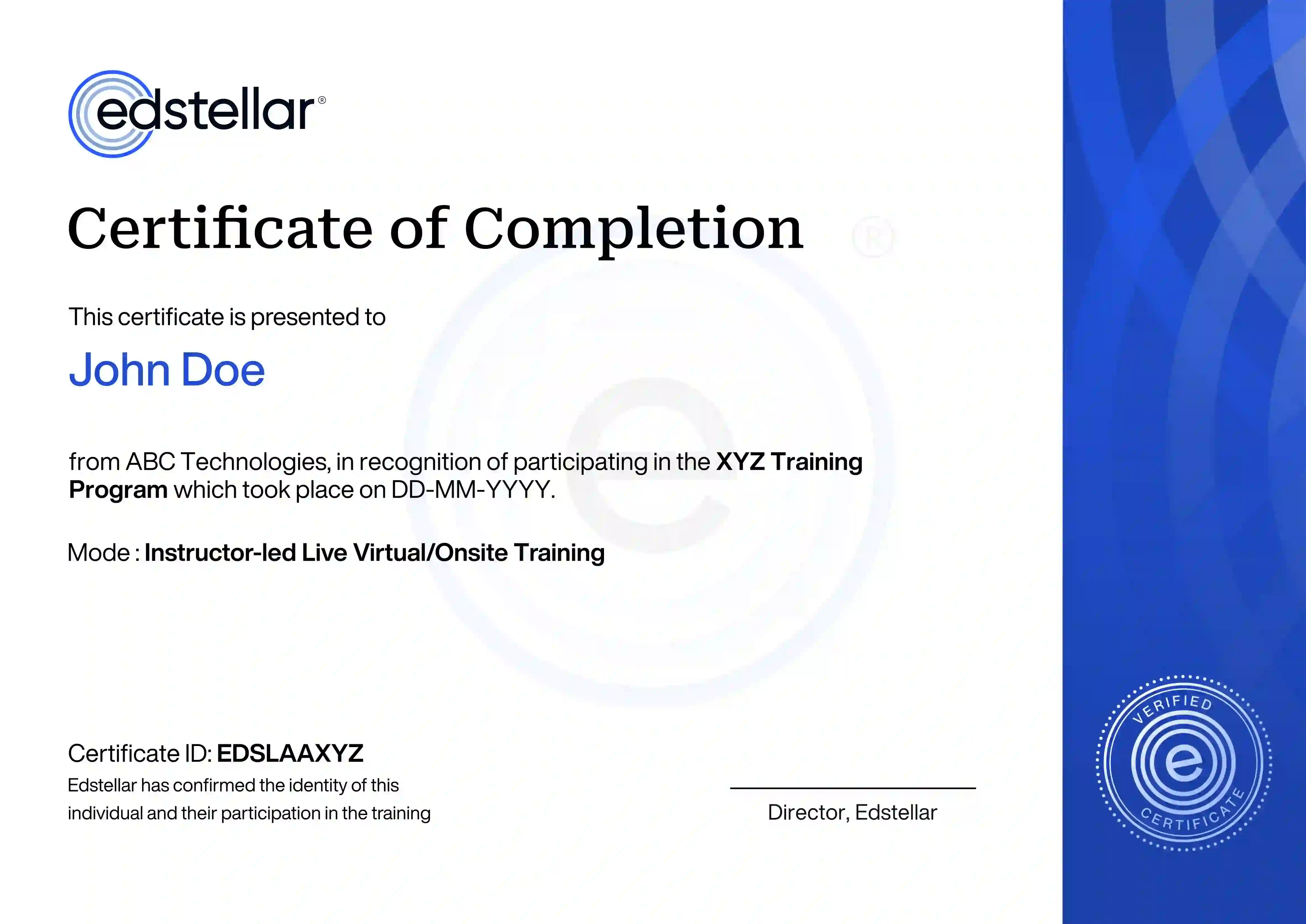
Get Your Team Members Recognized with Edstellar’s Course Certificate
Upon successful completion of the training course offered by Edstellar, employees receive a course completion certificate, symbolizing their dedication to ongoing learning and professional development.
This certificate validates the employee's acquired skills and is a powerful motivator, inspiring them to enhance their expertise further and contribute effectively to organizational success.


We have Expert Trainers to Meet Your F5 Configuring BIG - IP AFM: Advanced Firewall Manager Training Needs
The instructor-led training is conducted by certified trainers with extensive expertise in the field. Participants will benefit from the instructor's vast knowledge, gaining valuable insights and practical skills essential for success in Access practices.
Other Related Corporate Training Courses
Explore More Courses
Edstellar is a one-stop instructor-led corporate training and coaching solution that addresses organizational upskilling and talent transformation needs globally. Edstellar offers 2000+ tailored programs across disciplines that include Technical, Behavioral, Management, Compliance, Leadership and Social Impact.
FAQs
BlogSitemap