Drive Team Excellence with IPv6 Implementation Corporate Training

IPv6 is the latest version of the Internet Protocol (IP) designed to support the predicted growth of connected devices. It offers scalability and readies networks for the future by ensuring that they are capable of handling increasing connectivity requirements. IPv6 also has stronger security features like IPsec, which protects against cyber threats. IPv6 Implementation training enables employees to improve network performance by enhancing routing and reducing delays, especially in large setups.

The IPv6 Implementation instructor-led training course provided by Edstellar can be customized to meet team requirements. The virtual/onsite IPv6 Implementation training course led by expert trainers ensures employees gain proficiency in leveraging IPv6's capabilities to optimize network performance, scalability, and security.

Get Customized Expert-led Training for Your Teams
Customized Training Delivery
Scale Your Training: Small to Large Teams
In-person Onsite, Live Virtual or Hybrid Training Modes
Plan from 2000+ Industry-ready Training Programs
Experience Hands-On Learning from Industry Experts
Delivery Capability Across 100+ Countries & 10+ Languages
""""

Skills Your Employees Will Gain

These are the core, hands-on capabilities your team builds during the program.

  • ICMPv6
    Icmpv6 (Internet control message protocol for ipv6) is crucial for network troubleshooting and error reporting in ipv6 networks. This skill is important for network engineers and administrators to ensure efficient communication and network reliability.
  • Autoconfiguration (SLAAC/DHCPv6)
    Autoconfiguration (Slaac/Dhcpv6) enables devices to automatically configure their ip addresses in ipv6 networks. this skill is important for network engineers to ensure efficient, scalable, and seamless connectivity.
  • Multicast
    Multicast is the ability to send data to multiple recipients simultaneously over a network. This Skill is important for network engineers and IT professionals to optimize bandwidth and enhance communication efficiency.
  • IPv6 Security
    IPv6 Security involves implementing measures to protect networks using IPv6 from threats. This skill is important for network engineers and cybersecurity professionals to ensure data integrity and confidentiality.
  • IPv6 Routing Protocols
    IPv6 Routing Protocols involve the methods and techniques for directing data traffic in IPv6 networks. This skill is important for network engineers and administrators to ensure efficient, scalable, and secure communication in modern networks.
  • Transition Mechanisms
    Transition Mechanisms refer to the strategies and processes that facilitate change within organizations. This skill is important for roles in management and change leadership, as it ensures smooth adaptation to new systems, enhancing efficiency and employee engagement.

What Your Team Will Achieve After This Training

  • Configure stateful or stateless autoconfiguration for IPv6 devices 
  • Implement multicast addressing and group management using MLDv2
  • Migrate from IPv4 to IPv6 using techniques like tunneling and address translation
  • Troubleshoot connectivity issues using ICMPv6 messages like Path MTU Discovery
  • Design an IPv6 addressing plan considering address types, subnet sizes, and notation
  • Analyze the key differences between IPv4 and IPv6 addressing schemes and header structures
  • Configure applications and services for IPv6 compatibility, including DNS, DHCP, and web protocols
  • Secure IPv6 networks by identifying vulnerabilities and applying best practices with firewalls and encryption

Topics & Program Outline

The curriculum is organized into focused modules built by industry experts and delivered virtually or on-premise. Interactive sessions reflect the evolving demands of the workplace, keeping the learning both relevant and practical.

  1. IPv6 overview
    • Introduction to IPv6
    • Historical background
  2. Key differences from IPv4
    • Address space
    • Header format
    • Autoconfiguration
  3. IPv6 header structure
    • Main header fields
    • Extension headers
  4. IPv6 deployment strategies
    • Dual-stack implementation
    • Tunneling techniques
  1. IPv6 address space
    • Address types and ranges
    • Global unicast addresses
  2. Types of IPv6 addresses
    • Unicast, multicast, anycast
    • Link-local and global addresses
  3. Address notation and prefixes
    • IPv6 address representation
    • IPv6 prefix notation
  4. Advanced subnetting techniques
    • Subnetting IPv6 networks
    • Address planning considerations
  1. Path MTU discovery
    • Fragmentation issues in IPv6
    • ICMPv6 Packet Too Big message
  2. Neighbor Discovery (ND)
    • Router discovery
    • Neighbor solicitation/advertisement
  3. Multicast Listener Discovery (MLD)
    • IPv6 multicast group management
    • MLD message types and functions
  1. Stateless and stateful autoconfiguration
    • IPv6 Stateless Address Autoconfiguration (SLAAC)
    • IPv6 Dynamic Host Configuration Protocol (DHCPv6)
  2. Duplicate address detection
    • DAD process in IPv6
    • Preventing address conflicts
  3. Ethernet support for IPv6
    • Neighbor discovery in Ethernet networks
    • Address resolution and ARP replacement
  1. Multicast address space
    • Reserved multicast addresses
    • Scoping and group management
  2. MLDv2 for IPv6
    • Improved group management
    • Source-specific multicast (SSM)
  3. IGMPv3
    • Protocol enhancements for IPv6
  1. Threat comparison with IPv4
    • Common IPv6 security risks
    • Differences in attack vectors
  2. Mitigating IPv6 threats
    • Best practices for IPv6 security
    • Firewalls, IDS/IPS, and ACLs
  3. IPsec, VPNs, and PKI for IPv6
    • Encryption and authentication mechanisms
    • Secure communication over IPv6 networks
  1. Dual-stack implementation
    • Running IPv4 and IPv6 concurrently
    • Configuration and compatibility considerations
  2. Tunneling techniques
    • Encapsulation methods (IPv6 over IPv4)
    • Configuring and troubleshooting tunnels
  3. Proxying and translation
    • Network Address Translation (NAT)
    • Protocol translation mechanisms
  1. DNS in IPv6
    • AAAA records and DNSSEC
    • Transition mechanisms for DNS
  2. DHCPv6
    • Address assignment and configuration
    • DHCPv6 server and client operation
  3. FTP, SSH, HTTP, HTTPS in IPv6
    • Application layer protocols and IPv6 support
    • Configuring and securing applications for IPv6
  1. Dynamic routing with IPv6
    • OSPFv3, RIPng, BGP-4
    • Configuration and operation in IPv6 networks
  2. IPv6 multicast routing
    • PIM-DM, PIM-SM, and MLDv2
    • Multicast routing protocol operation in IPv6
  3. Routing protocols for IPv6
    • Differences from IPv4 implementations
    • Interoperability and transition strategies
  1. Traffic classes in IPv6
    • Differentiated services (DiffServ)
    • Integrated services (IntServ)
  2. Flow label in IPv6
    • IPv6 header field for QoS
    • Usage and significance in traffic classification
  3. RSVP and ECN
    • Resource Reservation Protocol (RSVP)
    • Explicit Congestion Notification (ECN) in IPv6
  1. Deployment strategies for Windows
    • IPv6 support in Windows operating systems
    • Configuration and administration tools
  2. Application compatibility
    • Testing and troubleshooting IPv6-enabled applications
    • Addressing and connectivity considerations
  3. Programming interfaces
    • Winsock APIs and socket programming for IPv6
    • IPv6 support in development frameworks
  1. Linux IPv6 programming interface
    • Socket library and system calls for IPv6
    • Address data structures and conversion functions
  2. Socket programming with TCP and UDP
    • Creating and managing IPv6 sockets
    • Sending and receiving data over IPv6 networks
  3. IPv6-ready system configuration
    • Kernel settings, interface configuration, and network debugging
  1. Configuring a Linux server for IPv6
    • Kernel compilation with IPv6 support
    • Setting system parameters and resolving names
  2. IPv6 protocol implementation
    • DNS, SNMP, DHCP, and other network services
    • Configuring and securing network daemons for IPv6
  1. Tunneling techniques
    • Setting up IPv6 tunnels for connectivity
    • Configuring gateway and forwarding settings
  2. Enabling IPv6 services
    • Configuring application and network services for IPv6
    • Firewall settings, service discovery, and security considerations
  1. IPv6 configuration on Cisco routers
    • Enabling IPv6 routing and addressing
    • Implementing access control and routing policies
  2. IPv6 services and management
    • SNMP, SSH, Telnet, and NTP over IPv6
    • Monitoring and maintaining IPv6 networks with Cisco IOS

Who Should Attend?

This program suits professionals at many levels across the organization, including:

  • Network Engineers
  • System Administrators
  • IT Specialists
  • Network Administrators
  • Security Engineers
  • Infrastructure Engineers
  • Cloud Engineers
  • Data Center Engineers
  • Telecommunications Engineers
  • Network Security Engineers
  • Network Analysts
  • Managers

What are the Prerequisites?

Employees with a basic understanding of networking concepts and protocols, including TCP/IP, and familiarity with IPv4 addressing and subnetting can take up the IPv6 Implementation training course.

Request a Quote for your Corporate Training Requirements

Valid number

Delivering Training for Organizations across 100 Countries and 10+ Languages

Choose the Format That Fits Your Team

We design training your teams actually engage with, and deliver it the way that suits you best. Through a vetted global trainer network, Edstellar runs sessions in 10+ languages with consistent quality anywhere.

Virtual IPv6 Implementation Training

Virtual / online: expert-led live sessions delivered anywhere, with consistency and easy scheduling.

We deliver anywhere worldwide
Standardized content for consistent outcomes
Join from own workspace, no travel
We scale to large groups across sites
Interactive tools keep remote learners engaged
On-site IPv6 Implementation Training

On-site (in-house): immersive, instructor-led learning at your office.

Our trainers run face-to-face at your office
We tailor setup/content to your workplace and tools
Group exercises drive collaboration
Live demos +  hands-on practice
Direct trainer access to clarify doubts
Off-site IPv6 Implementation Training

Off-site: focused, instructor-led group learning away from everyday workplace distractions.

We host your teams at a venue of your preferred choice
Built-in group activities for bonding
Full uninterrupted schedule for focus/retention
Boosts morale and signals commitment

Get a Proposal Shaped to Your Needs

Need pricing for onsite, offsite, or virtual delivery? Get a proposal tailored to your team's needs.

Request a Group Training Quote
""
How Many Team Members Need Training?
Please select an option or fill in the custom field.
"'

Is Your Corporate Training Requirement Only for IPv6 Implementation ?

Please select at least one course.
""
Add the List of Training Workshops
search icon

      Please select the course

      No. of Courses selected: 0

      Clear

      Upload a CSV

      Send us your Training Requirements in 3 Easy steps

      1. 1
      2. 2
        Add the required training workshops
      3. 3
        Upload to get a quick quote or email it to contact@edstellar.com

      ""

      Looking for a Complete Package?

      Looking for a one-time pricing option for all your annual training requirements?

      View Corporate Training Packages
      ""
      Select the Option that Best Describes Your Corporate Training Requirement

      Please select an option or choose from the recurring options.
      ""
      Verify and Submit Your Request

      Review Your Corporate Training Selection Summary

      Training Program: IPv6 Implementation Training

      1. No of Team Members

      2. Selected Training Preference

      3. Selected Recurring Sessions

      1

      Review your Requirements

      Training Workshops Selected :


        Excel
        File has been
        successfully uploaded.
        Fill the form to submit
 your details
        Submit Your Professional Contact Information
        Valid number
        We've received your enquiry. Our team will be in touch soon.
        Oops! Something went wrong while submitting the form.
        Starter
        120 licences

        Tailor-Made Trainee Licenses with Our Exclusive Training Packages!

        View Package

        64 hours of group training (includes VILT/In-person On-site)

        Tailored for SMBs

        Growth
        320 licences

        Tailor-Made Trainee Licenses with Our Exclusive Training Packages!

        View Package

        160 hours of group training (includes VILT/In-person On-site)

        Ideal for growing SMBs

        Enterprise
        800 licences

        Tailor-Made Trainee Licenses with Our Exclusive Training Packages!

        View Package

        400 hours of group training (includes VILT/In-person On-site)

        Designed for large corporations

        Custom
        Unlimited licenses

        Tailor-Made Trainee Licenses with Our Exclusive Training Packages!

        View Package

        Unlimited duration

        Designed for large corporations

        What Sets Edstellar Apart

        Experienced Trainers

        Our trainers are drawn from a vetted global network and bring years of industry expertise, keeping every session practical and impactful.

        Proven Quality

        With a strong global track record, Edstellar is known for quality and engaging delivery.

        Industry-Relevant Curriculum

        Our programs are built by experts to match the demands of today's industry.

        Fully Customizable

        Every program can be tailored to your organization's goals.

        Comprehensive Support

        We provide pre- and post-session support for a complete learning experience.

        Global Multi-Location & Multilingual Training Delivery

        We deliver in multiple languages to support diverse global teams.

        Hear from Organizations We've Trained

        "Attending the IPv6 Implementation training was transformational for my professional development. As a Senior Software Engineer, the deep dive into IPv6 addressing gave me the confidence to tackle complex challenges head-on. routing setup were immediately applicable to my work. These specialized skills have positioned me for significant advancement opportunities within my organization. This course has become foundational to my continued success.”

        Darrin Palmer

        Senior Software Engineer,

        IT Services and Solutions Provider

        "This IPv6 Implementation course transformed my approach to network transition solutions. The comprehensive modules on dual stack implementation were invaluable for our network implementation projects. I can now confidently implement for diverse client requirements. The deep coverage of tunneling mechanisms gave me advanced skills I immediately applied to We delivered a high-visibility enterprise project two months ahead of schedule.”

        Song Jian

        Senior Software Engineer,

        Digital Innovation Platform

        "As a Senior Software Engineer overseeing IP networking initiatives, the IPv6 Implementation training significantly elevated our team's capabilities. The course expertly covered transition mechanisms, security policies, operational effectiveness. Our team delivered record-breaking results in the subsequent quarter, exceeding all targets. Our department has achieved remarkable improvements, demonstrating this course's lasting organizational impact.”

        Yaser Jawad

        Senior Software Engineer,

        Enterprise Software Development Firm

        “Edstellar’s IT & Technical training programs have been instrumental in strengthening our engineering teams and building future-ready capabilities. The hands-on approach, practical cloud scenarios, and expert guidance helped our teams improve technical depth, problem-solving skills, and execution across multiple projects. We’re excited to extend more of these impactful programs to other business units.”

        Aditi Rao

        L&D Head,

        A Global Technology Company

        Recognition That Motivates Your Team

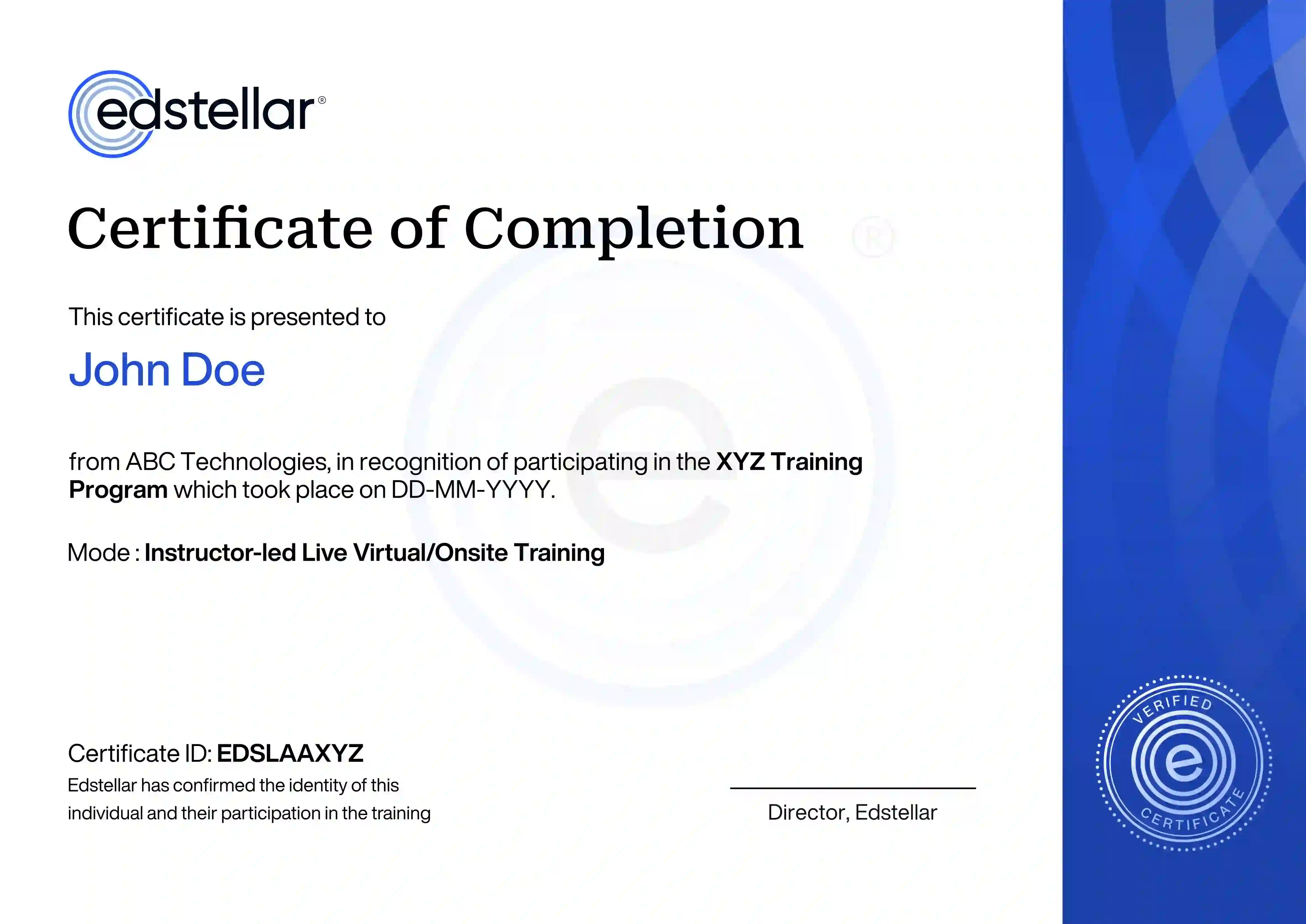
        Upon successful completion of the training course offered by Edstellar, employees receive a course completion certificate, symbolizing their dedication to ongoing learning and professional development.

        This certificate validates the employee's acquired skills and is a powerful motivator, inspiring them to enhance their expertise further and contribute effectively to organizational success.

        Recognition That Motivates Your Team
        ""

        Other Related Corporate Training Courses