Drive Team Excellence with Julia Programming Corporate Training

Julia Programming is a high-level, high-performance programming language designed for numerical computing and data science, featuring a syntax that is both easy to read and write, while also offering speed comparable to traditional compiled languages like C and Fortran. Julia Programming enhances productivity by handling large-scale mathematical computations efficiently, accelerating data analysis, and streamlining algorithm development, facilitating faster decision-making. Julia Programming training course is essential as it equips teams with advanced skills in numerical analysis, scientific computing, and algorithm development using Julia Programming.

Edstellar's instructor-led Julia Programming training course is delivered through virtual/onsite training formats by industry experts with extensive experience in computational science and data analysis. The course curriculum is expertly crafted and customizable, focusing on practical applications and tailored to meet the specific needs of professionals. The course includes valuable insights into Julia Programming's functionalities, empowering teams to develop efficient algorithms, analyze complex datasets, and enhance their problem-solving abilities.

Get Customized Expert-led Training for Your Teams
Customized Training Delivery
Scale Your Training: Small to Large Teams
In-person Onsite, Live Virtual or Hybrid Training Modes
Plan from 2000+ Industry-ready Training Programs
Experience Hands-On Learning from Industry Experts
Delivery Capability Across 100+ Countries & 10+ Languages
""""

Skills Your Employees Will Gain

These are the core, hands-on capabilities your team builds during the program.

  • Numerical Accuracy
    Numerical Accuracy is the ability to perform calculations and analyze data precisely. This skill is important for roles in finance, engineering, and data analysis, ensuring reliable decision-making.
  • Parallel Computing
    Parallel Computing is the simultaneous execution of multiple calculations or processes. This skill is important for software developers and data scientists to enhance performance and efficiency in handling large datasets and complex algorithms.
  • Data Analysis
    Data Analysis is the process of inspecting, cleansing, and modeling data to discover useful information. This skill is important for roles like data scientist and business analyst, as it drives informed decision-making and strategy development.
  • Machine Learning
    Machine Learning is the ability to develop algorithms that enable computers to learn from data. This skill is important for data scientists and AI engineers to create predictive models and enhance automation.
  • Algorithm Development
    Algorithm Development is the process of designing and implementing step-by-step procedures for solving problems. This skill is important for data scientists and software engineers, as it enables efficient data processing and innovative solutions.
  • Statistical Analysis
    Statistical Analysis involves collecting, interpreting, and presenting data to identify trends and patterns. This skill is important for data-driven roles, enabling informed decision-making and strategic planning.

What Your Team Will Achieve After This Training

  • Analyze complex datasets using Julia Programming's advanced data analysis capabilities to extract meaningful insights and drive informed decision-making processes
  • Develop optimized solutions for computational problems commonly encountered in professional domains, leveraging Julia Programming's high-performance computing capabilities
  • Implement parallel computing techniques in Julia Programming to improve processing speed and efficiency for large-scale computational tasks relevant to professional work
  • Utilize Julia Programming for high-performance computing applications such as scientific simulations, numerical modeling, and machine learning algorithms, enhancing productivity and innovation within the organization
  • Leverage Julia Programming's capabilities for shared projects and interdisciplinary initiatives within the organization to collaborate effectively with colleagues and stakeholders

Topics & Program Outline

The curriculum is organized into focused modules built by industry experts and delivered virtually or on-premise. Interactive sessions reflect the evolving demands of the workplace, keeping the learning both relevant and practical.

  1. What niche is filled by Julia Programming
    • Combining the ease of Python with the speed of C
    • Use in scientific and numerical computing
    • Julia Programming in machine learning and data science
  2. How can Julia Programming help you with data analysis
    • Speeding up data processing and analytics
    • Seamless handling of large datasets
    • Integration with existing data analysis ecosystems
  3. Getting started with Julia Programming’s REPL
    • Basic operations in the Julia Programming REPL
    • Common REPL shortcuts and commands
  4. Alternative environments for Julia Programming development: Juno, IJulia Programming, and Sublime-IJulia Programming
    • Setting up Juno for Julia Programming development
    • Using IJulia Programming for interactive notebooks
    • Configuring Sublime Text for Julia Programming development
  5. The Julia Programming ecosystem: Documentation and package search
    • Navigating Julia Programming's documentation
    • Finding and using packages in Julia Programming
    • Community contributions and package development
  6. Julia Programming forums and Julia Programming community
    • Getting involved in the Julia Programming community
    • Finding help and resources on Julia Programming forums
  1. Introduction to Julia Programming REPL and batch execution via “Hello World”
    • Writing your first Julia Programming program
    • Running Julia Programming scripts in batch mode
    • Exploring Julia Programming's interactive mode with "Hello World"
  2. Julia Programming string types
    • Understanding string literals and interpolation
    • Common string operations and functions
  1. What is a variable? Why do we use a name and a type for it?
    • The basics of variables in Julia Programming
    • Importance of naming and types for variables
    • Dynamic typing in Julia Programming
  2. Integers
    • Different integer types and their uses
    • Integer operations and overflow behavior
    • Converting between integer types
  3. Floating-point numbers
    • Precision and representation of floating-point numbers
    • Floating-point arithmetic and rounding errors
    • Special floating-point values: Inf and NaN
  4. Complex numbers
    • Defining and working with complex numbers in Julia Programming
    • Complex number arithmetic and functions
  5. Rational numbers
    • Creating and using rational numbers
    • Arithmetic with rational numbers
  1. Vectors
    • Creating and manipulating vectors
    • Vector operations and functions
    • Applications of vectors in data analysis
  2. Matrices
    • Defining and working with matrices
    • Matrix arithmetic and linear algebra operations
  3. Multi-dimensional arrays
    • Creating and accessing multi-dimensional arrays
    • Multi-dimensional array operations
  4. Heterogeneous arrays (cell arrays)
    • Understanding heterogeneous arrays
    • Working with cell arrays in Julia Programming
    • When to use heterogeneous arrays
  5. Comprehensions
    • Syntax and use of comprehensions for array creation
    • Examples of comprehension for different data structures
  1. Tuples
    • Creating and using tuples
    • Tuple operations and unpacking
    • When to use tuples over arrays
  2. Ranges
    • Understanding ranges in Julia Programming
    • Creating and using ranges for efficient computation
    • Converting ranges to arrays and other data structures
  3. Dictionaries
    • Basics of creating and using dictionaries
    • Performance considerations with dictionaries
  4. Symbols
    • What are symbols, and how are they used in Julia Programming?
    • Comparing symbols to strings
  1. Abstract types
    • Understanding abstract types in Julia Programming's type hierarchy
    • Defining and using abstract types
    • How abstract types enable polymorphism
  2. Composite types
    • Defining custom data structures with composite types
    • Working with composite types: constructors, fields, and methods
  3. Parametric composite types
    • Introduction to parametric types and their benefits
    • Defining and using parametric composite types
    • Examples of parametric types in generic programming
  1. How to define a function in Julia Programming
    • Basics of function definition and syntax
    • Named functions vs. anonymous functions
  2. Julia Programming functions as methods operating on types
    • Understanding methods in Julia Programming
    • Function overloading and type dispatch
  3. Multiple dispatch
    • How multiple dispatch works in Julia Programming
    • Advantages of multiple dispatch for software design
    • Writing functions with multiple dispatch
  4. How multiple dispatch differs from traditional object-oriented programming
    • Comparison of multiple dispatch and OOP paradigms
    • Transitioning from OOP to a multiple dispatch mindset
  5. Parametric functions
    • Defining functions with type parameters
    • Benefits of parametric functions
    • Examples of parametric functions in Julia Programming
  6. Functions changing their input
    • Mutable vs. immutable types in function arguments
    • When and how to modify function inputs
    • Examples of functions that change their inputs
  7. Anonymous functions
    • Creating and using anonymous functions
    • Passing anonymous functions as arguments
  8. Optional function arguments
    • Syntax and usage of optional arguments
    • Default values for function parameters
    • Designing functions with optional parameters
  9. Required function arguments
    • Ensuring function arguments are provided
    • Using assertion for argument validation
    • Design patterns for required arguments
  1. Inner constructors
    • Purpose and usage of inner constructors
    • Ensuring object invariants with inner constructors
  2. Outer constructors
    • How outer constructors complement inner constructors
    • Using outer constructors for additional flexibility
    • Design patterns with outer constructors
  1. Compound expressions and scoping
    • Using compound expressions for complex logic
    • Understanding the scope in Julia Programming
    • Scoping rules for variables and functions
  2. Conditional evaluation
    • Syntax and usage of conditional statements
    • Nesting and chaining conditions
    • Practical examples of conditional logic
  3. Loops
    • Writing for and while loops
    • Loop control statements: break and continue
  4. Exception handling
    • Try, catch, and finally block in Julia Programming
    • Defining custom exceptions
  5. Tasks (coroutines)
    • Introduction to asynchronous programming with tasks
    • Creating and managing tasks
  1. Modules
    • Defining modules to organize code
    • Exporting and importing modules
    • Module namespaces and scoping
  2. Packages
    • Creating Julia Programming packages
    • Managing package dependencies
    • Publishing and maintaining Julia Programming packages
  1. Symbols
    • Understanding symbols in Julia Programming metaprogramming
    • Creating and manipulating symbols
    • Use of symbols in dynamic code generation
  2. Expressions
    • Constructing and evaluating expressions
    • Manipulating expressions for code transformation
    • The role of expressions in macros
  3. Quoting
    • The concept of quoting in Julia Programming
    • Creating quoted expressions
    • Unquoting and interpolation in quoted expressions
  4. Internal representation
    • Exploring Julia Programming's AST (Abstract Syntax Tree)
    • How Julia Programming code is represented internally
    • Modifying and analyzing the internal representation
  5. Parsing
    • Parsing strings into Julia Programming expressions
    • Custom parsers for domain-specific languages
  6. Evaluation
    • Evaluating Julia Programming expressions programmatically
    • The global evaluation context
    • Security considerations in code evaluation
  7. Interpolation
    • Interpolating values into expressions
    • Limitations of interpolation
  1. Filesystem
    • Basic file operations: reading, writing, and appending
    • Navigating the filesystem with Julia Programming
    • File metadata and manipulation
  2. Data I/O
    • Reading and writing CSV and Excel files
    • Working with JSON and XML
    • Serialization and deserialization of Julia Programming objects
  3. Lower Level Data I/O
    • Binary data reading and writing
    • Buffering and stream manipulation
    • Performance considerations for large data sets
  4. Dataframes
    • Introduction to DataFrame operations
    • Data cleaning and transformation
  1. Defining distributions
    • Creating custom probability distributions
    • Properties and methods of distributions
  2. Interface for evaluating and sampling from distributions
    • Random sampling techniques
    • Evaluating distribution functions (PDF, CDF)
    • Statistical testing and inference with distributions
  3. Mean, variance, and covariance
    • Calculating statistical moments
    • Applications in data analysis and modeling
    • Multivariate distributions and their properties
  4. Hypothesis testing
    • Formulating and testing hypotheses
    • P-values, confidence intervals, and power analysis
  5. Generalized linear models: a linear regression example
    • Understanding linear models in Julia Programming
    • Fitting a model to data
    • Model diagnostics and interpretation
  1. Plotting packages: Gadfly, Winston, Gaston, PyPlot, Plotly, Vega
    • Overview and comparison of plotting packages
    • Setting up and basic examples for each package
    • Choosing the right package for your needs
  2. Introduction to Gadfly
    • Core concepts of Gadfly and its syntax
    • Creating various types of plots with Gadfly
    • Customizing plots: themes, scales, and geometries
  3. Interact and Gadfly
    • Building interactive visualizations with Gadfly and Interact
    • Linking widgets to plots for dynamic data exploration
  1. Introduction to Julia Programming’s message passing implementation
    • Basics of parallel computing in Julia Programming
    • Communication between processes with message passing
    • Designing algorithms for distributed computing
  2. Remote calling and fetching
    • Executing functions on remote workers
    • Fetching results from asynchronous computations
    • Error handling and debugging in distributed environments
  3. Parallel map (pmap)
    • Using pmap for parallelizing operations over collections
    • Handling exceptions and failures in pmap
    • Performance tuning and optimization tips
  4. Parallel for
    • Load balancing and synchronization issues
    • Integrating parallel loops with other Julia Programming features
  5. Scheduling via tasks
    • Understanding Julia Programming's task-based concurrency
    • Creating and managing tasks for concurrent execution
    • Combining tasks with parallel computing for efficiency
  6. Distributed arrays
    • Working with large datasets using DistributedArrays.jl
    • Splitting data across workers for parallel processing

Who Should Attend?

This program suits professionals at many levels across the organization, including:

  • Software Engineers
  • Data Scientists
  • Data Analysts
  • Machine Learning Engineers
  • AI Researchers
  • Computational Scientists
  • Statisticians
  • Quantitative Analysts
  • Research Scientists
  • Econometricians
  • Bioinformaticians
  • Managers

What are the Prerequisites?

Professionals with a basic understanding of programming concepts can take the Julia Programming training course.

Request a Quote for your Corporate Training Requirements

Valid number

Delivering Training for Organizations across 100 Countries and 10+ Languages

Choose the Format That Fits Your Team

We design training your teams actually engage with, and deliver it the way that suits you best. Through a vetted global trainer network, Edstellar runs sessions in 10+ languages with consistent quality anywhere.

Virtual Julia Programming Training

Virtual / online: expert-led live sessions delivered anywhere, with consistency and easy scheduling.

We deliver anywhere worldwide
Standardized content for consistent outcomes
Join from own workspace, no travel
We scale to large groups across sites
Interactive tools keep remote learners engaged
On-site Julia Programming Training

On-site (in-house): immersive, instructor-led learning at your office.

Our trainers run face-to-face at your office
We tailor setup/content to your workplace and tools
Group exercises drive collaboration
Live demos +  hands-on practice
Direct trainer access to clarify doubts
Off-site Julia Programming Training

Off-site: focused, instructor-led group learning away from everyday workplace distractions.

We host your teams at a venue of your preferred choice
Built-in group activities for bonding
Full uninterrupted schedule for focus/retention
Boosts morale and signals commitment

Get a Proposal Shaped to Your Needs

Need pricing for onsite, offsite, or virtual delivery? Get a proposal tailored to your team's needs.

Request a Group Training Quote
""
How Many Team Members Need Training?
Please select an option or fill in the custom field.
"'

Is Your Corporate Training Requirement Only for Julia Programming?

Please select at least one course.
""
Add the List of Training Workshops
search icon

      Please select the course

      No. of Courses selected: 0

      Clear

      Upload a CSV

      Send us your Training Requirements in 3 Easy steps

      1. 1
      2. 2
        Add the required training workshops
      3. 3
        Upload to get a quick quote or email it to contact@edstellar.com

      ""

      Looking for a Complete Package?

      Looking for a one-time pricing option for all your annual training requirements?

      View Corporate Training Packages
      ""
      Select the Option that Best Describes Your Corporate Training Requirement

      Please select an option or choose from the recurring options.
      ""
      Verify and Submit Your Request

      Review Your Corporate Training Selection Summary

      Training Program: Julia Programming Training

      1. No of Team Members

      2. Selected Training Preference

      3. Selected Recurring Sessions

      1

      Review your Requirements

      Training Workshops Selected :


        Excel
        File has been
        successfully uploaded.
        Fill the form to submit
 your details
        Submit Your Professional Contact Information
        Valid number
        We've received your enquiry. Our team will be in touch soon.
        Oops! Something went wrong while submitting the form.
        Starter
        120 licences

        Tailor-Made Trainee Licenses with Our Exclusive Training Packages!

        View Package

        64 hours of group training (includes VILT/In-person On-site)

        Tailored for SMBs

        Growth
        320 licences

        Tailor-Made Trainee Licenses with Our Exclusive Training Packages!

        View Package

        160 hours of group training (includes VILT/In-person On-site)

        Ideal for growing SMBs

        Enterprise
        800 licences

        Tailor-Made Trainee Licenses with Our Exclusive Training Packages!

        View Package

        400 hours of group training (includes VILT/In-person On-site)

        Designed for large corporations

        Custom
        Unlimited licenses

        Tailor-Made Trainee Licenses with Our Exclusive Training Packages!

        View Package

        Unlimited duration

        Designed for large corporations

        What Sets Edstellar Apart

        Experienced Trainers

        Our trainers are drawn from a vetted global network and bring years of industry expertise, keeping every session practical and impactful.

        Proven Quality

        With a strong global track record, Edstellar is known for quality and engaging delivery.

        Industry-Relevant Curriculum

        Our programs are built by experts to match the demands of today's industry.

        Fully Customizable

        Every program can be tailored to your organization's goals.

        Comprehensive Support

        We provide pre- and post-session support for a complete learning experience.

        Global Multi-Location & Multilingual Training Delivery

        We deliver in multiple languages to support diverse global teams.

        Hear from Organizations We've Trained

        "The Julia Programming training provided me with comprehensive capabilities that elevated my expertise. As a Quantitative Researcher, I needed to understand strategic frameworks deeply, and this course delivered perfectly. The interactive labs gave me hands-on experience with industry best practices. I now handle complex technical scenarios with enhanced confidence and systematic efficiency. Highly recommend for anyone serious about this field.”

        Cary Chandler

        Quantitative Researcher,

        IT Services and Solutions Provider

        "The Julia Programming training enhanced my ability to architect and implement sophisticated strategic implementation strategies. Understanding advanced methodologies through intensive practical simulations exercises proved invaluable for initiatives. Our solution delivery efficiency and quality have increased substantially across the board. The detailed exploration of expert-led workshops provided methodologies I leverage in every engagement.”

        Gennady Makarov

        Statistical Analyst,

        Enterprise Software Development Firm

        "As a Research Scientist leading professional expertise operations, the Julia Programming training provided our team with essential industry best practices expertise at scale. The comprehensive modules on real-world case our complete operational footprint. Our department achieved a remarkable 50% improvement in operational efficiency metrics. This course has proven invaluable for driving our organizational transformation and sustained excellence.”

        Latha Thomas

        Research Scientist,

        Technology Consulting Services Company

        “Edstellar’s IT & Technical training programs have been instrumental in strengthening our engineering teams and building future-ready capabilities. The hands-on approach, practical cloud scenarios, and expert guidance helped our teams improve technical depth, problem-solving skills, and execution across multiple projects. We’re excited to extend more of these impactful programs to other business units.”

        Aditi Rao

        L&D Head,

        A Global Technology Company

        Recognition That Motivates Your Team

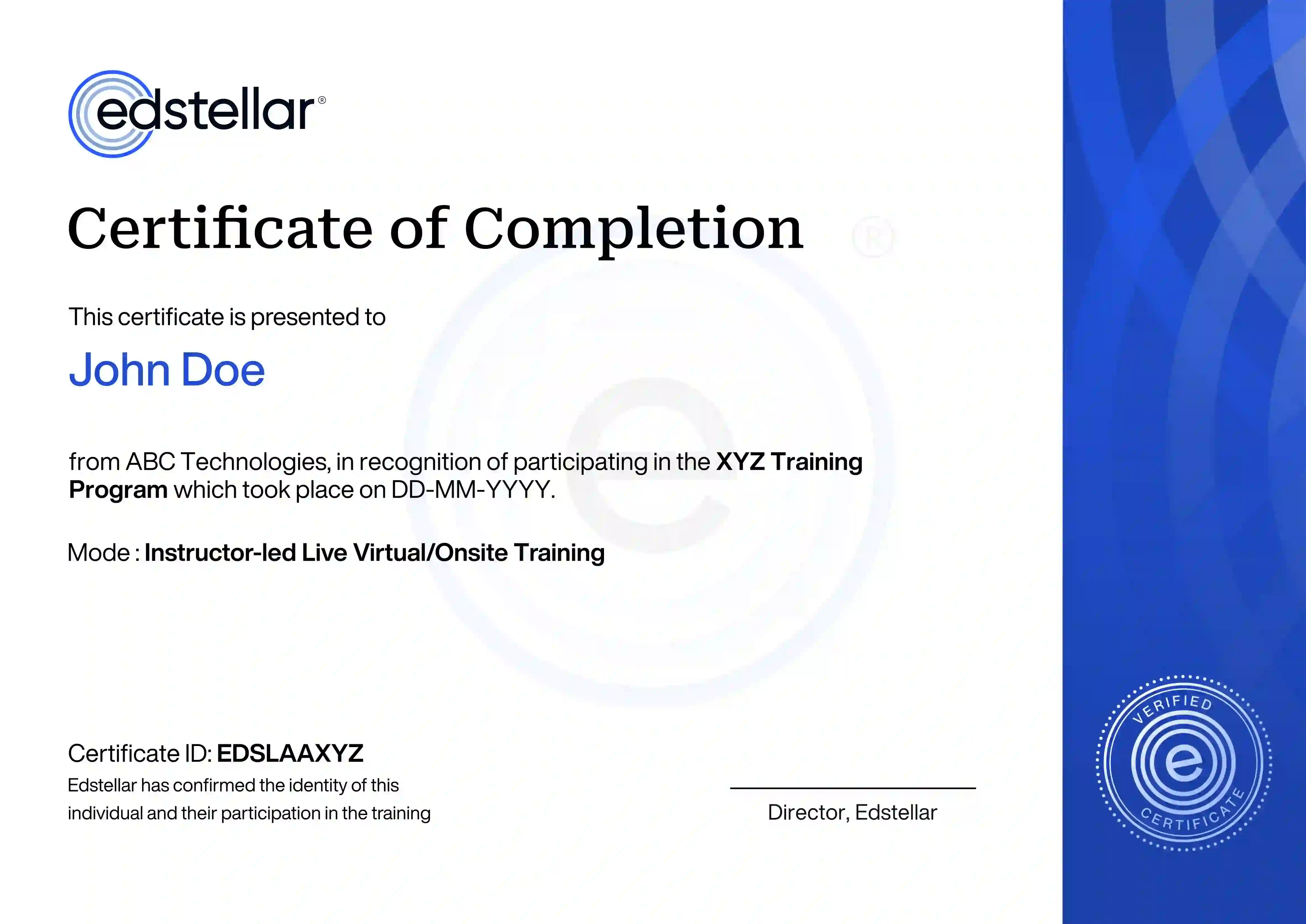
        Upon successful completion of the training course offered by Edstellar, employees receive a course completion certificate, symbolizing their dedication to ongoing learning and professional development.

        This certificate validates the employee's acquired skills and is a powerful motivator, inspiring them to enhance their expertise further and contribute effectively to organizational success.

        Recognition That Motivates Your Team

        Other Related Corporate Training Courses