Drive Team Excellence with F# Corporate Training

F sharp is a Functional-First programming language designed for the .NET framework, emphasizing succinct, expressive, and type-safe code. Organizations might adopt F sharp for its ability to handle complex mathematical computations, concurrency, and parallelism effectively, enhancing productivity and scalability in data-intensive or scientific computing tasks. Training in F# generally involves learning its syntax, functional programming paradigms, and leveraging its features for building robust, efficient software solutions.

Edstellar's virtual/onsite F# training course offers customizations and employs cutting-edge methodologies. Our trainers are known for their expertise in F# instructor-led training course and have vast experience guiding teams through the complexities of functional programming, software development, and system architecture.

Get Customized Expert-led Training for Your Teams
Customized Training Delivery
Scale Your Training: Small to Large Teams
In-person Onsite, Live Virtual or Hybrid Training Modes
Plan from 2000+ Industry-ready Training Programs
Experience Hands-On Learning from Industry Experts
Delivery Capability Across 100+ Countries & 10+ Languages
""""

Skills Your Employees Will Gain

These are the core, hands-on capabilities your team builds during the program.

  • Functional Programming
    Functional Programming is a programming paradigm that treats computation as the evaluation of mathematical functions. This skill is important for software developers as it enhances code reliability, maintainability, and facilitates parallel processing.
  • Immutable Data Structures
    Immutable Data Structures are data types that cannot be modified after creation. This skill is important for software developers as it enhances code reliability, simplifies debugging, and improves performance in concurrent programming.
  • Pattern Matching
    Pattern Matching is the ability to identify and analyze recurring themes or structures in data. this skill is important for data analysts and software developers to optimize processes and enhance decision-making.
  • Asynchronous Programming
    Asynchronous Programming allows tasks to run concurrently, improving efficiency and responsiveness. This skill is important for web developers and software engineers to enhance user experience.
  • Type Inference
    Type Inference is the ability of a programming language to automatically deduce variable types. This skill is important for software developers as it enhances code readability, reduces errors, and improves efficiency in development.
  • Higher-Order Functions
    Higher-Order Functions are functions that take other functions as arguments or return them. This skill is important for software developers as it enhances code reusability and modularity.

What Your Team Will Achieve After This Training

  • Optimize application performance through proper utilization of F sharp features and best practices
  • Design robust software architectures that leverage F sharp's strong type system and expressive syntax
  • Implement parallel processing techniques to optimize performance and enhance application responsiveness
  • Analyze complex problems and apply functional programming principles to develop efficient solutions using F sharp
  • Evaluate the suitability of F sharp for different use cases and domains, selecting appropriate tools and techniques for each scenario
  • Create scalable and maintainable applications by leveraging advanced features such as asynchronous programming and pattern matching

Topics & Program Outline

The curriculum is organized into focused modules built by industry experts and delivered virtually or on-premise. Interactive sessions reflect the evolving demands of the workplace, keeping the learning both relevant and practical.

  1. About F#
    • History and development of F#
    • Core principles of functional programming in F#
    • Comparison with object-oriented programming paradigms
    • Benefits of using F# for specific problem domains
  2. Features of F#
    • Type inference and static typing 
    • Powerful pattern matching 
    • Immutability and functional constructs
  3. Uses of F#
    • Data science and machine learning
    • Financial modeling
    • Web development
    • System programming


  1. IDE for F#
    • Visual Studio with the F# language service 
    • Visual Studio Code with the Ionide extension 
    • Emacs with the F sharp mode 
    • Other IDEs with F# support 
  2. Writing F# programs on Linux
    • Prerequisites: installing Mono or .NET Core SDK
    • Using the dotnet command-line tool 
    • Text editors and IDEs with F# support on Linux
  1. Tokens in F#
    • Keywords 
    • Identifiers 
    • Literals
    • Operators 
    • Punctuators
  2. Comments
    • Single-line comments using 
    • Multi-line comments using 
    • XML documentation comments 
  3. A basic program and application entry point in F#
    • Simple printf function
    • let keyword for variable declaration and initialization


  1. Integral data types
    • 32-bit signed integer 
    • Alias for int
    • 64-bit signed integer
    • 32-bit unsigned integer
    • 8-bit unsigned integer
  2. Floating-point data types
    • floa
    • double
    • decima
  3. Text data types
    • string
    • char
  4. Other data types
    • Arrays
    • Tuples
    • Lists
    • Records
    • Unions
  1. Variable declaration
    • Using the let keyword
    • Implicit type inference vs. explicit type annotation
    • Declaring multiple variables in a single statement 
  2. Defining a variable
    • Assigning values to variables using the = operator
    • Different ways to initialize variables
    • Understanding constant vs. mutable variables
    • Using pattern matching for variable assignment 
  3. Mutable variables
    • Reassigning values to variables after initial declaration
    • Potential drawbacks of mutability 
    • Techniques for managing mutable state effectively
  1. Arithmetic operators
    • Basic arithmetic operations
    • Modulo operator
    • Integer division (div) vs. floating-point division (/)
    • Operator precedence and using parentheses for control
  2. Comparison operators
    • Equality (==) and inequality (!=) comparisons
    • Less than (<), greater than (>), less than or equal to (<=), greater than or equal to (>=)
    • Combining comparisons with logical operators (&&, ||)
    • Using pattern matching
  3. Boolean operators
    • Logical AND (&&) for combining true conditions
    • Logical OR (||) for combining conditions where at least one must be true
    • Logical NOT (!) for inverting a boolean value
  4. Bitwise operators
    • Bitwise AND (&), OR (|), XOR (xor) for manipulating bits in integers
    • Left shift (<<) and right shift (>>) for bitwise operations
    • Use cases for bitwise operators
  1. If statements
    • Basic if condition with a single expression to execute
    • Using then to specify the code to run if the condition is true
    • Handling the case where the condition is false 
  2. If else statements
    • Executing different code blocks based on the truth value of the condition
    • Nesting if else statements for more complex decision logic
    • Using else if for handling multiple alternative conditions
  3. Nested if statements
    • Creating hierarchical decision structures with multiple if and else if statements
    • Ensuring proper indentation for readability
  4. Pattern matching 
    • Matching on different data types and their structures (e.g., matching on specific values or ranges)
    • Using wildcard patterns (_) to handle unmatched cases
    • Guard clauses (when) for additional conditions within a pattern match
  1. For loop
    • Iterating a specific number of times using a counter variable
    • Syntax: for i = start to end [step] do expression
    • Controlling the starting, ending, and step values
    • Using downto for iterating backwards
  2. While loop
    • Repeating code as long as a condition is true
    • Syntax: while condition do expression
    • Using break statement to exit the loop prematurely
  3. Nested loops
    • Combining loops to create more complex control flow patterns
    • Understanding the order of execution in nested loops
    • Using nested loops for multi-dimensional problems
    • Be mindful of potential performance implications of nested loops
  1. Function definition
    • Syntax and structure
    • Named vs. anonymous functions
    • First-class functions
    • Examples of function definitions
  2. Parameters of a function
    • Mandatory, optional, and default parameters
    • Pattern matching and destructuring
    • Currying
    • Naming and organizing parameters
  3. Calling a function
    • Syntax and semantics
    • Passing arguments: positional, named, tuples
    • Invocation and evaluation order
    • Error handling and exception propagation
  4. Recursive functions
    • Concept of recursion
    • Common recursive algorithms
  5. Lambda expression
    • Syntax and semantics
    • Anonymous functions
    • Higher-order functions
    • Advantages of lambda expressions
  6. Function composition and pipelining
    • Concept of function composition
    • Composition operators (>> and <<)
    • Pipe operator (|>)
  1. F# tuples
    • Creating tuples with different data types
    • Using parentheses to group elements within a tuple
    • Anonymous tuples for temporary data groupings
  2. F# accessing tuples
    • Retrieving individual elements by position
    • Using pattern matching for destructuring tuples into variables
    • Accessing elements with custom names within the pattern match
    • Handling cases where tuples have different numbers of elements
  3. F# return multiple values
    • Returning multiple values from a function using tuples
    • Avoiding the need for complex data structures
    • Using pattern matching to unpack returned tuples in the calling function
  4. F# built-in functions
    • Exploring functions for working with tuples
    • Using functions for creating tuples 
    • Leveraging built-in functions
  1. F# object and classes
    • Creating instances of classes using the new keyword
    • Differences between objects and classes
  2. Constructor
    • Special method that initializes an object's state during creation
    • Defining constructor parameters to specify initial values
    • Constructor overloading
    • Using constructors
  3. Self-Identifier (this keyword)
    • Referring to the current object within a class method
    • Using this to access properties and methods of the object itself
    • Understanding the scope of this within a class
    • Avoiding unnecessary use of this for clarity
  4. F# static
    • Defining members
    • Static keyword to declare static members
    • Use cases for static members
    • Difference between static and instance members
  1. F# exception handling
    • Implementing try-catch blocks
    • Catching specific exceptions 
    • Re-throwing exceptions 
  2. User defined exception
    • Creating custom exception types to represent specific error scenarios
    • Defining exception types with properties 
    • Throwing user-defined exceptions using the raise keyword
  3. Throwing exception
    • Signaling an error condition using the raise keyword
    • Providing informative exception messages for debugging
    • Throwing exceptions only when necessary
  4. Assertion
    • Verifying assumptions about program state using assertions
    • Using the assert expression to raise an exception if a condition fails
    • Assertions for debugging and program correctness checks
    • Understanding the limitations of assertions 

Who Should Attend?

This program suits professionals at many levels across the organization, including:

  • Software Engineers
  • Functional Programmers
  • Data Scientists
  • Data Analysts
  • Financial Engineers
  • Quantitative Analysts
  • Algorithm Developers
  • Game Developers
  • AI Researchers
  • Computational Scientists
  • Research Scientists
  • Managers

What are the Prerequisites?

Employees with a basic understanding of F# and software development can take up the F# training course.

Request a Quote for your Corporate Training Requirements

Valid number

Delivering Training for Organizations across 100 Countries and 10+ Languages

Choose the Format That Fits Your Team

We design training your teams actually engage with, and deliver it the way that suits you best. Through a vetted global trainer network, Edstellar runs sessions in 10+ languages with consistent quality anywhere.

Virtual F# Training

Virtual / online: expert-led live sessions delivered anywhere, with consistency and easy scheduling.

We deliver anywhere worldwide
Standardized content for consistent outcomes
Join from own workspace, no travel
We scale to large groups across sites
Interactive tools keep remote learners engaged
On-site F# Training

On-site (in-house): immersive, instructor-led learning at your office.

Our trainers run face-to-face at your office
We tailor setup/content to your workplace and tools
Group exercises drive collaboration
Live demos +  hands-on practice
Direct trainer access to clarify doubts
Off-site F# Training

Off-site: focused, instructor-led group learning away from everyday workplace distractions.

We host your teams at a venue of your preferred choice
Built-in group activities for bonding
Full uninterrupted schedule for focus/retention
Boosts morale and signals commitment

Get a Proposal Shaped to Your Needs

Need pricing for onsite, offsite, or virtual delivery? Get a proposal tailored to your team's needs.

Request a Group Training Quote
""
How Many Team Members Need Training?
Please select an option or fill in the custom field.
"'

Is Your Corporate Training Requirement Only for F#?

Please select at least one course.
""
Add the List of Training Workshops
search icon

      Please select the course

      No. of Courses selected: 0

      Clear

      Upload a CSV

      Send us your Training Requirements in 3 Easy steps

      1. 1
      2. 2
        Add the required training workshops
      3. 3
        Upload to get a quick quote or email it to contact@edstellar.com

      ""

      Looking for a Complete Package?

      Looking for a one-time pricing option for all your annual training requirements?

      View Corporate Training Packages
      ""
      Select the Option that Best Describes Your Corporate Training Requirement

      Please select an option or choose from the recurring options.
      ""
      Verify and Submit Your Request

      Review Your Corporate Training Selection Summary

      Training Program: F# Training

      1. No of Team Members

      2. Selected Training Preference

      3. Selected Recurring Sessions

      1

      Review your Requirements

      Training Workshops Selected :


        Excel
        File has been
        successfully uploaded.
        Fill the form to submit
 your details
        Submit Your Professional Contact Information
        Valid number
        We've received your enquiry. Our team will be in touch soon.
        Oops! Something went wrong while submitting the form.
        Starter
        120 licences

        Tailor-Made Trainee Licenses with Our Exclusive Training Packages!

        View Package

        64 hours of group training (includes VILT/In-person On-site)

        Tailored for SMBs

        Growth
        320 licences

        Tailor-Made Trainee Licenses with Our Exclusive Training Packages!

        View Package

        160 hours of group training (includes VILT/In-person On-site)

        Ideal for growing SMBs

        Enterprise
        800 licences

        Tailor-Made Trainee Licenses with Our Exclusive Training Packages!

        View Package

        400 hours of group training (includes VILT/In-person On-site)

        Designed for large corporations

        Custom
        Unlimited licenses

        Tailor-Made Trainee Licenses with Our Exclusive Training Packages!

        View Package

        Unlimited duration

        Designed for large corporations

        What Sets Edstellar Apart

        Experienced Trainers

        Our trainers are drawn from a vetted global network and bring years of industry expertise, keeping every session practical and impactful.

        Proven Quality

        With a strong global track record, Edstellar is known for quality and engaging delivery.

        Industry-Relevant Curriculum

        Our programs are built by experts to match the demands of today's industry.

        Fully Customizable

        Every program can be tailored to your organization's goals.

        Comprehensive Support

        We provide pre- and post-session support for a complete learning experience.

        Global Multi-Location & Multilingual Training Delivery

        We deliver in multiple languages to support diverse global teams.

        Hear from Organizations We've Trained

        "The F# training provided me with comprehensive capabilities that elevated my expertise. As a Software Engineer, I needed to understand advanced methodologies deeply, and this course delivered perfectly. The with hands-on exercises gave me hands-on experience with industry best practices. I've confidently led multiple high-visibility initiatives leveraging this comprehensive knowledge. Highly recommend for anyone serious about this field.”

        Karen Hopkins

        Software Engineer,

        Technology Consulting Services Company

        "This F# course transformed my approach to strategic implementation solutions. The comprehensive modules on expert-led workshops were invaluable for our strategic projects. I can now confidently implement industry best practices for diverse client requirements. The deep coverage of real-world case studies gave me advanced skills I immediately applied to We've reduced implementation timelines by 45% on comparable projects.”

        Tomasz Wojcik

        Software Architect,

        Enterprise Software Development Firm

        "The F# training transformed our team's entire approach to strategic implementation management and execution. As a ML Engineer, the extensive coverage of practical applications, practical simulations, and hands-on proven concepts to enhanced capabilities. Our department achieved a remarkable 50% improvement in operational efficiency metrics. Our team's productivity and solution quality have improved measurably, validating this investment.”

        Wajid Ishaq

        ML Engineer,

        Digital Innovation Platform

        “Edstellar’s IT & Technical training programs have been instrumental in strengthening our engineering teams and building future-ready capabilities. The hands-on approach, practical cloud scenarios, and expert guidance helped our teams improve technical depth, problem-solving skills, and execution across multiple projects. We’re excited to extend more of these impactful programs to other business units.”

        Aditi Rao

        L&D Head,

        A Global Technology Company

        Recognition That Motivates Your Team

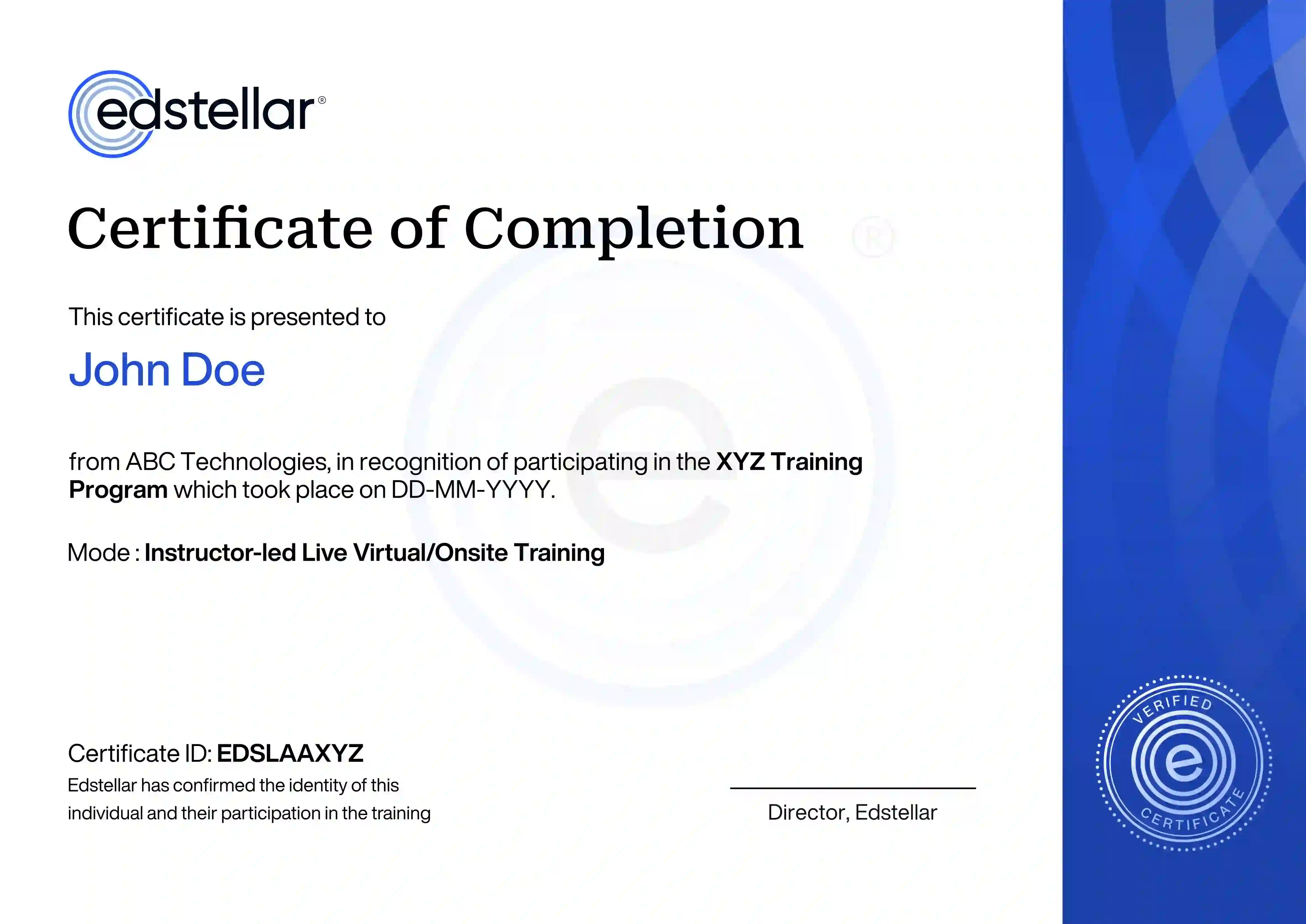
        Upon successful completion of the training course offered by Edstellar, employees receive a course completion certificate, symbolizing their dedication to ongoing learning and professional development.

        This certificate validates the employee's acquired skills and is a powerful motivator, inspiring them to enhance their expertise further and contribute effectively to organizational success.

        Recognition That Motivates Your Team
        ""

        Other Related Corporate Training Courses