Corporate GitOps Continuous Deployment for Kubernetes Training Course
Edstellar's GitOps Continuous Deployment for Kubernetes instructor-led training course equips employees with the skills to implement efficient GitOps workflows, manage Kubernetes clusters, and streamline CI/CD pipelines. Teams will learn to deploy and monitor applications, resolve conflicts, and scale infrastructure.
(Virtual / On-site / Off-site)
Available Languages
English, Español, 普通话, Deutsch, العربية, Português, हिंदी, Français, 日本語 and Italiano
Drive Team Excellence with GitOps Continuous Deployment for Kubernetes Corporate Training
GitOps Continuous Deployment for Kubernetes involves using Git as the single source of truth for declarative infrastructure and application code, with automated processes for deploying changes to Kubernetes clusters based on Git repository events. In organizations it streamlines and automates the deployment process, ensuring consistency, scalability, and reliability of applications running on Kubernetes clusters, while also providing visibility, auditability, and version control for infrastructure and application changes. GitOps Continuous Deployment for Kubernetes training course focuses on imparting skills to efficiently manage infrastructure and application deployments using Git-based workflows, ensuring organizations can leverage Kubernetes effectively and securely.
The GitOps Continuous Deployment for Kubernetes instructor-led training course provided by Edstellar can be customized to meet team requirements. The virtual/onsite GitOps Continuous Deployment for Kubernetes training course led by expert trainers ensures that employees gain a comprehensive understanding of GitOps principles and best practices.

Skills Your Employees Will Gain
These are the core, hands-on capabilities your team builds during the program.
- GitOps PrinciplesGitOps Principles involve using Git as a single source of truth for managing infrastructure and applications. This skill is important for DevOps roles, ensuring streamlined deployments, version control, and enhanced collaboration.
- Kubernetes ManagementKubernetes Management involves orchestrating containerized applications for scalability and reliability. This skill is important for DevOps and cloud engineering roles, ensuring efficient deployment and resource optimization.
- CI/CD PipelinesCi/cd pipelines refer to continuous integration and continuous deployment processes that automate software development. This skill is important for devops and software engineering roles, ensuring efficient, reliable, and rapid delivery of code changes.
- Infrastructure as CodeInfrastructure as Code (IaC) is the practice of managing and provisioning infrastructure through code. This skill is important for DevOps and cloud engineering roles, enabling automation, consistency, and rapid deployment.
- AutomationAutomation is the use of technology to perform tasks with minimal human intervention. This Skill is important for roles in engineering, IT, and manufacturing to enhance efficiency, reduce errors, and save time.
- MonitoringMonitoring is the skill of systematically observing and assessing processes or performance. This skill is important for roles in management, quality assurance, and IT, ensuring efficiency and timely issue resolution.
What Your Team Will Achieve After This Training
- Analyze the benefits of GitOps for application deployment, including improved consistency, security, and rollback capabilities
- Apply tools like Spinnaker and Terraform to set up a GitOps environment, integrating Git repositories with CI/CD pipelines
- Evaluate the features and architectural differences between Spinnaker and Terraform to determine their use cases for GitOps
- Understand Git workflows for GitOps, including choosing the right workflow for branching strategies and managing infrastructure code
- Analyze use cases for GitOps deployments, including microservices, serverless functions, and multi-cloud environments
- Design and configure CI/CD pipelines using tools like Jenkins or GitLab CI to automate deployments and integrate testing
- Troubleshoot common GitOps deployment failures, analyze logs, and debug configuration issues using tools like kubectl
Topics & Program Outline
The curriculum is organized into focused modules built by industry experts and delivered virtually or on-premise. Interactive sessions reflect the evolving demands of the workplace, keeping the learning both relevant and practical.
- What is GitOps?
- Definition and core principles
- History and evolution of GitOps
- Key components and workflow
- Benefits of GitOps
- Improved deployment consistency
- Enhanced security and auditability
- Faster and more reliable rollbacks
- GitOps vs traditional continuous delivery
- Differences in workflows
- Advantages and disadvantages of each approach
- The importance of developer experience
- Enhancing collaboration and productivity
- Reducing cognitive load
- Streamlining the development lifecycle
- Overview of Spinnaker
- Introduction to Spinnaker
- Core features and capabilities
- Overview of Terraform
- Introduction to Terraform
- Core features and capabilities
- Installation of Spinnaker
- Prerequisites and system requirements
- Step-by-step installation guide
- Configuring initial settings
- Configuring Spinnaker for GitOps
- Integrating Spinnaker with Git
- Setting up pipelines and workflows
- Installation of Terraform
- Prerequisites and system requirements
- Step-by-step installation guide
- Configuring initial settings
- Integrating Terraform with Spinnaker
- Connecting Terraform with Spinnaker
- Automating infrastructure provisioning
- Managing Terraform state and configurations
- Features of Spinnaker
- Continuous delivery and deployment
- Multi-cloud support
- Application management and monitoring
- Features of Terraform
- Infrastructure as code
- Resource management and provisioning
- State management and version control
- Architectural comparison: Spinnaker vs. Terraform
- Core architectural differences
- Integration points and workflows
- Best practices for using both tools
- Designing effective pipelines
- Managing infrastructure and application code
- Ensuring security and compliance
- Git workflows for GitOps
- Overview of Git workflows
- Choosing the right workflow for your team
- Using Git branches for deployment
- Creating and managing branches
- Merging and rebasing strategies
- Handling hotfixes and feature branches
- Managing Git repositories for infrastructure code
- Structuring repositories for GitOps
- Using submodules and monorepos
- Versioning and tagging releases
- Overview of Kubernetes architecture
- Kubernetes components and their roles
- Cluster architecture and design
- Understanding namespaces and RBAC
- Deploying Kubernetes clusters
- Creating clusters using various tools
- Configuring cluster networking
- Securing the cluster
- Managing Kubernetes resources
- Understanding Kubernetes objects
- Managing resources with kubectl and Helm
- Best practices for Kubernetes configurations
- Using ConfigMaps and Secrets
- Setting resource limits and requests
- Managing environment-specific configurations
- GitOps for microservices deployment
- Managing microservices with GitOps
- Automating deployments and rollbacks
- GitOps for serverless applications
- Deploying serverless functions with GitOps
- Integrating with FaaS platforms
- GitOps for multi-cloud deployments
- Managing infrastructure across multiple cloud providers
- Ensuring consistency and compliance
- Introduction to CI/CD pipelines
- Overview of CI/CD concepts
- Benefits of CI/CD for GitOps
- Key components of a CI/CD pipeline
- Configuring CI tools for GitOps
- Choosing the right CI tool
- Setting up build and test pipelines
- Integrating CI with GitOps workflows
- Integrating CI pipelines with GitOps workflows
- Automating code deployments
- Managing pipeline triggers and events
- Automating tests and deployments
- Writing effective test cases
- Automating unit, integration, and end-to-end tests
- Deploying code to staging and production environments
- Containerization basics
- Introduction to containerization
- Benefits of using containers
- Key container technologies
- Building and deploying containers with Docker
- Writing Dockerfiles and building images
- Pushing images to container registries
- Deploying containers to Kubernetes
- Deploying containerized applications on Kubernetes
- Creating Kubernetes manifests for applications
- Using Helm charts for deployment
- Managing application lifecycle
- Managing application versions and rollbacks
- Implementing versioning strategies
- Rolling back to previous versions
- Handling blue-green and canary deployments
- Cluster management best practices
- Regular maintenance and updates
- Monitoring cluster health
- Securing the cluster
- Scaling Kubernetes clusters
- Horizontal and vertical scaling
- Using Kubernetes autoscalers
- Backup and recovery strategies
- Implementing backup solutions
- Restoring from backups
- Ensuring data consistency and availability
- Managing cluster updates and upgrades
- Planning for cluster upgrades
- Minimizing downtime during upgrades
- Introduction to Kubernetes monitoring tools
- Overview of monitoring concepts
- Key monitoring tools
- Setting up Prometheus for monitoring
- Installing and configuring Prometheus
- Creating monitoring rules and alerts
- Configuring Grafana dashboards
- Integrating Grafana with Prometheus
- Creating and customizing dashboards
- Sharing and managing dashboards
- Alerting and log management
- Setting up alerting mechanisms
- Managing logs with tools like Fluentd and Elasticsearch
- Multi-cloud deployment strategies
- Benefits of multi-cloud deployments
- Challenges and considerations
- Tools and frameworks for multi-cloud management
- Using Kubernetes in a hybrid cloud environment
- Designing hybrid cloud architectures
- Managing workloads across on-premises and cloud environments
- Ensuring consistency and security
- Managing deployments across AWS, Azure, and GCP
- Setting up Kubernetes clusters on major cloud providers
- Integrating cloud-specific services
- Best practices for cloud-native applications
- Designing cloud-native applications
- Leveraging cloud services for scalability and resilience
- Ensuring security and compliance
- Organizing teams for GitOps
- Roles and responsibilities in GitOps
- Structuring teams for effective collaboration
- Communication and coordination strategies
- Collaborative deployment strategies
- Planning and coordinating deployments
- Managing dependencies and integrations
- Managing deployment schedules
- Planning release cycles
- Coordinating with development and operations teams
- Handling emergency and out-of-cycle deployments
- Using GitOps to improve team coordination
- Enhancing visibility and transparency
- Reducing deployment risks and failures
- Continuous improvement and feedback loops
- Scaling applications with Kubernetes
- Strategies for application scaling
- Using Kubernetes scaling features
- Managing resources efficiently
- Horizontal and vertical scaling techniques
- Understanding horizontal scaling
- Implementing vertical scaling
- Choosing the right scaling approach
- Auto-scaling Kubernetes clusters
- Configuring cluster autoscalers
- Managing auto-scaling policies
- Best practices for managing high-traffic applications
- Optimizing performance and resource usage
- Handling peak loads and traffic spikes
- Ensuring application availability and reliability
- Common issues in GitOps workflows
- Identifying typical GitOps problems
- Troubleshooting deployment failures
- Resolving configuration conflicts
- Debugging Kubernetes deployments
- Using kubectl for debugging
- Analyzing logs and events
- Debugging common Kubernetes issues
- Resolving configuration conflicts
- Identifying and fixing misconfigurations
- Managing configuration changes
- Tools and techniques for effective troubleshooting
- Essential troubleshooting tools
- Developing a troubleshooting workflow
Who Should Attend?
This program suits professionals at many levels across the organization, including:
- DevOps Engineers
- Software Engineers
- Cloud Engineers
- System Administrators
- IT Specialists
- Network Engineers
- Security Engineers
- Site Reliability Engineers
- Infrastructure Engineers
- Platform Engineers
- Operations Engineers
- Managers
What are the Prerequisites?
Employees with a basic understanding of cloud infrastructure concepts and software development processes can take up the GitOps Continuous Deployment for Kubernetes training course.
Choose the Format That Fits Your Team
We design training your teams actually engage with, and deliver it the way that suits you best. Through a vetted global trainer network, Edstellar runs sessions in 10+ languages with consistent quality anywhere.


.webp)
Virtual / online: expert-led live sessions delivered anywhere, with consistency and easy scheduling.
.webp)
On-site (in-house): immersive, instructor-led learning at your office.
.webp)
Off-site: focused, instructor-led group learning away from everyday workplace distractions.
Get a Proposal Shaped to Your Needs
Need pricing for onsite, offsite, or virtual delivery? Get a proposal tailored to your team's needs.
64 hours of group training (includes VILT/In-person On-site)
Tailored for SMBs
Tailor-Made Trainee Licenses with Our Exclusive Training Packages!
160 hours of group training (includes VILT/In-person On-site)
Ideal for growing SMBs
Tailor-Made Trainee Licenses with Our Exclusive Training Packages!
400 hours of group training (includes VILT/In-person On-site)
Designed for large corporations
Tailor-Made Trainee Licenses with Our Exclusive Training Packages!
Unlimited duration
Designed for large corporations
What Sets Edstellar Apart
Experienced Trainers
Our trainers are drawn from a vetted global network and bring years of industry expertise, keeping every session practical and impactful.
Proven Quality
With a strong global track record, Edstellar is known for quality and engaging delivery.
Industry-Relevant Curriculum
Our programs are built by experts to match the demands of today's industry.
Fully Customizable
Every program can be tailored to your organization's goals.
Comprehensive Support
We provide pre- and post-session support for a complete learning experience.
Global Multi-Location & Multilingual Training Delivery
We deliver in multiple languages to support diverse global teams.
Hear from Organizations We've Trained
"The GitOps Continuous Deployment for Kubernetes training exceeded my expectations in every way. As a Senior Kubernetes Engineer, I gained comprehensive knowledge of practical applications that transformed my approach to and immediately applicable. My ability to architect solutions and solve complex problems has improved substantially. The instructor's expertise in real-world case studies made complex concepts crystal clear and actionable.”
Betty Hopkins
Senior Kubernetes Engineer,
Scalable Container Management Platform
"The GitOps Continuous Deployment for Kubernetes training enhanced my ability to architect and implement sophisticated strategic implementation strategies. Understanding advanced methodologies through intensive hands-on exercises exercises organizational initiatives. We delivered a high-visibility enterprise project two months ahead of schedule. The detailed exploration of interactive labs provided methodologies I leverage in every engagement.”
Gao Na
Lead Network Architect,
Microservices Infrastructure Company
"This GitOps Continuous Deployment for Kubernetes course provided our team with comprehensive strategic frameworks capabilities we immediately put into practice. As a Principal Systems Engineer managing complex strategic that significantly enhanced our delivery capacity. We've successfully deployed these methodologies across all regional operations centers. The training fundamentally improved our team's performance metrics and overall efficiency.”
Lutfi Wajid
Principal Systems Engineer,
Enterprise Kubernetes Solutions Provider
“Edstellar’s IT & Technical training programs have been instrumental in strengthening our engineering teams and building future-ready capabilities. The hands-on approach, practical cloud scenarios, and expert guidance helped our teams improve technical depth, problem-solving skills, and execution across multiple projects. We’re excited to extend more of these impactful programs to other business units.”
Aditi Rao
L&D Head,
A Global Technology Company
Recognition That Motivates Your Team
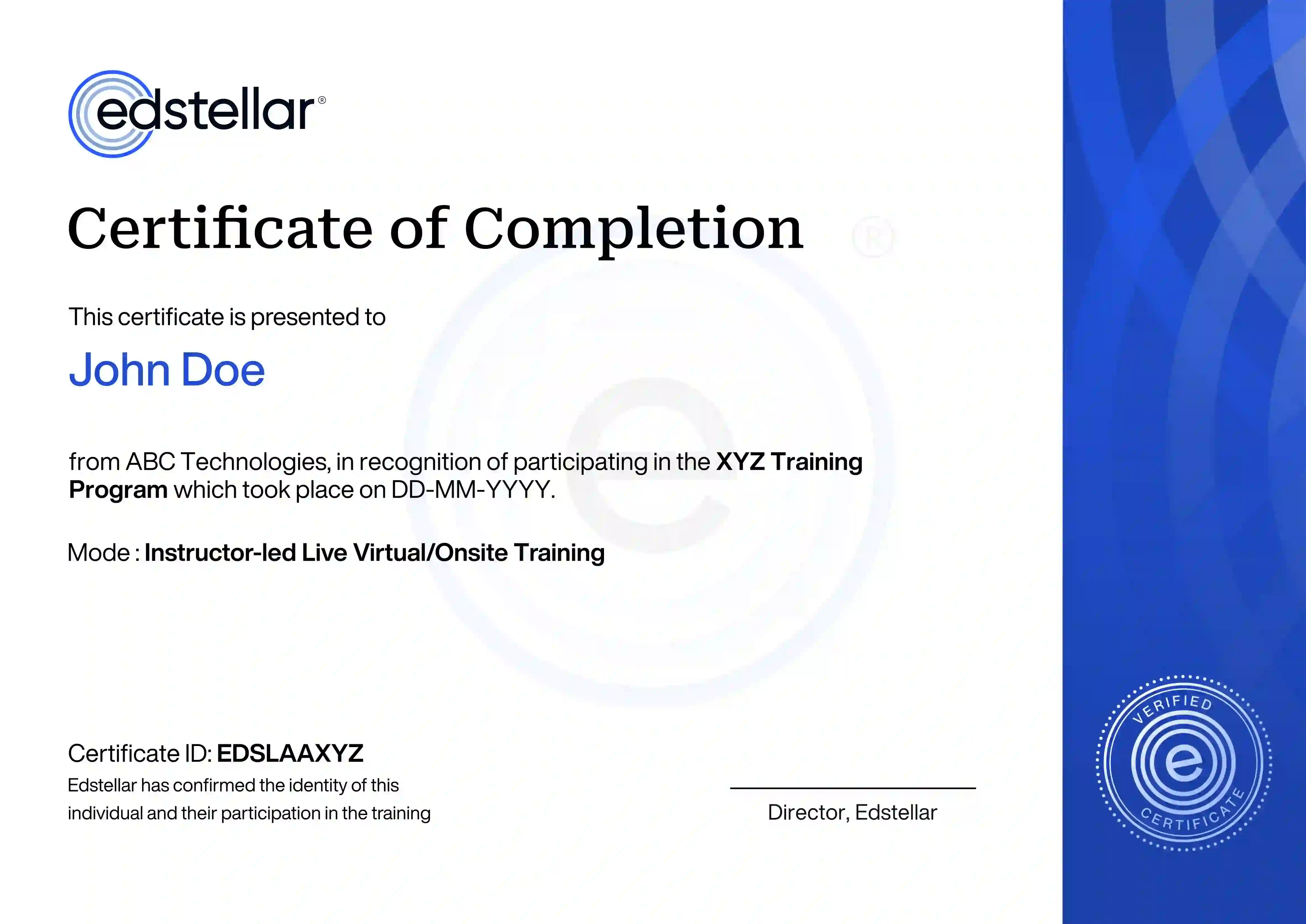
Upon successful completion of the training course offered by Edstellar, employees receive a course completion certificate, symbolizing their dedication to ongoing learning and professional development.
This certificate validates the employee's acquired skills and is a powerful motivator, inspiring them to enhance their expertise further and contribute effectively to organizational success.


Other Related Corporate Training Courses
Explore More Courses
Edstellar is a one-stop instructor-led corporate training and coaching solution that addresses organizational upskilling and talent transformation needs globally.
Marketing Excellence
Operational Excellence
Finance Excellence
HR Excellence
IT Excellence
Customer Service
Leadership Excellence
Quality Management
Software
How it WorksFAQ'sCorporate Training
CatalogStellar AI
Skill MatrixHRMS Integration
Who we ServeCEO RetreatsPricingTraining DeliveryPartner with Edstellar
CareersContact us