Corporate CompTIA Network+ Training Course
Edstellar's instructor-led CompTIA Network+ training course equips teams with essential networking skills for optimized organizational communication and data flow. The course enables employees to acquire practical skills in managing wired and wireless networks, ensuring enhanced operational efficiency.
(Virtual / On-site / Off-site)
Available Languages
English, Español, 普通话, Deutsch, العربية, Português, हिंदी, Français, 日本語 and Italiano
Drive Team Excellence with CompTIA Network+ Corporate Training
CompTIA Network+ is a globally recognized program that provides essential training for employees in the networking field. Organizations require this course to ensure their IT staff possesses the fundamental knowledge and skills to design, manage, and troubleshoot network infrastructures. The course is vital for maintaining efficient and secure network operations, foundational to any business's communication and data management systems. CompTIA Network+ training course equips teams with these critical networking abilities, enhancing organizational connectivity and security and supporting overall business objectives and technological reliability.
Edstellar's instructor-led CompTIA Network+ training course offers a comprehensive curriculum from industry experts with years of practical experience. The course conducted through virtual/onsite formats, ensures employees gain hands-on skills in network configuration, troubleshooting, and security measures. With customizable content tailored to organizational needs, teams learn applicable techniques and strategies to optimize network performance and mitigate risks effectively.

Skills Your Employees Will Gain
These are the core, hands-on capabilities your team builds during the program.
- Network ArchitectureNetwork Architecture is the design and structure of a network's components and systems. this skill is important for IT professionals to ensure efficient, secure, and scalable networks.
- Network SecurityNetwork Security involves protecting computer networks from intrusions, attacks, and unauthorized access. This skill is important for IT professionals to safeguard sensitive data and ensure system integrity.
- SubnettingSubnetting is the process of dividing a network into smaller, manageable sub-networks. this skill is important for network administrators to optimize performance, enhance security, and efficiently manage IP addresses.
- Switching TechnologiesSwitching Technologies refers to the ability to adapt and transition between different tech platforms and tools. This skill is important for IT professionals, as it enhances flexibility, problem-solving, and innovation in dynamic work environments.
- Wireless NetworkingWireless Networking is the ability to connect devices without physical cables, using technologies like Wi-Fi. This skill is important for IT roles, enabling seamless communication and efficient data transfer in modern workplaces.
- Network ManagementNetwork Management involves overseeing and maintaining computer networks to ensure optimal performance and security. This skill is important for IT professionals to ensure seamless connectivity and data integrity.
What Your Team Will Achieve After This Training
- Apply network configuration techniques to design and implement scalable and resilient network architectures that meet organizational needs and support future growth
- Utilize troubleshooting skills to quickly identify and resolve network issues, reducing downtime and maintaining business continuity
- Implement network security measures to protect organizational data from external threats and internal vulnerabilities, enhancing the overall cybersecurity posture
- Leverage knowledge of advanced networking technologies such as SDN and NFV to drive innovation and efficiency in network management, positioning the organization at the forefront of technological advancements
- Employ monitoring tools and protocols to continuously assess network performance and optimize operations, ensuring the reliability and effectiveness of communication systems
Topics & Program Outline
The curriculum is organized into focused modules built by industry experts and delivered virtually or on-premise. Interactive sessions reflect the evolving demands of the workplace, keeping the learning both relevant and practical.
- Compare and contrast OSI model layers
- Explanation of OSI model layers
- Similarities and differences between OSI layers
- Configure SOHO networks
- Setting up small office/home office (SOHO) networks
- Configuring routers, switches, and access points for SOHO environments
- Summarize Ethernet standards
- Overview of Ethernet standards (IEEE 802.3)
- Key characteristics and specifications
- Summarize copper cabling types
- Types of copper cables (e.g., Cat5e, Cat6)
- Characteristics and applications of each type
- Summarize fiber optic cabling types
- Types of fiber optic cables (e.g., single-mode, multi-mode)
- Advantages and applications of each type
- Deploy Ethernet cabling
- Installation procedures for Ethernet cables
- Deploy networking devices
- Installation and configuration of networking devices
- Placement considerations for optimal performance
- Explain network interfaces
- Understanding Network Interface Cards (NICs)
- Different types of network interfaces (e.g., Ethernet, Wi-Fi)
- Deploy common Ethernet switching features
- Configuring VLANs (Virtual LANs)
- Implementing Spanning Tree Protocol (STP)
- Setting up port security and Quality of Service (QoS)
- Explain network troubleshooting methodology
- Overview of network troubleshooting processes
- Steps to identify and resolve network issues
- Troubleshoot common cable connectivity issues
- Identifying cable connectivity problems
- Troubleshooting methods for resolving connectivity issues
- Explain IPv4 addressing schemes
- Overview of IPv4 address structure and classes
- Different addressing schemes (e.g., static, dynamic, subnetting)
- Explain IPv4 forwarding
- Understanding the IPv4 packet forwarding process
- Routing decisions and forwarding table lookup
- Configure IP networks and subnets
- Steps to configure IP addresses and subnets
- Subnetting techniques and subnet mask calculations
- Use appropriate tools to test IP configuration
- Selection and application of IP testing tools
- Verification of IP configurations using tools
- Troubleshoot IP networks
- Identification and resolution of common IP network issues
- Troubleshooting techniques for IPv4 and IPv6 networks
- Explain IPv6 addressing schemes
- Overview of IPv6 addressing structure
- Types of IPv6 addresses and their usage
- Compare and contrast routing concepts
- Explanation of static vs. dynamic routing
- Differences between distance vector and link-state routing
- Compare and contrast dynamic routing concepts
- Overview of interior vs. exterior gateway protocols
- Comparison of routing protocol features and behaviors
- Install and troubleshoot routers
- Procedures for router installation and configuration
- Troubleshooting common router issues and errors
- Explain network types and characteristics
- Overview of LAN, WAN, MAN, and PAN
- Characteristics and advantages of each network type
- Explain tiered switching architecture
- Description of hierarchical network design
- Benefits of the tiered switching architecture
- Explain virtual LANs
- Definition and purpose of VLANs
- Implementation and configuration of VLANs
- Compare and contrast transport protocols
- Overview of TCP and UDP protocols
- Differences in reliability, connection-oriented vs. connectionless
- Use appropriate tools to scan network ports
- Selection and application of port scanning tools
- Identification of open and closed ports on a network
- Explain the use of network-addressing services
- Overview of DHCP, APIPA, and static IP addressing
- Role of network addressing services in IP configuration
- Explain the use of name-resolution services
- Overview of DNS and WINS services
- Resolution of hostnames to IP addresses
- Configure DNS services
- Configuration and management of DNS servers
- DNS record types and their functions
- Explain the use of web, file/print, and database services
- Overview of web servers, file sharing, and database services
- Roles and functions of each network application
- Explain the use of email and voice services
- Overview of email servers and VoIP services
- Communication and collaboration through email and voice services
- Use of network management services
- Utilization of SNMP and Syslog for network monitoring
- Management and monitoring of network devices and services
- Use event management to ensure network availability
- Identification and response to network events and alarms
- Implementation of event management strategies
- Use performance metrics to ensure network availability
- Monitoring and analysis of network performance metrics
- Optimization and improvement of network performance
- Common security concepts
- Overview of Confidentiality, Integrity, and Availability (CIA) triad
- Principles of least privilege and defense-in-depth
- Authentication methods
- Overview of authentication mechanisms (e.g., passwords, biometrics)
- Implementation and management of authentication protocols
- Compare and contrast security appliances
- Overview of firewalls, IDS/IPS, and VPN concentrators
- Differences in features and capabilities of security appliances
- Troubleshoot service and security issues
- Identification and resolution of common security incidents
- Troubleshooting techniques for secure network environments
- Summarize wireless standards
- Overview of IEEE 802.11 standards
- Characteristics and features of different wireless standards
- Install wireless networks
- Planning and deployment of wireless access points
- Configuration and setup of wireless network infrastructure
- Troubleshoot wireless networks
- Identification and resolution of common wireless issues
- Troubleshooting techniques for wireless network problems
- Configure and troubleshoot wireless security
- Implementation and management of wireless security protocols
- Troubleshooting security issues in wireless networks
- WAN provider links
- Overview of different types of WAN links (e.g., DSL, cable, fiber)
- Selection and implementation of WAN connectivity options
- Compare and contrast remote access methods
- Explanation of VPN, dial-up, and remote desktop access
- Differences in remote access technologies and protocols
- Organizational documentation and policies
- Development and implementation of security policies and procedures
- Documentation requirements for security compliance
- Physical security methods
- Overview of physical security controls (e.g., access control, surveillance)
- Measures to protect physical assets and infrastructure
- Compare and contrast Internet of Things devices
- Explanation of IoT devices and their security implications
- Risks and challenges associated with IoT device security
- Explain disaster recovery concepts
- Overview of disaster recovery planning and strategies
- Measures to mitigate the impact of disasters on network operations
- Explain high-availability concepts
- Description of high availability solutions (e.g., redundancy, failover)
- Strategies for maintaining continuous network availability
- Compare and contrast types of attacks
- Overview of common network attacks (e.g., DDoS, phishing)
- Differences in attack vectors and techniques
- Apply network hardening techniques
- Implementation of security controls and measures
- Hardening network devices and infrastructure against potential threats
- Virtualization and storage area network technologies
- Overview of virtualization technologies (e.g., hypervisors, VMs)
- Explanation of storage area network (SAN) architecture and components
- Datacenter network architecture
- Design and implementation of data center network infrastructure
- Integration of network services and technologies in data center environments
Who Should Attend?
This program suits professionals at many levels across the organization, including:
- Network Engineers
- IT Technicians
- Network Administrators
- Systems Administrators
- IT Support Specialists
- Network Analysts
- Technical Support Engineers
- Infrastructure Engineers
- Systems Engineers
- Security Analysts
- Network Architects
- Managers
What are the Prerequisites?
Employees with a basic understanding and experience in Networking can take the CompTIA Network+ training course.
Choose the Format That Fits Your Team
We design training your teams actually engage with, and deliver it the way that suits you best. Through a vetted global trainer network, Edstellar runs sessions in 10+ languages with consistent quality anywhere.


.webp)
Virtual / online: expert-led live sessions delivered anywhere, with consistency and easy scheduling.
.webp)
On-site (in-house): immersive, instructor-led learning at your office.
.webp)
Off-site: focused, instructor-led group learning away from everyday workplace distractions.
Get a Proposal Shaped to Your Needs
Need pricing for onsite, offsite, or virtual delivery? Get a proposal tailored to your team's needs.
64 hours of group training (includes VILT/In-person On-site)
Tailored for SMBs
Tailor-Made Trainee Licenses with Our Exclusive Training Packages!
160 hours of group training (includes VILT/In-person On-site)
Ideal for growing SMBs
Tailor-Made Trainee Licenses with Our Exclusive Training Packages!
400 hours of group training (includes VILT/In-person On-site)
Designed for large corporations
Tailor-Made Trainee Licenses with Our Exclusive Training Packages!
Unlimited duration
Designed for large corporations
What Sets Edstellar Apart
Experienced Trainers
Our trainers are drawn from a vetted global network and bring years of industry expertise, keeping every session practical and impactful.
Proven Quality
With a strong global track record, Edstellar is known for quality and engaging delivery.
Industry-Relevant Curriculum
Our programs are built by experts to match the demands of today's industry.
Fully Customizable
Every program can be tailored to your organization's goals.
Comprehensive Support
We provide pre- and post-session support for a complete learning experience.
Global Multi-Location & Multilingual Training Delivery
We deliver in multiple languages to support diverse global teams.
Hear from Organizations We've Trained
"The CompTIA Network+ training provided me with comprehensive capabilities that elevated my expertise. As a Senior Software Engineer, I needed to understand strategic frameworks deeply, and this course delivered perfectly. exercises gave me hands-on experience with industry best practices. The knowledge gained has been immediately applicable to mission-critical projects and initiatives. Highly recommend for anyone serious about this field.”
Hiram Ferguson
Senior Software Engineer,
Enterprise Networking Platform
"The CompTIA Network+ training enhanced my ability to architect and implement sophisticated strategic implementation strategies. Understanding industry best practices through intensive interactive labs exercises proved invaluable for organizational initiatives. Our project success rate and profitability increased dramatically within the quarter. The detailed exploration of expert-led workshops provided methodologies I leverage in every engagement.”
Ruben Martinez
Senior Software Engineer,
Software-Defined Networking Company
"This CompTIA Network+ course provided our team with comprehensive advanced methodologies capabilities we immediately put into practice. As a Senior Software Engineer managing complex technical mastery projects, the significantly enhanced our delivery capacity. We completed our comprehensive digital transformation initiative significantly ahead of schedule. The training fundamentally improved our team's performance metrics and overall efficiency.”
Jamal Nasser
Senior Software Engineer,
Network Infrastructure Solutions Provider
“Edstellar’s IT & Technical training programs have been instrumental in strengthening our engineering teams and building future-ready capabilities. The hands-on approach, practical cloud scenarios, and expert guidance helped our teams improve technical depth, problem-solving skills, and execution across multiple projects. We’re excited to extend more of these impactful programs to other business units.”
Aditi Rao
L&D Head,
A Global Technology Company
Recognition That Motivates Your Team
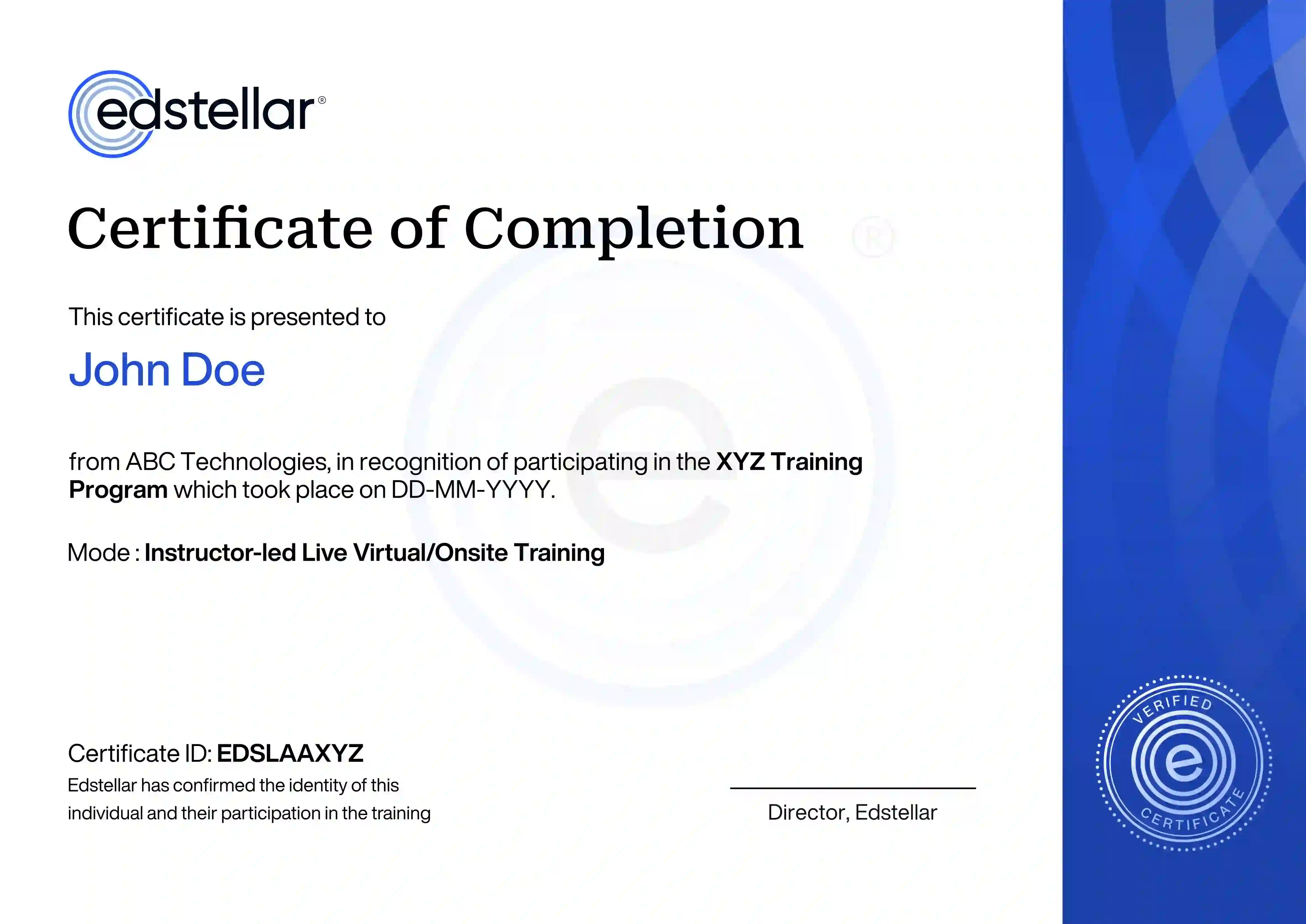
Upon successful completion of the training course offered by Edstellar, employees receive a course completion certificate, symbolizing their dedication to ongoing learning and professional development.
This certificate validates the employee's acquired skills and is a powerful motivator, inspiring them to enhance their expertise further and contribute effectively to organizational success.


We have Expert Trainers to Meet Your CompTIA Network+ Training Needs
The instructor-led training is conducted by certified trainers with extensive expertise in the field. Participants will benefit from the instructor's vast knowledge, gaining valuable insights and practical skills essential for success in Access practices.
Other Related Corporate Training Courses
Explore More Courses
Edstellar is a one-stop instructor-led corporate training and coaching solution that addresses organizational upskilling and talent transformation needs globally.
Marketing Excellence
Operational Excellence
Finance Excellence
HR Excellence
IT Excellence
Customer Service
Leadership Excellence
Quality Management
Software
How it WorksFAQ'sCorporate Training
CatalogStellar AI
Skill MatrixHRMS Integration
Who we ServeCEO RetreatsPricingTraining DeliveryPartner with Edstellar
CareersContact us