Corporate Network Functions Virtualization Training Course
Edstellar's instructor-led Network Functions Virtualization training course equips teams with design, deployment, and management skills to enhance network flexibility and operational efficiency. The course empowers teams to virtualize network functions like firewalls and load balancers on standardized hardware, promoting faster service deployment.
(Virtual / On-site / Off-site)
Available Languages
English, Español, 普通话, Deutsch, العربية, Português, हिंदी, Français, 日本語 and Italiano
Drive Team Excellence with Network Functions Virtualization Corporate Training
Network Functions Virtualization (NFV) is a network architecture concept that shifts network functions from proprietary hardware to virtualized environments, enabling entire classes of network node functions, like firewalls and load balancers, to be managed as flexible, software-driven services. This transformation is vital for organizations as it dramatically increases network agility and efficiency, reduces costs, and accelerates service deployment. Network Functions Virtualization training course is essential as it equips teams with the necessary skills to implement and manage these advanced virtualized networks. The course enables employees to understand the theoretical underpinnings of NFV and learn practical applications, ensuring that they can leverage these technologies to meet the evolving demands of their organizations effectively.
Edstellar's instructor-led Network Functions Virtualization training course offers virtual/onsite sessions conducted by industry experts with extensive experience in the domain. The course is characterized by its practical, hands-on approach and customizable curriculum, tailored to meet your organization's needs and challenges.

Skills Your Employees Will Gain
These are the core, hands-on capabilities your team builds during the program.
- Virtualization TechnologiesVirtualization Technologies involve creating virtual versions of hardware or software, enabling efficient resource management. This skill is important for IT roles, as it enhances scalability, reduces costs, and improves system reliability.
- Network ArchitectureNetwork Architecture is the design and structure of a network's components and systems. this skill is important for IT professionals to ensure efficient, secure, and scalable networks.
- Software-Defined Networking (SDN)Software-Defined Networking (SDN) is a network architecture approach that enables centralized control of network resources. This skill is important for network engineers and IT professionals to enhance flexibility, optimize performance, and streamline management in dynamic environments.
- NFV DeploymentNfv Deployment involves implementing network functions virtualization to enhance network efficiency and flexibility. This skill is important for network engineers and IT professionals to optimize resources and reduce costs.
- Virtual Network Functions (VNFs)Virtual Network Functions (VNFs) are software-based network services that replace traditional hardware. This skill is important for network engineers and cloud architects to enhance scalability, reduce costs, and improve service agility in modern IT environments.
- Network OrchestrationNetwork Orchestration is the automated management of network resources, enabling seamless connectivity and efficiency. this skill is important for network engineers and IT professionals to optimize performance and reduce downtime.
What Your Team Will Achieve After This Training
- Design security measures for NFV infrastructures, safeguarding against potential threats and ensuring compliance with regulatory standards
- Develop strategies for integrating NFV solutions into organizational IT infrastructures, leading to improved system efficiency and reduced operational costs
- Evaluate the effectiveness of different NFV deployments, using performance metrics and business outcomes to guide future network planning and development
- Apply NFV principles to redesign and optimize existing network architectures, ensuring enhanced flexibility and scalability in response to evolving business needs
- Analyze existing network setups to identify opportunities for implementing NFV, which will enable a transition toward more dynamic and manageable network environments
Topics & Program Outline
The curriculum is organized into focused modules built by industry experts and delivered virtually or on-premise. Interactive sessions reflect the evolving demands of the workplace, keeping the learning both relevant and practical.
- Ideas behind network transformation
- Evolution of networking concepts
- Drivers for change in network technologies
- The changing telecoms industry landscape
- Emerging trends and innovations
- Impact of market dynamics on network strategies
- Regulatory and economic factors influencing changes
- Network virtualization basics
- Introduction to virtualization in networking
- Key concepts and terminologies
- Benefits of network virtualization
- Network virtualization defined
- Defining features of network virtualization
- Comparison with traditional networking models
- Network virtualization survey
- Current market analysis
- Future trends and predictions
- Challenges and opportunities
- Enablers for network functions virtualization
- Role of cloud computing
- Importance of industry standard high volume servers
- Other technological advancements
- What is network functions virtualization (NFV)?
- Fundamental principles of NFV
- Core components and architecture
- Why network virtualization (NV)?
- Strategic benefits for businesses
- Cost-effectiveness and operational flexibility
- Benefits and value proposition of NFV
- What business problems it solves
- Overview of key virtualization principles
- Impact on IT and business operations
- NFV infrastructure
- Overview of hardware resources
- The virtualization layer and its functionalities
- Virtual resources and management
- How NV relates to software-defined networking (SDN)
- Comparative analysis of NV and SDN
- Synergies and differences
- NFV and Software Defined networks (SDN)
- Integration of NFV with SDN technologies
- Enhanced network management and operations
- Challenges for network functions virtualization
- Identifying and addressing common obstacles
- Strategies for effective implementation
- Virtualization Network Function (VNF)
- Definition and roles
- Examples and practical applications
- NFVI (Network Functions Virtualization Infrastructure) layer
- Components and setup
- Relationship with overall NFV architecture
- VNF (Virtualized Network Function) layer
- Architecture and functionality
- Interaction with other NFV components
- Operation support subsystem (OSS) layer
- Role in NFV infrastructure
- Key functions and benefits
- NFV Management and Orchestration (MANO) layer
- Overview and critical features
- Challenges in management and orchestration
- Traditional telco architecture vs. Service-Based Architecture (SBA)
- Comparative analysis
- Transition processes and benefits
- SBA network elements or network functions (NFs) in 5G
- Key components and their functionalities
- Interconnectivity and communication protocols
- NFs communications with open REST-based interfaces
- Importance of REST-based interfaces in NFs
- Benefits for network management and scalability
- Deploys as containers orchestrated by Kubernetes
- Containerization in 5G networks
- Role of Kubernetes in network function deployment
- HTTP/2 and its well-developed security mechanisms
- Advantages of HTTP/2 in 5G networking
- Security features and implications
- 5GC NFs (functions like AUSF, AMF, NEF, etc.)
- Detailed examination of each function
- Role and importance in the 5G ecosystem
- Trends in cloud solutions
- Current trends and their impact on NFV
- The future outlook for cloud technologies in networking
- Capitalization of NFV
- Economic benefits and cost savings
- Business models enabled by NFV
- NFV’s software-driven approach
- Key features and advantages of a software-driven strategy
- Comparison with hardware-centric approaches
- NFV to build dynamic, virtualized networks
- Techniques and technologies for dynamic networking
- NFV awareness: application and content
- Promoting NFV awareness among stakeholders
- Content strategies for effective communication
- Virtualizing network applications
- Methods and benefits of virtualizing applications
- Challenges and solutions
- NFV management and orchestration
- Fundamentals of NFV MANO
- Key MANO functional blocks and their roles
- Security management and monitoring specification
- Specifications and standards for secure NFV deployment
- Monitoring tools and techniques
- Use cases for NFV security management
- Real-world scenarios and solutions
- Impact of security management on network operations
- Security management requirements
- Essential requirements for security management
- Compliance and regulatory considerations
- Security monitoring and management architecture
- Architectural components and their functionalities
- Integration with existing systems
- Secure VNF bootstrapping protocol
- Procedures and protocols for secure VNF initialization
- VNF secure personalization and policy protocol
- Personalization techniques for enhanced security
- Policy management and enforcement strategies
- NFV deployments
- Overview of deployment strategies and models
- Evaluation of deployment success and efficiency
- VNF integrated security monitoring
- Techniques for integrated security monitoring
- Benefits and challenges
Who Should Attend?
This program suits professionals at many levels across the organization, including:
- Network Engineers
- Virtualization Engineers
- IT Architects
- Systems Engineers
- Network Administrators
- Cloud Engineers
- IT Infrastructure Specialists
- DevOps Engineers
- Network Analysts
- Technical Support Specialists
- Systems Administrators
- Managers
What are the Prerequisites?
Employees with a basic understanding of networking concepts and virtualization technologies can take the Network Functions Virtualization training course.
Choose the Format That Fits Your Team
We design training your teams actually engage with, and deliver it the way that suits you best. Through a vetted global trainer network, Edstellar runs sessions in 10+ languages with consistent quality anywhere.


.webp)
Virtual / online: expert-led live sessions delivered anywhere, with consistency and easy scheduling.
.webp)
On-site (in-house): immersive, instructor-led learning at your office.
.webp)
Off-site: focused, instructor-led group learning away from everyday workplace distractions.
Get a Proposal Shaped to Your Needs
Need pricing for onsite, offsite, or virtual delivery? Get a proposal tailored to your team's needs.
64 hours of group training (includes VILT/In-person On-site)
Tailored for SMBs
Tailor-Made Trainee Licenses with Our Exclusive Training Packages!
160 hours of group training (includes VILT/In-person On-site)
Ideal for growing SMBs
Tailor-Made Trainee Licenses with Our Exclusive Training Packages!
400 hours of group training (includes VILT/In-person On-site)
Designed for large corporations
Tailor-Made Trainee Licenses with Our Exclusive Training Packages!
Unlimited duration
Designed for large corporations
What Sets Edstellar Apart
Experienced Trainers
Our trainers are drawn from a vetted global network and bring years of industry expertise, keeping every session practical and impactful.
Proven Quality
With a strong global track record, Edstellar is known for quality and engaging delivery.
Industry-Relevant Curriculum
Our programs are built by experts to match the demands of today's industry.
Fully Customizable
Every program can be tailored to your organization's goals.
Comprehensive Support
We provide pre- and post-session support for a complete learning experience.
Global Multi-Location & Multilingual Training Delivery
We deliver in multiple languages to support diverse global teams.
Hear from Organizations We've Trained
"This Network Functions Virtualization course was exactly what I needed to advance my career. As a Senior Software Engineer, mastering strategic frameworks has become crucial for my success. The in-depth coverage daily. These specialized skills have positioned me for significant advancement opportunities within my organization. The real-world examples and deep dive into practical simulations were particularly valuable for my professional growth.”
Nancy Grant
Senior Software Engineer,
Enterprise Networking Platform
"The Network Functions Virtualization training enhanced my ability to architect and implement sophisticated technical mastery strategies. Understanding industry best practices through intensive expert-led workshops exercises proved enterprise initiatives. We've successfully expanded our service portfolio based on these enhanced capabilities. The detailed exploration of interactive labs provided methodologies I leverage in every engagement.”
Krzysztof Kaminski
Senior Software Engineer,
Network Infrastructure Solutions Provider
"As a Senior Software Engineer leading professional expertise operations, the Network Functions Virtualization training provided our team with essential advanced methodologies expertise at scale. The comprehensive modules on real-world operational footprint. Our team's capability maturity level increased by three full stages within six months. This course has proven invaluable for driving our organizational transformation and sustained excellence.”
Najib Yusuf
Senior Software Engineer,
Network Management Solutions
“Edstellar’s IT & Technical training programs have been instrumental in strengthening our engineering teams and building future-ready capabilities. The hands-on approach, practical cloud scenarios, and expert guidance helped our teams improve technical depth, problem-solving skills, and execution across multiple projects. We’re excited to extend more of these impactful programs to other business units.”
Aditi Rao
L&D Head,
A Global Technology Company
Recognition That Motivates Your Team
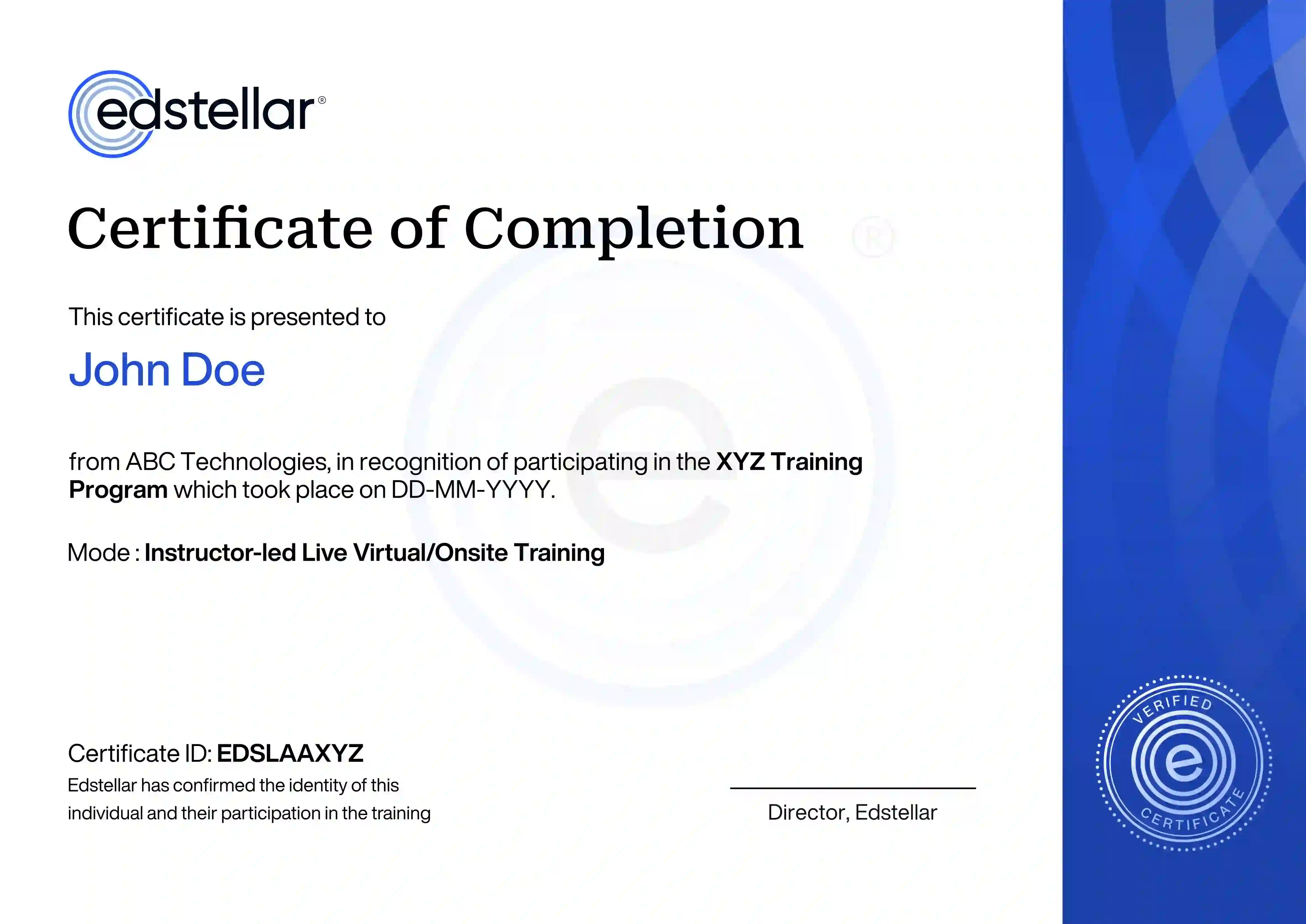
Upon successful completion of the training course offered by Edstellar, employees receive a course completion certificate, symbolizing their dedication to ongoing learning and professional development.
This certificate validates the employee's acquired skills and is a powerful motivator, inspiring them to enhance their expertise further and contribute effectively to organizational success.


Other Related Corporate Training Courses
Explore More Courses
Edstellar is a one-stop instructor-led corporate training and coaching solution that addresses organizational upskilling and talent transformation needs globally.
Learning Technology
Learning Content Design and Development
Learning Governance, Analytics & ROI
Digital Learning Ecosystem
Training Simulations, AR/VR & Case Studies
Employee Performance Support
Leadership Pipeline & Succession PlanningStrategic Workforce Planning for EnterprisesTransformation & Risk Advisory for EnterprisesDEI Consulting for EnterprisesEmployee Engagement Consulting for Enterprises
Cultural Transformation