Corporate Oracle PL/SQL Fundamentals Training Course
Edstellar's Oracle PL/SQL Fundamentals instructor-led training course equips employees with essential SQL and PL/SQL skills. Teams learn to write SQL queries, manage database objects, handle exceptions, and implement PL/SQL blocks. Upskill your teams to enhance application performance and data integrity.
(Virtual / On-site / Off-site)
Available Languages
English, Español, 普通话, Deutsch, العربية, Português, हिंदी, Français, 日本語 and Italiano
Drive Team Excellence with Oracle PL/SQL Fundamentals Corporate Training
Oracle Procedural Language/Structured Query Language (PL/SQL) is Oracle Corporation's procedural extension for SQL and the Oracle relational database. PL/SQL's robust error handling ensures smooth application operation, while its data security features allow control over sensitive information. The language enables automation of routine tasks, boosting productivity and reducing human error. The Oracle PL/SQL Fundamentals training course stimulates knowledgeable and skilled employees, enabling them to optimize database operations and support the organization's data-driven decision-making processes.
The Oracle PL/SQL Fundamentals instructor-led training course provided by Edstellar can be customized to meet team requirements. The virtual/onsite Oracle PL/SQL Fundamentals training course, led by expert trainers, ensures employees gain essential PL/SQL skills to optimize database operations and support data-driven decision-making.

Skills Your Employees Will Gain
These are the core, hands-on capabilities your team builds during the program.
- SQL QueryingSql Querying is the ability to write and execute structured queries to retrieve and manipulate data in databases. This skill is important for data analysts and developers to efficiently extract insights and support decision-making.
- PL/SQL ProgrammingPl/sql programming is a procedural extension of sql used for managing and manipulating data in oracle databases. this skill is important for database developers and data analysts to efficiently automate tasks, enhance performance, and ensure data integrity.
- Data ManipulationData Manipulation is the process of adjusting, organizing, and analyzing data to extract meaningful insights. This skill is important for data analysts and scientists, as it enables them to transform raw data into actionable information, driving informed decision-making.
- Error HandlingError Handling is the process of anticipating, detecting, and resolving errors in software or systems. This skill is important for developers and IT professionals to ensure reliability, enhance user experience, and maintain system integrity.
- Transaction ControlTransaction Control is the ability to manage and oversee financial transactions effectively, ensuring accuracy and compliance. this skill is important for roles in finance, accounting, and auditing, as it helps maintain integrity and trust in financial reporting.
- Stored ProceduresStored Procedures are precompiled SQL code that execute complex queries efficiently. This skill is important for database administrators and developers to optimize performance and ensure data integrity.
What Your Team Will Achieve After This Training
- Analyze the basic elements of PL/SQL syntax and structure
- Apply knowledge of data types to declare and initialize variables in PL/SQL code
- Create simple PL/SQL programs using control flow statements like if-then, case, and loops (while, for)
- Implement cursors to iterate through and process data sets fetched from the database
- Troubleshoot code errors using exception-handling techniques
- Design user-defined data structures like records and associative arrays to manage complex data
- Evaluate the benefits of embedding SQL statements within PL/SQL code for data manipulation
- Synthesize basic building blocks of PL/SQL to write application logic for automating database tasks
Topics & Program Outline
The curriculum is organized into focused modules built by industry experts and delivered virtually or on-premise. Interactive sessions reflect the evolving demands of the workplace, keeping the learning both relevant and practical.
- What is an Oracle database
- Introduction to Oracle Database
- Key features and benefits
- Versions and editions
- Relational database structures
- Definition and components of relational databases
- Schema and data modeling
- Tables, rows and columns
- Structure and purpose of tables
- Data organization in rows and columns
- Indexes, primary keys and foreign keys
- Types of indexes and their uses
- Importance of primary and foreign keys
- Constraints and relationships
- Data types
- Overview of Oracle data types
- Usage
- The data dictionary
- Purpose and structure of the data dictionary
- Accessing and using data dictionary views
- What is SQL*Plus
- Introduction to SQL*Plus
- Features and benefits
- Getting started
- Installation and configuration
- Connecting to the database
- Entering and executing SQL statements
- Basic SQL statement structure
- Execution and result handling
- Editing SQL statements
- Editing commands and techniques
- Using buffers
- Creating, editing and executing SQL files
- Writing and saving SQL scripts
- Executing scripts from SQL*Plus
- What is Oracle SQL developer
- Overview and features
- Comparison with SQL*Plus
- Starting SQL developer
- Installation and setup
- Interface walkthrough
- Configure a connection
- Creating and managing database connections
- Troubleshooting connection issues
- Navigation tabs
- Exploring the user interface
- Using tabs and views
- SQL worksheet
- Writing and executing SQL queries
- Utilizing worksheet features
- The SELECT statement
- Basic structure and syntax
- The SELECT and FROM clauses
- Specifying columns and tables
- Using aliases
- Conditions and the WHERE clause
- Filtering data with conditions
- Using comparison operators
- Other conditional operators
- BETWEEN, IN, LIKE, and IS NULL
- Logical operators
- AND, OR, NOT
- Combining conditions
- The ORDER BY clause
- Sorting query results
- Multiple column sorting
- Column aliases
- Renaming columns in results
- Arithmetic expressions
- Performing calculations in queries
- Precedence of operators
- Understanding operator precedence
- Overview of built-in aggregate functions
- SUM, AVG, COUNT, MAX, MIN
- The GROUP BY clause
- Grouping data for aggregation
- The HAVING clause
- Filtering groups with conditions
- Overview of table joins
- Introduction to joins
- Inner joins
- Syntax and use cases
- Table aliases
- Simplifying query writing
- Outer joins
- Left, right, and full outer joins
- Self joins
- Joining a table to itself
- ANSI standard joins
- Syntax and usage
- Function types
- Overview of function categories
- Using the table dual to try out functions
- Purpose of the dual table
- Numeric functions
- Common numeric functions
- Character functions
- Common character functions
- String concatenation
- Combining strings in queries
- Date arithmetic and date functions
- Working with dates
- Conversion functions
- TO_CHAR, TO_NUMBER, TO_DATE
- The NVL and NVL2 functions
- Handling null values
- The DECODE function
- Conditional logic in queries
- CASE expressions
- Advanced conditional logic
- The COALESCE and NULLIF functions
- Handling null values and comparisons
- Command line substitution parameters
- Using substitution variables
- The ACCEPT command
- Prompting for user input
- The DEFINE and UNDEFINE commands
- Defining and removing variables
- Overview of subqueries
- Introduction to subqueries
- Use a subquery as an alternative to join
- Subqueries vs joins
- Handle multiple records in subqueries
- Working with multiple rows
- Subquery in a HAVING clause
- Filtering groups with subqueries
- Anti-join
- Using subqueries for anti-joins
- In-line views
- Creating and using in-line views
- Top-N queries
- Retrieving top N records
- Complex subqueries
- Writing complex subqueries
- Multi-column subqueries
- Working with multiple columns
- Correlated subqueries
- Introduction and usage
- Subquery rules
- Best practices and guidelines
- Combining unrelated aggregates
- Using aggregates in subqueries
- Using the ANY, ALL and SOME operators
- Comparison operators in subqueries
- Inserting rows
- Syntax and usage
- Updating rows
- Syntax and usage
- Deleting rows
- Syntax and usage
- Verifying updates
- Confirming data changes
- Transaction control
- Understanding transactions
- Commit and rollback
- Transaction management
- Savepoints
- Using savepoints in transactions
- Commits and constraints
- Managing constraints with commits
- Amending data in SQL Developer
- Editing data in SQL Developer
- Creating tables
- Syntax and usage
- Specifying constraints
- Defining constraints
- Altering tables, columns and constraints
- Modifying table structures
- Dropping tables, columns and constraints
- Removing tables and constraints
- Copying tables
- Duplicating table structures
- Creating indexes
- Syntax and usage
- Dropping indexes
- Removing indexes
- Listing indexes
- Viewing index information
- Creating and using views
- Syntax and usage
- Dropping views
- Removing views
- Listing views
- Viewing view information
- Create a sequence
- Syntax and usage
- View sequence details
- Accessing sequence information
- Create a synonym
- Syntax and usage
- List synonyms
- Viewing synonym information
- What is PL/SQL?
- Introduction to PL/SQL
- Basic elements
- PL/SQL syntax and structure
- Variables and constants
- Declaring and using variables
- Data types (30 minutes)
- Overview of PL/SQL data types
- Initializing variables and assigning values
- Syntax and usage
- Using SQL statements in code
- Embedding SQL in PL/SQL
- Generating output to SQL or SQL Developer
- Outputting results from PL/SQL
- IF THEN ELSIF ELSE statements
- Syntax and usage
- CASE statements
- Conditional logic with CASE
- The basic loop construct
- Loop syntax and usage
- WHILE and FOR loops
- Iteration constructs
- Nested and labeled loops
- Using nested loops
- The GOTO statement
- Syntax and usage
- The CONTINUE statement
- Loop control with CONTINUE
- What is a cursor?
- Introduction to cursors
- Implicit and explicit cursors
- Differences and usage
- Cursor operations
- Declaring, opening, and closing cursors
- Declaring, opening and closing cursors
- Syntax and usage
- Fetching rows
- Retrieving data with cursors
- Status checking
- Monitoring cursor status
- Using cursors FOR UPDATE
- Locking rows with cursors
- The cursor FOR loop
- Iterating with cursor FOR loop
- Parameterized cursors
- Using parameters with cursors
- The EXCEPTION section
- Introduction to exception handling
- Types of exception
- System-raised and user-declared exceptions
- Handling named system-raised exceptions
- Common system exceptions
- Handling unnamed system-raised exceptions
- Catching unnamed exceptions
- User-declared exceptions and application errors
- Defining and raising exceptions
- WHEN OTHERS THEN NULL
- Using WHEN OTHERS
- Nested and labeled blocks
- Structuring PL/SQL code
- Propagation of exceptions
- Exception propagation and handling
- Scope of variables and cursors
- Understanding scope in PL/SQL
- Scope of GOTO statements
- Using GOTO with scope considerations
- Declaring record types
- Syntax and usage
- Handling PL/SQL records
- Working with record structures
- Nested records
- Creating and using nested records
- Declaring PL/SQL index-by tables or associative arrays
- Syntax and usage
- PL/SQL table built-in functions
- Common built-in functions
- Manipulating PL/SQL tables or associative arrays
- Working with associative arrays
Who Should Attend?
This program suits professionals at many levels across the organization, including:
- PL/SQL Developers
- Database Developers
- SQL Developers
- IT Administrators
- Systems Analysts
- Application Developers
- Data Analysts
- Data Engineers
- Business Intelligence Analysts
- Technical Support Engineers
- Report Developers
- Managers
What are the Prerequisites?
There are no specific prerequisites for Oracle PL/SQL Fundamentals training. However, it is beneficial to have a basic understanding of databases and exposure to information technology.
Choose the Format That Fits Your Team
We design training your teams actually engage with, and deliver it the way that suits you best. Through a vetted global trainer network, Edstellar runs sessions in 10+ languages with consistent quality anywhere.


.webp)
Virtual / online: expert-led live sessions delivered anywhere, with consistency and easy scheduling.
.webp)
On-site (in-house): immersive, instructor-led learning at your office.
.webp)
Off-site: focused, instructor-led group learning away from everyday workplace distractions.
Get a Proposal Shaped to Your Needs
Need pricing for onsite, offsite, or virtual delivery? Get a proposal tailored to your team's needs.
64 hours of group training (includes VILT/In-person On-site)
Tailored for SMBs
Tailor-Made Trainee Licenses with Our Exclusive Training Packages!
160 hours of group training (includes VILT/In-person On-site)
Ideal for growing SMBs
Tailor-Made Trainee Licenses with Our Exclusive Training Packages!
400 hours of group training (includes VILT/In-person On-site)
Designed for large corporations
Tailor-Made Trainee Licenses with Our Exclusive Training Packages!
Unlimited duration
Designed for large corporations
What Sets Edstellar Apart
Experienced Trainers
Our trainers are drawn from a vetted global network and bring years of industry expertise, keeping every session practical and impactful.
Proven Quality
With a strong global track record, Edstellar is known for quality and engaging delivery.
Industry-Relevant Curriculum
Our programs are built by experts to match the demands of today's industry.
Fully Customizable
Every program can be tailored to your organization's goals.
Comprehensive Support
We provide pre- and post-session support for a complete learning experience.
Global Multi-Location & Multilingual Training Delivery
We deliver in multiple languages to support diverse global teams.
Hear from Organizations We've Trained
"The Oracle PL/SQL Fundamentals training provided me with comprehensive capabilities that elevated my expertise. As a Principal DBA, I needed to understand practical applications deeply, and this course delivered with interactive labs gave me hands-on experience with industry best practices. I've confidently led multiple high-visibility initiatives leveraging this comprehensive knowledge. Highly recommend for anyone serious about this field.”
Milton Davidson
Principal DBA,
Enterprise Database Solutions Provider
"This Oracle PL/SQL Fundamentals course transformed my approach to technical mastery solutions. The comprehensive modules on practical simulations were invaluable for our professional services projects. I can now confidently implement for diverse client requirements. The deep coverage of hands-on exercises gave me advanced skills I immediately applied to We've successfully expanded our service portfolio based on these enhanced capabilities.”
Huang Chao
Senior Integration Engineer,
Enterprise Data Platform Provider
"This Oracle PL/SQL Fundamentals course provided our team with comprehensive advanced methodologies capabilities we immediately put into practice. As a Senior Backend Architect managing complex technical mastery projects, that significantly enhanced our delivery capacity. We've successfully deployed these methodologies across all regional operations centers. The training fundamentally improved our team's performance metrics and overall efficiency.”
Adel Mahmoud
Senior Backend Architect,
Oracle Technology Consulting Firm
“Edstellar’s IT & Technical training programs have been instrumental in strengthening our engineering teams and building future-ready capabilities. The hands-on approach, practical cloud scenarios, and expert guidance helped our teams improve technical depth, problem-solving skills, and execution across multiple projects. We’re excited to extend more of these impactful programs to other business units.”
Aditi Rao
L&D Head,
A Global Technology Company
Recognition That Motivates Your Team
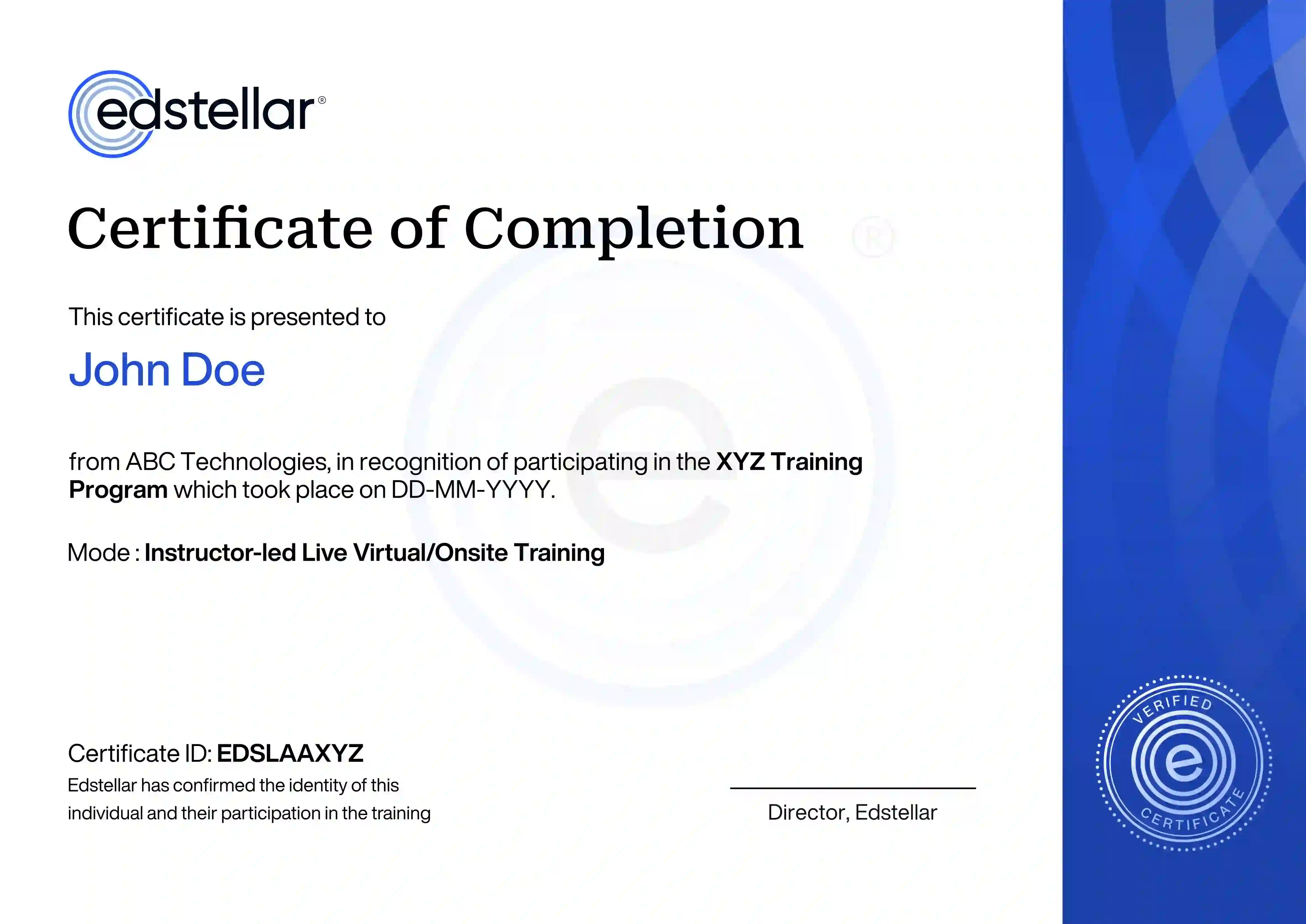
Upon successful completion of the training course offered by Edstellar, employees receive a course completion certificate, symbolizing their dedication to ongoing learning and professional development.
This certificate validates the employee's acquired skills and is a powerful motivator, inspiring them to enhance their expertise further and contribute effectively to organizational success.


Other Related Corporate Training Courses
Explore More Courses
Edstellar is a one-stop instructor-led corporate training and coaching solution that addresses organizational upskilling and talent transformation needs globally.
Marketing Excellence
Operational Excellence
Finance Excellence
HR Excellence
IT Excellence
Customer Service
Leadership Excellence
Quality Management
Software
How it WorksFAQ'sCorporate Training
CatalogStellar AI
Skill MatrixHRMS Integration
Who we ServeCEO RetreatsPricingTraining DeliveryPartner with Edstellar
CareersContact us