Corporate Tax Crime and Fraud Investigation Training Course
Edstellar's instructor-led Tax Crime and Fraud Investigation training course empowers teams with investigative skills to achieve compliance and financial integrity for the organization. The course equips employees to detect and investigate tax fraud, analyze financial data for irregularities, and implement forensic accounting methodologies.
(Virtual / On-site / Off-site)
Available Languages
English, Español, 普通话, Deutsch, العربية, Português, हिंदी, Français, 日本語 and Italiano
Drive Team Excellence with Tax Crime and Fraud Investigation Corporate Training
Tax Crime and Fraud Investigation involves identifying, examining, and addressing fraudulent activities related to taxes, ensuring organizational compliance and financial integrity. It is vital for organizations to implement these practices to prevent financial losses, maintain ethical standards, and comply with legal regulations. Tax Crime and Fraud Investigation training course equips employees with the advanced techniques and skills to conduct thorough investigations and uphold the organization's legal and ethical responsibilities.
Edstellar's instructor-led Tax Crime and Fraud Investigation training course offers virtual/onsite sessions facilitated by industry experts with extensive experience in the domain. Employees benefit from practical insights, customizable curriculums, and hands-on exercises tailored to real-world scenarios.

Skills Your Employees Will Gain
These are the core, hands-on capabilities your team builds during the program.
- Forensic AccountingForensic Accounting involves investigating financial discrepancies and fraud. This skill is important for auditors and financial analysts, as it ensures accuracy and integrity in financial reporting.
- Fraud DetectionFraud Detection is the ability to identify and prevent fraudulent activities through data analysis and pattern recognition. This skill is important for roles in finance, security, and compliance, as it safeguards assets and maintains trust.
- Financial AnalysisFinancial Analysis is the process of evaluating financial data to assess an organization's performance and make informed decisions. This skill is important for roles like financial analyst, accountant, and investment manager, as it drives strategic planning and risk management.
- Legal ProceduresLegal Procedures refer to the established processes and rules governing legal actions. This skill is important for roles like lawyers and paralegals, ensuring compliance and effective advocacy.
- Evidence CollectionEvidence Collection is the systematic gathering of information to support investigations or decision-making. This skill is important for roles in law enforcement, legal professions, and research, as it ensures accuracy, credibility, and integrity in findings.
- Interviewing SkillsInterviewing Skills involve effectively assessing candidates through structured questions and active listening. This skill is important for HR professionals to identify top talent and ensure a good fit for the organization.
What Your Team Will Achieve After This Training
- Utilize regulatory knowledge to ensure organizational compliance with tax laws and prevent legal repercussions
- Analyze financial data to identify irregularities and potential fraudulent activities within organizational operations
- Develop comprehensive strategies to mitigate tax evasion and fraud risks, ensuring compliance with legal standards
- Implement forensic accounting methodologies to trace illicit financial transactions and recover misappropriated assets
- Assess organizational vulnerabilities and design proactive measures to prevent financial crimes, enhancing overall security
Topics & Program Outline
The curriculum is organized into focused modules built by industry experts and delivered virtually or on-premise. Interactive sessions reflect the evolving demands of the workplace, keeping the learning both relevant and practical.
- Introduction
- Overview of financial investigations
- Scope and significance of financial crime investigations
- Key objectives of investigation processes
- The importance of financial investigations
- Impact of financial crimes on the economy
- The role of financial investigations in ensuring compliance
- Management of financial investigations
- Structuring investigation teams
- Developing investigation plans and strategies
- Resource allocation and management
- Leadership skills
- Essential leadership qualities for investigators
- Decision-making in high-pressure situations
- Motivating and managing investigation teams
- Managing limited resources
- Optimizing the use of available resources
- Prioritizing tasks and objectives
- Techniques for efficient resource management
- Domestic investigations
- Navigating local laws and regulations
- Collaboration with domestic agencies
- International investigations
- Challenges in cross-border investigations
- International legal frameworks and cooperation
- Strategies for effective international investigations
- The fundamentals of ownership
- Definition and types of ownership
- Legal implications of ownership
- Ownership structures
- Asset ownership and their tax commitments
- Tax obligations of different asset types
- Reporting requirements for asset ownership
- Impact of ownership on tax liabilities
- Misuse of corporate legislation
- Common tactics for exploiting corporate laws
- Legal measures to prevent abuse
- Offshore companies and tax crimes
- Role of offshore companies in tax evasion
- Regulatory challenges in dealing with offshore entities
- Sources of information
- Identifying reliable information sources
- Techniques for gathering evidence
- Analyzing information for investigations
- The investigative responsibility of banks and other economic institutions
- Role of financial institutions in investigations
- Compliance and reporting obligations
- Collaboration with investigative agencies
- Prosecutorial and investigative challenges
- Common obstacles in financial investigations
- Strategies to overcome prosecutorial challenges
- Threats and risks assessments
- Identifying potential threats in financial investigations
- Assessing risk factors
- Mitigation strategies
- Tools for effective investigation
- Technological tools for financial investigations
- Data analysis software
- Forensic accounting techniques
- Illicit flows of finances
- Methods of money laundering
- Tracking illicit financial flows
- Track money in complex financial arrangements
- Techniques for tracing financial transactions
- Analyzing complex financial structures
- Collaboration with financial institutions
- Bribery and corruption awareness
- Identifying indicators of bribery and corruption
- Legal implications and penalties
- Preventive measures
- Role of tax and financial crime investigators in combating offenses
- Responsibilities of investigators
- Techniques for detecting bribery and corruption
- Awareness for tax examiners and auditors
- Training programs for examiners and auditors
- Recognizing signs of corruption
- Reporting mechanisms
- Issues about bribery and other types of corruption
- Types of corruption affecting tax assessments
- Legal frameworks for combating corruption
- Support on how to recognize indicators of potential bribery attempts
- Identifying red flags
- Techniques for investigating bribery
- Preventive strategies
- Corruption in the direction of routine tax assessments and audits
- Impact of corruption on tax assessments
- Strategies for mitigating corruption
- Risks posed by corruption and money laundering
- Global impact of corruption and laundering
- Risk factors and assessment
- Effective co-operation between government agencies and countries
- International legal frameworks
- Current initiatives to improve inter-agency cooperation
- Ongoing international initiatives
- Tools and frameworks for cooperation
- Future trends
- Usage of modern techniques to identify connections between suspects of financial crimes
- Advanced analytical techniques
- Data mining and pattern recognition
- Various agencies involved in the battle against financial crimes
- Roles of different agencies
- Collaboration strategies
- International instruments available
- Legal instruments and treaties
- Tools for international cooperation
- Electronic sales suppression
- Techniques for detecting electronic sales suppression
- Legal implications
- False invoicing
- Identifying false invoices
- Techniques for investigating invoice fraud
- Identifying tax crimes via transaction reports
- Analyzing transaction reports
- Techniques for detecting tax crimes
- Checklist to audit corporate reports
- Key indicators of fraud in corporate reports
- Audit techniques
- Analysis of different cooperation models
- Types of cooperation models
- Benefits and challenges
- Combating financial crime
- Techniques for combating financial crimes
- Tools and strategies
- Models for sharing information between tax administration and law enforcement units
- Legal frameworks
- The role of the financial information unit and financial regulators
- Responsibilities of financial information units
- Collaboration with regulators
- Methods of proof
- Types of evidence
- Techniques for gathering proof
- Planning, conducting, and recording interviews
- Steps for effective interviewing
- Recording techniques
- International initiatives
- International legal frameworks
- Planning, conducting, and recording interviews
- Effective interview planning
- Conducting and documenting interviews
- Investigative techniques
- Advanced interview techniques
- Psychological strategies
- Effective interview guidelines
- Legal considerations
- Dos and don’ts of investigative interviews
- Common pitfalls
- The role of human psychology in conducting investigative interviews
- Psychological principles in interviews
- Techniques for understanding interviewees
- Functions of point of sales systems
- Role in financial transactions
- Techniques for monitoring and investigating
- Areas of risk to tax administrations
- Identifying high-risk areas
- Strategies for mitigating risks
- Frauds over taxes on profit and earnings
- Common fraud techniques
- Investigative strategies
- Customs duties
- Impact of customs duties on tax fraud
- Investigative techniques
- VAT
- VAT fraud schemes
- Techniques for detection and investigation
- Social security
- Fraud in social security systems
- Investigative strategies
- Recovering the proceeds of crime
- Techniques for asset recovery
- Legal frameworks and processes
Who Should Attend?
This program suits professionals at many levels across the organization, including:
- Tax Investigators
- Forensic Accountants
- Financial Crime Analysts
- Tax Compliance Officers
- Audit Associates
- Fraud Detection Specialists
- Revenue Officers
- Compliance Analysts
- Legal Investigators
- Tax Audit Managers
- Fraud Investigation Managers
- Financial Crime Managers
What are the Prerequisites?
Employees with a basic understanding of financial accounting and taxation principles can take the Tax Crime and Fraud Investigation course.
Choose the Format That Fits Your Team
We design training your teams actually engage with, and deliver it the way that suits you best. Through a vetted global trainer network, Edstellar runs sessions in 10+ languages with consistent quality anywhere.


.webp)
Virtual / online: expert-led live sessions delivered anywhere, with consistency and easy scheduling.
.webp)
On-site (in-house): immersive, instructor-led learning at your office.
.webp)
Off-site: focused, instructor-led group learning away from everyday workplace distractions.
Get a Proposal Shaped to Your Needs
Need pricing for onsite, offsite, or virtual delivery? Get a proposal tailored to your team's needs.
64 hours of group training (includes VILT/In-person On-site)
Tailored for SMBs
Tailor-Made Trainee Licenses with Our Exclusive Training Packages!
160 hours of group training (includes VILT/In-person On-site)
Ideal for growing SMBs
Tailor-Made Trainee Licenses with Our Exclusive Training Packages!
400 hours of group training (includes VILT/In-person On-site)
Designed for large corporations
Tailor-Made Trainee Licenses with Our Exclusive Training Packages!
Unlimited duration
Designed for large corporations
What Sets Edstellar Apart
Experienced Trainers
Our trainers are drawn from a vetted global network and bring years of industry expertise, keeping every session practical and impactful.
Proven Quality
With a strong global track record, Edstellar is known for quality and engaging delivery.
Industry-Relevant Curriculum
Our programs are built by experts to match the demands of today's industry.
Fully Customizable
Every program can be tailored to your organization's goals.
Comprehensive Support
We provide pre- and post-session support for a complete learning experience.
Global Multi-Location & Multilingual Training Delivery
We deliver in multiple languages to support diverse global teams.
Hear from Organizations We've Trained
"The Tax Crime and Fraud Investigation course revolutionized how I approach my daily responsibilities. As a Senior Software Engineer, understanding practical applications was essential, and this training delivered beyond invaluable real-world experience. My ability to architect solutions and solve complex problems has improved substantially. The instructor's insights on hands-on exercises have proven instrumental in my professional advancement.”
Wilfredo Chandler
Senior Software Engineer,
IT Services and Solutions Provider
"The Tax Crime and Fraud Investigation training provided critical insights into industry best practices that enhanced my consulting capabilities. As a Senior Software Engineer, I now leverage real-world case studies exercises on interactive labs prepared me perfectly for real-world client scenarios. Our solution delivery efficiency and quality have increased substantially across the board, demonstrating immediate value from this investment.”
Fang Wei
Senior Software Engineer,
Global Technology Solutions Provider
"As a Senior Software Engineer leading operational excellence operations, the Tax Crime and Fraud Investigation training provided our team with essential advanced methodologies expertise at scale. The comprehensive modules operational footprint. Our team has automated eighteen critical business processes, reducing manual effort by 70%. This course has proven invaluable for driving our organizational transformation and sustained excellence.”
Youssef Ibrahim
Senior Software Engineer,
Enterprise Software Development Firm
“Edstellar’s Management training programs have greatly improved our teams’ ability to lead with clarity, confidence, and operational efficiency. The sessions combine practical leadership frameworks, real-world case studies, and hands-on exercises that strengthen decision-making, cross-functional collaboration, and execution excellence across departments, driving measurable improvements in overall business performance.”
Meera Rao
HR & L&D Head,
A Global Services Company
Recognition That Motivates Your Team
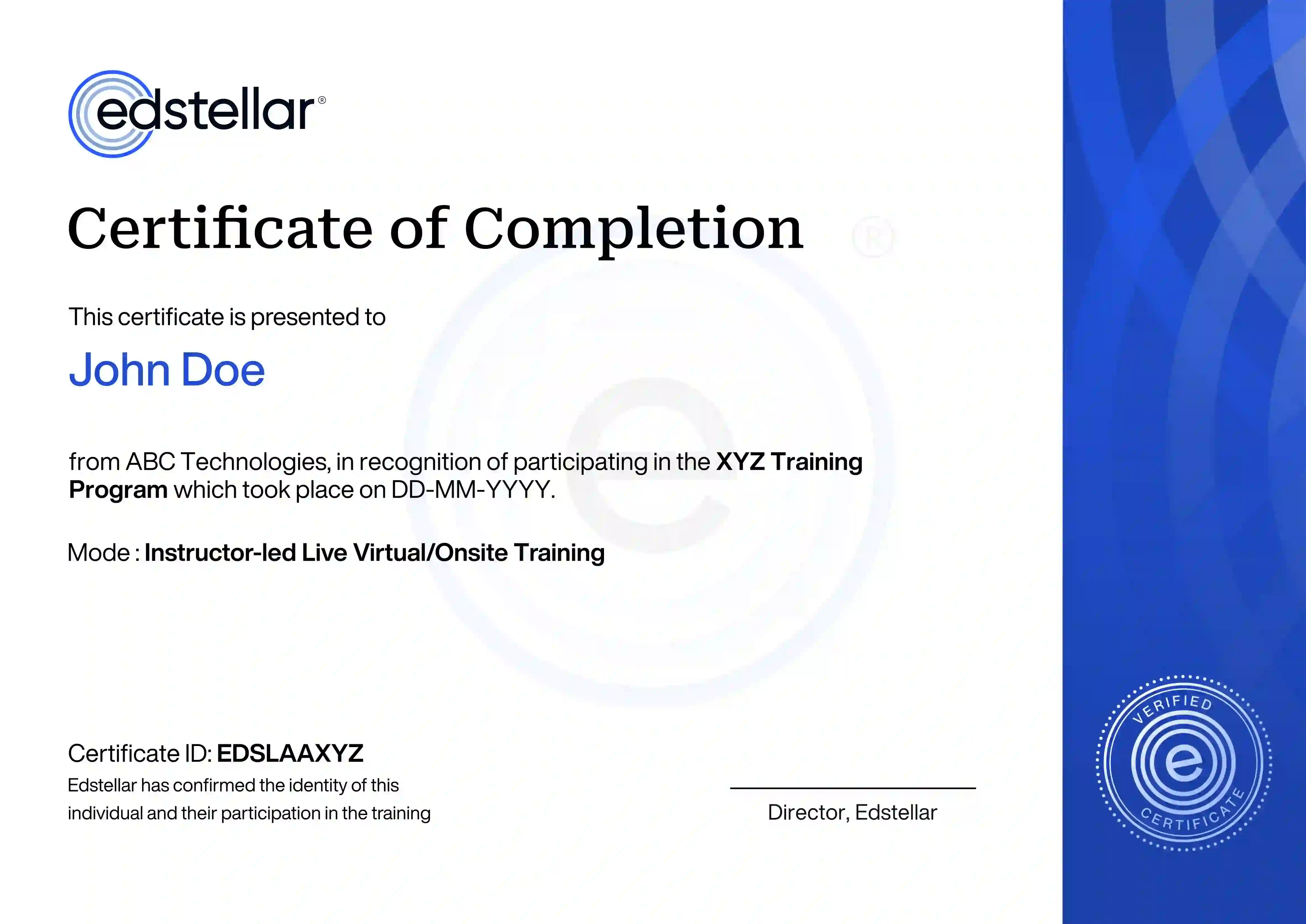
Upon successful completion of the training course offered by Edstellar, employees receive a course completion certificate, symbolizing their dedication to ongoing learning and professional development.
This certificate validates the employee's acquired skills and is a powerful motivator, inspiring them to enhance their expertise further and contribute effectively to organizational success.


Other Related Corporate Training Courses
Explore More Courses
Edstellar is a one-stop instructor-led corporate training and coaching solution that addresses organizational upskilling and talent transformation needs globally.
Learning Technology
Learning Content Design and Development
Learning Governance, Analytics & ROI
Digital Learning Ecosystem
Training Simulations, AR/VR & Case Studies
Employee Performance Support
Leadership Pipeline & Succession PlanningStrategic Workforce Planning for EnterprisesTransformation & Risk Advisory for EnterprisesDEI Consulting for EnterprisesEmployee Engagement Consulting for Enterprises
Cultural Transformation