Corporate Appian Developer Training Course
Edstellar’s Appian Developer instructor-led training course equips teams with low-code application development skills to achieve faster process automation and business agility for the organization. The course covers escalations, gateways, and document management. Upskill and enhance your team to stay ahead in business process management.
(Virtual / On-site / Off-site)
Available Languages
English, Español, 普通话, Deutsch, العربية, Português, हिंदी, Français, 日本語 and Italiano
Drive Team Excellence with Appian Developer Corporate Training
Empower your teams with expert-led on-site, off-site, and virtual Appian Developer Training through Edstellar, a premier corporate training provider for organizations globally. Designed to meet your specific training needs, this group training program ensures your team is primed to drive your business goals. Help your employees build lasting capabilities that translate into real performance gains.
Appian Developer refers to professionals skilled in using the Appian Low-Code Automation Platform to create BPM and low-code applications, essential for organizations seeking streamlined processes, increased efficiency, and accelerated digital transformation. Training in Appian Development provides the knowledge and skills needed to effectively utilize this platform, enabling individuals to design, build, and customize applications to meet specific business needs.
Edstellar's virtual/onsite Appian Developer training course offers customization and employs cutting-edge methodologies. Our trainers are renowned for their expertise in Appian Developer instructor-led training courses and have extensive experience in navigating the intricacies of the platform in designing and implementing BPM solutions, automating workflows, and integrating external systems.

Key Skills Employees Gain from instructor-led Appian Developer Training
Appian Developer skills corporate training will enable teams to effectively apply their learnings at work.
- Appian Design ToolsAppian Design Tools involve creating applications using the Appian platform's visual interface. This skill is important for developers and business analysts to streamline processes, enhance efficiency, and deliver effective solutions.
- Business Process ModelingBusiness Process Modeling (BPM) is the graphical representation of an organization's processes. This skill is important for analysts and managers to optimize efficiency and drive improvements.
- User Interface DevelopmentUser Interface Development involves designing and creating user-friendly interfaces for software applications. This skill is important for roles like UI/UX designers and front-end developers, as it enhances user experience and engagement.
- External System IntegrationExternal System Integration is the ability to connect and synchronize different software systems. this skill is important for roles in IT and software development, ensuring seamless data flow and enhanced functionality across platforms.
- Security ImplementationSecurity Implementation involves deploying measures to protect systems and data from threats. This skill is important for IT roles to ensure data integrity and compliance.
- Data IntegrationData Integration is the process of combining data from different sources into a unified view. this skill is important for roles like data analysts and engineers, as it enables informed decision-making and enhances data accuracy.
Key Learning Outcomes of Appian Developer Training Workshop for Employees
Upon completing Edstellar’s Appian Developer workshop, employees will gain valuable, job-relevant insights and develop the confidence to apply their learning effectively in the professional environment.
- Design BPM applications using Appian's tools and components
- Develop complex business rules and logic for workflow automation
- Configure document management systems for efficient document handling
- Create custom reports and dashboards for data visualization
- Integrate external systems and APIs for seamless data exchange
- Optimize application performance through advanced techniques
- Manage application lifecycle from development to deployment
Key Benefits of the Appian Developer Group Training with Instructor-led Face to Face and Virtual Options
Attending our Appian Developer group training classes provides your team with a powerful opportunity to build skills, boost confidence, and develop a deeper understanding of the concepts that matter most. The collaborative learning environment fosters knowledge sharing and enables employees to translate insights into actionable work outcomes.
- Equips the team with the techniques to become proficient in Appian's low-code development platform
- Empowers professionals with the skills to efficiently create custom business applications
- Develops required skill in professionals to lead digital transformation initiatives
- Instills ideas in employees for leveraging Appian's capabilities in process automation
- Provides teams with the insights into becoming certified Appian developers
- Enables employees to proactively solve problems and deliver high-quality solutions aligned with business objectives
Topics and Outline of Appian Developer Training
Our virtual and on-premise Appian Developer training curriculum is structured into focused modules developed by industry experts. This training for organizations provides an interactive learning experience that addresses the evolving demands of the workplace, making it both relevant and practical.
- Overview of BPM concepts
- What is Business Process Management (BPM)?
- Benefits of using BPM tools
- Different types of BPM methodologies
- Introduction to Appian interface
- Layout of the Appian designer
- Key functionalities of the designer interface
- Common navigation elements
- Navigating Appian designer
- Creating new applications
- Opening and editing existing applications
- Working with different application components
- Configuring escalation rules
- Defining triggers for escalations
- Setting escalation conditions and timeframes
- Selecting escalation actions
- Handling escalated tasks:
- Identifying and resolving escalated tasks
- Understanding the impact of escalations on workflows
- Organizing objects within Appian applications
- Types of objects in Appian
- Creating and structuring folders for organization
- Best practices for folder hierarchy management
- Managing folder permissions
- Assigning user and group permissions for accessing folders
- Controlling read, write, and execute permissions
- Implementing security best practices for folder access
- Understanding different types of gateways
- Exclusive gateways for branching workflows
- Inclusive gateways for merging workflows
- Complex gateways for advanced branching and merging
- Implementing conditional routing in workflows
- Using gateways to define decision points in workflows
- Configuring conditions for different branches
- Controlling the flow of execution based on conditions
- Managing user groups and permissions
- Creating and managing user groups
- Assigning users to groups
- Defining group permissions for different application objects
- Implementing role-based access control (RBAC)
- Defining user roles and their associated permissions
- Granting access based on assigned roles
- Maintaining separation of duties and data security
- Creating custom data types (CDTs)
- Defining the structure of CDTs with attributes and data types
- Creating relationships between CDTs
- Using CDTs to store and manage custom data
- Integrating CDTs into application design
- Utilizing CDTs in process models and forms
- Mapping CDT attributes to process variables and form fields
- Leveraging CDTs for data exchange and manipulation
- Configuring data stores for data persistence
- Selecting appropriate data store types
- Establishing connections to external data sources
- Configuring data store settings for security and performance
- Optimizing query rules for performance
- Writing efficient queries to retrieve data from data stores
- Utilizing indexing and other optimization techniques
- Understanding the impact of query complexity on performance
- Setting up document libraries
- Creating and structuring document libraries for organization
- Defining document metadata and properties
- Configuring document versioning and retention policies
- Managing document revisions
- Tracking changes made to documents over time
- Restoring previous versions of documents
- Auditing document history for accountability
- Uploading and downloading documents
- Uploading documents to Appian document libraries
- Downloading documents for local editing or offline access
- Managing document permissions for access control
- Version control and document locking
- Preventing simultaneous editing conflicts with document locking
- Maintaining a history of document revisions with version control
- Parsing Excel files for data extraction
- Extracting data from specific Excel sheets and ranges
- Transforming and manipulating extracted data
- Integrating parsed data into Appian applications
- Integrating parsed data into applications
- Using extracted data as process variables or form field values
- Performing calculations and transformations on extracted data
- Leveraging parsed data for decision-making and reporting
- Building custom user interfaces with SAIL
- Understanding the SAIL (Simple Application Interface Language) scripting language
- Creating custom forms, reports, and user interfaces
- Utilizing advanced SAIL features
- Implementing complex logic in SAIL expressions
- Writing SAIL expressions for data manipulation and calculations
- Using logical operators, functions, and conditional statements in SAIL
- Debugging and troubleshooting SAIL expressions
- Creating basic reports
- Designing report layouts using grids, charts, and filters
- Selecting data sources for reports
- Previewing and running reports
- Configuring report parameters
- Adding user-defined filters
- Implementing dynamic reporting with parameters
- Scheduling and sharing reports
- Managing records within Appian applications
- Designing record data structures and relationships
- Creating, updating, and deleting records
- Generating record lists and views
- Implementing record actions and behaviors
- Defining triggers for record actions
- Automating tasks and notifications based on record events
- Customizing record actions using SAIL
- Integrating Tempo for social collaboration
- Understanding Tempo newsfeed
- Configuring Tempo for communication and updates
- Posting to feeds and commenting on posts
- Utilizing smart services for enhanced functionality
- Overview of common smart services
- Integrating smart services into application workflows
- Leveraging smart services for process automation
- Designing user-friendly sites
- Utilizing Appian Sites for custom portals and interfaces
- Understanding site structure and components
- Employing best practices for UI/UX design in sites
- Customizing site layouts and themes
- Using provided templates and themes
- Modifying themes with CSS
- Creating custom layouts
- Integrating external systems via web APIs
- Understanding REST and SOAP web services
- Consuming external web APIs from Appian
- Handling data formats (JSON, XML)
- Configuring API authentication and authorization
- Implementing security mechanisms for web API access
- Using OAuth and other authentication methods
- Managing API keys and permissions
- Packaging applications for deployment
- Understanding the process of creating application packages
- Including necessary dependencies in application packages
- Managing application versions and releases
- Migrating applications between environments
- Best practices for deploying applications in different Appian environments
- Using import/export functionality for application migration
- Handling environment-specific configurations
Who Can Take the Appian Developer Training Course
The Appian Developer training program can also be taken by professionals at various levels in the organization.
- Application Developers
- Software Engineers
- Business Process Analysts
- Automation Engineers
- Systems Architects
- Workflow Designers
- IT Analysts
- Integration Specialists
- Quality Assurance Analysts
- Software Development Managers
- Process Improvement Managers
- Automation Managers
Prerequisites for Appian Developer Training
Professionals with a basic understanding of business process management concepts can take up the Appian Developer training course.
Corporate Group Training Delivery Modes
for Appian Developer Training
At Edstellar, we understand the importance of impactful and engaging training for employees. As a leading Appian Developer training provider, we ensure the training is more interactive by offering Face-to-Face onsite/in-house or virtual/online sessions for companies. This approach has proven to be effective, outcome-oriented, and produces a well-rounded training experience for your teams.


.webp)
Edstellar's Appian Developer virtual/online training sessions bring expert-led, high-quality training to your teams anywhere, ensuring consistency and seamless integration into their schedules.
.webp)
Edstellar's Appian Developer inhouse face to face instructor-led training delivers immersive and insightful learning experiences right in the comfort of your office.
.webp)
Edstellar's Appian Developer offsite face-to-face instructor-led group training offer a unique opportunity for teams to immerse themselves in focused and dynamic learning environments away from their usual workplace distractions.
Explore Our Customized Pricing Package
for
Appian Developer Corporate Training
Looking for pricing details for onsite, offsite, or virtual instructor-led Appian Developer training? Get a customized proposal tailored to your team’s specific needs.
64 hours of group training (includes VILT/In-person On-site)
Tailored for SMBs
Tailor-Made Trainee Licenses with Our Exclusive Training Packages!
160 hours of group training (includes VILT/In-person On-site)
Ideal for growing SMBs
Tailor-Made Trainee Licenses with Our Exclusive Training Packages!
400 hours of group training (includes VILT/In-person On-site)
Designed for large corporations
Tailor-Made Trainee Licenses with Our Exclusive Training Packages!
Unlimited duration
Designed for large corporations
Edstellar: Your Go-to Appian Developer Training Company
Experienced Trainers
Our trainers bring years of industry expertise to ensure the training is practical and impactful.
Quality Training
With a strong track record of delivering training worldwide, Edstellar maintains its reputation for its quality and training engagement.
Industry-Relevant Curriculum
Our course is designed by experts and is tailored to meet the demands of the current industry.
Customizable Training
Our course can be customized to meet the unique needs and goals of your organization.
Comprehensive Support
We provide pre and post training support to your organization to ensure a complete learning experience.
Multilingual Training Capabilities
We offer training in multiple languages to cater to diverse and global teams.
What Our Clients Say
We pride ourselves on delivering exceptional training solutions. Here's what our clients have to say about their experiences with Edstellar.
"The Appian Developer training exceeded my expectations in every way. As a Low-Code Developer, I gained comprehensive knowledge of integration development that transformed my approach to process automation. The hands-on practical and immediately applicable. My ability to architect solutions and solve complex problems has improved substantially. The instructor's expertise in expression rules made complex concepts crystal clear and actionable.”
Carol Gilbert
Low-Code Developer,
IT Services and Solutions Provider
"This Appian Developer course was precisely what I needed to design robust BPM architectures. The hands-on approach to records and reports and seamless integration with integration objects was outstanding preparation. BPM platforms projects using advanced techniques from this training. Our client satisfaction scores improved by 35% across all accounts. The comprehensive curriculum has elevated my solution delivery capabilities significantly.”
Zhao Na
BPM Developer,
Technology Consulting Services Company
"As a Solutions Developer leading BPM operations, the Appian Developer training provided our team with essential interface design expertise at scale. The comprehensive modules on interface design and expression across our complete operational footprint. Our department achieved a remarkable 50% improvement in operational efficiency metrics. This course has proven invaluable for driving our organizational transformation and sustained excellence.”
Ganga Pradhan
Solutions Developer,
Digital Innovation Platform
“Edstellar’s IT & Technical training programs have been instrumental in strengthening our engineering teams and building future-ready capabilities. The hands-on approach, practical cloud scenarios, and expert guidance helped our teams improve technical depth, problem-solving skills, and execution across multiple projects. We’re excited to extend more of these impactful programs to other business units.”
Aditi Rao
L&D Head,
A Global Technology Company
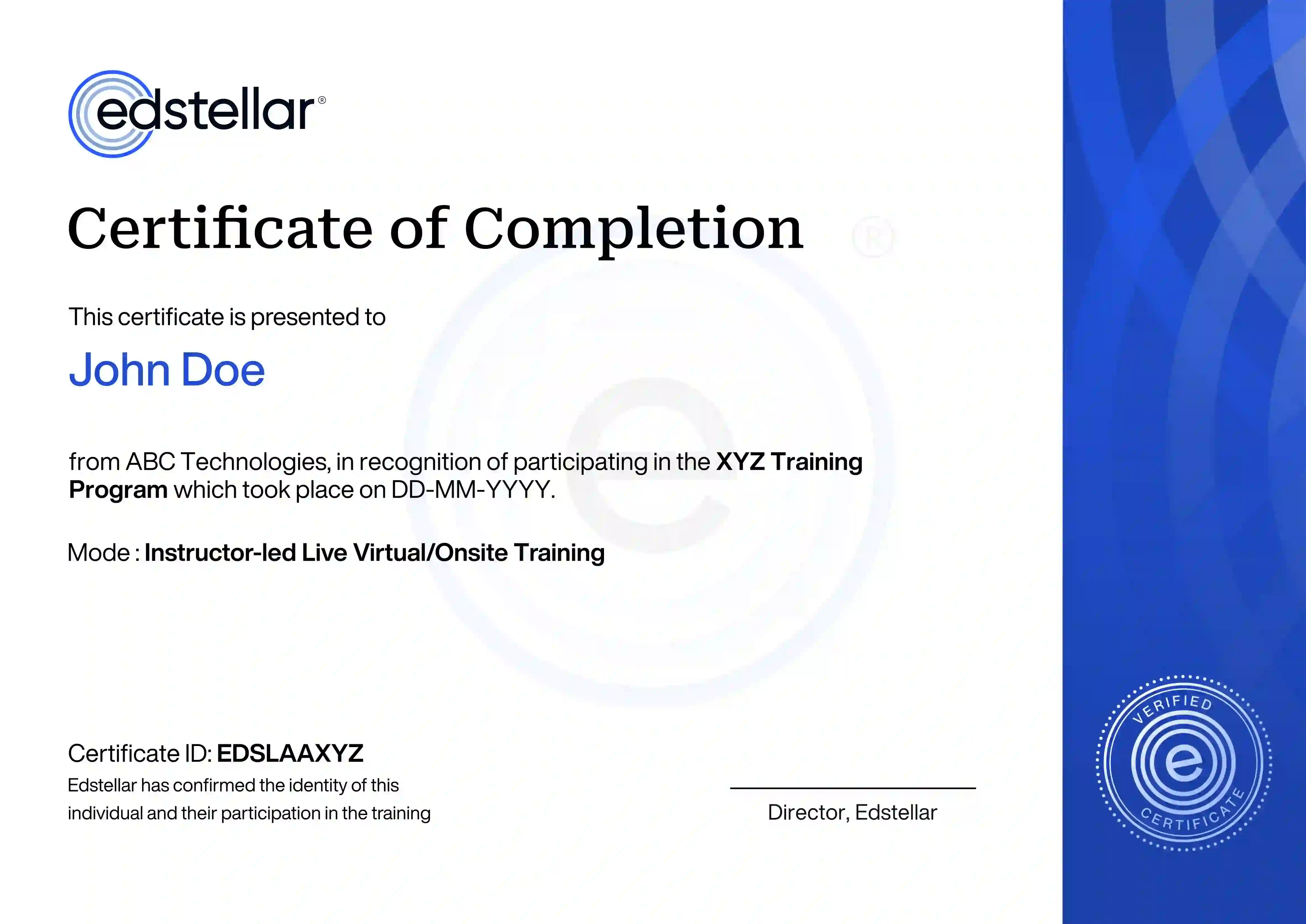
Get Your Team Members Recognized with Edstellar’s Course Certificate
Upon successful completion of the training course offered by Edstellar, employees receive a course completion certificate, symbolizing their dedication to ongoing learning and professional development.
This certificate validates the employee's acquired skills and is a powerful motivator, inspiring them to enhance their expertise further and contribute effectively to organizational success.


We have Expert Trainers to Meet Your Appian Developer Training Needs
The instructor-led training is conducted by certified trainers with extensive expertise in the field. Participants will benefit from the instructor's vast knowledge, gaining valuable insights and practical skills essential for success in Access practices.
Other Related Corporate Training Courses
Explore More Courses
Edstellar is a one-stop instructor-led corporate training and coaching solution that addresses organizational upskilling and talent transformation needs globally. Edstellar offers 2000+ tailored programs across disciplines that include Technical, Behavioral, Management, Compliance, Leadership and Social Impact.
FAQs
BlogSitemap