Corporate Financial Accounting and Taxation Training Course
Edstellar's instructor-led Financial Accounting and Taxation training course empowers teams with financial management skills to achieve financial reporting and regulatory compliance for the organization. The course equips employees with tax planning, methods for interpreting financial statements, & the ability to navigate complex tax regulations.
(Virtual / On-site / Off-site)
Available Languages
English, Español, 普通话, Deutsch, العربية, Português, हिंदी, Français, 日本語 and Italiano
Drive Team Excellence with Financial Accounting and Taxation Corporate Training
Empower your teams with expert-led on-site, off-site, and virtual Financial Accounting and Taxation Training through Edstellar, a premier corporate training provider for organizations globally. Designed to meet your specific training needs, this group training program ensures your team is primed to drive your business goals. Help your employees build lasting capabilities that translate into real performance gains.
Financial Accounting and Taxation is the systematic process of recording, analyzing, and reporting an organization’s financial transactions and tax obligations. It is essential for maintaining precise financial records and ensuring regulatory compliance. It is vital for organizations as it aids in strategic decision-making, risk management, and legal adherence, safeguarding financial integrity and enhancing operational efficiency. Financial Accounting and Taxation training course equips employees with advanced financial management skills, enabling them to contribute effectively to the organization's financial health and compliance.
Edstellar's instructor-led Financial Accounting and Taxation training course, facilitated by industry experts with years of hands-on experience, is delivered through virtual/onsite formats. The course offers a tailored curriculum, practical insights, and customizable modules to suit diverse organizational needs. Employees gain proficiency in financial reporting, tax planning, and compliance strategies, empowering them to contribute effectively to their organization's regulatory requirements.

Key Skills Employees Gain from instructor-led Financial Accounting and Taxation Training
Financial Accounting and Taxation skills corporate training will enable teams to effectively apply their learnings at work.
- Financial ReportingFinancial Reporting is the process of preparing and presenting financial statements to communicate a company's financial performance. This skill is important for accountants and financial analysts, as it ensures transparency, aids decision-making, and complies with regulations.
- Audit PreparationAudit Preparation involves organizing financial records and documentation to ensure compliance and accuracy. This skill is important for accountants and auditors to facilitate smooth audits and identify discrepancies.
- Cost AnalysisCost Analysis is the process of evaluating the costs associated with a project or business operation. This skill is important for financial analysts and project managers as it aids in budgeting, resource allocation, and maximizing profitability.
- Financial StatementsFinancial Statements are formal records of the financial activities of a business, providing insights into its performance. This skill is important for roles in finance, accounting, and management, as it enables professionals to analyze data, make informed decisions, and ensure compliance.
- Revenue RecognitionRevenue Recognition is the accounting principle that determines when revenue is recorded. This skill is important for finance roles to ensure accurate financial reporting and compliance.
- Taxation LawsTaxation Laws refer to the regulations governing tax obligations. This skill is important for roles in finance, accounting, and law, ensuring compliance and optimizing tax strategies.
Key Learning Outcomes of Financial Accounting and Taxation Training Workshop for Employees
Upon completing Edstellar’s Financial Accounting and Taxation workshop, employees will gain valuable, job-relevant insights and develop the confidence to apply their learning effectively in the professional environment.
- Apply accounting conventions and policies to maintain precise and consistent financial records in professional practice
- Analyze financial statements to provide insights and support strategic decision-making processes within the organization
- Develop effective revenue recognition methods to ensure compliance with financial reporting standards and enhance financial transparency
- Evaluate the impact of major financial scandals like Worldcom and Enron to improve corporate governance and ethical standards in financial reporting
- Implement International Accounting Standards (IAS) and International Financial Reporting Standards (IFRS) to align with global financial reporting practices and enhance international business operations
Key Benefits of the Financial Accounting and Taxation Group Training with Instructor-led Face to Face and Virtual Options
Attending our Financial Accounting and Taxation group training classes provides your team with a powerful opportunity to build skills, boost confidence, and develop a deeper understanding of the concepts that matter most. The collaborative learning environment fosters knowledge sharing and enables employees to translate insights into actionable work outcomes.
- Learn advanced techniques for precise financial reporting, enhancing the reliability of your organization's financial statements
- Equip employees with tax planning and compliance skills, ensuring adherence to regulatory requirements and optimizing tax liabilities
- Develop proficiency in interpreting financial statements, enabling you to provide valuable insights for strategic decision-making
- Explore methods to navigate complex tax regulations, improving your ability to manage tax-related challenges effectively
- Learn how to implement International Accounting Standards (IAS) and International Financial Reporting Standards (IFRS), aligning your organization's financial practices with global standards
Topics and Outline of Financial Accounting and Taxation Training
Our virtual and on-premise Financial Accounting and Taxation training curriculum is structured into focused modules developed by industry experts. This training for organizations provides an interactive learning experience that addresses the evolving demands of the workplace, making it both relevant and practical.
- Accounting conventions
- Definition and importance
- Types of accounting conventions
- Consistency convention
- Prudence convention
- Materiality convention
- Application in financial statements
- Accounting policies
- Definition and purpose
- Selection of accounting policies
- Changes in accounting policies
- Disclosure of accounting policies
- Revenue recognition
- Principles of revenue recognition
- Methods of revenue recognition
- Revenue recognition under IFRS and IAS
- Impact of revenue recognition on financial statements
- Worldcom / Enron scandals
- Overview of the Worldcom scandal
- Overview of the Enron scandal
- Impact on accounting practices and regulations
- International Accounting Standards (IAS)
- History and development of IAS
- Key IAS standards
- Application and compliance with IAS
- Differences between IAS and national accounting standards
- International Financial Reporting Standards (IFRS)
- Introduction to IFRS
- Importance of IFRS in global financial reporting
- Major IFRS standards
- Transition from IAS to IFRS
- Components of financial reports
- Overview of financial reports
- Importance of financial reporting
- Users of financial reports
- Structure of financial reports
- Balance sheet
- Definition and purpose
- Components of a balance sheet
- Classification of assets and liabilities
- Analysis of the balance sheet
- Profit & loss statement
- Definition and purpose
- Components of a profit & loss statement
- Revenue and expense recognition
- Analysis of profit & loss statement
- Statement of cash flow
- Purpose and importance
- Components of cash flow statement
- Cash flow from operating activities
- Cash flow from investing activities
- Cash flow from financing activities
- Statement of changes in equity
- Purpose and components
- Share capital and reserves
- Retained earnings
- Analysis of changes in equity
- Accompanying notes to the accounts
- Purpose and importance
- Types of notes
- Disclosure requirements
- Analysis of notes to the accounts
- Ratio analysis
- Definition and purpose
- Types of financial ratios
- Liquidity ratios
- Profitability ratios
- Efficiency ratios
- Solvency ratios
- Vertical balance sheet & P&L statement
- Definition and purpose
- Format of vertical balance sheet
- Format of vertical P&L statement
- Analysis using vertical statements
- Horizontal balance sheet & P&L statement
- Definition and purpose
- Format of horizontal balance sheet
- Format of horizontal P&L statement
- Comparative analysis using horizontal statements
- DuPont model
- Introduction to DuPont analysis
- Components of DuPont model
- Application of DuPont model in financial analysis
- Benefits of DuPont analysis
- Income vs. Taxable income
- Definition of income
- Definition of taxable income
- Differences between income and taxable income
- Calculation of taxable income
- Income tax
- Overview of income tax
- Types of income tax
- Calculation of income tax
- Filing income tax returns
- Corporation tax
- Definition and purpose
- Calculation of corporation tax
- Corporation tax rates
- Filing corporation tax returns
- Value Added Tax (VAT)
- Introduction to VAT
- Calculation of VAT
- VAT rates and exemptions
- Filing VAT returns
- Customs & excise duty
- Overview of customs duty
- Overview of excise duty
- Calculation of duties
- Timing difference & deferred tax
- Definition of timing differences
- Concept of deferred tax
- Calculation of deferred tax
- Accounting for deferred tax
- Inventory control
- Importance of inventory control
- Methods of inventory control
- Inventory valuation techniques
- Inventory management systems
- Accounts receivable
- Definition and importance
- Management of accounts receivable
- Credit policies and terms
- Collection strategies
- Accounts payable
- Definition and importance
- Management of accounts payable
- Payment terms and policies
- Strategies for optimizing accounts payable
- Reconciliation of sub-ledgers
- Purpose of reconciliation
- Types of sub-ledgers
- Reconciliation process
- Importance of accurate reconciliation
- Other current assets & current liabilities
- Definition of current assets
- Definition of current liabilities
- Management of other current assets
- Management of other current liabilities
- Sales
- Role of ERP in sales management
- Sales order processing
- Integration with CRM
- Sales reporting and analysis
- Bill of material
- Definition and importance
- Components of bill of material
- Creation and management in ERP
- Integration with production planning
- Material management
- Overview of material management
- Inventory management in ERP
- Procurement and sourcing
- Warehouse management
- Procurement
- Role of ERP in procurement
- Supplier management
- Purchase order processing
- Procurement reporting and analysis
- Production
- Production planning in ERP
- Manufacturing execution systems
- Quality control and assurance
- Production reporting and analysis
- Finance
- Financial management in ERP
- General ledger accounting
- Accounts payable and receivable
- Financial reporting and analysis
- Capital investment appraisal
- Definition and importance
- Methods of investment appraisal
- Risk assessment in investment appraisal
- Decision-making process
- Return on Investment (ROI)
- Definition and calculation
- Importance of ROI
- Analysis of ROI
- Application in decision-making
- Payback period
- Definition and calculation
- Importance of payback period
- Analysis of the payback period
- Application in investment decisions
- Net Present Value (NPV)
- Definition and calculation
- Importance of NPV
- Analysis of NPV
- Application in capital budgeting
- Internal rate of return (IRR)
- Definition and calculation
- Importance of IRR
- Analysis of IRR
- Application in investment appraisal
- Lease or buy decisions
- Factors influencing lease or buy decisions
- Financial analysis of leasing vs buying
- Tax implications of leasing vs buying
- Decision-making criteria
- Tax implications thereof
- Tax treatment of capital expenditures
- Depreciation and amortization
- Tax credits and incentives
- Impact on financial statements
- Preparation of master budget
- Definition and components
- Steps in preparing a master budget
- Coordination among departments
- Monitoring and updating the master budget
- Fixed vs. flexible budgets
- Definition and differences
- Advantages and disadvantages
- Application in different scenarios
- Analysis and comparison
- Quarterly reviews
- Purpose of quarterly reviews
- Process of conducting quarterly reviews
- Adjustments and revisions
- Reporting and analysis
- Forward planning
- Importance of forward planning
- Techniques for forward planning
- Integration with strategic goals
- Monitoring and updating forward plans
- Budget/actual comparison
- Purpose of budget/actual comparison
- Methods of comparison
- Analysis of variances
- Reporting and corrective actions
- Zero-based budgets
- Definition and concept
- Steps in preparing zero-based budgets
- Advantages and disadvantages
- Application in cost management
Who Can Take the Financial Accounting and Taxation Training Course
The Financial Accounting and Taxation training program can also be taken by professionals at various levels in the organization.
- Accountants
- Financial Analysts
- Tax Analysts
- Tax Accountants
- Financial Controllers
- Business Analysts
- Finance Assistants
- Payroll Administrators
- Compliance Officers
- Tax Managers
- Finance Managers
- Accounting Managers
Prerequisites for Financial Accounting and Taxation Training
Employees with a basic understanding of accounting principles and familiarity with tax regulations can take the Financial Accounting and Taxation training course.
Corporate Group Training Delivery Modes
for Financial Accounting and Taxation Training
At Edstellar, we understand the importance of impactful and engaging training for employees. As a leading Financial Accounting and Taxation training provider, we ensure the training is more interactive by offering Face-to-Face onsite/in-house or virtual/online sessions for companies. This approach has proven to be effective, outcome-oriented, and produces a well-rounded training experience for your teams.


.webp)
Edstellar's Financial Accounting and Taxation virtual/online training sessions bring expert-led, high-quality training to your teams anywhere, ensuring consistency and seamless integration into their schedules.
.webp)
Edstellar's Financial Accounting and Taxation inhouse face to face instructor-led training delivers immersive and insightful learning experiences right in the comfort of your office.
.webp)
Edstellar's Financial Accounting and Taxation offsite face-to-face instructor-led group training offer a unique opportunity for teams to immerse themselves in focused and dynamic learning environments away from their usual workplace distractions.
Explore Our Customized Pricing Package
for
Financial Accounting and Taxation Corporate Training
Looking for pricing details for onsite, offsite, or virtual instructor-led Financial Accounting and Taxation training? Get a customized proposal tailored to your team’s specific needs.
64 hours of group training (includes VILT/In-person On-site)
Tailored for SMBs
Tailor-Made Trainee Licenses with Our Exclusive Training Packages!
160 hours of group training (includes VILT/In-person On-site)
Ideal for growing SMBs
Tailor-Made Trainee Licenses with Our Exclusive Training Packages!
400 hours of group training (includes VILT/In-person On-site)
Designed for large corporations
Tailor-Made Trainee Licenses with Our Exclusive Training Packages!
Unlimited duration
Designed for large corporations
Edstellar: Your Go-to Financial Accounting and Taxation Training Company
Experienced Trainers
Our trainers bring years of industry expertise to ensure the training is practical and impactful.
Quality Training
With a strong track record of delivering training worldwide, Edstellar maintains its reputation for its quality and training engagement.
Industry-Relevant Curriculum
Our course is designed by experts and is tailored to meet the demands of the current industry.
Customizable Training
Our course can be customized to meet the unique needs and goals of your organization.
Comprehensive Support
We provide pre and post training support to your organization to ensure a complete learning experience.
Multilingual Training Capabilities
We offer training in multiple languages to cater to diverse and global teams.
What Our Clients Say
We pride ourselves on delivering exceptional training solutions. Here's what our clients have to say about their experiences with Edstellar.
"The Financial Accounting and Taxation training provided me with comprehensive capabilities that elevated my expertise. As a Senior Software Engineer, I needed to understand advanced methodologies deeply, and this course delivered interactive labs gave me hands-on experience with industry best practices. My ability to architect solutions and solve complex problems has improved substantially. Highly recommend for anyone serious about this field.”
Kenneth Parker
Senior Software Engineer,
Audit & Compliance Company
"This Financial Accounting and Taxation course was precisely what I needed to design robust operational excellence architectures. The hands-on approach to expert-led workshops and seamless integration with practical using advanced techniques from this training. Our solution delivery efficiency and quality have increased substantially across the board. The comprehensive curriculum has elevated my solution delivery capabilities significantly.”
Wei Chen
Senior Software Engineer,
Accounting Services Platform
"The Financial Accounting and Taxation training gave our team advanced industry best practices expertise that revolutionized our technical mastery approach. As a Senior Software Engineer, understanding real-world case studies initiatives across our entire portfolio. Our department achieved a remarkable 50% improvement in operational efficiency metrics. This training has become foundational to our team's strategic capabilities and continued growth.”
Subramanian Kumar
Senior Software Engineer,
Accounting Software Platform Provider
“Edstellar’s Management training programs have greatly improved our teams’ ability to lead with clarity, confidence, and operational efficiency. The sessions combine practical leadership frameworks, real-world case studies, and hands-on exercises that strengthen decision-making, cross-functional collaboration, and execution excellence across departments, driving measurable improvements in overall business performance.”
Meera Rao
HR & L&D Head,
A Global Services Company
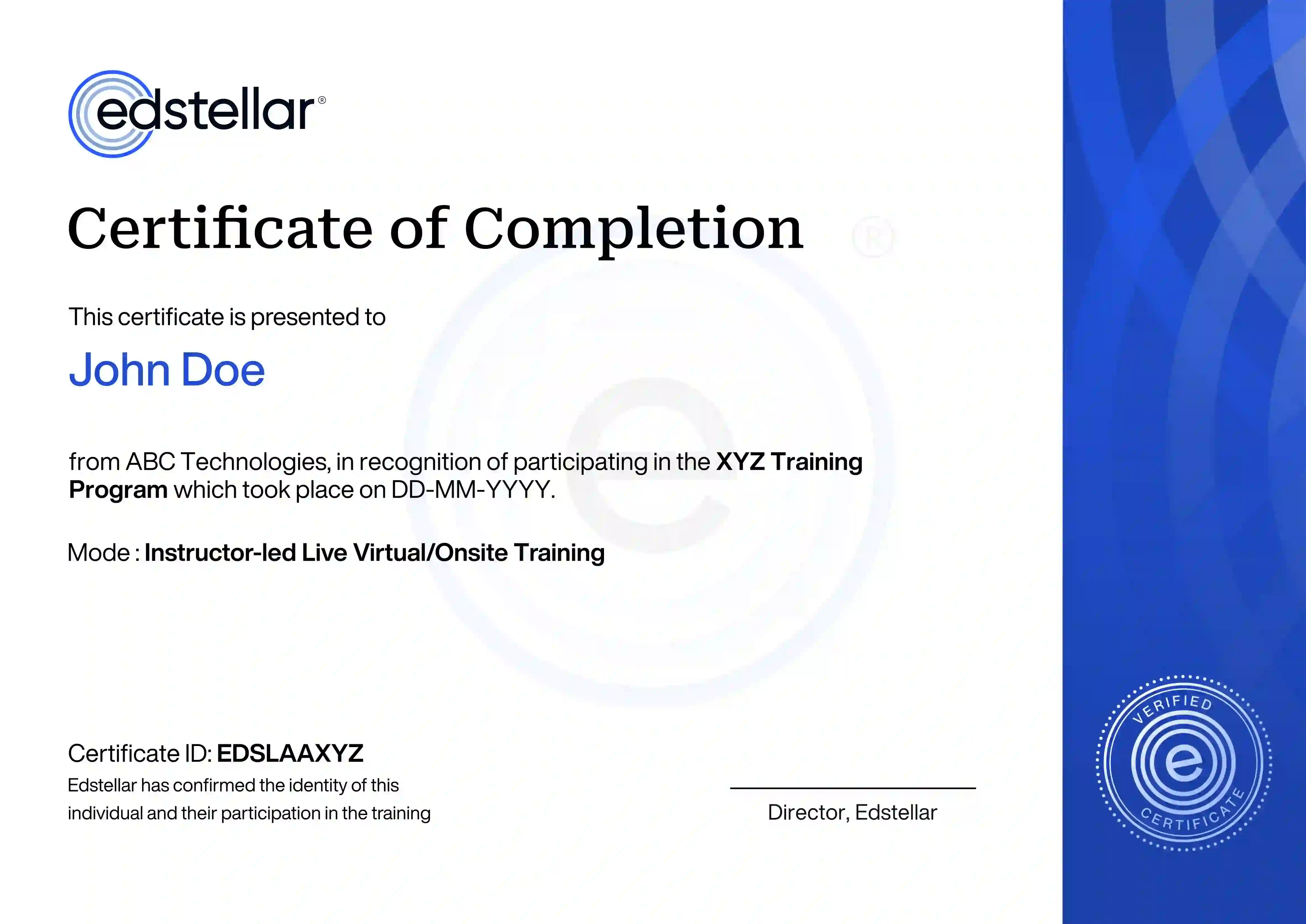
Get Your Team Members Recognized with Edstellar’s Course Certificate
Upon successful completion of the training course offered by Edstellar, employees receive a course completion certificate, symbolizing their dedication to ongoing learning and professional development.
This certificate validates the employee's acquired skills and is a powerful motivator, inspiring them to enhance their expertise further and contribute effectively to organizational success.


We have Expert Trainers to Meet Your Financial Accounting and Taxation Training Needs
The instructor-led training is conducted by certified trainers with extensive expertise in the field. Participants will benefit from the instructor's vast knowledge, gaining valuable insights and practical skills essential for success in Access practices.
Other Related Corporate Training Courses
Explore More Courses
Edstellar is a one-stop instructor-led corporate training and coaching solution that addresses organizational upskilling and talent transformation needs globally. Edstellar offers 2000+ tailored programs across disciplines that include Technical, Behavioral, Management, Compliance, Leadership and Social Impact.
FAQs
BlogSitemap