10 Most In-Demand Skills in Hong Kong for 2026
.webp)

.svg "edstellar")

Hong Kong stands as one of Asia's most dynamic economies, combining its role as a global financial centre with an accelerating push into innovation, smart city infrastructure, and green finance. The HKSAR government's Smart City Blueprint 2.0, the HKMA FinTech 2025 strategy, and the Northern Metropolis development programme have collectively triggered the largest wave of skilled talent demand the city has seen in a generation.
The scale of the talent gap is significant. The Construction Industry Council reported a shortage of 8,400 skilled construction professionals in 2024 as the Northern Metropolis and Lantau Tomorrow Vision projects ramp up simultaneously. The Hospital Authority projects a deficit of over 1,600 nurses by 2026 against the backdrop of a rapidly ageing population. Meanwhile, the HKPC Cyber Security Team identified more than 3,000 unfilled cybersecurity roles across the private and public sectors. The HKSAR government has responded with the Top Talent Pass Scheme to attract global talent, but building domestic capability through training and upskilling remains the most sustainable path forward.
This guide ranks the 10 most in-demand skills in Hong Kong for 2025 and 2026, drawing on data from the HKMA, the Labour Department, InvestHK, Cyberport, the Hospital Authority, and the Construction Industry Council. Whether you are looking to advance in financial services and FinTech, build expertise in cybersecurity, transition into AI and data science, or strengthen your credentials in project management, this guide delivers a data-backed roadmap.
Every ranking in this guide is backed by data from Hong Kong government bodies, statutory authorities, and industry organisations. We weighted Hong Kong-specific sources exclusively, because the city's unique position as a global financial centre with simultaneous infrastructure and innovation ambitions makes regional benchmarks insufficient. Here is where the numbers come from.
Hong Kong's shortage list reflects a city simultaneously operating as a global financial centre, building a Northern Metropolis, digitising every government service, and pivoting to green finance. The skills below cover the roles where hiring pressure is highest in 2026.
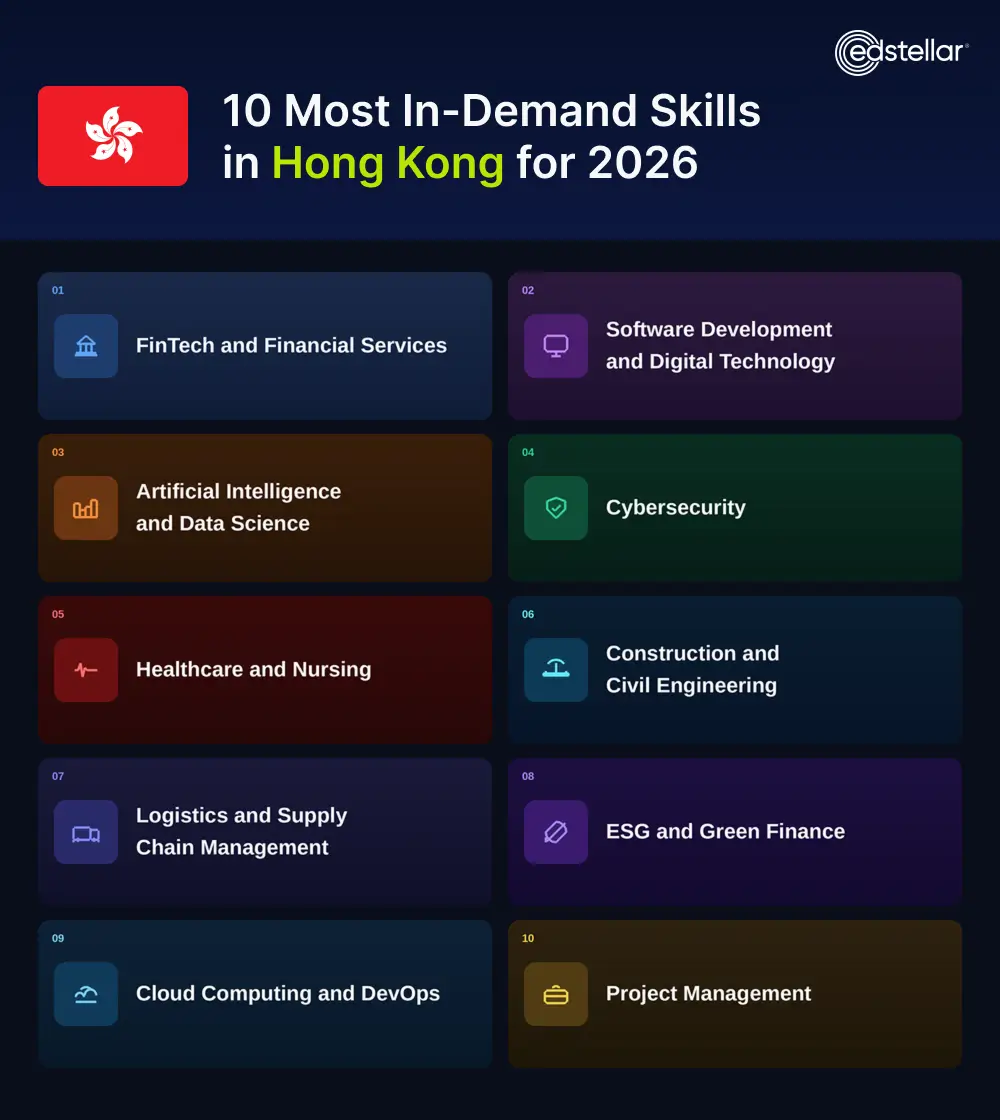

Hong Kong is home to one of the world's three most important financial centres, and the HKMA's FinTech 2025 strategy is actively reshaping what financial services employment looks like. Eight licensed virtual banks are now fully operational, the cross-border payment pilot Project mBridge has entered its minimum viable product phase, and the SFC's digital asset licensing regime has created a regulated framework for crypto exchange platforms. Each of these developments demands professionals who can bridge traditional financial knowledge with new technology capabilities.
The breadth of FinTech demand spans well beyond technical roles. RegTech specialists are needed to help financial institutions comply with evolving AML, KYC, and PDPO obligations at scale. WealthTech platforms targeting Hong Kong's high-net-worth population are recruiting for product managers, UX designers, and data engineers. Insurtech firms are hiring actuaries and data scientists to build predictive underwriting models. The common thread is that financial services professionals with digital fluency command a significant salary premium, with InvestHK data placing FinTech specialists 40% above the average financial sector wage.
With over 800 FinTech companies operating out of Hong Kong and the city ranked third globally for FinTech investment, the pipeline of new roles is not slowing. Professionals who invest in cross-disciplinary skills, combining finance fundamentals with technology expertise in areas such as blockchain, cloud infrastructure, or AI-driven analytics, are best positioned to capture senior roles.
Banking, Asset Management, Insurance, Payment Services, Crypto and Digital Assets, Investment Management

The HKSAR Smart City Blueprint 2.0 has embedded software development at the centre of Hong Kong's public and private sector transformation agenda. Government departments, banks, retailers, logistics operators, and healthcare providers are all running simultaneous digital transformation programmes, and the pool of experienced engineers available locally cannot meet the pace of demand. Cyberport's 1,900-strong tech ecosystem generated over 14,000 tech jobs by 2024, with full-stack development, mobile application engineering, and API integration consistently topping hiring lists.
The Innovation and Technology Fund invested over HKD 10 billion in R&D projects between 2021 and 2024, fuelling a generation of startups and scale-ups that are driving demand for engineers who can build, ship, and iterate quickly. Hong Kong's startup community, clustered around Cyberport and HKSTP, has a particular appetite for engineers proficient in cloud-native development, React and Angular frameworks, and Python and Node.js backends.
The Labour Department's vacancy data makes the demand picture clear: software and IT roles were the fastest-growing professional category in Hong Kong throughout 2024. Engineers who combine core development skills with an understanding of agile delivery methodologies, API-first design principles, and cloud deployment pipelines are commanding salaries of HKD 420,000 to 780,000 per year, with senior and lead roles frequently exceeding HKD 1 million.
Technology, Financial Services, Retail, Government, Startups, E-commerce
Explore Related Training:
Full Stack Web Development Python Programming All Software Development Programs"The green jobs market is rapidly evolving, and companies may struggle to keep up with the changing skill sets and requirements."



The HKSAR Innovation and Technology Bureau's Artificial Intelligence Strategy committed HKD 3 billion to AI research, talent development, and enterprise adoption from 2023. This investment is being matched by the private sector: banks are deploying AI for credit risk modelling, logistics firms are using predictive analytics to optimise cargo routing, and healthcare providers are piloting AI-assisted diagnostics. InnoHK, the government-backed research cluster at HKSTP, houses 28 R&D centres with AI as a core focus.
The leading universities, HKUST, HKU, and CUHK, all launched dedicated AI and data science degree programmes from 2023 onward, yet the Hong Kong Technology Industry Survey 2024 found that AI and data science remained the top technical hiring priority across financial services, logistics, and healthcare, with demand consistently outpacing domestic supply. Professionals with practical skills in machine learning model deployment, NLP, and large language model fine-tuning are particularly scarce.
The most commercially valuable AI talent sits at the intersection of domain knowledge and technical capability: finance professionals who can build credit scoring models, logistics analysts who can optimise multi-modal freight networks with machine learning, or healthcare professionals who can apply predictive analytics to patient outcomes. These hybrid profiles are commanding salaries of HKD 460,000 to 850,000 per year across industries.
Finance, Healthcare, Logistics, Retail, Government, Technology Consultancy
Explore Related Training:
AI Programming with Python Introduction to Natural Language Processing (NLP) All Artificial Intelligence Programs
Hong Kong's position as a global financial hub makes it a high-value target for cybercriminals. The Hong Kong Police recorded a 54% rise in cybercrime cases in 2023, with ransomware attacks, business email compromise, and financial fraud targeting banks, law firms, and listed corporations. The HKMA's Cybersecurity Fortification Initiative 2.0 responded by raising the mandatory baseline for all authorised institutions, requiring regular penetration testing, SIEM deployment, and formal cyber resilience programmes.
The HKPC Cyber Security Team identified a workforce gap of over 3,000 cybersecurity professionals in Hong Kong as of 2024. The most acute shortages are in penetration testing, threat intelligence analysis, cloud security architecture, and Zero Trust implementation, all roles that require both technical depth and an understanding of the financial services regulatory environment.
Cybersecurity professionals with certifications such as CISSP, CISM, CEH, or OSCP are commanding premium packages in Hong Kong, with experienced practitioners earning HKD 440,000 to 820,000 per year. The most in-demand profiles combine hands-on technical skills with the ability to communicate risk to senior leadership and regulators.
Banking, Government, Healthcare, Telecommunications, E-commerce, Regional Corporate Headquarters
Explore Related Training:
AI for Cybersecurity Professionals Cybersecurity Risk Management All Cybersecurity Programs
The Hospital Authority's Human Resources Planning Report 2024 projects a shortage of at least 1,610 registered nurses by 2026, driven by an ageing workforce, net emigration of healthcare professionals post-2020, and rising patient demand as Hong Kong's population over 65 approaches 30% by 2066. The Department of Health's Primary Healthcare Blueprint 2022–2032 commits HKD 7 billion to expanding district health centres, community nursing services, and elderly care facilities.
The severity of the shortage has prompted the Hospital Authority to launch structured overseas recruitment drives targeting registered nurses in the UK, Australia, New Zealand, and Southeast Asia. Nurses with specialist qualifications in geriatrics, mental health, critical care, and operating theatre nursing are particularly sought after, commanding a premium over general ward nursing salaries.
Digital health is creating a new dimension to nursing demand. Electronic patient record systems, telehealth consultations, AI-assisted clinical decision support, and remote vital sign monitoring are becoming standard tools. Nurses who combine strong clinical competencies with digital health literacy are positioned for advancement. Salaries for registered nurses in Hong Kong range from HKD 300,000 to 580,000 per year, with specialised and senior clinical roles exceeding HKD 700,000.
Hospital Authority, Private Hospitals, Elderly Care Homes, Community Health Centres, Government Healthcare

Hong Kong is in the middle of the most ambitious public construction programme in its modern history. The Northern Metropolis development, covering 2,200 hectares in the New Territories North, targets 186,000 new homes and a major innovation and technology zone by 2032. Running concurrently, the Kau Yi Chau Artificial Islands project under the Lantau Tomorrow Vision and a portfolio of MTR expansion works, highway upgrades, and public housing programmes have created a combined pipeline of over HKD 600 billion in capital works.
The Construction Industry Council's 2024 Workforce Survey found a shortage of 8,400 skilled construction professionals, with civil engineers, quantity surveyors, BIM specialists, and site managers topping the list. BIM adoption is now a requirement on all major government contracts, creating a skills divide between BIM-proficient professionals and those still relying on traditional 2D drafting.
For civil and structural engineers with three to eight years of experience, Hong Kong's infrastructure boom represents a generational career opportunity. Salaries for civil engineers range from HKD 360,000 to 720,000 per year, with project managers and BIM leads on major government programmes frequently earning above HKD 900,000.
Government Infrastructure, Property Development, MTR Corporation, Airport Authority, Civil Engineering and Development Department

Hong Kong International Airport retained its position as the world's busiest cargo airport in 2023, handling 4.4 million tonnes of freight. The HKD 141 billion Three-Runway System expansion project is designed to sustain that leadership position through 2050, and its completion will require a new generation of air cargo management, freight operations, and logistics technology professionals. Beyond aviation, Hong Kong's container port remains one of Asia's most critical transhipment hubs.
The HKTDC's Belt and Road intelligence reports consistently identify Hong Kong as the premier regional hub for cross-border e-commerce logistics, multimodal freight, and trade finance. The Greater Bay Area's integration is creating new demand for logistics professionals who understand cross-boundary customs procedures, cold chain requirements, and the digital platforms underpinning modern supply chain visibility. E-commerce growth across the GBA drove an 18% increase in third-party logistics job postings in 2023.
Professionals who combine operational logistics expertise with proficiency in supply chain analytics platforms and an understanding of cross-border trade compliance are commanding salaries of HKD 320,000 to 640,000 per year, with senior supply chain director roles in multinational corporations exceeding HKD 1 million.
Freight Forwarding, Aviation and Air Cargo, Port Operations, E-commerce, Retail, Trade Finance
"Technology is revolutionising work and, while AI integration is growing in Hong Kong, its potential is underutilised as the Hong Kong workforce is still catching up on Gen AI and Agentic AI usage. Structured upskilling and proactive change management are essential to unlock the potential of AI and address job security concerns."


Hong Kong issued HKD 65 billion in green bonds in 2023 alone, reinforcing its position as Asia's leading green finance hub. The HKMA and SFC jointly published the Common Ground Taxonomy in 2023, aligning Hong Kong's green finance classification system with both the EU Taxonomy and China's Green Bond Endorsed Project Catalogue. This alignment makes Hong Kong the only jurisdiction in Asia that can credibly intermediate between Chinese and European sustainable finance markets.
The SFC's enhanced Fund Manager Code of Conduct, which requires all licensed fund managers to consider climate-related risks from 2024, has created a compliance-driven hiring wave across asset management firms. Portfolio managers, compliance officers, risk analysts, and client advisers all now require fluency in TCFD reporting frameworks, carbon accounting methodologies, and climate scenario analysis. The Hong Kong Green Finance Association reported that over 70% of Hang Seng Index constituents had committed to net-zero targets by 2024.
ESG professionals with dual competencies in finance and sustainability are commanding significant premiums. A sustainability analyst at a major bank or asset manager can expect HKD 400,000 to 780,000 per year, while experienced ESG directors at listed corporations frequently earn above HKD 1 million.
Banking, Asset Management, Consulting, Government, Insurance, Listed Corporates

The OGCIO's Cloud-First Policy mandates that all new government IT systems must be deployed on cloud infrastructure from 2023, affecting over 70 government bureaux and departments. In the private sector, financial institutions are midway through legacy system modernisation programmes that require skilled professionals who can manage hybrid cloud environments, automate deployment pipelines, and maintain regulatory compliance during the transition period.
Cyberport's annual digital tech report recorded a 34% year-on-year increase in cloud and DevOps job postings between 2022 and 2024. HSBC, Standard Chartered, and Hang Seng Bank all announced major cloud transformation programmes during this period. AWS, Microsoft Azure, and Google Cloud all expanded their Asia Pacific operations hubs in Hong Kong, partnering with local universities and Cyberport on talent development programmes.
The most in-demand professionals combine expertise in at least one major cloud platform with hands-on proficiency in containerisation technologies, infrastructure as code, and CI/CD pipeline design. Cloud engineers and SRE specialists earn HKD 400,000 to 760,000 per year, with cloud security architects and principal engineers commanding packages at the higher end.
Technology, Financial Services, Telecommunications, Government, Retail

The DEVB's Capital Works Programme 2024–2025 allocates HKD 100 billion to public infrastructure projects across Hong Kong, from new road and rail links in the Northern Metropolis to hospital expansions, school construction, and public housing developments. The sheer volume and complexity of concurrent government projects has created an acute shortage of experienced project managers who understand public sector procurement frameworks.
Beyond construction, project management demand is surging in technology and financial services as organisations execute multi-year digital transformation programmes. The PMI Hong Kong Chapter reported a 22% increase in PMP exam enrolments between 2022 and 2024. Agile-certified professionals, particularly those with SAFe, Scrum Master, or Product Owner credentials, are in especially high demand for technology and FinTech projects.
Professional services firms including Deloitte, KPMG, PwC, and Accenture all listed project management and change management as top hiring priorities for their Hong Kong offices in 2024. Salaries for experienced project managers range from HKD 360,000 to 700,000 per year, with programme directors at major financial institutions frequently earning above HKD 1 million.
Construction, Technology, Financial Services, Government, Professional Services, Healthcare
"As AI takes over transactional tasks, the value of human-centric skills is rising. Relationship management, communication, and authentic client engagement are becoming key differentiators in an increasingly digital workplace."


Hong Kong Tech Talent Shortage: Hong Kong Business analysis of the technology skills gap, hiring challenges, and workforce development strategies across the city.
Hong Kong's skills demand is concentrated across distinct business clusters, each with its own industry profile and hiring priorities. Understanding these patterns helps corporate L&D teams target training investments where they will deliver the greatest impact.
Central and Admiralty dominate financial services, FinTech, and ESG hiring. Cyberport concentrates the majority of technology startup, FinTech, and AI roles. HKSTP in Sha Tin is the primary hub for R&D and deep tech talent. The Northern Metropolis is creating the largest construction workforce demand in Hong Kong's modern history. HKIA and the Kwai Tsing port terminals drive concentrated logistics and supply chain demand.
#On-site #Virtual #GroupTraining #Customized
Explore 2000+ industry ready instructor-led training programs.

Create dynamic leaders and cohesive teams. Learn more now!


Do a quick Skill gap analysis with Edstellar’s Free Skill Matrix tool

Unlock premium resources, tools, and frameworks designed for HR and learning professionals. Our L&D Hub gives you everything needed to elevate your organization's training approach.
Access L&D Hub Resources.svg)
.svg)
.svg)
.svg)

.svg)


.svg "Click Here to Follow on Medium")
.svg)


