A curated list of the most in-demand skills in Italy, compiled by a corporate trainer and team coach with 8+ years of experience in business communication, leadership development, and experiential learning programme design.
Italy stands at a pivotal crossroads in its economic trajectory. The country is simultaneously navigating the most ambitious public investment programme in its post-war history, a chronic digital transformation deficit that ranks among the most severe in Western Europe, and a demographic reality that makes it the EU's second most aged society.
The Piano Nazionale di Ripresa e Resilienza (PNRR), Italy's EUR 191.5 billion share of EU recovery funding, has placed more capital in the hands of Italian public and private sector actors than any programme since the Marshall Plan. But capital alone cannot transform an economy: it requires the skills to deploy it, and Italy's labour market is telling a consistent story about where those skills are in shortest supply.
The Unioncamere and ANPAL Excelsior survey, Italy's most comprehensive quarterly measure of employer demand, has placed digital and technology roles at the top of its hardest-to-fill list for three consecutive years. The Federazione Nazionale Ordini Professioni Infermieristiche reports 65,000 unfilled nursing posts against a backdrop of 23.5% of the population aged 65 or above. The Agenzia per la Cybersicurezza Nazionale documented a 65% increase in cyber attacks on Italian public administration and critical infrastructure.
Confindustria found that 44% of manufacturers cannot fill their technical engineering vacancies. These are not isolated data points; they form a coherent picture of a skills crisis that spans sectors and regions and is directly constraining Italy's ability to execute its own policy ambitions.
This research draws on data from MIMIT, AGID, the ACN, Istat, Confindustria, FNOPI, the GSE, Banca d'Italia, ANCE, and the Excelsior survey to identify the ten skills shaping Italy's employment market in 2025. Whether you are building a career in software development, moving into artificial intelligence and data science, strengthening expertise in cybersecurity, or pursuing opportunities in green energy and sustainability, this guide delivers a data-backed roadmap for professional development in Italy.
Sources Behind This Research
Every ranking in this guide is backed by data from Italian government ministries, industry bodies, and regulatory agencies. We weighted Italy-specific sources exclusively, because the country's unique combination of PNRR investment pressure, demographic ageing, digital transformation deficit, and green energy transition makes global benchmarks insufficient. Here is where the numbers come from.
Government
Ministero delle Imprese e del Made in Italy (MIMIT)
National AI Strategy 2024 and Transizione 5.0 Programme
MIMIT is Italy's primary ministry for industrial and digital policy. Its National AI Strategy sets the framework for AI adoption across six priority sectors, while the Transizione 5.0 incentive programme offers substantial tax credits for digital manufacturing technology investment, creating direct demand for technical professionals across Italy's industrial districts.
Digital Italy Strategy and PSN Cloud Programme 2024
AGID oversees Italy's national digital transformation, including the Polo Strategico Nazionale (PSN) cloud migration programme for all public administration bodies, the national digital identity (SPID/CIE) platform, and PNRR Mission 1 digital investment governance across 22,000 public administration entities.
Labour Force Survey and Technology Adoption in Enterprises 2024
Istat publishes Italy's authoritative national labour market data, including quarterly employment and vacancy statistics, digital skills gap measurements, and enterprise technology adoption rates that underpin the evidence base for Italy's skills policy across all sectors and regions.
Manufacturing Skills Survey and Digital Transformation Report 2024
Confindustria is Italy's primary industry employer federation, representing 150,000 member companies employing 5.5 million workers. Its annual skills and digital transformation surveys provide the most comprehensive data on professional shortages across Italy's manufacturing, engineering, and industrial sectors.
FNOPI (Federazione Nazionale Ordini Professioni Infermieristiche)
Nursing Workforce Shortage Analysis 2024
FNOPI represents Italy's registered nursing profession and publishes the most authoritative data on nursing workforce supply, demand, and regional distribution, including the 2024 estimate of 65,000 unfilled nursing posts across Italy's national and regional health systems.
Financial Stability Report and FinTech Market Analysis 2024
Banca d'Italia's financial stability and FinTech market reports track Italy's financial sector digitalisation, the growth of Milan's FinTech ecosystem, DORA Regulation compliance requirements, and the professional skills demanded by a financial sector undergoing rapid technology transformation.
Construction Workforce Survey and Superbonus Impact Analysis 2024
ANCE represents Italy's building construction sector and publishes annual workforce supply and demand analysis. Its 2024 survey quantified a shortage of 100,000 construction workers and documented the ongoing impact of Superbonus renovation incentives on the skills composition of Italy's construction labour market.
Quarterly Workforce Demand and Skills Gap Survey 2024
The Excelsior Survey is Italy's most comprehensive quarterly measurement of employer hiring intentions, skills gap severity, and occupational demand forecasts across all sectors and regions. Its consistent identification of digital and IT roles as Italy's hardest-to-fill positions for three consecutive years is the most widely cited evidence of the technology talent crisis.
"Technical skills create value only when people can communicate across functions, make decisions, take ownership, and adapt together. For HR and L&D leaders, the challenge is not simply to transfer knowledge, but to create opportunities to practise new behaviours through realistic work situations, feedback, and reflection."
Aleksandra Abramova
✓ Corporate trainer and team coach with 8+ years of experience in business communication, leadership development, and cross functional team collaboration, creator of B Quest immersive business simulation and author of How to Convince Online.
10 Key Skills in Demand Across Italy's Job Market
Italy's shortage list reflects the structural collision of PNRR investment pressure, chronic digital underperformance, demographic ageing, and a green energy transition that requires more new renewable capacity than the country has built in its entire history. The skills below cover the roles where hiring pressure is highest in 2026.
1
Software Development and Digital Technology
Research Score: 9.45/10
Italy's DESI 2023 ranking of 18th among 27 EU member states is a measurement of a structural gap that has been decades in the making and that the PNRR has made an urgent national priority to close. PNRR Mission 1 allocates EUR 40.3 billion to digitisation, covering the modernisation of public administration IT systems, broadband and 5G infrastructure rollout, and the creation of digital skills capacity across the workforce. The Agenzia per l'Italia Digitale is responsible for executing digital transformation across over 22,000 public administration bodies, a mandate that requires software engineers, platform architects, UX designers, and digital product managers in volumes that Italy's technology talent market has never been asked to supply at this scale or speed.
The Excelsior survey's consistent finding that digital and IT roles are the hardest to fill in Italy reflects a mismatch between the skills that Italy's education system has historically produced and the skills that a modern digital economy requires. Italian universities produce strong graduates in mathematics, physics, and classical engineering disciplines, but the applied software engineering and cloud development skills that employers need most are in shorter supply. Confindustria's 2024 survey found that 68% of Italian manufacturers planned major IT system investments within 12 months but lacked internal talent to execute them, concentrating demand in ERP customisation, industrial application development, and integration engineering alongside the more obvious cloud and web development roles.
For software developers, Italy's shortage translates directly into strong hiring leverage, accelerating career progression timelines and growing remote work flexibility as employers compete for a scarce pool of qualified engineers. Milan is the primary technology employment hub, followed by Rome, Turin, and Bologna, but remote work has expanded the effective market nationwide. Software developers in Italy earn EUR 35,000 to 65,000 per year, with senior engineers at technology companies and multinationals frequently exceeding EUR 80,000 in total compensation. International technology companies entering the Italian market through PNRR-linked investment are also paying packages that are competitive with Northern European standards.
Key Sub-skills
Full-Stack DevelopmentMobile App DevelopmentAPI IntegrationAgile and ScrumCloud-Native Development
Top Industries
Technology, Manufacturing, Financial Services, Public Administration, Retail, Healthcare
Italy's National AI Strategy, published in July 2024 by MIMIT, identifies six priority sectors for AI adoption: manufacturing, healthcare, agriculture, public administration, energy, and financial services. The strategy is backed by PNRR Mission 4 funding for AI competence centres at seven major Italian universities and aligns with EU AI Act compliance requirements that are creating immediate regulatory demand for AI governance professionals across industries. Fondazione ADAPT's 2024 skills analysis estimated that fewer than 15% of Italian businesses have the internal data and AI capabilities needed to execute their stated digital transformation ambitions, a gap of striking proportions given that the same businesses have access to EUR 40 billion in PNRR digital investment.
The Excelsior survey recorded AI-related job postings growing at 45% year-on-year in Italy between 2022 and 2024, the fastest growth rate of any professional category in the survey's history. Manufacturing is the largest and most distinctive driver: Italy's industrial districts in Lombardy, Veneto, and Emilia-Romagna are applying computer vision for quality inspection, machine learning for predictive maintenance, and AI-powered demand forecasting for just-in-time supply chains, all applications that require engineers who combine AI technical capability with manufacturing domain knowledge that is specific to Italy's industrial tradition. The agrifood sector, another Italian economic pillar, is similarly applying AI to crop management, supply chain optimisation, and food safety monitoring.
The EU AI Act, which entered into force in August 2024 with phased implementation through 2026, is creating compliance-driven demand for AI governance professionals, responsible AI specialists, and AI risk assessors across Italian financial services, healthcare, and public administration. This regulatory layer adds a new dimension of demand that is independent of AI adoption intent: even organisations that are not actively deploying AI must understand and comply with the Act's requirements regarding AI procurement and use. AI and data science professionals in Italy earn EUR 40,000 to 75,000 per year, with senior roles at Milan-based technology companies and multinationals regularly reaching EUR 90,000 to 110,000 in total compensation.
Key Sub-skills
Machine LearningDeep LearningNatural Language ProcessingPredictive AnalyticsComputer Vision
Top Industries
Manufacturing, Financial Services, Healthcare, Agrifood, Public Administration, Retail, Energy
“We are witnessing a real revolution, in which artificial intelligence is redefining our present. It is the new engine of global competition, of productivity, of sustainability and, if we are capable, of equity.”
Massimo Dal Checco
Founder, Jumpit Srl · Italy
3
Healthcare and Nursing
Research Score: 9.00/10
Italy's healthcare workforce crisis is shaped by the convergence of two powerful forces: one of Europe's oldest populations and a national health service that has been structurally underfunded relative to comparable EU healthcare systems for over a decade. With 23.5% of Italians aged 65 or above, the second-highest proportion in the EU after Greece, demand for both acute and long-term care services is rising inexorably. FNOPI documented 65,000 unfilled nursing posts in Italy in 2024, a shortage that translates directly into delayed discharges, reduced ward capacity, and lengthening waiting lists across the Servizio Sanitario Nazionale (SSN), Italy's universal public health system.
Post-pandemic attrition has compounded a pre-existing shortage. Nurses and allied health professionals left the SSN in significant numbers between 2021 and 2023, driven by a combination of pandemic burnout, comparatively low public sector wages relative to Northern European standards, and the appeal of better-compensated roles in the private healthcare sector, the Gulf states, and the UK. The Ministry of Health's projections estimate that Italy needs 80,000 additional healthcare workers by 2030, encompassing registered nurses, physiotherapists, social care assistants, and specialist clinicians. This demand is structural, not cyclical, driven by demographic realities that will not change within any planning horizon relevant to today's professional decisions.
PNRR Mission 6 is investing EUR 15.6 billion to reform and expand Italy's healthcare infrastructure, creating 1,350 new Case della Comunità (community health centres) and 600 new Ospedali di Comunità (community hospitals) that must be staffed with clinical professionals. Digital health is also reshaping nursing competency requirements: the national electronic health record (Fascicolo Sanitario Elettronico 2.0) rollout and telemedicine expansion under PNRR are creating demand for nurses with digital health literacy alongside clinical expertise. Registered nurses in Italy earn EUR 28,000 to 50,000 per year in the public sector, with private sector and specialist nursing roles frequently offering EUR 10,000 to 15,000 more.
Key Sub-skills
Clinical NursingPatient Assessment and TriageElderly and Long-term CareTelehealth and Digital HealthCommunity Health (Casa della Comunità)
Top Industries
Servizio Sanitario Nazionale (SSN), Private Hospital Groups (Humanitas, GVM, San Donato), Community Health Centres, Elderly Care Homes, Home Care Services
Italy's Agenzia per la Cybersicurezza Nazionale (ACN) was established by legislative decree in August 2021, reflecting the government's belated recognition of the scale of Italy's cyber exposure. ACN's 2023–2024 annual report documented a 65% increase in cyber incidents affecting Italian public administration, hospitals, and critical infrastructure, making Italy one of the most frequently attacked countries in Europe relative to its size. High-profile ransomware attacks on INPS (Italy's national social security institute), on multiple regional health systems, and on Campania's regional administration brought the issue into public consciousness and elevated ACN's national security mandate to Cabinet priority status.
The EU's NIS2 Directive, which Italy was required to transpose by October 2024, substantially expands mandatory cybersecurity obligations across critical infrastructure operators, essential service providers, healthcare organisations, and digital service providers. Every Italian hospital, energy company, water utility, and major financial institution now faces statutory cybersecurity risk management requirements that require dedicated professionals to implement and maintain. Istat's 2024 enterprise technology survey found that only 22% of Italian SMEs had a formal cybersecurity policy, the lowest rate among major EU economies, indicating that NIS2 compliance will drive a substantial and sustained wave of cybersecurity hiring across Italian businesses of all sizes over the next three to five years.
ACN's National Cybersecurity Strategy 2022–2026 explicitly targets training 3,000 new cybersecurity specialists annually through 2026, a target that signals both the scale of the shortage and the government's commitment to addressing it through investment in education and professional development. For professionals investing in cybersecurity credentials today, Italy's market combines strong demand, a clear regulatory tailwind from NIS2 and the ACN strategy, and a talent pool that remains significantly smaller than the market requires. Cybersecurity professionals in Italy earn EUR 40,000 to 75,000 per year, with senior roles at major financial institutions, energy companies, and ACN partner organisations regularly exceeding EUR 90,000.
Key Sub-skills
Network SecurityThreat IntelligencePenetration TestingNIS2 and GDPR ComplianceIncident Response
Top Industries
Public Administration, Banking, Healthcare, Energy, Manufacturing, Telecommunications, Critical Infrastructure
Italy's revised National Integrated Energy and Climate Plan (PNIEC 2023) targets 72% of electricity from renewables by 2030, requiring the installation of 70GW of new solar and wind capacity within seven years. To contextualise the challenge: this is more renewable capacity than Italy has built in its entire history to date, and it must be delivered simultaneously with the decommissioning of significant coal generation. The GSE projects a need for 120,000 additional renewable energy professionals by 2030, spanning installation engineers, grid integration specialists, project developers, and operations and maintenance technicians. Current vacancy rates in solar installation and offshore wind development are above 50%, reflecting a profession that barely existed at the required scale five years ago.
PNRR Mission 2 (Green Revolution and Ecological Transition) allocates EUR 59.46 billion to decarbonisation and energy transition, the largest single PNRR investment component. Italy's geography is both an opportunity and a challenge: its southern regions and islands offer exceptional solar irradiance and offshore wind resources, but also the greatest infrastructure deficit and the furthest distance from the manufacturing and professional services clusters of the industrial north. Developing Southern Italy's renewable energy potential requires professionals who can navigate complex permitting processes, manage community engagement across sensitive landscapes, and coordinate supply chains across long distances.
Italy's building stock is the oldest and least energy-efficient in the EU, with 75% of residential buildings predating 1990. The Superbonus renovation programme, which provided 110% tax credits for building energy upgrades, created a wave of renovation activity between 2020 and 2023 that temporarily absorbed all available energy auditors, heat pump technicians, building certifiers, and thermal insulation specialists. Though the incentive was restructured in 2024, the underlying demand for building renovation professionals is permanent, driven by EU EPBD 2024 minimum energy performance mandates. Green energy and sustainability professionals in Italy earn EUR 35,000 to 65,000 per year, with senior project directors on major renewable energy programmes frequently earning above EUR 80,000.
Key Sub-skills
Solar Energy System DesignOffshore and Onshore Wind EngineeringEnergy Efficiency AuditingHeat Pump TechnologyGrid Integration
Top Industries
Energy Utilities, Construction and Renovation, Government Infrastructure, Manufacturing, Agriculture, Transport
Edstellar's Training Needs Analysis consultants identify your priority skill gaps and build a customised training roadmap. Get matched with the right programmes in 48 hours.
Italy is the EU's second-largest manufacturing nation by output and the foundation of its economy, with industrial districts in Lombardy, Veneto, and Emilia-Romagna producing world-leading precision machinery, automotive components, fashion and luxury goods, food and beverage, and chemicals. The Transizione 4.0 and successor Transizione 5.0 government incentive programmes offer tax credits of 20 to 50% on investment in digital manufacturing technology, industrial automation, IoT systems, and AI-powered quality control, creating direct investment flows that require technical professionals to deploy. Confindustria's 2024 survey found that 44% of Italian manufacturers could not fill their technical and engineering vacancies, with automation engineers, industrial IoT specialists, and data-driven quality engineers the three hardest-to-hire profiles nationally.
Italy's automotive sector is undergoing the most significant structural transformation in its history. Stellantis, which operates six production facilities in Italy and employs over 40,000 people, is transitioning its product portfolio toward electric vehicles, requiring electrification engineers, battery management system specialists, and EV powertrain designers whose skills are fundamentally different from the internal combustion engineering expertise that dominates the existing workforce. Ferrari, Lamborghini, and the broader motorsport and high-performance automotive cluster around Maranello and Bologna are simultaneously applying advanced simulation, additive manufacturing, and lightweight composite materials engineering to next-generation vehicle development, creating demand for highly specialised engineering profiles.
The Italy Robot Association data showed a 12% increase in industrial robot installations in Italian manufacturing in 2023, the highest annual growth in a decade, reflecting industry's accelerating automation response to workforce costs and the skilled worker shortage. Each new automated production line requires commissioning engineers, PLC programmers, robot system integrators, and predictive maintenance specialists, creating secondary technical demand that compounds rather than replaces the original engineering shortage. Advanced manufacturing professionals in Italy earn EUR 32,000 to 60,000 per year, with automation engineers, EV systems specialists, and smart factory project leads at Stellantis, Ferrari, and their tier-1 suppliers regularly earning above EUR 75,000.
Key Sub-skills
Industrial Automation and RoboticsIoT Manufacturing SystemsPLC ProgrammingDigital Twin TechnologyLean Manufacturing and Six Sigma
Top Industries
Automotive, Precision Machinery, Food and Beverage, Fashion and Luxury Goods, Chemicals, Aerospace
The Italian government's Polo Strategico Nazionale (PSN) cloud programme, which has contracted with AWS and other providers to host the IT systems of all central public administration bodies on sovereign national cloud infrastructure, is the single largest driver of cloud talent demand in Italy's public sector. PSN's phased migration of thousands of public administration applications from legacy on-premise infrastructure to cloud platforms requires cloud migration architects, security engineers, DevOps practitioners, and cloud-native developers who understand both modern cloud platforms and the specific compliance, data classification, and procurement standards of Italian public administration. AGID's 2024 assessment found that only 26% of public administration bodies had completed any meaningful cloud migration, with skills shortage cited as the primary barrier by 61% of respondents.
Italy's enterprise cloud adoption rate of 41% for core business workloads sits below the EU average of 58%, indicating substantial migration work ahead for Italian companies and the sustained demand for cloud engineering talent it will generate. Italian SMEs, which account for 99% of all Italian businesses and a majority of total employment, are the least cloud-advanced segment, creating a large addressable market for cloud consulting, implementation, and managed services that requires a much larger pool of cloud-certified professionals than currently exists. AWS announced Italy's first dedicated national cloud region in 2023, and Microsoft expanded its Azure availability zones, both investments requiring local talent development that acknowledges the current gap between cloud deployment ambition and available skills.
The GDPR compliance requirements that apply to all Italian data controllers and processors are a consistent feature of Italian cloud architecture requirements, making cloud professionals who combine platform expertise with GDPR data protection knowledge especially valued. Cloud and DevOps professionals in Italy earn EUR 38,000 to 68,000 per year, with senior cloud architects and platform engineering leads at technology companies and major financial institutions regularly earning above EUR 80,000. The combination of PNRR-funded public sector demand and private sector digital transformation investment makes this one of the most sustained and policy-backed skills categories in Italy's 2025 labour market.
Key Sub-skills
AWS, Azure, and GCP ArchitectureKubernetesCI/CD PipelinesInfrastructure as CodeSite Reliability Engineering
Top Industries
Technology, Financial Services, Public Administration, Manufacturing, Healthcare, Retail
“Quantum, AI and the new technologies are all sectors hungry for STEM professionals. Italy must invest seriously in digital skills and scientific talent.”
Alessandra Santacroce
Governmental Programs Executive, IBM Italy · Latium, Italy
8
Construction and Building Renovation
Research Score: 8.00/10
Italy has the oldest and least energy-efficient building stock in the EU. Over 75% of residential buildings were constructed before 1990, the majority rated in the lowest energy performance categories under the EU's Energy Performance of Buildings framework. The EU's revised Energy Performance of Buildings Directive (EPBD 2024) requires member states to introduce minimum energy performance standards for existing buildings on a phased timeline, creating a building renovation obligation that will drive construction activity in Italy for decades. ANCE estimated the total renovation investment required to bring Italy's residential stock to minimum EU standards at over EUR 1 trillion over 20 years, a figure that requires a sustained construction and renovation workforce that Italy is not currently producing in sufficient numbers.
The Superbonus 110% programme, which incentivised energy renovation of residential and commercial buildings with generous tax credits between 2020 and 2023, provided a glimpse of both the potential and the constraints of Italy's renovation ambition. Over 450,000 renovation projects were initiated under the programme, temporarily absorbing all available energy auditors, building certifiers, insulation specialists, heat pump engineers, and BIM-capable project managers. The programme exposed the severity of the skills shortage in building energy efficiency and created a substantial backlog of renovation demand that persists even as the incentive has been restructured. ANCE's 2024 survey quantified a shortage of 100,000 construction workers nationally, attributing the gap to historical underinvestment in trades training and the emigration of Italian construction workers to better-paying European markets.
PNRR Missions 2 and 3 collectively fund EUR 25 billion in sustainable mobility infrastructure, port and airport upgrades, and building renovation programmes that require structural engineers, BIM specialists, site safety managers, and heritage restoration specialists alongside the energy efficiency professionals in greatest demand. Seismic risk engineering is a distinctly Italian requirement: with 60% of Italy's territory in high seismic risk zones, structural assessment and seismic retrofitting expertise is consistently in demand following every significant earthquake event. Construction and renovation professionals earn EUR 30,000 to 55,000 per year, with structural engineers, BIM leads, and energy efficiency project managers regularly earning above EUR 65,000.
Key Sub-skills
Structural EngineeringBuilding Information Modelling (BIM)Energy Efficiency DesignSeismic Risk AssessmentHeritage Building Restoration
Top Industries
Residential Construction, Public Infrastructure, Heritage and Cultural Asset Renovation, Sustainable Mobility, Port and Airport Infrastructure
Banca d'Italia's 2024 FinTech market analysis documented a 38% year-on-year increase in Italian FinTech company formation, with Milan establishing itself as Southern Europe's primary FinTech hub. The city now hosts over 600 FinTech companies, attracting investment from UK, US, and Asian FinTech investors alongside domestic venture capital. The three fastest-growing segments, digital payments, credit technology, and regulatory technology, are each generating demand for professionals who combine financial services knowledge with software development, data analytics, and regulatory compliance capabilities. Milan's dual identity as Italy's financial capital and its most international technology hub makes it uniquely positioned to build the talent ecosystem these companies need.
Italy's cashless payment transaction rate of 42% in 2023, among the lowest in the EU, is rising under sustained government and ECB pressure, driven by mandatory POS payment acceptance for retail transactions above EUR 10, consumer incentives for cashless payments, and the rapid expansion of Italian digital payment platforms. Each percentage point increase in cashless adoption translates into infrastructure investment and professional hiring across payment processing, digital banking, and embedded finance. The EU's Digital Operational Resilience Act (DORA), which became applicable to all Italian financial entities from January 2025, is creating immediate compliance-driven demand for IT risk officers, third-party risk managers, and ICT security specialists across every regulated bank, insurer, and investment firm in Italy.
Italian private banking and asset management, concentrated in Milan and serving both domestic and diaspora high-net-worth clients, is investing in WealthTech platforms, ESG-integrated portfolio tools, and AI-driven advisory systems that require technology professionals with financial services domain knowledge. Banca d'Italia and ECB supervision are increasingly expecting technology fluency from compliance and risk officers across all regulated institutions, creating internal pressure for finance professionals to build digital and data skills alongside their traditional expertise. Financial services and FinTech professionals in Italy earn EUR 38,000 to 70,000 per year, with digital transformation leads and senior compliance specialists at major banks regularly exceeding EUR 85,000.
Key Sub-skills
Digital Payment SystemsOpen Banking and PSD2RegTech and DORA ComplianceWealthTech and Digital AdvisoryFinancial Data Analytics
Italy's obligation to disburse EUR 191.5 billion in PNRR funds by August 2026 has created an unprecedented demand for project management capability across the Italian public administration, an institution that has historically had among the lowest project management professional penetration in the EU. AGID's 2024 PNRR implementation status report explicitly identified project management capacity in public bodies as the single most critical constraint on PNRR delivery, ahead of funding availability, procurement complexity, and political will. The government's response included emergency measures to hire project management specialists directly into public administration on fixed-term contracts and to accredit private sector project management support providers for deployment into under-resourced local authorities.
The scale of the PNRR project portfolio illustrates why the demand is so severe. Italy must simultaneously execute digital transformation programmes in 22,000 public administration bodies, build 1,350 community health centres, renovate thousands of school buildings, install 70GW of renewable energy, modernise ports and airports, and deliver rail and road infrastructure upgrades, all within the same compressed timeline and with the same narrow pool of qualified project managers. Confindustria's 2024 survey found that 51% of Italian companies had delayed or cancelled technology investment projects in the previous 12 months due to insufficient project management capacity, a finding that demonstrates the drag that the PM shortage is placing on Italy's private sector transformation ambitions as well as its public sector obligations.
The PMI Italy Chapter recorded a 31% increase in PMP certification enrolments between 2022 and 2024, the largest growth in the chapter's history, driven by PNRR employment demand and growing employer recognition that certified PMs deliver materially better project outcomes. Professionals with dual credentials in traditional frameworks (PMP, PRINCE2) and agile methodologies (Scrum, SAFe), combined with familiarity with Italy's public procurement code (Codice dei Contratti Pubblici), are the most sought-after profiles across both public and private sector employers. Project managers in Italy earn EUR 35,000 to 65,000 per year, with senior programme directors and PNRR delivery leads regularly exceeding EUR 80,000 in total compensation.
Key Sub-skills
PMP CertificationAgile and ScrumPRINCE2Risk ManagementStakeholder Engagement
Top Industries
Public Administration, Construction and Infrastructure, Technology, Manufacturing, Healthcare, Professional Services
“Transformative technologies, particularly artificial intelligence, are now at the centre of every organisation's agenda. IBM wants to be a reference point for productivity without sacrificing responsibility, ethics and inclusion.”
Living and Working in Italy: EURES guide covering career opportunities, working conditions, and key employment sectors for professionals considering Italy.
The Future of Work in Italy: Turning Technical Skills into Organizational Capability
Recent data helps explain the direction of Italy’s workplace transformation heading into 2026. According to Istat, the share of companies with at least ten employees using artificial intelligence doubled from 8.2% in 2024 to 16.4% in 2025. At the same time, a lack of adequate skills prevented nearly 60% of the companies that had considered investing in AI from moving forward. Work organization is also evolving. In 2025, Smart Working initiatives were present in 95% of large Italian companies and involved 53% of their employees, according to the Smart Working Observatory of Politecnico di Milano.
These developments suggest that Italy’s transformation challenge is not only technical. As organizations introduce new technologies and more flexible ways of working, they also need people who can translate specialist knowledge into coordinated decisions, clear communication, and effective execution.
Four human capabilities will be particularly important heading into 2026:
Cross-functional communication: translating specialist information into language that colleagues, clients, and decision-makers can act on.
Decision-making and accountability: clarifying ownership, evaluating trade-offs, and moving forward when information is incomplete.
Adaptability and learning agility: adjusting working methods and behaviours as technology, regulation, and market expectations evolve.
Collaboration across hybrid and multicultural teams: maintaining trust, alignment, and shared responsibility across locations, functions, and professional cultures.
For HR and L&D leaders, this means going beyond knowledge transfer. Behavioural capabilities develop through repeated practice, feedback, and reflection in situations that resemble real work. Action learning, cross-functional case work, business simulations, role-play, and facilitated team reflection can help employees test new behaviours and understand their impact. The organizations that adapt fastest will not necessarily be those that adopt the most technology, but those that build the collective human capability to use it effectively.
Skills Demand Across Italy's Key Regions
Italy's skills demand concentrates across distinct regional hubs, each anchored by specific industries and PNRR investment allocations. Understanding these patterns helps corporate L&D teams target training investments where they will deliver the greatest impact.
Manufacturing, AI/Data Science, Green Energy, Software Dev
Campania and Southern Italy
Tourism, Agriculture, Healthcare, Construction
Healthcare, Tourism, Construction, Green Energy
Tuscany
Fashion, Tourism, Agriculture, Healthcare, Pharma
Tourism, Healthcare, Manufacturing, Green Energy
Lombardy and Milan dominate technology, financial services, and AI hiring, accounting for over 40% of Italy's digital job postings. Lazio and Rome concentrate public administration, healthcare, and cybersecurity demand driven by PNRR Mission 1 digital transformation. Veneto and Emilia-Romagna remain the heart of Italy's manufacturing and industrial engineering talent needs, anchored by world-leading precision machinery and automotive component clusters. Piedmont centres on Stellantis's EV transition and Turin's growing technology ecosystem. Campania and Southern Italy generate sustained healthcare, construction, and green energy demand, boosted by PNRR cohesion funding and exceptional renewable energy resources. Tuscany combines fashion, pharma, and tourism with growing healthcare and manufacturing needs.
How to Develop These Skills in Demand in Italy
Italy's skills crisis spans the breadth of its PNRR ambitions: EUR 191.5 billion in recovery investment that must be deployed by August 2026, a digital transformation deficit that ranks among Western Europe's most severe, and a healthcare workforce gap that is widening as the population ages. The country's professional development ecosystem is expanding rapidly in response, combining EU-funded upskilling programmes, government incentive schemes, and an internationally recognised certification landscape.
Align training to PNRR priorities. PNRR Mission 1 allocates EUR 40.3 billion to digital transformation, Mission 2 allocates EUR 59.5 billion to the green transition, and Mission 6 invests EUR 15.6 billion in healthcare reform. Each mission creates specific professional demand that will persist through the disbursement deadline and beyond. Organisations that map their training investments to these three pillars are building capabilities that align directly with where Italy's public and private sector spending is concentrated.
Build from adjacent skills. Italy's universities produce strong graduates in mathematics, physics, and classical engineering, but the applied digital skills employers need most are in shorter supply. Professionals who bridge the gap between classical engineering and digital manufacturing, between traditional finance and FinTech, or between conventional healthcare and digital health are the profiles in greatest demand. Structured upskilling from adjacent competencies is often faster and more effective than starting from scratch.
Pursue certifications Italian employers recognise. For cloud computing, AWS, Azure, and Google Cloud certifications carry the strongest market recognition across PNRR-linked public sector and private sector roles. For cybersecurity, CISSP, CISM, and the ACN-recognised frameworks are valued by both Italian and multinational employers. For project management, PMP and PRINCE2 remain the standard across PNRR public procurement. For green energy, ENEA qualifications and the EU-recognised Building Energy Assessor (APE) certification are essential for renovation professionals.
Use ANPAL and regional co-funding. The Fondo Nuove Competenze allows companies to reskill employees on reduced hours with wage costs partially covered by INPS. The GOL programme (Garanzia di Occupabilità dei Lavoratori) provides funded upskilling pathways for job seekers and workers at risk of displacement. Regional European Social Fund allocations add further co-financing for approved training programmes. These mechanisms make structured skills development financially accessible for both employers and employees across Italy.
Account for Italy's regional diversity. Milan's technology and FinTech market requires different capabilities than Southern Italy's healthcare and renewable energy needs. Turin's automotive transition creates demand for EV and battery engineering skills that are less relevant in Rome's public administration context. Effective training strategies account for where teams are located and what the local labour market rewards, rather than applying a single national approach.
Italy's combination of PNRR investment pressure, regulatory compliance mandates, and demographic workforce constraints means demand for these 10 skill areas will remain elevated for years. Organisations that build their training strategies around these priorities, supported by Edstellar's catalogue of over 2,000 instructor-led courses, will be better positioned to attract and retain the talent needed to execute Italy's most ambitious transformation agenda.
Frequently Asked Questions
What are the most in-demand skills in Italy right now?
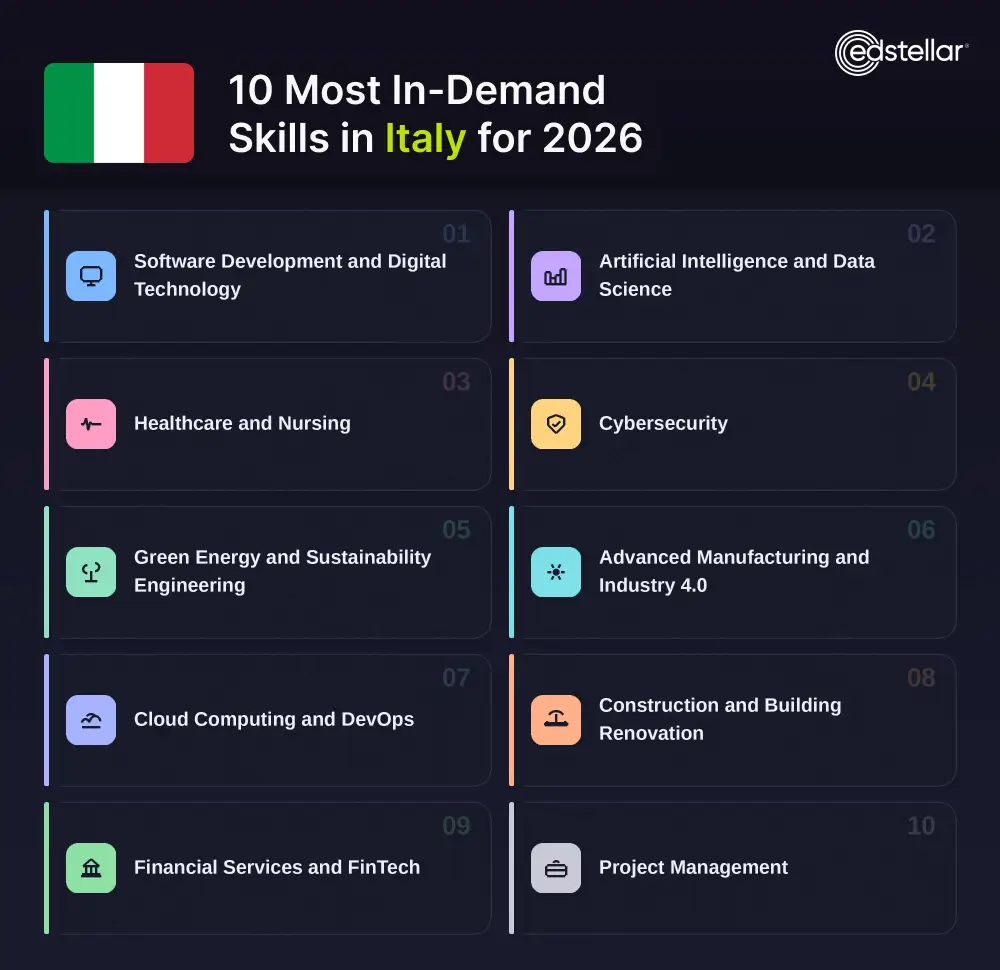
The ten most in-demand skills in Italy in 2025, based on MIMIT, AGID, ACN, Istat, and Excelsior survey data, are: Software Development and Digital Technology, Artificial Intelligence and Data Science, Healthcare and Nursing, Cybersecurity, Green Energy and Sustainability Engineering, Advanced Manufacturing and Industry 4.0, Cloud Computing and DevOps, Construction and Building Renovation, Financial Services and FinTech, and Project Management. Software Development leads with a score of 9.45/10, reflecting Italy's DESI 2023 ranking of 18th among 27 EU member states and the EUR 40.3 billion PNRR Mission 1 digitisation mandate.
How is the PNRR affecting Italy's job market?
Italy's PNRR (Piano Nazionale di Ripresa e Resilienza) allocates EUR 191.5 billion in EU recovery funds that must be disbursed by August 2026. It is the most significant driver of professional skills demand in Italy's current labour market, creating requirements for project managers, software engineers, cybersecurity specialists, green energy engineers, healthcare professionals, and construction workers simultaneously. AGID identified project management capacity shortage as the single most critical constraint on PNRR delivery in 2024. Confindustria found that 51% of Italian companies delayed technology investment due to insufficient PM capacity. The PNRR has also funded AI competence centres, cloud infrastructure, and skills training programmes that are reshaping Italy's professional development landscape.
How serious is Italy's nursing and healthcare workforce shortage?
FNOPI documented 65,000 unfilled nursing posts in Italy in 2024, against a backdrop of 23.5% of the population aged 65 or above, the second-highest in the EU. The Ministry of Health projects a need for 80,000 additional healthcare workers by 2030. Italy's healthcare shortage is both structural and self-reinforcing: comparatively low SSN wages relative to Northern European health systems have driven emigration of Italian nurses to the UK, Germany, and Switzerland, reducing domestic supply while demand grows. PNRR Mission 6 is investing EUR 15.6 billion in healthcare infrastructure, including 1,350 new community health centres that require staffing, making healthcare one of Italy's largest single sources of professional employment creation over the next five years.
What is NIS2 and how does it affect cybersecurity careers in Italy?
NIS2 is the EU's updated Network and Information Security Directive, which Italy was required to transpose into national law by October 2024. It significantly expands mandatory cybersecurity obligations to all critical infrastructure operators, essential service providers, healthcare organisations, digital service providers, and their key suppliers. Every Italian hospital, energy company, bank, and major public administration body now faces statutory cybersecurity risk management, incident reporting, and supply chain security requirements. Istat found that only 22% of Italian SMEs had a formal cybersecurity policy in 2024, the lowest in major EU economies, indicating that NIS2 compliance will drive years of cybersecurity hiring. ACN's National Cybersecurity Strategy is simultaneously funding training of 3,000 new cybersecurity specialists annually through 2026.
Is Italy a good market for software developers and tech professionals?
Yes, and increasingly so. Italy's DESI 2023 ranking of 18th out of 27 EU member states reflects a digital skills gap that the PNRR is now actively funding to close. The Excelsior survey found IT and digital roles the hardest category to fill for three consecutive years, with satisfaction rates below 40%. Software developers in Italy earn EUR 35,000 to 65,000 per year at base, with senior engineers at major technology companies and multinationals regularly exceeding EUR 80,000 in total compensation. Remote work flexibility has also expanded significantly, allowing developers based anywhere in Italy to access Milan-level salaries. The combination of strong demand, PNRR-backed public sector hiring, and growing international technology investment makes Italy one of the stronger European markets for technology professionals in 2025.
What opportunities does Italy's green energy transition create for engineers?
Italy's PNIEC targets 72% of electricity from renewables by 2030, requiring the installation of 70GW of new solar and wind capacity, more than Italy's entire renewable history to date. GSE projects 120,000 additional green energy professionals needed by 2030. Current vacancy rates in solar installation, offshore wind development, and energy efficiency engineering exceed 50%. PNRR Mission 2 allocates EUR 59.46 billion to the green transition, funding projects across Southern Italy, Sardinia, and Sicilian offshore zones that have Europe's best wind and solar resources. The EU EPBD 2024 building renovation mandate adds permanent demand for energy auditors, building certifiers, and heat pump engineers. Green energy engineers in Italy earn EUR 35,000 to 65,000 per year, with senior project directors on major renewable programmes exceeding EUR 80,000.
Conclusion
Italy's skills landscape in 2025 is defined by a paradox that is also an opportunity. The country has access to the most significant public investment programme in its post-war history through the EUR 191.5 billion PNRR, ambitious policy targets in digital transformation, green energy, and healthcare reform, and a manufacturing sector that remains among the most productive and innovative in the world. What it lacks, consistently and measurably, are the professionals with the specific skills to execute these ambitions at the pace required. This gap between ambition and capability, compounded by a demographic profile that makes Italy the EU's second most aged society, is the defining feature of Italy's labour market and it creates clear opportunities for every professional who chooses to close it.
The research scores in this guide reflect the convergence of PNRR investment, regulatory mandate, and demographic pressure across each skill area. Software development and AI sit at the top because they are enablers of every other transformation Italy is attempting. Healthcare and cybersecurity follow because one addresses a demographic inevitability and the other addresses an escalating national security threat. The organisations that close their skills gaps fastest, whether through structured upskilling, certification investment, or deliberate development of adjacent capabilities, will find themselves materially better positioned in Italy's talent market for years to come.
Organisations looking to upskill their Italy workforce across these in-demand skills can also explore our detailed comparison of corporate training companies in Italy to find the right training partner based on industry focus, delivery format, and programme coverage.
Ready to Upskill Your Italy Team?
Join 500+ organizations that trust Edstellar for corporate training. Get matched with expert trainers in 48 hours.
Aleksandra Abramova is a Milan based corporate trainer, facilitator, and team coach with more than eight years of experience in business communication, leadership development, and team collaboration.
Explore High-impact instructor-led training for your teams.
Unlock premium resources, tools, and frameworks designed for HR and learning professionals. Our L&D Hub gives you everything needed to elevate your organization's training approach.
.svg "edstellar")



















.svg "Click Here to Follow on Medium")
.svg)



.svg)


.svg)
.svg)
.svg)

.svg)