10 Most In-Demand Skills in Kuwait for 2026
.webp)

.svg "edstellar")

Kuwait's economy grew 2.6% in 2025 after two consecutive years of recession, yet a PwC survey found that 75% of respondents report the country has a shortage of people with specialised skills, impacting healthcare, IT, banking, construction, and education simultaneously. The ICT market alone is projected to reach $39.83 billion within the next five years, cybersecurity demand has jumped 25%, and the oil sector plans over 5,000 new jobs by 2026 as expansion projects accelerate.
At the same time, the Kuwaitization drive is replacing over 120,000 expatriate government workers, creating a dual challenge: building local talent capacity while maintaining the specialised workforce that runs the economy. For corporate L&D leaders and HR managers operating in the Gulf's fifth-largest oil producer, these numbers translate directly into urgent training priorities.
Several structural forces are intensifying this demand simultaneously. The New Kuwait Vision 2035 aims to transform the country into a regional financial, commercial, and cultural hub, but Kuwaitis form 83.8% of government workers and just 4.2% of private sector employees, with most graduates concentrated in administrative fields rather than the technical roles the economy needs.
The parliament suspension in May 2024 unlocked historic reforms: the Public Debt Law enabling $98 billion in bond issuance (leading to an S&P upgrade to AA-), a 15% corporate minimum tax on multinationals, and $8.7 billion in project awards in 2025 alone, a 44% year-over-year increase. KPC announced $300 billion in conventional energy projects and $110 billion in energy transition projects, the Mubarak Al Kabeer Port will create 50,000 jobs, and KDIPA has attracted over KWD 1.75 billion in foreign investment across 13 service sectors.
So which skills are truly driving Kuwait's economy, and where should organisations invest their training budgets? This guide breaks down the top 10 skills in demand in Kuwait, spanning oil and gas engineering, cybersecurity, artificial intelligence, healthcare, and financial services. Drawing on Kuwait Central Statistical Bureau data, KPC workforce reports, KiTalent industry analysis, and Gulf Talent salary benchmarks, it provides an evidence-based picture of what jobs are in demand in Kuwait, whether you are planning corporate upskilling programmes, supporting Kuwaitization compliance, or building workforce strategies for one of the Gulf's wealthiest economies.
Every ranking in this guide is backed by data from Kuwaiti government bodies, industry associations, and established hiring platforms.
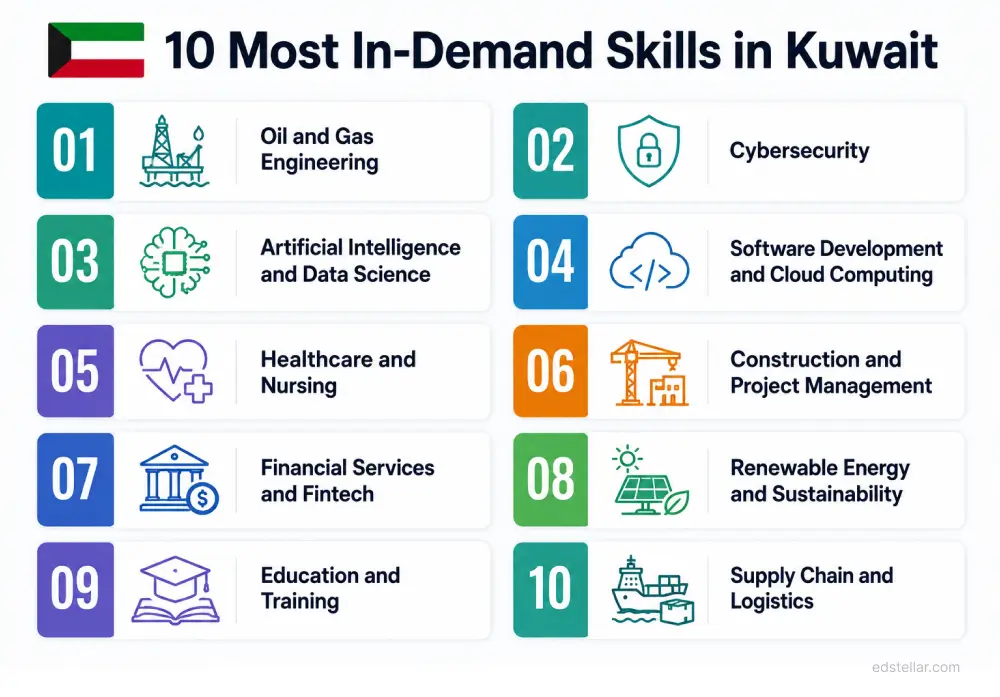
Kuwait's skills landscape in 2026 reflects the convergence of $300 billion in energy projects, a historic reform window after the parliament suspension, Kuwaitization requirements reshaping workforce composition, and a digital transformation drive targeting $39.83 billion in ICT market value. The 10 skills below span energy, technology, healthcare, construction, and financial services, mirroring the sectors where government investment, employer demand, and salary premiums are highest.

Kuwait Petroleum Corporation announced $300 billion in conventional energy projects and $110 billion in energy transition projects, and the oil sector plans over 5,000 new jobs by 2026 as expansion projects scale. KOC met its annual production target for the first time in seven years, reaching sustainable capacity of 2.59 million barrels per day, and Kuwait aims to boost output to 4 million barrels per day by 2035 through offshore exploration and enhanced recovery. Over 65% of new KOC roles in 2026 will focus on engineering and digital innovation skills, with technical roles making up 60% of new hires.
The talent shortage is concentrated in the most specialised tiers. Demand for reservoir engineers with heavy oil and carbonate experience exceeds local supply by a 3:1 ratio, and Kuwait City produces fewer than 200 petroleum engineering graduates per year. Saudi Arabia's Aramco and SABIC offer compensation premiums of 20–35% above Kuwaiti NOC scales, creating a talent drain that Kuwaitization mandates cannot address through quotas alone. The oil sector Kuwaitization rate stands at 91% for direct employees, but only 20% for contractor companies, where much of the specialised work is performed.
Major employers include Kuwait Oil Company (KOC), Kuwait National Petroleum Company (KNPC), Kuwait Gulf Oil Company (KGOC), and Petrochemical Industries Company (PIC), all operating under the KPC umbrella. International service companies including Halliburton, Schlumberger, and Baker Hughes maintain significant Kuwait operations. Petroleum engineers, drilling supervisors, HSE managers, reservoir engineers, process engineers, and instrumentation specialists are among the most sought-after roles. The Al Zour Refinery's increased activity is adding refining and downstream processing demand.
Upstream Oil & Gas (KOC), Refining & Petrochemicals (KNPC), Energy Services & EPC, Offshore Exploration

Cybersecurity demand in Kuwait jumped 25% between 2023 and 2024 according to industry salary data, and the ICT market is projected to reach $39.83 billion within the next five years, growing at nearly 10% annually. Kuwait's digital transformation across government services, banking, oil and gas operations, and smart city projects is creating an expanding attack surface that demands a correspondingly larger security workforce. The concentration of national wealth in sovereign funds (the Kuwait Investment Authority manages over $1 trillion) and critical energy infrastructure makes cybersecurity a matter of national economic security.
Cybersecurity professionals in Kuwait earn KWD 1,200–4,500 monthly, with entry-level analysts starting at the lower end and senior architects and CISOs commanding the upper range. CISSP, CISM, CEH, and CompTIA Security+ certifications carry significant salary premiums. The banking sector (National Bank of Kuwait, Gulf Bank, Kuwait Finance House, Boubyan Bank), telecommunications companies (Zain, Ooredoo, stc Kuwait), and government agencies are the primary employers. OT/ICS security for oil and gas infrastructure is a particularly high-demand specialisation unique to Kuwait's economic profile. With KPC's digital transformation creating new attack vectors across refining and upstream operations, chief information security officers who can bridge IT and OT security across both energy infrastructure and financial systems are among the most difficult leadership positions to fill in Kuwait.
The 57% skills shortage across the broader GCC region means Kuwait competes with the UAE, Saudi Arabia, and Qatar for the same limited pool of experienced security professionals. Kuwaitization requirements in government cybersecurity roles create additional pressure to develop local talent, but the education pipeline for cybersecurity specialists remains narrow. For mid-career IT professionals, cybersecurity represents one of the highest-return reskilling pathways in the Kuwaiti market.
Banking & Financial Services, Energy & Petrochemicals, Government & Defence, Telecommunications

AI is emerging as a critical skill for Kuwait's economic transformation, driven by government-backed digital transformation initiatives under Vision 2035 and the growing adoption of AI in finance (fintech and fraud detection), oil and gas (predictive maintenance), telecommunications, and government services. Data Scientists earn KWD 1,800–3,000 monthly, while entry-level AI engineers earn KWD 1,200–1,800 and experienced engineers command KWD 2,000–2,800. Microsoft and Google are investing in Kuwait's digital ecosystem, bolstering demand for AI specialists.
Over 60% of new KOC oil sector roles in 2026 require skills in automation and data analytics, reflecting the energy sector's digital transformation. The banking sector is deploying AI for credit scoring, customer analytics, and regulatory compliance, while smart city projects in Kuwait City and the Northern Special Economic Zone require AI systems for traffic management, energy optimisation, and public services. 28% of CEOs cite skills shortage as their primary challenge, with AI, machine learning, and data science candidates in critically short supply.
Major employers include KPC subsidiaries (for AI in energy operations), National Bank of Kuwait and Kuwait Finance House (for AI in financial services), Zain and Ooredoo (for AI in telecommunications), and the Central Agency for Information Technology (CAIT) for government digital services. For professionals in traditional engineering or business roles, upskilling into AI and data science represents one of the most direct pathways to higher compensation in Kuwait's evolving economy. All salaries are tax-free, with benefits packages typically including housing allowances, education allowances, and annual flights.
Energy & Petrochemicals, Banking & Financial Services, Telecommunications, Government & Public Sector
Explore Related Training:
Machine Learning with Python Data Science with Python All AI Training Programs"As someone who has built and scaled a recruiting agency into a full-service HR provider, I've seen firsthand that Kuwait's unemployment issue isn't about a lack of jobs; it's about a mismatch between candidates' skills and employers' needs."



The ICT market in Kuwait is projected to reach $39.83 billion within five years, growing at nearly 10% annually, with high internet penetration, government-backed digital transformation, and demand for automation in finance, healthcare, and logistics driving the sector. Software engineers earn KWD 1,200–2,400 monthly, and Cloud Architects command $120,000–$180,000 annually, making cloud architecture one of the highest-paying technology roles in the emirate. Employers seek professionals with expertise in Python, machine learning, cybersecurity frameworks, DevOps tools, and blockchain development. Cloud architects who can design secure, scalable environments for government e-services and enterprise digital platforms are among the most sought-after professionals in the Kuwaiti market.
Kuwait's e-government initiative, the smart city components of the Northern Special Economic Zone, and the digital platforms underpinning financial services are all driving demand for full-stack developers, cloud engineers, and DevOps professionals. The government's digital transformation is among the most active hiring areas, as ministries and public agencies modernise service delivery. The banking sector's shift toward digital banking, mobile payments, and open APIs creates additional technology hiring demand.
Major employers include the Central Agency for Information Technology (CAIT), National Bank of Kuwait, Kuwait Finance House, Zain, Ooredoo, and international technology firms expanding in the Kuwaiti market. For international developers, Kuwait offers tax-free salaries with housing and transport allowances. Kuwaitization requirements for technology roles are being implemented but remain less strict than in government and energy sectors due to the acute shortage of local technology talent.
Government Digital Services, Banking & Financial Technology, Telecommunications, Energy Digitisation

Kuwait faces a structural nursing shortage, particularly in critical care, emergency, and operating theatre specialties, with specialised nursing demand increasing 15% in the past year alone. The Ministry of Health plans to recruit over 1,000 new nurses in 2026, and three new hospitals opening by 2026 will drive a 5.8% growth in the healthcare workforce. Kuwait relies heavily on internationally recruited nurses, primarily from the Philippines, India, Egypt, and Jordan, to staff government hospitals and health centres.
The Kuwaitization drive in healthcare is advancing but faces unique challenges. While the government seeks to develop Kuwaiti healthcare professionals through sponsored education programmes, the pipeline of locally trained clinical specialists remains narrow. The healthcare system serves approximately 4.9 million people (including 3.4 million expatriates), and expanding demand for primary care, chronic disease management, and geriatric services adds to the existing shortage across acute care specialties.
Major employers include the Ministry of Health (operating 35+ hospitals and clinics), Kuwait Health Assurance Hospitals Company, and private healthcare providers. Salary packages for international nurses include tax-free base pay, housing provided by the employer, health insurance, and annual return flights, making Kuwait competitive for nurse recruitment. For healthcare professionals, Kuwait offers structured career pathways through the Kuwait Medical Licensing Examination and registration with the Kuwait Nursing Board.
Government Hospitals (MOH), Private Healthcare Groups, Primary Healthcare, Pharmaceutical & Medical Devices

Kuwait awarded $8.7 billion worth of projects in 2025, a 44% year-over-year increase and the highest value since 2017, with the 2025–2026 budget approving $5.6 billion for 124 additional projects. The Mubarak Al Kabeer Port, launched through a partnership with Chinese state enterprises in December 2025, is expected to create 50,000 jobs across construction, logistics, and operations phases. The Northern Special Economic Zone, major electrical grid expansion, and ongoing housing and infrastructure projects are driving sustained construction demand across the country.
Civil engineers earn KWD 800–1,500 monthly, project managers command KWD 1,500–2,500, and senior programme directors at major infrastructure projects earn significantly higher packages. Kharafi National, Combined Group Contracting Company, and Kuwait Municipality are among the top construction employers alongside international contractors. BIM expertise, digital project management, and modular construction knowledge are increasingly valued as Kuwait's construction sector modernises.
The construction sector faces dual pressures: Kuwaitization quotas requiring local hiring alongside the reality that specialised construction skills remain concentrated among expatriate professionals. The technical education pipeline through PAAET (Public Authority for Applied Education and Training) is expanding construction-related programmes, but the gap between graduate output and project demand remains significant. For international construction professionals, Kuwait offers tax-free compensation with comprehensive benefits packages.
Infrastructure & Ports, Government Housing Projects, Energy Infrastructure (KPC), Commercial Real Estate

Kuwait has a strong and stable banking sector, with the Kuwait Investment Authority (KIA) managing over $1 trillion in sovereign wealth, and government-backed initiatives are encouraging fintech platforms, digital banking, and financial innovation. Financial analysts earn KWD 1,000–1,800 monthly, with senior roles at major banks and investment firms commanding significantly higher packages. The Public Debt Law enacted in March 2025, enabling bond issuance for the first time since 2017, is creating new demand for debt capital markets specialists, project finance professionals, and investment bankers.
National Bank of Kuwait (NBK), Kuwait Finance House (KFH), Gulf Bank, Boubyan Bank, and Agility are among the largest financial employers, alongside international firms including HSBC, Citibank, and JPMorgan operating through Kuwait's regulatory framework. Islamic finance is a significant component of the market, with KFH and Boubyan Bank among the world's leading Islamic financial institutions. The convergence of traditional banking with digital platforms is creating demand for fintech developers, digital banking specialists, and regulatory technology professionals.
Kuwaitization requirements in financial services are among the strictest in the economy, creating strong demand for Kuwaiti nationals with combined finance and technology skills. AML compliance, risk management, and regulatory reporting are growing specialisations as Kuwait's financial sector integrates with global standards. For finance professionals, the combination of tax-free income and access to one of the world's largest sovereign wealth funds makes Kuwait an attractive career destination.
Banking & Financial Holdings, Islamic Finance & Takaful, Investment Management (KIA), Insurance & Capital Markets
Explore Related Training:
AI for Financial Services Industry Financial Risk Management All Finance & Accounting Programs
KPC's $110 billion energy transition portfolio includes digital transformation, renewable energy, green hydrogen, and carbon capture projects, positioning Kuwait as a late but substantial entrant into the Gulf's clean energy race. The 15% corporate minimum tax enacted in January 2025 and evolving ESG requirements are creating demand for sustainability reporting, carbon accounting, and environmental compliance professionals. Kuwait's Vision 2035 environmental pillar targets reducing the country's carbon footprint while maintaining energy export competitiveness.
Solar energy projects are expanding, with Kuwait's abundant sunlight making solar PV a natural fit for domestic power generation. The Al Shagaya Renewable Energy Complex, one of the largest solar projects in the GCC, is driving demand for solar engineers, grid integration specialists, and energy storage professionals. The broader energy transition requires professionals who can bridge traditional oil and gas operations with clean energy technologies, creating hybrid roles unique to Kuwait's energy-dominated economy.
For professionals in energy engineering, environmental science, or project management, adding renewable energy and sustainability credentials represents a high-return career investment. The intersection of Kuwait's traditional hydrocarbon expertise with emerging clean energy creates career pathways that leverage existing industry knowledge while opening doors to new growth sectors. ESG reporting and climate risk assessment skills are in particular demand as KDIPA attracts international investors who increasingly require sustainability compliance.
Energy Transition (KPC), Solar & Renewable Power, Government & Policy, Financial Services (Green Finance)
Explore Related Training:
Renewable Energy and Sustainability All Environmental Sustainability Programs
Kuwait's education sector is at the centre of the Kuwaitization challenge: most Kuwaiti graduates are concentrated in administrative fields, creating a mismatch with the technical roles the economy needs. The Creative Human Capital pillar of Vision 2035 focuses on developing young talent, increasing women's workforce participation, and reforming curricula to strengthen science, technology, and critical thinking. The government allocated $7.36 billion to PAAET in fiscal year 2022/2023, underscoring investment in vocational and applied education.
The Kuwaitization of teaching positions is advancing, with expatriate teachers and administrative staff being phased out at the end of the 2024–2025 academic year (for teachers) and December 2025 (for administrators). Private schools serving the expatriate community (approximately 70% of the population) continue to recruit international educators, particularly for English-medium instruction, STEM subjects, and international curricula (British, American, IB). Corporate training is growing as organisations invest in upskilling to bridge the gap between university output and employer requirements.
Universities including Kuwait University, Gulf University for Science and Technology (GUST), and the American University of Kuwait require academic staff across STEM, business, and healthcare programmes. The National Skilling Programme and PAAET vocational training centres are expanding capacity in technical disciplines aligned with Vision 2035 priorities. For L&D professionals, the scale of Kuwait's reskilling challenge, particularly in transitioning government workers into private sector roles, creates sustained demand for corporate trainers and instructional designers.
Public Schools & Universities, Private International Schools, PAAET & Vocational Institutes, Corporate Training
Explore Related Training:
Advanced Leadership Communication Strategies All Leadership Communication Programs
The Mubarak Al Kabeer Port, Kuwait's flagship infrastructure project launched in partnership with Chinese state enterprises, will create 50,000 jobs and position the country as a trade gateway connecting the northern Gulf with Iraq and Central Asia. The Northern Special Economic Zone accompanying the port will require supply chain managers, customs specialists, warehouse operations professionals, and logistics coordinators. Kuwait's role in the oil supply chain, managing production, export, and global distribution of approximately 2.59 million barrels per day, adds energy logistics to the demand profile.
The $8.7 billion in project awards in 2025 and $5.6 billion approved for 124 projects in the 2025–2026 budget are generating massive procurement and logistics requirements. Construction materials, heavy equipment, specialised components, and consumer goods must be sourced, transported, and delivered across a rapidly expanding project portfolio. The retail sector is also modernising, with e-commerce growth driving demand for last-mile delivery, warehouse automation, and digital supply chain management.
KDIPA's efforts to attract foreign investment across 13 service sectors create additional demand for trade compliance, international logistics, and free zone management professionals. Major employers include Agility (one of the world's largest logistics companies, headquartered in Kuwait), the Kuwait Ports Authority, and the logistics divisions of major construction and retail groups. For logistics professionals, Kuwait's combination of tax-free income and strategic position in the Gulf makes it an attractive career destination.
Ports & Maritime (Mubarak Al Kabeer), Energy Supply Chain (KPC), Retail & E-Commerce, Construction Procurement
Explore Related Training:
Supply Chain Management Fundamentals AI for Supply Chain All Operations Management Programs"We believe that the future begins today and that equipping our youth with vital knowledge and skills is essential for driving innovation and contributing to the development of the local digital economy."


Top highest-salary jobs in Kuwait covering the most in-demand roles and sectors driving workforce demand across the country.
Kuwait's skills demand is concentrated in a small number of high-investment sectors, with the oil industry, government services, and construction accounting for the majority of hiring activity. Understanding these sector-level patterns helps corporate L&D teams and HR managers target training investments where they will have the greatest impact.
The energy sector drives the highest-paying and most acute talent shortages, with KPC and its subsidiaries dominating upstream, downstream, and petrochemical employment. Financial services, concentrated in Kuwait City's banking district, offers strong careers in both conventional and Islamic finance. The Mubarak Al Kabeer Port and Northern Special Economic Zone represent the next wave of construction and logistics demand. For organisations planning workforce strategies, aligning training programmes with these sector-level demand patterns ensures that upskilling investments deliver maximum return.
#On-site #Virtual #GroupTraining #Customized
Explore 2000+ industry ready instructor-led training programs.

Create dynamic leaders and cohesive teams. Learn more now!

Do a quick Skill gap analysis with Edstellar’s Free Skill Matrix tool

Unlock premium resources, tools, and frameworks designed for HR and learning professionals. Our L&D Hub gives you everything needed to elevate your organization's training approach.
Access L&D Hub Resources.svg)
.svg)
.svg)
.svg)

.svg)


.svg "Click Here to Follow on Medium")
.svg)


