10 Most In-Demand Skills in Spain for 2026

.svg "edstellar")

Spain's labour market is outpacing most of Europe. The country created 605,400 jobs in 2025, pushing total employment to a record 22.46 million and dropping unemployment below 10% for the first time since 2008, according to INE data analysed by BBVA Research. Spain accounted for 44% of all new jobs created across the Eurozone, with job postings running 52% above pre-pandemic levels. Yet beneath this growth lies a structural skills mismatch: labour shortages in digital and green fields exceed the average by 212% and 52% respectively according to Cedefop, and the country needs more than 300,000 foreign workers annually by 2026 to fill essential roles.
The gap is most acute in technology, healthcare, construction, and renewable energy. Spain needs an estimated 1.39 million additional ICT specialists to meet the EU Digital Decade 2030 target, while the construction sector urgently requires over 700,000 professionals to address a housing deficit that the Bank of Spain has revised upward to 700,000 homes. At the same time, the PERTE Chip programme is mobilising EUR 12.25 billion for semiconductors, and the National AI Strategy (ENIA) has attracted more than EUR 2 billion in AI investment since 2020. These investments are creating demand for technical talent that Spain's education system cannot produce fast enough.
So which skills in demand in Spain should corporate L&D leaders, HR managers, and workforce planners prioritise? This guide breaks down the top 10 high demand skills in Spain across technology, healthcare, construction, energy, and services. It draws on SEPE shortage occupation data, INE employment statistics, INCIBE cybersecurity reports, and Cedefop skills forecasts to give you a data-backed picture of what jobs are in demand in Spain, whether you are planning corporate upskilling programmes, navigating the Spanish work visa system, or building workforce strategies for one of Europe's fastest-growing economies.
Every ranking in this guide is backed by data from Spanish government bodies, EU institutions, and established industry sources.
Spain's skills demand reflects an economy being reshaped by three forces simultaneously: a digital transformation backed by billions in EU recovery funds, a renewable energy transition that is making Spain Europe's solar leader, and a housing crisis that cannot be solved without a construction workforce that is rapidly ageing out.
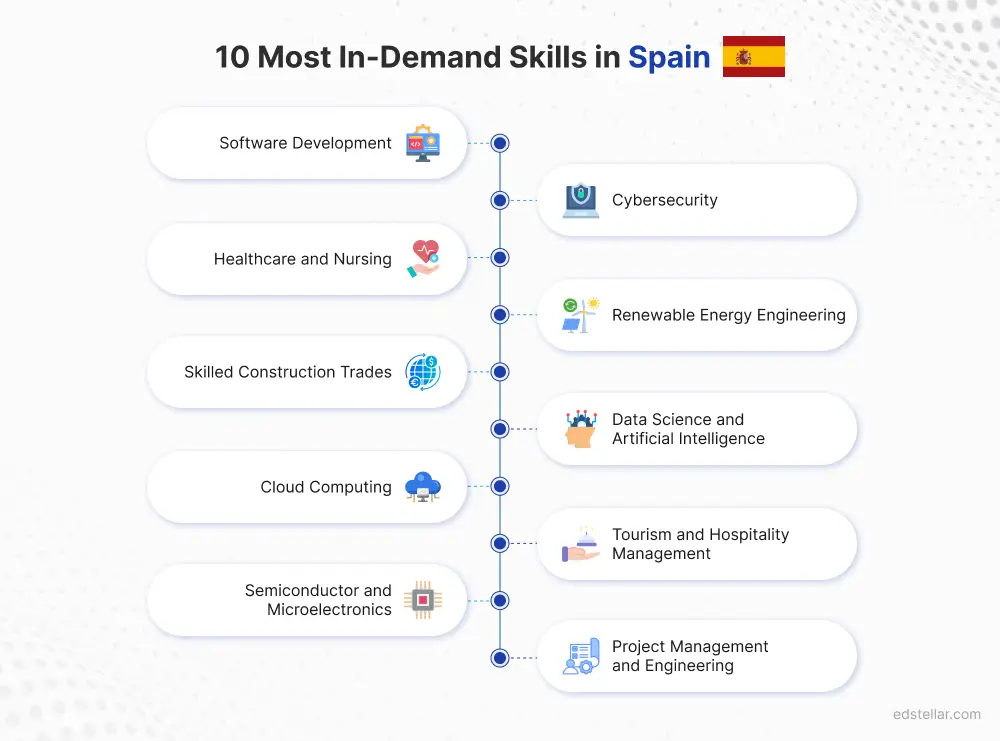
The 10 skills below are ranked by a weighted research score factoring in government policy investment (including PERTE programmes), shortage severity from SEPE data, salary premium, cross-sector applicability, and alignment with Spain's Digital Spain 2026 and PNIEC energy targets.

Spain needs an estimated 1.39 million additional ICT specialists to meet the EU Digital Decade 2030 target of 10% ICT employment, and between 25,000 and 50,000 developer positions currently remain unfilled across the country according to industry assessments. Spain's ICT workforce grew 6.8% year-on-year, surpassing the EU average of 4.2%, but the pace of job creation continues to outstrip the talent pipeline. The Digital Spain Plan 2025 sets a goal for 20,000 new specialists in cybersecurity, AI, and data, though this target barely scratches the surface of total demand.
Madrid and Barcelona are the primary technology hubs, together creating over 26,000 tech jobs and generating EUR 2.5 billion annually. Telefónica, Indra, Amadeus, and Santander Digital are among the largest tech employers, while startups supported by the Ley de Startups (Startup Act) are scaling across fintech, healthtech, and proptech verticals. CaixaBank Tech, BBVA's AI Factory, and Cabify's engineering teams recruit hundreds of developers annually. DevOps engineers are particularly scarce, with cloud/AI/DevOps shortages identified as the most persistent across the market.
Software developers in Spain earn between EUR 35,000 and EUR 72,000 annually, with senior engineers at top-tier companies earning above EUR 80,000. Salaries in Madrid and Barcelona run 15 to 20% above the national average, and companies paying EUR 100,000 or more include Datadog, Personio, Revolut, and several US-headquartered firms with Spanish offices. Python, Java, JavaScript, TypeScript, and Go are the most requested languages, with React, Spring Boot, and Kubernetes dominating job listings. Spanish language proficiency is expected at domestic firms but not always required at multinational companies.
Banking and Financial Services, Telecommunications, Travel Technology, E-commerce
Explore Related Training:
AI Programming with Python Full Stack Development All Software Development Programs
Spain's cybersecurity market was valued at USD 5.3 billion in 2025 and is projected to reach USD 11.3 billion by 2034. INCIBE and CONETIC's 2025 study counts 164,761 cybersecurity workers in Spain, a 35% increase from 2021, but projects the sector will need 282,157 by 2029. Spain is the fourth-largest cybersecurity market in Europe with 3,431 companies and EUR 6.35 billion in sector revenue. Despite this growth, the professional shortage remains severe, with industry estimates citing 30,000 to 80,000 unfilled positions and 53% of firms turning to AI-driven security agents to compensate.
INCIBE, headquartered in León, coordinates national cybersecurity capacity building through training programmes, online courses, and industry partnerships. The Digital Spain Plan targets 20,000 new specialists across cybersecurity, AI, and data. Major employers recruiting security professionals include Telefónica Tech, Indra, S21sec, ElevenPaths, Accenture Security Spain, and the Centro Criptológico Nacional (CCN). Spain's banking sector (Santander, BBVA, CaixaBank, Bankinter) is a particularly large consumer of cybersecurity talent, given EU regulatory requirements including DORA and NIS2 compliance.
Cybersecurity professionals in Spain earn between EUR 35,000 and EUR 80,000 annually, with senior security architects and CISOs commanding EUR 90,000 or more. Key certifications valued by Spanish employers include CISSP, CEH, CISA, and ENS (Esquema Nacional de Seguridad) knowledge. Spanish language is typically required for governance and compliance roles but less critical for technical positions at multinational firms. INCIBE offers scholarships and subsidies for cybersecurity education and certifications.
Banking and Financial Services, Telecommunications, Government, Energy and Utilities
Explore Related Training:
Cybersecurity Risk Management Threat Intelligence All Cybersecurity Programs
EURES identified health professionals as one of the highest shortage occupation groups in Spain in 2024, and OECD Health at a Glance 2025 data confirms that Spain has only 5.9 practising nurses per 1,000 population, well below the OECD average of 9.2. While Spain's doctor density (3.8 per 1,000) is above the EU average, the country needs at least 100,000 additional nurses to reach the EU average ratio, and critical shortages persist in family medicine, anaesthesiology, geriatrics, radiology, and psychiatry. Brain drain is a factor: Spanish doctors and nurses actively emigrate to higher-paying EU countries including Germany, the UK, and the Netherlands. Rural areas face the most severe gaps, particularly for GPs and paediatricians.
In July 2022, the government launched the largest employment process in the history of the Sistema Nacional de Salud (SNS), leading to the stabilisation of 80,000 health professional positions to reduce temporary employment. However, graduation rates for healthcare professionals remain comparatively low relative to other EU countries, limiting the long-term pipeline. Vacancies in the MIR (Médico Interno Residente) specialisation programme have been increased, along with nurse training places. Major hospital networks including Hospital La Paz, Hospital Clínic de Barcelona, Hospital Gregorio Marañón, and Fundación Jiménez Díaz are all actively recruiting, and private healthcare groups Quironsalud and HM Hospitales are expanding across the country.
Nurses in Spain earn between EUR 25,000 and EUR 40,000 annually, with specialist nurses earning more. Doctors earn EUR 50,000 to EUR 90,000 depending on specialisation and whether they work in the public or private sector. Spanish language proficiency at C1 level is mandatory for clinical roles. For EU healthcare professionals, qualifications are recognised through the EU Professional Qualifications Directive, while non-EU professionals must have their credentials homologated by the Spanish Ministry of Education.
Public Health System (SNS), Private Hospital Groups, Home Care Services, Pharmaceutical Companies

Spain's renewable energy targets of 71 additional GW between 2025 and 2030 could generate approximately 889,000 jobs, including 110,000 green-skilled positions according to BBVA Research analysis. Spain already leads Europe in solar energy, with 21% of electricity generation from solar sources. The renewables sector currently includes 81,000 direct and indirect employees across approximately 4,000 companies, and this base is scaling rapidly as Spain implements its PNIEC (Plan Nacional Integrado de Energía y Clima) targets.
Iberdrola, Spain's largest utility, announced plans to welcome 15,000 new professionals under its 2025 to 2028 Strategic Plan and create 10,000 additional jobs worldwide by 2026. Acciona Energía, Endesa (Enel), Naturgy, and Siemens Gamesa (now Siemens Energy) are all expanding their Spanish operations. Green hydrogen is emerging as a major growth area, with Spain positioning itself as a European hydrogen hub through the PERTE for Renewable Energies, Renewable Hydrogen, and Storage. Large-scale solar farms in Andalucía, Extremadura, and Castilla-La Mancha require engineers, project managers, and installation technicians in numbers that domestic training centres cannot produce fast enough.
Renewable energy engineers in Spain earn between EUR 35,000 and EUR 65,000 annually, with senior project managers and grid integration specialists commanding EUR 70,000 or more. Key qualifications include electrical or energy engineering degrees, PV system design certifications, and experience with grid-scale battery storage systems. Spanish language is required for most site-based and regulatory-facing roles, though English may be sufficient for engineering roles at international companies like Siemens Energy.
Energy Utilities, Solar and Wind Developers, Green Hydrogen, Grid Infrastructure
Explore Related Training:
Renewable Energy and Sustainability Green Project Management All Environmental Sustainability Programs"A shortage of digital skills is impeding growth for the most digitally advanced companies. 81% of businesses view digital skills as important or essential, rising to 95% for digitally intensive businesses."



Spain urgently needs more than 700,000 construction professionals including bricklayers, electricians, plumbers, and carpenters, according to industry data. The workforce is ageing rapidly: only 16% of construction workers are under 34, compared to 32% before the financial crisis, and one in five is now over 58. Developers report delays of up to a year in completing projects due to staffing shortages, directly worsening a housing crisis where the Bank of Spain estimates a deficit of 700,000 homes.
The numbers are stark. Housing starts in Q4 2025 reached 34,200 units, the best Q4 in 17 years, yet net household creation of 226,000 annually still far outpaces completions. Construction costs rose 5.46% in 2025, driven mainly by labour cost increases of 8 to 15% across multiple regions. The average price of free-market housing jumped 10.4% year-on-year in Q2 2025, with the shortage concentrated in Madrid, Barcelona, Valencia, Alicante, and the Canary Islands. Spain launched recruitment drives in Honduras, the Philippines, and other countries to staff construction sites, but the domestic training pipeline remains the core bottleneck. Young Spaniards increasingly view the sector as unstable and physically demanding, and vocational training (FP) enrolment in construction trades has not recovered to pre-crisis levels.
Skilled construction workers in Spain earn between EUR 22,000 and EUR 40,000 annually, with specialised electricians and project site supervisors at the higher end. Civil engineers and quantity surveyors earn EUR 35,000 to EUR 55,000. Key skills in demand include masonry, electrical installation, plumbing, HVAC systems, and increasingly building information modelling (BIM). Spanish language is essential for site-based roles. SEPE lists multiple construction trades on the quarterly shortage occupation catalogue across nearly all provinces.
Residential Construction, Infrastructure, Tourism and Hospitality Facilities, Renovation and Retrofit

Spain ranks fifth in Europe for AI investment since 2020, with more than EUR 2 billion invested in artificial intelligence. According to IndesIA, 24% of the 120,000 tech jobs offered in Spain in 2023 required data skills, projected to rise to 30%. Yet 30% of AI and machine learning roles remain unfilled due to talent shortages, and industry predictions suggest AI will contribute EUR 16.5 billion to Spain's GDP. The National AI Strategy (ENIA) and the National Quantum Technologies Strategy (EUR 800 million allocation) are both driving demand for data professionals across the public and private sectors.
Financial institutions are the largest employers of data scientists in Spain. Santander, BBVA, CaixaBank, and Bankinter have all built in-house AI and analytics teams. Telefónica's AI Factory, Indra's data division, and Inditex's supply chain analytics team are also significant recruiters. The data engineering function is increasingly critical as Spanish enterprises manage growing data volumes across cloud platforms. High-demand specialisations include NLP for the Spanish and Catalan markets, computer vision for manufacturing and retail, and generative AI applications.
Data scientists in Spain earn between EUR 35,000 and EUR 90,000 annually, with senior roles frequently exceeding EUR 100,000 at top companies. AI and ML specialist salaries have risen approximately 10% year-on-year, reflecting intense competition for a limited talent pool. Key skills include Python, R, TensorFlow, PyTorch, SQL, and experience with cloud analytics platforms (AWS SageMaker, Azure ML, Google Vertex AI). Spanish language proficiency is expected at domestic companies, though English is the working language at many multinational firms with Spanish offices.
Banking and Financial Services, Telecommunications, Retail and Fashion, Government and Public Sector

Cloud, AI, and DevOps shortages have been identified as the most persistent in Spain's technology job market, with 2025 to 2026 seeing recovery in openings and increased demand for AI-related roles and senior hires. Spain's digital transformation push, backed by EU recovery funds, is accelerating cloud adoption across both the public and private sector. The government's España Digital 2026 programme targets comprehensive digital modernisation of public administration, creating demand for cloud engineers who can architect and manage government cloud infrastructure.
AWS, Microsoft Azure, and Google Cloud are all expanding their Spanish presence, with data centres in Madrid and Aragón. Telefónica Tech offers managed cloud services to enterprise clients, while CaixaBank Tech and BBVA Technology manage some of Europe's largest private cloud deployments. Accenture, Deloitte, and Capgemini's Spanish operations recruit cloud architects and migration specialists at scale. The Ley de Startups has spurred cloud-native development across Spain's growing startup ecosystem, particularly in Madrid, Barcelona, Valencia, and Málaga.
Cloud engineers in Spain earn between EUR 40,000 and EUR 75,000 annually, with certified architects and senior platform engineers earning above EUR 80,000. Key certifications include AWS Solutions Architect, Azure Administrator, GCP Professional, and Kubernetes (CKA/CKAD). DevOps engineers with cloud expertise can command EUR 50,000 to EUR 85,000. Spanish language proficiency is expected at most employers, though English is the working language at many cloud provider teams and international consultancies.
Banking and Financial Services, Public Sector, Telecommunications, Consulting and Professional Services
Explore Related Training:
Multi-Cloud (AWS + Azure) with DevOps Cloud Security Essentials All Cloud Computing Programs
Spain's hospitality industry reported a shortfall of approximately 200,000 workers during the summer of 2023 despite high general unemployment, and the sector will need to fill an estimated 900,000 jobs by 2030 according to McKinsey analysis. Currently, only 50,000 students graduate from professional hospitality and tourism training each year, creating a massive gap between supply and demand. Spain launched international recruitment drives in Honduras, the Philippines, and other countries to staff hotels and resorts, but the challenge runs deeper than volume.
Tourism employment surpassed 3 million workers for the first time in Q2 2025 according to the Ministry of Tourism, reaching 3,024,347 workers (+2.0% year-on-year). Hospitality alone accounts for 64% of tourism employment (approximately 1.8 million people), yet 95% of hospitality workers earn below the national average salary. However, chefs and kitchen staff are in globally short supply, hotel managers with digital skills are scarce, and the sector faces a mass exodus of experienced workers due to working conditions and limited career progression. Meliá Hotels International, NH Hotel Group (Minor International), Barceló Group, Riu Hotels, and Iberostar are among the largest employers, alongside thousands of independent restaurants and accommodation providers. Spain's hospitality sector accounts for approximately 12% of GDP.
Hospitality professionals in Spain earn between EUR 18,000 and EUR 35,000 annually for operational roles, with hotel general managers and senior chefs earning EUR 40,000 to EUR 65,000. Seasonal work is common, which depresses average annual compensation. Key skills in demand include revenue management, digital marketing for tourism, food safety and APPCC compliance, sustainable tourism practices, and multilingual customer service. Spanish plus at least one additional language (English, German, French) is essential for customer-facing roles.
Hotels and Resorts, Restaurants, Tour Operators, Cruise Lines and Marinas
Explore Related Training:
Explore Training Programs
The PERTE Chip programme will mobilise EUR 12.25 billion to strengthen Spain's semiconductor value chain, the largest industrial project ever launched in Spain under the European recovery funds. Two calls for proposals have been launched: Chip Missions (EUR 60 million) to bolster the design centre ecosystem and support R&D, and Chip Chairs (EUR 80 million) to promote specialised training through collaboration between businesses and universities. Spain secured an agreement to establish Imec's second European manufacturing and R&D centre in Málaga, with over EUR 600 million in investment expected by 2030.
The semiconductor sector in Spain is nascent compared to Taiwan, South Korea, or the US, but the PERTE investment is creating demand from scratch. Chip assembly plants, design centres, and microelectronics research facilities are being established across the country, with Málaga, Barcelona, Madrid, and Bilbao as the primary locations. Universities including UPC Barcelona, Universidad de Sevilla, and Universidad de Granada are expanding microelectronics programmes, and the Chip Chairs initiative is building industry-academia collaboration to fill the pipeline. The National Quantum Technologies Strategy (EUR 800 million) adds further demand for adjacent physics and engineering skills.
Semiconductor engineers in Spain earn between EUR 35,000 and EUR 65,000 annually, with senior IC design and process engineers earning more as the sector matures. The talent market is global: Spanish semiconductor companies compete with Intel, TSMC, and ASML for the same pool of European chip talent. Key skills include VLSI design, FPGA programming, semiconductor process engineering, and clean-room fabrication technology. Multilingual proficiency (Spanish plus English) is essential given the international nature of the industry.
Semiconductor Manufacturing, Defence and Aerospace, Automotive, Telecommunications

Cedefop forecasts that managers and directors are among the fastest-growing occupation groups in Spain, with more than 704,000 jobs expected to be created. The scale and complexity of PERTE programmes across semiconductors, renewable energy, electric vehicles, healthcare, and digitalisation require project managers who can coordinate multi-year, multi-million-euro initiatives across public and private stakeholders. Spain's EU recovery fund allocation (the largest in Europe) has created a pipeline of infrastructure and transformation projects that will run through the end of the decade.
Demand spans every sector. Construction companies need project managers for the Big Push housing and infrastructure pipeline. Renewable energy developers need them to coordinate solar farms, wind installations, and hydrogen plants. Technology companies need them for cloud migration and digital transformation programmes. The public sector needs them to manage the disbursement and execution of Next Generation EU funds. Spanish companies including Ferrovial, ACS Group, Sacyr, and Acciona are among the world's largest infrastructure operators, creating demand for internationally experienced project managers.
Project managers in Spain earn between EUR 40,000 and EUR 70,000 annually, with senior programme directors at large infrastructure companies earning above EUR 80,000. PMP, PRINCE2, and Agile certifications (Scrum Master, SAFe) are highly valued. Key skills include Agile and hybrid project management, stakeholder management across public and private sectors, budget management for EU-funded projects, and risk management. Spanish language is required for most roles, with English as an additional requirement for international projects.
Infrastructure and Construction, Energy and Utilities, Technology, Public Sector and EU Programmes
Explore Related Training:
Construction Project Management Project Risk Management All Project Management Programs"There is still a significant gap between the skills the market needs and those that graduates possess, with a talent gap estimated at 41.8 points out of 100. Companies dedicate over 102 hours to training new employees and could create 11% more jobs if talent mismatches were eliminated. It is crucial that all players, including young people and universities, work together to close this gap."


Why Spain's Economy Is Booming: Analysis of the economic forces driving Spain's outperformance versus other major European economies, covering job creation, sector growth, and structural reforms.
Spain received the largest allocation of EU Next Generation recovery funds in Europe, and the PERTE (Proyectos Estratégicos para la Recuperación y Transformación Económica) programmes channel these funds into specific sectors. Understanding which PERTEs are active and their workforce implications helps training teams prioritise investment.
The combined PERTE investment exceeds EUR 40 billion in public funds, with private co-investment expected to multiply this further. For corporate training teams, the PERTE roadmap provides a direct signal of where government-backed demand will concentrate over the next three to five years: semiconductors, green energy, digital infrastructure, and electric vehicles represent the largest skill creation opportunities.
Pete Ford is a corporate training specialist with over 15 years of experience in training methodologies, employee engagement, and performance improvement. He has a proven track record of developing and implementing effective training programs that enhance employee skills and productivity.
#On-site #Virtual #GroupTraining #Customized
Explore 2000+ industry ready instructor-led training programs.

Create dynamic leaders and cohesive teams. Learn more now!

Do a quick Skill gap analysis with Edstellar’s Free Skill Matrix tool

Unlock premium resources, tools, and frameworks designed for HR and learning professionals. Our L&D Hub gives you everything needed to elevate your organization's training approach.
Access L&D Hub Resources.svg)
.svg)
.svg)
.svg)

.svg)


.svg "Click Here to Follow on Medium")
.svg)


