Drive Team Excellence with Threat Intelligence Corporate Training

Threat intelligence is the practice of gathering, analyzing, and interpreting information about potential cybersecurity threats to an organization's systems, networks, and data. It is crucial for organizations to leverage threat intelligence to stay informed about the evolving landscape of cyber threats and to proactively identify and mitigate potential risks, thereby enhancing their overall cybersecurity posture. Training in threat intelligence equips individuals with the knowledge and skills needed to effectively collect, analyze, and utilize threat data to protect organizational assets from cyber attacks

This instructor-led training, available both virtually and onsite, ensures an interactive and engaging learning environment. Professionals will explore topics like cyber threat landscapes, types of cyber threats, intelligence-gathering techniques, and tools for threat analysis. The course emphasizes practical skills in handling real-world scenarios, including using advanced software and analytical tools specific to threat intelligence

Get Customized Expert-led Training for Your Teams
Customized Training Delivery
Scale Your Training: Small to Large Teams
In-person Onsite, Live Virtual or Hybrid Training Modes
Plan from 2000+ Industry-ready Training Programs
Experience Hands-On Learning from Industry Experts
Delivery Capability Across 100+ Countries & 10+ Languages
""""

Skills Your Employees Will Gain

These are the core, hands-on capabilities your team builds during the program.

  • Threat Analysis
    Threat Analysis is the process of identifying and evaluating potential security threats to an organization. this skill is important for cybersecurity roles, as it helps protect sensitive data and systems from attacks.
  • Legal Compliance
    Legal Compliance is the ability to understand and adhere to laws and regulations relevant to a business. This skill is important for roles in law, finance, and HR to mitigate risks and ensure ethical operations.
  • Intelligence Interpretation
    Intelligence Interpretation is the ability to analyze and derive insights from complex data. this skill is important for roles in security, law enforcement, and data analysis, as it aids in informed decision-making and strategic planning.
  • Platform Utilization
    Platform Utilization is the ability to effectively leverage software and tools for optimal performance. this skill is important for roles in it, marketing, and project management, enhancing productivity and collaboration.
  • Incident Response
    Incident Response is the ability to quickly identify, manage, and mitigate security incidents. This skill is important for cybersecurity roles, ensuring swift recovery and minimizing damage.
  • Risk Management
    Risk Management is the process of identifying, assessing, and mitigating potential risks to minimize their impact. This skill is important for roles in finance, project management, and compliance, as it ensures informed decision-making and protects organizational assets.

What Your Team Will Achieve After This Training

  • Ability to identify and analyze potential cyber threats using advanced techniques and tools
  • Familiarity with legal and ethical considerations in threat intelligence gathering and dissemination
  • Practical experience in using threat intelligence platforms and tools to monitor and assess threats
  • Skills in collecting, processing, and interpreting intelligence data to inform cybersecurity strategies
  • Improved incident response capabilities, enabling quicker and more effective action in the face of security breaches
  • Enhanced ability to contribute to the organization's overall cybersecurity strategy by proactively managing and mitigating risks
  • Comprehensive understanding of current and emerging cyber threat landscapes, including various types of cyber threats and their impacts

Topics & Program Outline

The curriculum is organized into focused modules built by industry experts and delivered virtually or on-premise. Interactive sessions reflect the evolving demands of the workplace, keeping the learning both relevant and practical.

  1. Understanding intelligence
    • Intelligence lexicon and definitions
    • Traditional intelligence cycle
    • Richards Heuer, Jr., Sherman Kent, and intelligence tradecraft
    • Structured analytical techniques
  2. Understanding cyber threat intelligence
    • Defining threats
    • Understanding risk
    • Cyber threat intelligence and its role
    • Expectations of organizations and analysts
    • Diamond model and activity groups
    • Four types of threat detection
  3. Threat intelligence consumption
    • Sliding scale of cybersecurity
    • Consuming intelligence for different goals
    • Enabling other teams with intelligence
  4. Positioning the team to generate intelligence
    • Building an intelligence team
    • Positioning the team in the organization
    • Prerequisites for intelligence generation
  5. Planning and direction (developing requirements)
    • Intelligence requirements
    • Priority intelligence requirements
    • Beginning the intelligence lifecycle
    • Threat modeling
  1. Primary collection source: intrusion analysis
    • Intrusion analysis as a core skillset
    • Methods to performing intrusion analysis
    • Intrusion kill chain
    • MITRE ATT&CK
    • Diamond model
  2. Kill Chain Courses of Action
    • Passively discovering activity in historical data and logs
    • Detecting future threat actions and capabilities
    • Denying access to threats
    • Delaying and degrading adversary tactics and malware
  3. Kill chain deep dive
    • Scenario introduction
    • Notification of malicious activity
    • Pivoting off of a single indicator to discover adversary activity
    • Identifying and categorizing malicious actions
    • Using network and host-based data
    • Interacting with incident response teams
    • Interacting with Malware reverse engineers
    • Effectively leveraging requests for information
  4. Handling multiple kill chains
    • Identifying different simultaneous intrusions
    • Managing and constructing multiple kill chains
    • Linking related intrusions
    • Extracting knowledge from the intrusions for long-term tracking
  1. Collection source: Malware
    • Data from malware analysis
    • Key data types to analyze and pivot on
    • Virustotal and malware parsers
    • Identifying intrusion patterns and key indicators
  2. Collection source: domains
    • Domain deep dive
    • Different types of adversary domains
    • Pivoting off of information in domains
  3. Collection source: external datasets
    • Building repositories from external datasets
    • Open-source intelligence collection tools and frameworks
  4. Collection Source: Malware
    • Data from Malware analysis
    • Key data types to analyze and pivot on
    • Virustotal and malware parsers
    • Identifying intrusion patterns and key indicators
  5. Collection source: domains
    • Domain deep dive
    • Different types of adversary domains
    • Pivoting off of information in domains
  6. Collection source: external datasets
    • Building repositories from external datasets
    • Open-source intelligence collection tools and frameworks
  1. Exploitation: storing and structuring data
    • Storing threat data
    • Threat information sharing
    • MISP as a storage platform
  2. Analysis: logical fallacies and cognitive biases
    • Logical fallacies
    • Cognitive biases
    • Common cyber threat intelligence informal fallacies
  3. Analysis: exploring hypotheses
    • Analysis of competing hypotheses
    • Hypotheses generation
    • Understanding and identifying knowledge gaps
  4. Analysis: different types of analysis
    • Visual analysis
    • data analysis
    • Temporal analysis
    • Case Study: panama papers
    • Analysis: clustering intrusions
    • Style guide
    • Names and clustering rules
  5. ACH for intrusions
  6. Activity groups and diamond model for clusters
    • Style guide
    • Names and clustering rules
    • ACH for intrusions
    • Activity groups and diamond model for clusters
  1. Logical fallacies and cognitive biases
    • Identifying and defeating bias
    • Logical fallacies and examples
    • Common cyber threat intelligence informal fallacies
    • Cognitive biases and examples
  2. Dissemination: tactical
    • Understanding the audience and consumer
    • Threat data feeds and their limitations
  3. Dissemination: operational
    • Different methods of campaign correlation
    • Understanding perceived adversary intentions
    • Leveraging the diamond model for campaign analysis
  4. Dissemination: strategic
    • Report writing pitfalls
    • Report writing best practices
    • Different types of strategic output

Who Should Attend?

This program suits professionals at many levels across the organization, including:

  • Cybersecurity Analysts
  • Threat Analysts
  • Information Security Managers
  • Incident Response Specialists
  • Security Architects
  • IT Security Analysts
  • Risk Managers
  • Intelligence Analysts
  • Security Operations Managers
  • Security Engineers
  • Compliance Officers
  • Vulnerability Analysts

What are the Prerequisites?

Professionals can take the Threat Intelligence training course with a basic understanding of the command line in Linux and familiarity with security terminology

Request a Quote for your Corporate Training Requirements

Valid number

Delivering Training for Organizations across 100 Countries and 10+ Languages

Choose the Format That Fits Your Team

We design training your teams actually engage with, and deliver it the way that suits you best. Through a vetted global trainer network, Edstellar runs sessions in 10+ languages with consistent quality anywhere.

Virtual Threat Intelligence Training

Virtual / online: expert-led live sessions delivered anywhere, with consistency and easy scheduling.

We deliver anywhere worldwide
Standardized content for consistent outcomes
Join from own workspace, no travel
We scale to large groups across sites
Interactive tools keep remote learners engaged
On-site Threat Intelligence Training

On-site (in-house): immersive, instructor-led learning at your office.

Our trainers run face-to-face at your office
We tailor setup/content to your workplace and tools
Group exercises drive collaboration
Live demos +  hands-on practice
Direct trainer access to clarify doubts
Off-site Threat Intelligence Training

Off-site: focused, instructor-led group learning away from everyday workplace distractions.

We host your teams at a venue of your preferred choice
Built-in group activities for bonding
Full uninterrupted schedule for focus/retention
Boosts morale and signals commitment

Get a Proposal Shaped to Your Needs

Need pricing for onsite, offsite, or virtual delivery? Get a proposal tailored to your team's needs.

Request a Group Training Quote
""
How Many Team Members Need Training?
Please select an option or fill in the custom field.
"'

Is Your Corporate Training Requirement Only for Threat Intelligence?

Please select at least one course.
""
Add the List of Training Workshops
search icon

      Please select the course

      No. of Courses selected: 0

      Clear

      Upload a CSV

      Send us your Training Requirements in 3 Easy steps

      1. 1
      2. 2
        Add the required training workshops
      3. 3
        Upload to get a quick quote or email it to contact@edstellar.com

      ""

      Looking for a Complete Package?

      Looking for a one-time pricing option for all your annual training requirements?

      View Corporate Training Packages
      ""
      Select the Option that Best Describes Your Corporate Training Requirement

      Please select an option or choose from the recurring options.
      ""
      Verify and Submit Your Request

      Review Your Corporate Training Selection Summary

      Training Program: Threat Intelligence Training

      1. No of Team Members

      2. Selected Training Preference

      3. Selected Recurring Sessions

      1

      Review your Requirements

      Training Workshops Selected :


        Excel
        File has been
        successfully uploaded.
        Fill the form to submit
 your details
        Submit Your Professional Contact Information
        Valid number
        We've received your enquiry. Our team will be in touch soon.
        Oops! Something went wrong while submitting the form.
        Starter
        120 licences

        Tailor-Made Trainee Licenses with Our Exclusive Training Packages!

        View Package

        64 hours of group training (includes VILT/In-person On-site)

        Tailored for SMBs

        Growth
        320 licences

        Tailor-Made Trainee Licenses with Our Exclusive Training Packages!

        View Package

        160 hours of group training (includes VILT/In-person On-site)

        Ideal for growing SMBs

        Enterprise
        800 licences

        Tailor-Made Trainee Licenses with Our Exclusive Training Packages!

        View Package

        400 hours of group training (includes VILT/In-person On-site)

        Designed for large corporations

        Custom
        Unlimited licenses

        Tailor-Made Trainee Licenses with Our Exclusive Training Packages!

        View Package

        Unlimited duration

        Designed for large corporations

        What Sets Edstellar Apart

        Experienced Trainers

        Our trainers are drawn from a vetted global network and bring years of industry expertise, keeping every session practical and impactful.

        Proven Quality

        With a strong global track record, Edstellar is known for quality and engaging delivery.

        Industry-Relevant Curriculum

        Our programs are built by experts to match the demands of today's industry.

        Fully Customizable

        Every program can be tailored to your organization's goals.

        Comprehensive Support

        We provide pre- and post-session support for a complete learning experience.

        Global Multi-Location & Multilingual Training Delivery

        We deliver in multiple languages to support diverse global teams.

        Hear from Organizations We've Trained

        "Attending the Threat Intelligence training was transformational for my professional development. As a Senior Software Engineer, the deep dive into advanced methodologies gave me the confidence to tackle complex challenges case studies were immediately applicable to my work. These specialized skills have positioned me for significant advancement opportunities within my organization. This course has become foundational to my continued success.”

        Gabriel Dixon

        Senior Software Engineer,

        Human Resources Technology Platform

        "This Threat Intelligence course was precisely what I needed to design robust professional expertise architectures. The hands-on approach to interactive labs and seamless integration with practical simulations was projects using advanced techniques from this training. Client engagement and retention metrics have improved significantly across our practice. The comprehensive curriculum has elevated my solution delivery capabilities significantly.”

        Miguel Santos

        Senior Software Engineer,

        Workforce Management Platform

        "As a Senior Software Engineer leading strategic implementation operations, the Threat Intelligence training provided our team with essential industry best practices expertise at scale. The comprehensive modules on across our complete operational footprint. We've successfully deployed these methodologies across all regional operations centers. This course has proven invaluable for driving our organizational transformation and sustained excellence.”

        Ashok Mukherjee

        Senior Software Engineer,

        Talent Management Solutions Firm

        “Edstellar’s IT & Technical training programs have been instrumental in strengthening our engineering teams and building future-ready capabilities. The hands-on approach, practical cloud scenarios, and expert guidance helped our teams improve technical depth, problem-solving skills, and execution across multiple projects. We’re excited to extend more of these impactful programs to other business units.”

        Aditi Rao

        L&D Head,

        A Global Technology Company

        Recognition That Motivates Your Team

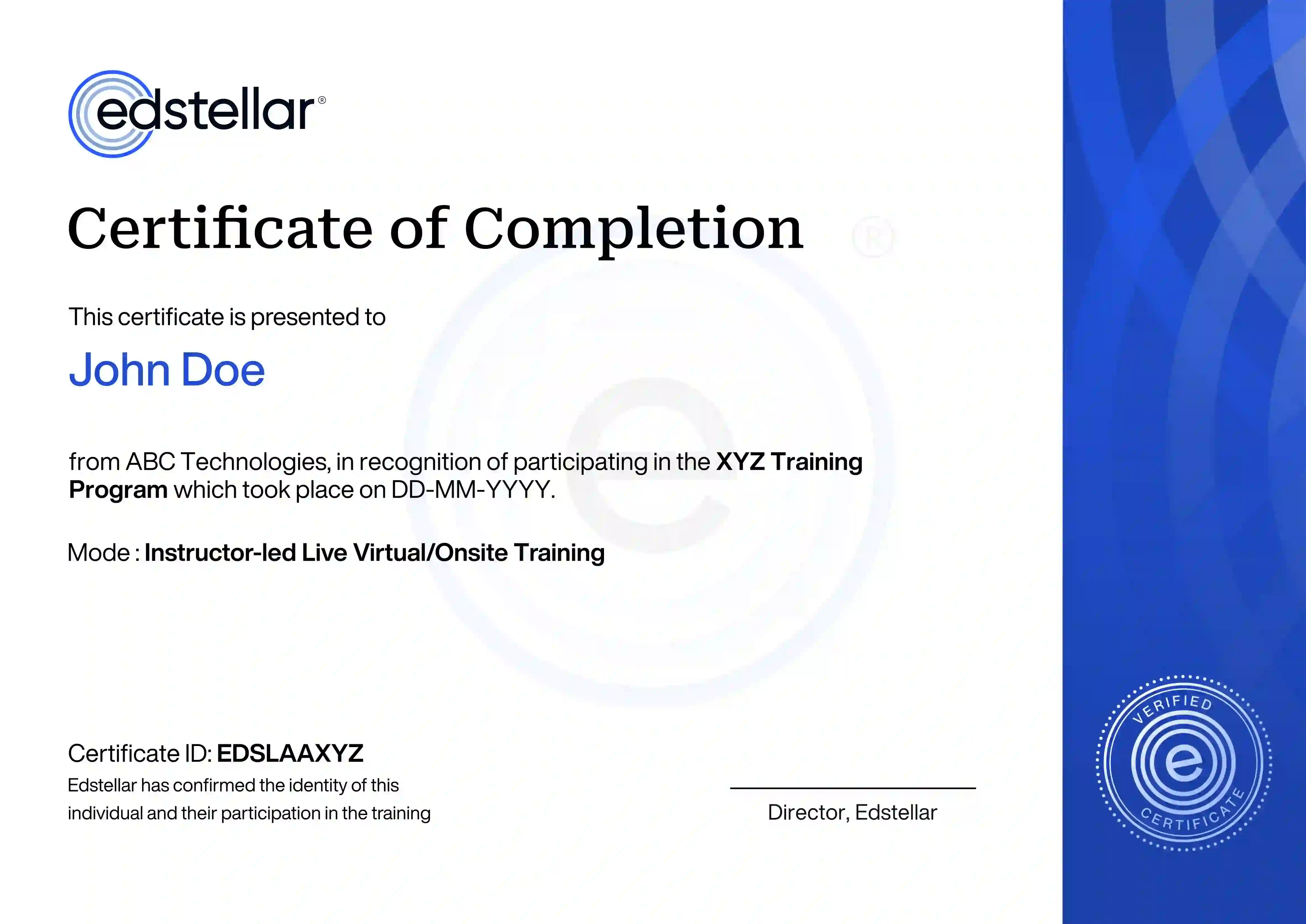
        Upon successful completion of the training course offered by Edstellar, employees receive a course completion certificate, symbolizing their dedication to ongoing learning and professional development.

        This certificate validates the employee's acquired skills and is a powerful motivator, inspiring them to enhance their expertise further and contribute effectively to organizational success.

        Recognition That Motivates Your Team
        Other Related Corporate Training Courses