10 Most In-Demand Skills in South Korea for 2026

.svg "edstellar")

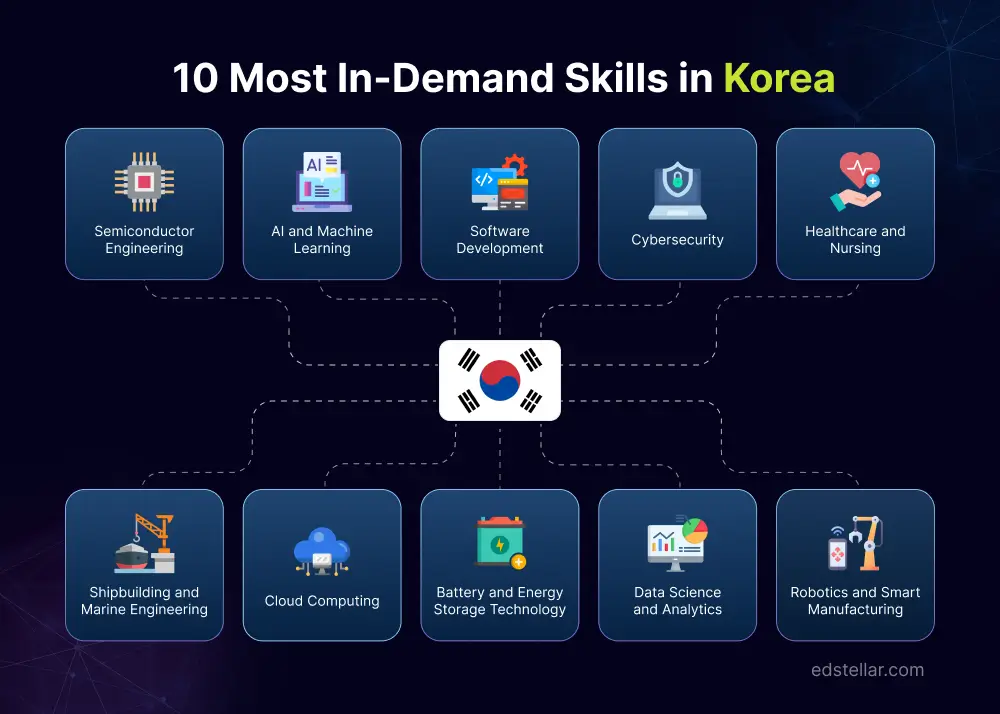
South Korea is projected to face a shortage of over 820,000 workers by 2033, according to a Korea Times report citing government data, as the country's economically active population is expected to peak in 2029 and decline afterward. At the same time, South Korea became a "super-aged" society at the end of 2024, with more than 20% of its population aged 65 or over, reaching this milestone in roughly seven years compared with 11 years for Japan. Between 2025 and 2029, the country will lack at least 580,000 science and engineering specialists, and talent shortages are especially acute in semiconductors, AI, biotech, and quantum technologies.
The Korean government is responding with some of the largest industrial policy investments in Asia. The Ministry of Science and ICT (MSIT) has committed KRW 1.6 trillion to secure 10,000 advanced GPUs and build national AI computing infrastructure. The K-Chips Act provides tax breaks of up to 25% for semiconductor facility investment.
The government unveiled a 700 trillion won ($534 billion) semiconductor plan in December 2025, and Samsung alone plans to hire 60,000 people over five years. With the working-age population projected to shrink by 9.4 million by 2044, these policy commitments are creating massive demand for technical talent that Korea's shrinking domestic workforce cannot supply alone.
So which skills in demand in South Korea should corporate L&D leaders, HR managers, and workforce planners prioritise? This guide breaks down the top 10 high demand skills in South Korea across semiconductors, technology, healthcare, manufacturing, and energy. It draws on MOEL employment data, MSIT policy announcements, Korea Semiconductor Industry Association projections, and KISA cybersecurity reports to give you a data-backed picture of what jobs are in demand in South Korea, whether you are planning corporate upskilling programmes, supporting E-7 skilled worker visa applications, or building workforce strategies for one of Asia's most technologically advanced economies.
Every ranking in this guide is backed by data from South Korean government bodies, industry associations, and established hiring platforms.
South Korea's skills shortages are driven by three converging forces: a super-aged society with the world's lowest fertility rate, an industrial policy pouring trillions of won into semiconductors and AI, and a talent pipeline where the best STEM students increasingly choose medicine over engineering. The 10 skills below are ranked by a weighted research score that factors in government policy investment, shortage volume from MOEL and industry data, salary premium, cross-sector applicability, and recency of policy action.

The Korea Semiconductor Industry Association (KSIA) projects the sector will need 304,000 workers by 2031, with a shortfall of up to 54,000 in design and other specialised roles. South Korea's total semiconductor exports reached USD 141.9 billion in 2024, making chips the country's largest export item at 20.8% of total exports according to InvestKOREA data. The government plans to cultivate and supply 150,000 specialised semiconductor personnel by 2030 through regulatory reform and financial support, but the pipeline of contract department graduates will only reach 400 to 480 annually by 2027, a fraction of what is needed.
The K-Chips Act, enacted in March 2025, provides tax breaks of up to 25% for facility investment in semiconductors and other strategic industries. In December 2025, the government unveiled a 700 trillion won ($534 billion) semiconductor plan to expand the Yongin mega-cluster to 10 fabrication plants by 2047. Samsung has announced plans to hire 60,000 people over five years, with semiconductor roles as a top priority, while SK Hynix is investing 120 trillion won in a separate cluster. These investments are creating demand for chip designers, process engineers, equipment specialists, and packaging engineers that far exceeds domestic supply.
Semiconductor engineers in South Korea earn between KRW 60 million and KRW 150 million annually, with senior process engineers at Samsung and SK Hynix at the higher end. The careers of semiconductor engineers are relatively short, often ending while workers are in their 40s, creating a constant need for fresh talent. For international professionals, the E-7-1 visa covers semiconductor roles, and the new Top-Tier Visa introduced in 2025 specifically targets foreign talent in semiconductors, biotechnology, and batteries.
Semiconductor Manufacturing, Display Technology, AI Hardware, Telecommunications
MSIT's 2025 work plan commits KRW 1.6341 trillion to secure 10,000 advanced GPUs by year-end, establishing clustered GPU infrastructure to expand national AI computing capacity. An additional 3,000 GPUs will be leased from the private sector. The AI Framework Act, enacted in December 2024, provides the legislative foundation for South Korea's push to become a top 3 global AI leader. The government will significantly increase its AI semiconductor demonstration budget from KRW 41.7 billion in 2024 to KRW 87.1 billion in 2025.
To support AI transformation startups and emerging industry companies, MSIT is providing policy funds totalling KRW 810 billion in 2025. The AI Pathfinder Project will attract world-class AI researchers from abroad, offering up to KRW 2 billion in annual support per researcher. Major Korean companies are investing heavily: Samsung, Naver, Kakao, and LG are all expanding AI research labs. Naver's HyperCLOVA X and Samsung's Gauss are competing in the large language model space, creating demand for ML engineers, NLP specialists, and AI infrastructure architects. Understanding how data engineers support these AI systems is increasingly important for organisations building their AI capabilities.
AI engineers in South Korea earn between KRW 70 million and KRW 160 million annually, with senior ML engineers and AI architects at top companies commanding higher compensation. According to industry forecasts, AI-related job opportunities in South Korea are growing at 38% annually. The E-7-1 visa covers AI and ML specialist roles, and the Top-Tier Visa specifically targets AI talent. Korean language proficiency is not always required for research-focused roles at global companies, though it is expected at domestic firms.
Technology and Internet, Semiconductor, Financial Services, Automotive and Robotics

South Korea's tech sector is projected to contribute 25% to the nation's GDP by 2029, up from 20.1% in 2020, with the sector's economic impact expected to reach $147.94 billion according to industry forecasts. Between 2025 and 2029, the country will lack at least 580,000 science and engineering specialists, and the growing tendency of top STEM students to pursue careers in medicine rather than engineering is intensifying the software talent crunch. The K-Digital Platform (KDP), launched in 2021, is expanding from 20 locations to 60 by 2025 to improve digital skills through vocational training programmes.
Major Korean tech companies are competing fiercely for developer talent. Naver, Kakao, Coupang, and Woowa Brothers (Baedal Minjok) have been in a salary escalation war, driving up compensation across the industry. Samsung SDS, LG CNS, and SK C&C recruit thousands of software engineers annually for enterprise solutions and cloud migration projects. Startups in Pangyo Techno Valley (South Korea's "Silicon Valley") and Seoul's Gangnam district are absorbing talent across frontend, backend, mobile, and platform engineering. DevOps engineers are particularly sought after as Korean enterprises accelerate their cloud-native transformation.
Software developers in South Korea earn between KRW 50 million and KRW 156 million annually, with senior engineers at top-tier companies like Naver and Kakao earning above KRW 100 million. Entry-level developers in Seoul typically start at KRW 50 to 70 million. Python, Java, JavaScript, TypeScript, and Kotlin are the most requested languages, with Spring Boot, React, and Kubernetes frameworks dominating job listings. The E-7-1 visa covers software engineering roles, and Korean language proficiency at TOPIK Level 4 or above is typically expected for domestic companies.
Internet and E-commerce, Financial Technology, Gaming, Enterprise Software
Explore Related Training:
AI Programming with Python Full Stack Development All Software Development Programs"We were very fast in implementing projects to train people across a wide range of subjects from as early as 2019. The talent trained through such efforts should be contributing to making the country more competitive, but they are leaving the country."



South Korea's cybersecurity market generated USD 3.4 billion in 2025 and is expected to reach USD 9.4 billion by 2033, growing at a CAGR of 13.4% according to industry analysis. The cybersecurity workforce gap in South Korea has almost doubled, from approximately 16,000 to 31,000 in the most recent year, making it one of the largest annual increases globally. The Korea Internet and Security Agency (KISA) reported over 1,200 cyberattacks targeting manufacturing firms, underscoring the urgency for security professionals across the industrial base.
The Korean government has committed $607 million to boost cyber defence capabilities, and KISA received KRW 25.5 billion specifically for next-generation cybersecurity technology development. North Korean state-sponsored cyber threats add a unique dimension to South Korea's security landscape, driving demand for threat intelligence analysts, incident response specialists, and national security cyber professionals. Major employers include Samsung SDS, SK Shieldus (formerly ADT Caps), AhnLab (Korea's largest cybersecurity firm), and the National Intelligence Service's cyber division.
Cybersecurity analysts in South Korea earn between KRW 50 million and KRW 120 million annually, with senior security architects and CISOs commanding higher compensation. Key certifications valued by Korean employers include CISSP, CISA, and Korea's own ISMS-P (Information Security Management System-Personal Information) certification. The E-7-1 visa covers information security specialist roles. Korean language proficiency is typically required for government and defence-related security positions but less critical for roles at multinational companies.
Defence and Government, Financial Services, Semiconductor Manufacturing, Telecommunications
Explore Related Training:
Cybersecurity Risk Management Threat Intelligence All Cybersecurity Programs
South Korea became a super-aged society at the end of 2024, and projections indicate that national health insurance expenditures will surpass revenues starting in 2025, with accumulated reserves expected to be depleted by 2030 according to PMC research. The workforce that historically provided care is rapidly shrinking, from 72% to 56% of the total population by 2040. The 2024-2025 South Korean medical crisis, triggered by trainee doctor walkouts over government plans to increase medical school admissions, exposed deep structural vulnerabilities in the healthcare workforce.
Workforce shortages are particularly severe in home healthcare, elderly care, and rural hospitals. In 2024, 37.8% of elderly South Koreans lived alone, with 18.7% having no assistance when ill. Hospitals face a paradox where new nurses wait months or years for posts while experienced nurses are placed on unpaid leave as hospitals suppress hiring to manage costs. The government's plan to add 2,000 medical school seats annually is meeting resistance from the medical profession, but demographic reality demands expansion. Major hospital networks including Seoul National University Hospital, Samsung Medical Center, and Asan Medical Center are all navigating these workforce pressures.
Registered nurses in South Korea earn between KRW 35 million and KRW 65 million annually, with specialist nurses and nurse practitioners earning more. Doctors earn significantly higher, with specialists commanding KRW 100 million to KRW 300 million. Healthcare professionals need Korean language proficiency at TOPIK Level 5 or above for clinical roles. The E-7-1 visa covers medical specialist positions, and qualification recognition requires passing Korean licensing examinations administered by the Korea Health Personnel Licensing Examination Institute.
Hospital Systems, Municipal Health Services, Home Care, Medical Device Companies

The proportion of foreign workers in South Korea's three major shipbuilding companies (HD Korea Shipbuilding & Offshore Engineering, Hanwha Ocean, and Samsung Heavy Industries) surged from 5% (4,640 people) in 2021 to 18% (20,200 people) in the most recent reporting period, according to Korea Herald data. At HD Hyundai Heavy Industries' Ulsan Shipyard, more than 15 of about 20 employees in a large assembly workshop are foreign workers handling welding and painting tasks that domestic workers increasingly avoid.
South Korean shipyards hold a 135 trillion KRW order backlog secured through 2028 for LNG carriers, container ships, and defence vessels, but the industry is projected to face a shortage of over 40,000 workers over the next five years. The E-9 shipbuilding visa quota was temporarily introduced with 5,000 workers allocated in both 2023 and 2024, dropping to 2,500 in 2025. HD Hyundai has partnered with Persona AI to develop humanoid welding robots for shipyards, a direct response to the skilled welder shortage. The E-7-3 visa now covers shipyard welders, ship electricians, and transmission electricians, confirming these as official shortage occupations. Hanwha Ocean (formerly DSME) and Samsung Heavy Industries are similarly recruiting foreign skilled tradespeople across their Geoje and Tongyeong yards.
Skilled shipyard workers earn between KRW 40 million and KRW 70 million annually, with specialised welders and marine electricians at the higher end. Marine engineers with degree qualifications earn KRW 60 million to KRW 100 million. The roots industries (casting, forging, welding, heat treatment, surface treatment, and precision machining) were added to the E-7-3 visa in January 2025 as category S740, reflecting the government's recognition that these foundational manufacturing skills are in critical shortage across the economy.
Shipbuilding, Offshore Engineering, Maritime Equipment, Defence Shipyards

South Korea's cloud computing market is expected to reach USD 9.95 billion in 2025 and grow at a CAGR of 25.9% to reach USD 31.46 billion by 2030, according to Mordor Intelligence. The government announced plans to invest USD 2.9 billion with private sector partners to build a national AI computing centre by 2030, with cloud infrastructure as the backbone. The data centre market alone is projected to grow from USD 1.81 billion in 2025 to USD 3.42 billion by 2030, with 58 existing facilities and 26 upcoming facilities tracked across 16 locations.
AWS, Microsoft Azure, Google Cloud, and domestic providers NHN Cloud and Naver Cloud are all expanding their Korean presence. Samsung SDS runs one of Asia's largest enterprise cloud platforms, while LG CNS provides hybrid cloud solutions to Korean conglomerates. The K-Digital Platform's expansion to 60 locations by 2025 includes cloud skills training as a core component. Korean enterprises are migrating legacy systems to cloud at an accelerating pace, driven by the government's digital transformation mandates for public sector agencies. Organisations building cloud teams should understand how cloud engineers fit into modern infrastructure strategies.
Cloud engineers in South Korea earn between KRW 55 million and KRW 120 million annually, with certified AWS Solutions Architects and Azure specialists at the higher end. Key certifications valued by Korean employers include AWS Solutions Architect, Azure Administrator, GCP Professional Cloud Architect, and Kubernetes certifications (CKA/CKAD). Korean language proficiency varies by employer: multinational cloud providers often operate in English, while domestic enterprises typically require Korean at TOPIK Level 4 or above.
Financial Services, Public Sector, E-commerce, Enterprise IT Services
Explore Related Training:
Multi-Cloud (AWS + Azure) with DevOps Cloud Security Essentials All Cloud Computing Programs
South Korea is home to three of the world's leading battery manufacturers: LG Energy Solution, Samsung SDI, and SK On. LG Energy Solution hired 1,688 workers in the first half of 2024, bringing its total workforce to 11,793 according to Korea Herald reporting. However, the industry faces a skills gap that threatens its competitive position against Chinese rivals like CATL and BYD. Samsung SDI and SK On have both targeted 2026 for mass production of lithium iron phosphate (LFP) batteries, while SK On inaugurated its first solid-state battery pilot plant in September 2025.
The battery sector's talent needs are shifting as the technology evolves. Traditional lithium-ion expertise remains essential, but next-generation skills in solid-state battery development, LFP chemistry, battery recycling, and energy storage system (ESS) integration are growing rapidly. The Top-Tier Visa introduced in 2025 specifically includes secondary batteries as a priority sector for foreign talent recruitment. Companies are investing in joint research programmes with KAIST, POSTECH, and Seoul National University to develop domestic talent pipelines.
Battery engineers in South Korea earn between KRW 55 million and KRW 110 million annually, with cell development specialists and battery management system (BMS) engineers at the higher end. The sector faces a unique challenge: Korean battery makers operated at around 50% capacity in the first half of 2025 due to EV demand headwinds, creating uncertainty for short-term hiring even as long-term talent needs remain critical. Professionals with solid-state battery, recycling, or ESS expertise are in particularly short supply.
Battery Manufacturing, Electric Vehicles, Energy Storage, Consumer Electronics
Explore Related Training:
Renewable Energy and Sustainability All Environmental Sustainability Programs
South Korea faces a shortage rate of 33.3% for data scientists and 14.7% for data analysts according to industry workforce data, reflecting a structural gap between the volume of data Korean companies generate and their capacity to analyse it. The government's digital transformation push, combined with the AI computing infrastructure expansion, is driving demand for professionals who can bridge the gap between raw data and business intelligence across every major sector.
Financial services firms including KB Financial Group, Shinhan Financial, and Hana Financial are building data science teams to power credit scoring models, fraud detection systems, and personalised banking services. Samsung Electronics and LG Electronics use data analytics extensively for manufacturing quality control, supply chain optimisation, and consumer behaviour analysis. The public sector is also investing: the National Information Society Agency (NIA) coordinates data-driven government initiatives, and the K-Digital Platform includes data analytics training across its 60 vocational centres.
Data scientists in South Korea earn between KRW 55 million and KRW 130 million annually, with senior analytics managers at financial institutions and tech companies earning above KRW 100 million. Key skills in demand include Python, R, SQL, Spark, and experience with cloud-based analytics platforms (AWS Redshift, Google BigQuery, Snowflake). Korean language proficiency at TOPIK Level 4 or above is expected at domestic companies, though multinational firms and research institutions may operate in English.
Financial Services, E-commerce, Manufacturing, Public Sector and Government

South Korea's robotics market is valued at USD 894.97 million in 2025 and projected to reach USD 1,874.65 million by 2033, driven by the country's aging workforce and the need to automate manufacturing processes. HD Hyundai has partnered with Persona AI to develop humanoid welding robots for shipyards, a direct response to the skilled labour shortage. Hyundai Motor Group's acquisition of Boston Dynamics positions the company as a global leader in mobile robotics, with applications spanning logistics, construction, and industrial inspection.
The roots industries designation under the E-7-3 visa (covering casting, forging, welding, heat treatment, surface treatment, and precision machining) reflects the reality that foundational manufacturing skills are disappearing as Korean workers avoid physically demanding factory jobs. Companies are investing in cobots (collaborative robots), automated guided vehicles (AGVs), and smart factory systems to compensate. Samsung, Hyundai, and LG all operate smart factories that integrate IoT sensors, AI-driven quality control, and robotic assembly lines, creating demand for professionals who can design, programme, and maintain these systems.
Robotics engineers in South Korea earn between KRW 55 million and KRW 110 million annually, with autonomous systems and AI robotics specialists commanding higher salaries. Smart manufacturing engineers who combine automation expertise with data analytics skills are particularly valued. Key qualifications include experience with ROS (Robot Operating System), PLC programming, industrial IoT platforms, and familiarity with Korean manufacturing standards. The E-7-1 visa covers robotics engineering and automation specialist roles.
Automotive Manufacturing, Shipbuilding, Electronics Assembly, Logistics and Warehousing
"To become one of the top three AI powers, talent capable of actually applying AI to our key industries including manufacturing, bio, and energy is essential."

South Korea Jobs Report: Breakdown of employment trends across sectors, covering job growth in services and IT alongside declines in manufacturing and construction.
South Korea's skills demand is uniquely shaped by massive government-led industrial policy. Understanding which programmes are receiving the largest funding helps corporate training teams and workforce planners anticipate where demand will intensify over the next three to five years.
The pattern is clear: semiconductor and AI receive the largest direct investment, but the ripple effects touch every sector. Companies that align their training budgets with these national priorities are better positioned to attract talent and access government co-funding. The K-Digital Platform in particular offers a direct mechanism for employer-sponsored training at scale, with courses available for both working professionals and job seekers.
Pete Ford is a corporate training specialist with over 15 years of experience in training methodologies, employee engagement, and performance improvement. He has a proven track record of developing and implementing effective training programs that enhance employee skills and productivity.
#On-site #Virtual #GroupTraining #Customized
Explore 2000+ industry ready instructor-led training programs.

Create dynamic leaders and cohesive teams. Learn more now!

Do a quick Skill gap analysis with Edstellar’s Free Skill Matrix tool

Unlock premium resources, tools, and frameworks designed for HR and learning professionals. Our L&D Hub gives you everything needed to elevate your organization's training approach.
Access L&D Hub Resources.svg)
.svg)
.svg)
.svg)

.svg)


.svg "Click Here to Follow on Medium")
.svg)


