10 Most In-Demand Skills in Iceland for 2026
.webp)

.svg "edstellar")

Iceland's labour market is uniquely shaped by its small population, extraordinary natural resources, and outsized global ambitions. With fewer than 400,000 people, Iceland operates the world's most renewable electricity grid, hosts a globally significant data centre sector, runs one of the world's most comprehensive national genetics databases through deCODE Genetics, and welcomes over 2.2 million tourists a year.
Landspitáli reports over 800 healthcare vacancies, Samtök iðnaðarins documents 2,000+ unfilled technology positions and 3,000+ unfilled construction roles, and Samtök ferðaþjónustunnar found that over 60% of tourism businesses face staffing shortages severe enough to affect service delivery.
What makes Iceland's skills landscape different from larger economies is the concentration of critical shortages. The government's Stafraænt Ísland (Digital Iceland) programme, the Húsnæðisáætlun housing action plan, the green hydrogen national pilot, and the CarbFix carbon capture expansion are all competing for the same limited pool of qualified professionals. This guide ranks the 10 most in-demand skills in Iceland for 2025 and 2026.
Every ranking in this guide is backed by data from Icelandic government bodies, industry federations, and research institutions. We weighted Iceland-specific sources exclusively, because the country's unique economic structure means global benchmarks rarely apply. Here is where the numbers come from.
Iceland's shortage list is unlike any other European country. Healthcare, technology, and construction shortages are familiar, but the list also includes geothermal engineering, fisheries technology, and sustainable tourism management, skills shaped by Iceland's unique geography, natural resources, and economic structure.
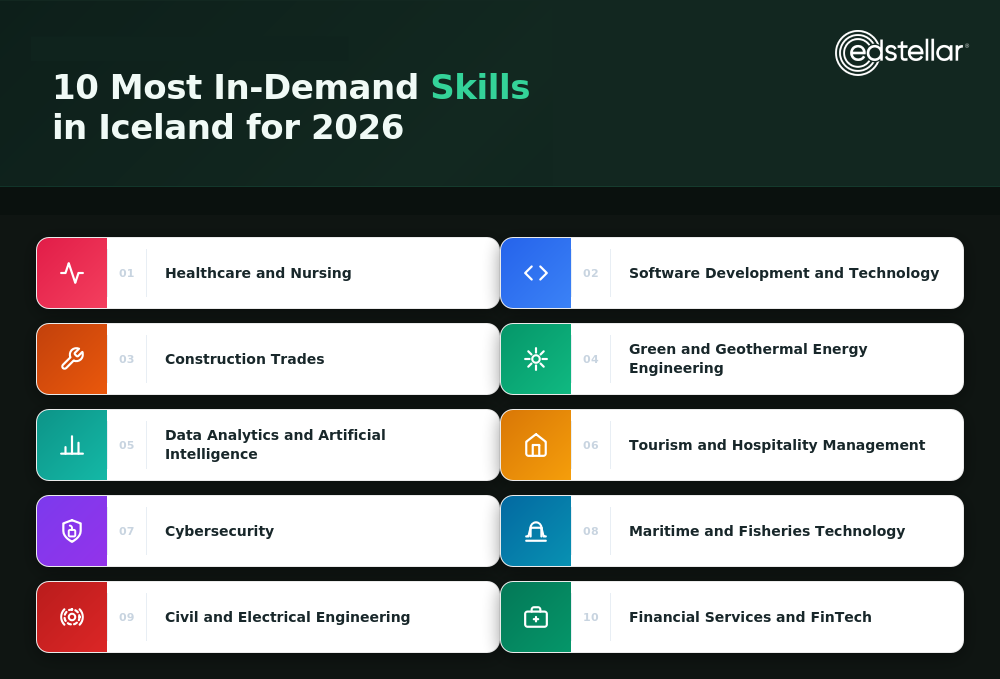

Healthcare and nursing is Iceland's most acute and persistent skills shortage. Landspitáli, the National University Hospital, reported over 800 vacancies across nursing, specialist medicine, and allied health professions in 2025, a number that is extraordinary for a country of Iceland's size. The Directorate of Health and the Ministry of Health have placed nursing at the top of Iceland's shortage occupation list for work permits, and structured international recruitment programmes are actively running to bring registered nurses from the Philippines, Poland, and other EEA countries.
The shortage is not limited to Landspitáli. Regional hospitals, primary care centres (heilsugæslustöðvar), mental health services, and home care organisations all report vacancy rates that compromise patient care quality. Monthly salaries for registered nurses in Iceland range from ISK 600,000 to ISK 850,000, with ICU and specialist nurses earning considerably more. Despite these salaries being among the highest in Europe on a purchasing power basis, the shortage persists because the domestic nursing education pipeline at the University of Iceland and Reykjavik University cannot produce graduates fast enough to replace retirements and meet growing demand.
Key sub-skills in demand include general nursing, ICU and emergency nursing, mental health nursing, midwifery, and allied health professions such as physiotherapy and radiology.
Landspitáli National University Hospital, Regional Hospitals, Primary Care Centres, Mental Health Services, Home Care and Social Services

Iceland's technology sector is growing at approximately 8% per year, driven by globally significant companies including CCP Games (the studio behind EVE Online and one of the world's largest online game operators), Össur (a global leader in prosthetics technology), Marel (the world's leading food processing equipment manufacturer), and a fast-growing fintech cluster. The Stafraænt Ísland (Digital Iceland) government programme is digitising public services across every ministry and municipality, creating parallel demand in both the private and public sectors at the same time. Samtök iðnaðarins estimates over 2,000 unfilled technology positions in Iceland in 2025.
The output of Reykjavik University and the University of Iceland's computer science departments has not kept pace with this demand. Senior software engineers in Iceland earn ISK 1,000,000 to ISK 1,500,000 per month, among the highest salaries of any profession in the country, yet vacancies persist. The combination of high salaries, Iceland's quality of life, and the concentration of genuinely interesting technology companies makes Iceland an attractive destination for international software engineers, but the competition from larger technology markets means Iceland must work harder than most countries to attract and retain the talent it needs.
Priority sub-skills include full-stack development, Python and TypeScript engineering, cloud-native development, APIs and microservices, and mobile development for iOS and Android.
Technology and Gaming, Financial Services and Fintech, Healthcare IT, Government Digital Services, Manufacturing Technology (Össur, Marel)
Explore Related Training:
Full Stack Web Development Python Programming All Software Development Programs
Iceland's Reykjavik Capital Region faces one of Europe's most acute housing shortages relative to population size. Property prices in Reykjavik have reached record levels, and the government's Húsnæðisáætlun (Housing Action Plan) targets over 4,000 new residential units per year to address a backlog that has taken years to accumulate. Samtök iðnaðarins reported over 3,000 unfilled positions across construction trades in 2025, with electricians, plumbers, carpenters, and concrete specialists in the most severe shortage.
Iceland has historically relied on construction workers from Poland, the Baltic states, and other EEA countries to fill gaps, but competition across Europe for the same tradespeople has intensified as housing programmes in the Netherlands, Denmark, and Germany are running simultaneously. The Sundabraut tunnel project (estimated at ISK 50 billion), harbour expansion programmes in Reykjavik and Akureyri, and the ongoing construction of geothermal plant facilities add major infrastructure demand on top of the residential housing backlog.
Key trades in shortage include electrical installation, plumbing and heating, carpentry and joinery, concrete and masonry, and civil engineering and groundworks.
Residential Construction, Commercial Building, Civil Infrastructure (Roads, Tunnels, Harbours), Public Buildings, Geothermal Plant Construction
"As a sparsely populated country, access to digital skills is an ongoing challenge in Iceland, despite having a highly digitally literate population."



Iceland generates 100% of its electricity from renewable sources, making it the world's most renewable economy and a global reference point for the energy transition. Landsvirkjun (the National Power Company), HS Orka, and Reykjavik Energy (Orkuveita Reykjavíkur) are all expanding capacity to supply a growing data centre sector, green hydrogen pilot programmes, and industrial loads from new aluminium and silicon processing plants. Orkustofnun (the National Energy Authority) has identified a shortage of geothermal engineers, energy systems specialists, and electrical engineers that has led Landsvirkjun and HS Orka to conduct active international recruitment.
CarbFix, the Reykjavik Energy-led carbon mineralisation technology that has attracted global investment and is now being adapted for industrial-scale carbon capture at sites in Iceland, Belgium, and beyond, requires specialist geochemical and chemical engineering expertise that Iceland is working hard to develop domestically. The green hydrogen national pilot programme adds hydrogen engineering specialists to the demand picture. Iceland's global leadership in geothermal means it also exports expertise, with Icelandic energy engineers working on projects in East Africa, Central America, and Southeast Asia, which tightens the domestic pool further.
Priority sub-skills include geothermal engineering and reservoir management, electrical power systems engineering, renewable energy project management, green hydrogen technology, and carbon capture and storage engineering.
Geothermal Power Generation, Hydropower, Data Centre Energy Management, Green Hydrogen, Carbon Capture (CarbFix), Industrial Energy Operations
Explore Related Training:
Renewable Energy and Sustainability Energy Transition and Innovation Environmental Protection and Sustainability
Iceland holds unique structural advantages in data and AI that set it apart from most countries its size. deCODE Genetics, an Amgen subsidiary headquartered in Reykjavik, operates the world's most comprehensive national genetic database and is a global leader in genomic research, requiring bioinformaticians and computational biologists in numbers that exceed what Icelandic universities produce. Hafrannsóknastofnun (the Marine and Freshwater Research Institute) runs one of the world's most data-intensive fisheries monitoring programmes. The Stafraænt Ísland programme is generating government data infrastructure that requires analytical capability across every ministry. And the fintech sector, led by companies such as Meniga, Borgun, and Indó, is building sophisticated data products that need data scientists and machine learning engineers.
Samtök iðnaðarins identifies data analytics as the second fastest-growing professional category in Iceland after software development. Reykjavik University's AI research group is among the strongest in the Nordic region, but industry demand consistently outpaces graduate supply. AI and ML engineers at senior levels earn ISK 1,200,000 to ISK 1,600,000 per month, among the highest-paid professionals in Iceland.
Key sub-skills include machine learning engineering, data science and statistical modelling, bioinformatics and genomic data analysis, business intelligence and data visualisation, and natural language processing.
Genetics Research and Bioinformatics, Financial Services and Fintech, Government Digital Services, Fisheries Management and Marine Research, Healthcare Analytics

Tourism is Iceland's largest single employment sector, accounting for approximately 15% of the workforce, and its recovery to over 2.2 million visitor arrivals in 2024 has been accompanied by a workforce crisis that pre-dates the pandemic. Samtök ferðaþjónustunnar (the Icelandic Travel Industry Association) reported that over 60% of tourism businesses face staff shortages severe enough to affect service delivery. Hotel managers, tour operations managers, adventure tourism guides, and sustainable tourism development specialists are in the most acute shortage.
What distinguishes Iceland's tourism skills shortage from other countries is the sustainability dimension. The Ministry of Tourism, Industry and Innovation's Ferðaáætlun (Tourism Action Plan) places sustainable tourism management at the centre of Iceland's tourism strategy, creating demand for professionals who understand both hospitality operations and environmental management. Iceland's fragile landscape, volcanic activity risks, and overtourism pressures in areas such as the Golden Circle and the South Coast mean that tourism operators need managers who can deliver exceptional visitor experiences while managing environmental impact and safety.
Key sub-skills include hotel and accommodation management, tour operations management, sustainable tourism development, adventure and outdoor tourism guiding, and destination marketing and revenue management.
Hotels and Accommodation, Tour Operations, Adventure Tourism, Destination Management Organisations, Restaurants and Food Service

CERT-IS, Iceland's Computer Emergency Response Team, recorded a consistent year-on-year increase in significant cybersecurity incidents in its 2024 Annual Report, targeting Icelandic government ministries, financial institutions, and data centre infrastructure. Iceland's role as a major European data centre hub, hosting facilities operated by Verne Global, Advania, and others that serve clients across Europe, makes it a target for state-sponsored and criminal cyber operations at a scale disproportionate to the country's population. The Stafraænt Ísland digital transformation programme creates cybersecurity requirements across every public organisation simultaneously.
The NIS2 directive, now implemented into Icelandic law, and the DORA regulation (applying to the financial sector from January 2025) have added a significant compliance-driven dimension to cybersecurity hiring. FME (the Financial Supervisory Authority) and Seðlabanki Íslands (the Central Bank of Iceland) have both expanded their cybersecurity supervision requirements, and the three major banks (Landsbankinn, Arion Bank, and Íslandsbanki) are all building dedicated cyber resilience teams in response.
Key sub-skills include network and infrastructure security, cloud security, threat intelligence and incident response, governance risk and compliance, and identity and access management.
Government and Public Sector, Financial Services, Data Centre Operations, Telecommunications, Critical National Infrastructure
Explore Related Training:
Cybersecurity Risk Management Oracle Cloud Infrastructure Security Professional All Cybersecurity Programs
Iceland's fishing and fish processing industry generates approximately ISK 350 billion in annual export revenue and remains the country's second-largest export sector after tourism. Fiskistofa (the Directorate of Fisheries) and Matís (Iceland's Food and Biotech R&D institute) have identified a growing need for professionals who combine marine biology or fisheries science with technology skills, as the industry automates fish processing plants with robotics and computer vision systems. The automation of processing facilities at companies such as Skaginn 3X and Valka is creating demand for automation engineers and systems integrators.
Hafrannsóknastofnun (the Marine and Freshwater Research Institute) requires marine biologists, oceanographers, and data scientists for the sustainable fisheries management that Iceland's quota system depends on. Climate change is altering fish stock locations and migration patterns, making ocean data science skills increasingly critical. Fishing vessel operators increasingly need marine engineers who can maintain and operate automated navigation systems, onboard processing equipment, and sensor arrays.
Key sub-skills include fisheries science and marine biology, fish processing automation and robotics, marine engineering and vessel systems, oceanographic data analysis, and aquaculture management.
Commercial Fishing Fleets, Fish Processing and Aquaculture, Marine Research Institutions, Vessel Engineering and Maintenance, Fisheries Regulation and Compliance

Iceland's infrastructure pipeline is substantial relative to the size of the economy. The Sundabraut tunnel project (estimated at ISK 50 billion, connecting the eastern suburbs of Reykjavik under Kollafjörður), harbour expansion programmes in Reykjavik and Akureyri, Ring Road upgrades, and the electrical grid expansion needed to supply new data centres and industrial facilities are all in various stages of planning and construction. Vegagerðin (the Icelandic Road and Coastal Administration) and Reykjavik Energy both report difficulty recruiting civil and electrical engineers.
The data centre sector is a particular driver of electrical engineering demand. Iceland's cheap, 100% renewable electricity makes it one of Europe's most attractive data centre locations, and the electrical engineers needed to design, construct, and maintain high-voltage power supply infrastructure for hyperscale data centre campuses are globally scarce. SA's 2025 employer survey consistently places civil and electrical engineering in the top five hard-to-fill professional categories in Iceland.
Key sub-skills include civil structural engineering, electrical power systems engineering, geotechnical engineering, project engineering and site management, and high-voltage systems and grid engineering.
Infrastructure (Roads, Tunnels, Harbours), Electrical Power Distribution, Data Centre Construction, Geothermal Plant Engineering, Commercial and Residential Development
Explore Related Training:
Construction Project Management Earned Value Management in Primavera All Project Management Programs
Iceland's three major banks, Landsbankinn, Arion Bank, and Íslandsbanki, are all in sustained growth phases following the post-2008 financial crisis recovery. Each is investing heavily in digital banking platforms, ESG reporting infrastructure, and regulatory compliance capabilities required under NIS2 and DORA. FME (Fjármálaeftiritið, the Financial Supervisory Authority) has expanded its supervisory headcount as the complexity and number of regulated entities grows.
The fintech sector adds further demand. Meniga, a global personal finance management platform originally built in Reykjavik and now operating across Europe, is expanding its engineering and product teams. Indó, Iceland's newest digital bank, and Borgun, a major payments processor, are both scaling rapidly. SFF's 2025 workforce report identifies DORA compliance, digital banking engineering, and ESG and sustainable finance as the three fastest-growing skill categories in Icelandic financial services.
Key sub-skills include risk management and regulatory compliance (NIS2, DORA, AML), fintech product development, financial data analytics, ESG reporting and sustainable finance, and digital banking and payments engineering.
Banking (Landsbankinn, Arion Bank, Íslandsbanki), Fintech and Payments (Meniga, Borgun, Indó), Insurance, Investment Management, Regulatory Compliance
Explore Related Training:
Environmental Protection and Sustainability Global Environmental Law and Governance All Data Analytics Programs"High-tech and software companies face the challenge of a lack of specialized knowledge, which can hamper their growth."

OECD Economic Survey: Iceland 2025 overview covering economic growth, workforce participation, and skills development across the Icelandic economy.
Iceland's skills demand is concentrated in the Reykjavik Capital Region but distributed across the country through sector-specific clusters. Understanding these regional patterns helps organisations target recruitment and training investments effectively.
The Reykjavik Capital Region concentrates the majority of technology, financial services, and cybersecurity roles, while healthcare shortages are distributed nationally with particular severity outside the capital. East Iceland's aluminium and silicon processing operations at Fjarðaál and PCC BakkiSilicon create concentrated demand for energy and electrical engineering. The North around Akureyri serves as Iceland's second urban hub with its own healthcare, education, and fisheries workforce needs. Fisheries technology demand is strongest in the Westfjords, West, and North where Iceland's largest fishing fleets and processing plants operate.
#On-site #Virtual #GroupTraining #Customized
Explore 2000+ industry ready instructor-led training programs.

Create dynamic leaders and cohesive teams. Learn more now!

Do a quick Skill gap analysis with Edstellar’s Free Skill Matrix tool

Unlock premium resources, tools, and frameworks designed for HR and learning professionals. Our L&D Hub gives you everything needed to elevate your organization's training approach.
Access L&D Hub Resources.svg)
.svg)
.svg)
.svg)

.svg)


.svg "Click Here to Follow on Medium")
.svg)


