10 Most In-Demand Skills in Denmark for 2026

.svg "edstellar")

Denmark is facing one of the most acute skills shortages in its modern history. With over 49,447 private sector job vacancies recorded in Q4 2025 by Statistics Denmark, and a structural IT specialist shortfall exceeding 7,000 roles today, Danish employers across technology, healthcare, construction, and energy are competing intensely for qualified professionals.
The government has responded with landmark policy measures: the NIS2 Act entered Danish law on 1 July 2025 mandating cybersecurity compliance for thousands of organisations, the DKK 500 million "Prepared for the Future IV" VET reform targets green trades and technical training, and SIRI's bi-annual Positive Lists now designate 180 higher education and 54 skilled trade occupations as official government shortage roles eligible for fast-track immigration access.
Whether you are an employer assessing workforce capability gaps, a professional targeting jobs in Denmark, or a training manager benchmarking against the market, understanding which skills are in demand in Denmark is essential for strategic planning in 2026 and beyond. This guide ranks the top ten in-demand jobs in Denmark by research score, drawing on government shortage data, industry surveys, and active hiring signals from Denmark's largest job platforms.
Denmark's labour market is shaped by three converging forces: digital transformation, the green energy transition, and an ageing population. The IDA (Danish Society of Engineers) projects a STEM graduate deficit of 13,000 by 2030 and 20,400 by 2040, while healthcare faces a projected shortfall of 15,000 social and healthcare workers within a decade. For foreigners evaluating the best jobs in Denmark for foreigners, the Positive List programme provides the clearest official guide: roles listed by SIRI require no labour market test, enabling fast-track work permit access. The skills profiled below represent the most validated, policy-confirmed, and actively recruited occupations shaping Denmark jobs in demand right now.
Every ranking in this guide is backed by data from Denmark government bodies, EU labour market agencies, and primary industry surveys. The research score assigned to each skill reflects a weighted assessment of policy drivers, active market demand, and recency of data. No ranking is based on opinion alone.
Denmark's shortage list is unusual in Europe for running across both highly specialised professional roles and traditional skilled trades at the same time. The skills below reflect that split, from AI engineers and renewable energy specialists to electricians, welders, and mechanics, with sub-skills and hiring industries detailed against each.
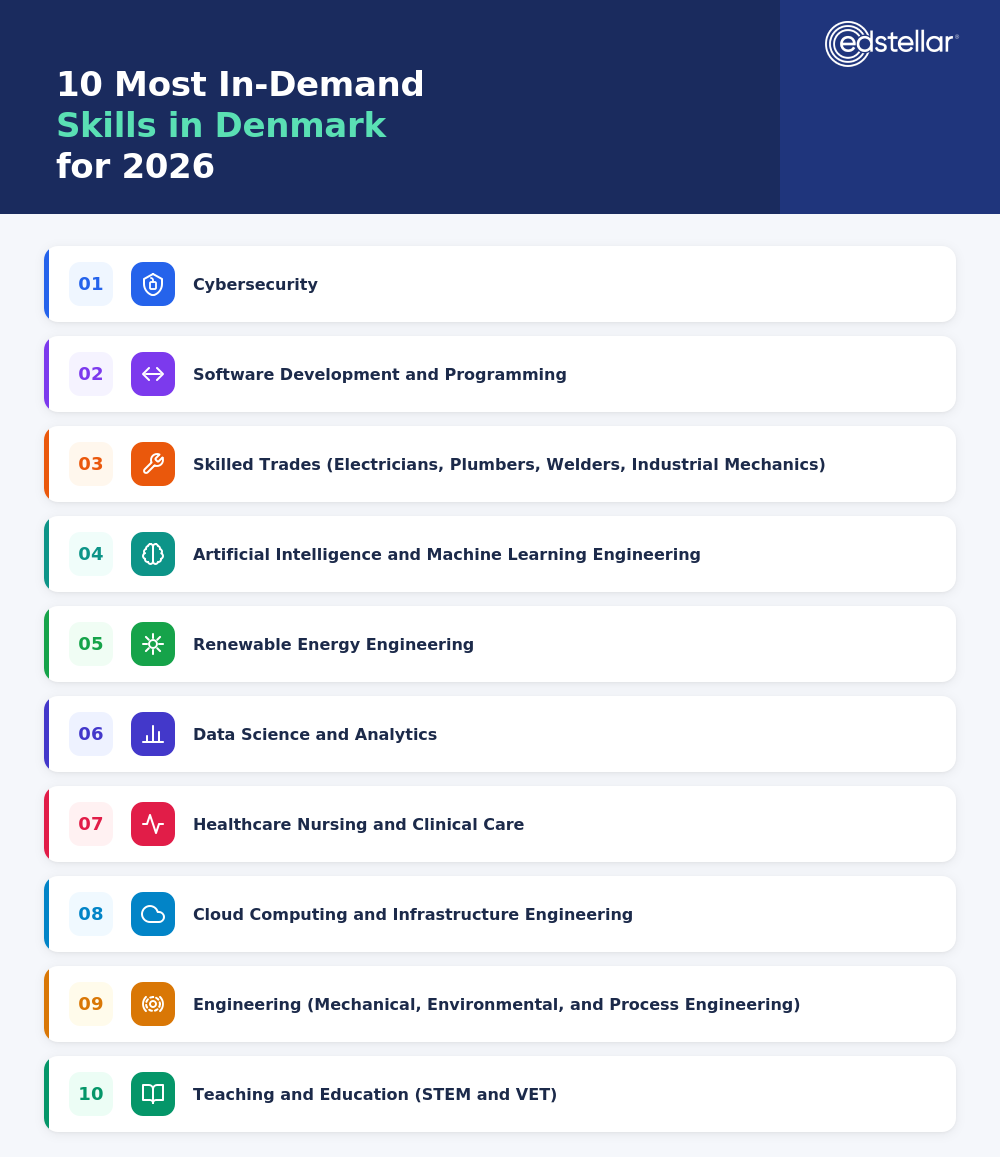

Cybersecurity has become Denmark's most urgent compliance-driven skills need following the NIS2 Act entering Danish law in 2025. The regulation requires organisations to implement strict security controls, enforce rapid incident reporting, and establish board-level accountability, significantly increasing demand for cybersecurity professionals.
The national talent gap continues to widen, with thousands of cybersecurity roles remaining unfilled. Increasing regulatory pressure and evolving threat landscapes are pushing organisations to prioritise security capabilities across all levels of operations.
Industries such as financial services, energy, healthcare, and public administration face the highest demand. Professionals with the key cybersecurity skills for 2026, spanning NIS2 compliance, cloud security architecture, and incident response, are the ones Danish employers find hardest to source.
Financial Services, Energy and Critical Infrastructure, Healthcare, Public Administration, Telecommunications
Explore Related Training:
Vulnerability Assessment and Penetration Testing (VAPT) Cloud Penetration Testing All Cybersecurity Programs
Software development remains one of the most critical skill areas in Denmark's technology sector, with a persistent shortage of qualified professionals. According to Wirtek's annual survey, 32% of Danish companies abandoned IT role hiring entirely due to the difficulty of finding qualified candidates, and software development ranks as the single most in-demand IT competency in Denmark.
The gap is driven by rapid demand growth across industries and a limited domestic talent pipeline. Government initiatives and industry efforts are focused on expanding both local training and international recruitment to address the shortage.
Full-stack developers with cloud-native and microservices expertise are particularly in demand. Organizations are prioritizing upskilling programs to strengthen internal capabilities and reduce hiring dependency across fintech, manufacturing, and public sector digital services.
Technology and IT Services, Financial Services and Fintech, Manufacturing and Industry 4.0, Public Sector Digital Services, Pharma and Life Sciences
Explore Related Training:
Reactive Extension for JavaScript (RxJS) Microservices Architecture All Software Development Programs
Denmark's green infrastructure expansion is creating a significant shortage of certified tradespeople, prompting government action through immigration policy and vocational training investment. Skilled trades are now officially recognised as shortage occupations on SIRI's Positive List, enabling faster recruitment of international talent.
Construction and energy infrastructure projects are heavily impacted by workforce gaps, with delays and rising costs highlighting the urgency. Industry demand continues to outpace the available skilled labour supply.
Efforts to modernise vocational education and expand apprenticeship programs are underway, but organisations must also invest in internal training and workforce development to meet immediate demand across offshore wind, district heating, and industrial maintenance projects.
Construction and Civil Engineering, Offshore Wind and Energy Infrastructure, Manufacturing and Industrial Production, Building Services and Facilities Management, Shipbuilding and Marine
Explore Related Training:
Construction Project Management Lean Manufacturing Green Belt All People Management Programs"We started off lacking highly skilled professionals, especially digital people and people with engineering skills, but now, due to the labour market and the change in demography, it seems like there's a lack of people at every possible level."



Artificial intelligence and machine learning are rapidly expanding across Denmark's economy, driven by regulatory frameworks and increasing enterprise adoption. Organisations are integrating AI into operations while navigating evolving compliance requirements including the EU AI Act.
Demand for AI engineers and MLOps specialists continues to outpace supply, creating a persistent talent gap. Investments in AI infrastructure and national strategies are further accelerating long-term demand for skilled professionals.
Industries such as healthcare, financial services, manufacturing, and public administration are actively building AI capabilities. Professionals with the essential AI and ML engineering skills for 2026, including LLM development, MLOps, and AI ethics compliance, are consistently the hardest to recruit in Denmark's technology market.
Technology and Software, Healthcare and Diagnostics, Financial Services, Manufacturing and Robotics, Public Administration

Denmark's leadership in offshore wind and green energy is driving sustained demand for renewable energy engineers. Large-scale infrastructure projects and long-term national targets are creating continuous workforce requirements across the energy sector.
Significant investments in renewable infrastructure, grid expansion, and energy storage are accelerating the need for skilled professionals. The transition to a green economy requires both engineering expertise and digital capabilities.
Organisations across energy, manufacturing, and infrastructure sectors are prioritising talent development to support complex renewable energy projects and ensure long-term sustainability goals are achieved.
Offshore Wind Energy, Onshore Renewable Energy, Grid and Transmission Infrastructure, Energy Storage, Green Technology Manufacturing
Explore Related Training:
Green Manufacturing Renewable Energy and Sustainability All Data Analytics Programs
Data science and analytics are among the fastest-growing skill areas in Denmark, driven by increasing adoption of data-driven decision-making across industries. According to Wirtek, analytics demand among Danish companies doubled from 17% to 35% year-on-year, making it the fastest-accelerating IT competency in the country.
Government digitalisation strategies and investments are accelerating demand for data professionals across both public and private sectors. Companies are actively hiring data engineers, analysts, and scientists to support large-scale transformation initiatives.
Employers are prioritising professionals with strong programming, cloud data platform expertise, and business intelligence capabilities. Professionals with Python, SQL, and cloud data platform expertise are essential to build the internal data capabilities Danish organisations need to compete.
Financial Services, Manufacturing, Healthcare and Life Sciences, Energy, Retail and E-commerce
Explore Related Training:
Data Warehousing and Business Intelligence Predictive Analytics for Business All Data Analytics Programs
Denmark continues to face a significant shortage of nursing and healthcare professionals, driven by an ageing population and increasing demand for clinical services. Healthcare roles remain among the most difficult to fill across the country, with CEDEFOP projecting 11,000–17,000 additional hospital employees needed.
Government initiatives and policy interventions are focused on addressing workforce gaps, but demand continues to outpace supply. Hospitals, community care providers, and social services are actively seeking skilled professionals to maintain service quality.
Specialised clinical skills, digital health system knowledge, and patient care expertise are critical for healthcare professionals. Organisations are investing in upskilling and workforce development to manage long-term demand across Denmark's five administrative regions.
Hospitals and Secondary Care, Primary and Community Healthcare, Aged Care and Social Services, Mental Health Services, Rehabilitation and Physiotherapy
Explore Related Training:
ChatGPT for Healthcare Healthcare Data Analysis With Machine Learning All Operating Systems Programs"The large projects meant to push us towards the green transition and give further impetus to digitisation may well suffer from the lack of engineers and IT specialists. If we don't have the skills at home, the tasks will not be solved. And that is a problem."


Cloud computing is a core pillar of Denmark's digital economy, supported by strong infrastructure and government-led digitalisation initiatives. Organisations are rapidly adopting cloud-first strategies across both public and private sectors.
Demand for cloud professionals continues to grow, driven by large-scale data centre investments and enterprise cloud adoption. Multi-cloud expertise, platform management, and cost optimisation are now critical capabilities for modern IT teams.
Cloud engineers with expertise in Azure, AWS, Kubernetes, and infrastructure as code are among the most actively recruited technology professionals in Denmark. Industries such as financial services, manufacturing, and public sector organisations rely on cloud infrastructure for scalability, efficiency, and innovation.
IT Services and Consulting, Financial Services, Public Sector and e-Government, Data Centres and Hosting, Manufacturing (Industry 4.0)

Engineering roles in Denmark are under increasing pressure due to the combined impact of green transition initiatives and industrial automation. IDA projects a STEM graduate shortfall of 13,000 by 2030, and organisations are experiencing a growing shortage of qualified engineers across multiple disciplines.
Demand is rising across manufacturing, pharmaceuticals, infrastructure, and cleantech sectors, with companies facing extended hiring timelines and increased competition for talent. The shortage is expected to persist over the long term.
Employers are prioritising professionals with strong technical expertise, process optimisation skills, and sustainability-focused capabilities. Upskilling and workforce development are essential to bridge engineering talent gaps across Denmark's industrial base.
Green Energy and Cleantech, Manufacturing and Process Industries, Pharmaceuticals and Life Sciences, Construction and Infrastructure, Maritime and Offshore
Explore Related Training:
Lean Six Sigma Green Belt Design for Six Sigma All Quality Management Programs
Denmark is experiencing a growing shortage of qualified teachers across primary, secondary, and vocational education. This challenge directly impacts the country's ability to build future talent pipelines across critical sectors.
Education institutions face increasing difficulty in recruiting and retaining teaching professionals, particularly in STEM subjects and vocational training. This shortage creates long-term pressure on workforce development and national competitiveness.
There is strong demand for educators with expertise in technical subjects, digital learning tools, and practical training delivery. Upskilling and investment in teaching capabilities are essential to support Denmark's evolving workforce needs across the education sector.
Primary and Secondary Education, Vocational Education and Training (VET), Higher Education, Special Needs Education, Early Childhood Education

Denmark's Labour Market Model: Euronews examines Denmark's flexicurity model and its role in driving European competitiveness, with insights from the Confederation of Danish Business.
Denmark's skills demand varies across its five administrative regions, shaped by local industry concentrations and infrastructure investments. Understanding these regional patterns helps corporate L&D teams target training investments where they will deliver the greatest impact.
Greater Copenhagen dominates technology, finance, and cybersecurity hiring, with the highest concentration of IT job openings in the country. Central Denmark around Aarhus is the second-largest tech hub, with strong demand for software developers and data scientists. Southern Denmark, anchored by Odense's robotics cluster and offshore wind operations, drives engineering and skilled trades demand. The West Coast around Esbjerg is emerging as Denmark's green energy capital, creating concentrated demand for renewable energy engineers and certified tradespeople.
"We have scaled up the technology, but we also need to scale up and upskill our workforce to reach our goals."

Pete Ford is a corporate training specialist with over 15 years of experience in training methodologies, employee engagement, and performance improvement. He has a proven track record of developing and implementing effective training programs that enhance employee skills and productivity.
#On-site #Virtual #GroupTraining #Customized
Explore 2000+ industry ready instructor-led training programs.

Create dynamic leaders and cohesive teams. Learn more now!

Do a quick Skill gap analysis with Edstellar’s Free Skill Matrix tool

Unlock premium resources, tools, and frameworks designed for HR and learning professionals. Our L&D Hub gives you everything needed to elevate your organization's training approach.
Access L&D Hub Resources.svg)
.svg)
.svg)
.svg)

.svg)


.svg "Click Here to Follow on Medium")
.svg)


