An expert-curated list of the most in-demand skills in Switzerland, reviewed by a corporate trainer with 12+ years of experience in soft skills, leadership, NLP, and a PhD in Human Requirements in the Era of Industry 4.0.
Switzerland occupies a unique position in the global economy, simultaneously home to the world's most concentrated pharmaceutical cluster, the largest offshore wealth management centre on earth, Europe's premier MedTech hub, and one of the world's foremost AI research institutions in ETH Zurich. This extraordinary sectoral density, across a country of just 8.8 million people, makes Switzerland's labour market one of the most specialised and skills-intensive in the world.
Digitalswitzerland's 2024 Digital Skills Barometer found that 72% of Swiss employers experienced difficulty filling software development and IT roles, the highest rate ever recorded. The Swiss Nursing Association estimates a shortage of over 12,000 nursing and care professionals by 2025. scienceindustries reports life sciences sector demand growing at 6% annually with regulatory affairs, bioinformatics, and cell and gene therapy skills consistently outpacing domestic supply.
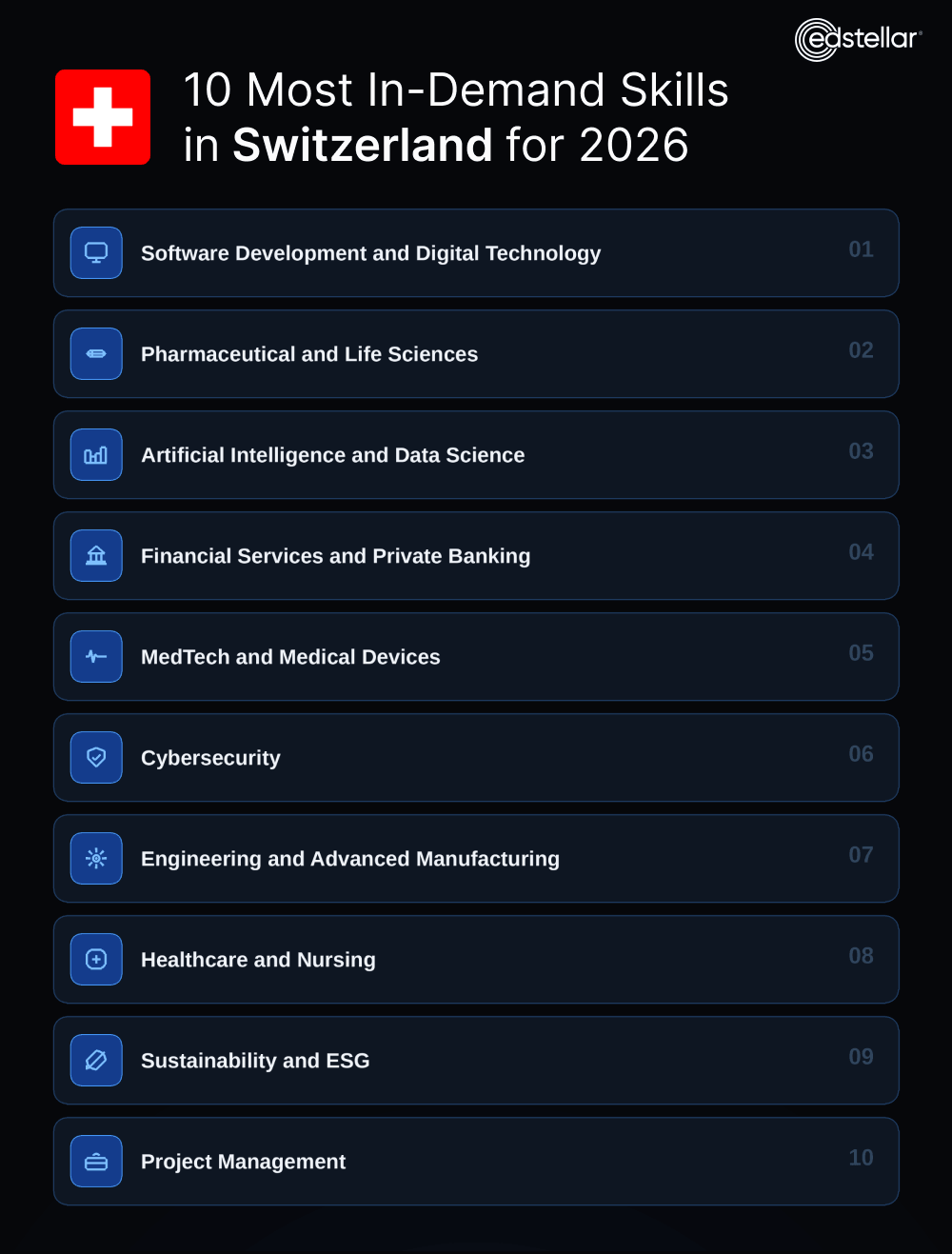
This guide ranks the 10 most in-demand skills in Switzerland for 2025 and 2026, drawing on data from SECO, the Swiss Federal Statistical Office, Digitalswitzerland, scienceindustries, the Swiss Bankers Association, MedTech Switzerland, the National Cyber Security Centre, and FINMA.
Sources Behind This Research
Every ranking in this guide is backed by data from Swiss federal authorities, industry federations, and regulatory bodies. We weighted Switzerland-specific sources exclusively, because the country's unique combination of pharmaceutical, financial, MedTech, and technology clusters makes global benchmarks insufficient. Here is where the numbers come from.
Government
SECO (State Secretariat for Economic Affairs)
Labour Market Intelligence and Skills Policy Reports 2024
Switzerland's primary national labour market data including job vacancy rates, sectoral employment forecasts, and skills shortage designations informing federal immigration policy and training investment.
Quarterly employment and vacancy surveys providing definitive national data on workforce participation, occupation-level vacancy rates, and wage trends across major industries.
National Cybersecurity Strategy 2023–2027 and Annual Threat Report
Defines the cyber risk landscape facing Swiss organisations and sets the framework for critical infrastructure protection. 25% increase in reported incidents in 2023–2024.
Sustainable Finance Guidelines and Digital Asset Framework 2024
Regulatory frameworks for ESG disclosure, digital assets, and operational resilience that are primary drivers of compliance and risk management hiring across Swiss financial services.
Annual barometer measuring digital skills supply and demand across Swiss employers. Found 72% difficulty rate in filling software and IT roles, the highest ever recorded.
Covers workforce data on the Basel-area life sciences cluster, sector employment growth at 6% annually, and skills needed across drug development, manufacturing, and regulatory functions.
Employment data across Switzerland's banking sector tracking demand for digital, compliance, and advisory skills in private banking and digital assets.
Tracks employment, skills gaps, and regulatory compliance challenges across Switzerland's medical device and digital health sectors employing 65,000+ people.
Swiss AI Strategy Implementation and Innovation Grant Data 2024
Provides picture of AI talent supply, startup formation, and skills demanded by companies emerging from Switzerland's research ecosystem. AI accounted for 34% of new tech company registrations.
"The most in-demand skills in Switzerland today go beyond technical ability. Professionals who develop a strong combination of strategic thinking, interpersonal effectiveness, and adaptability build the well rounded competencies essential for success in one of the world's most competitive and innovation driven economies.
"
Sonal Gupta
✓ PhD holder in Human Requirements in the Era of Industry 4.0 and co-author of The MBA Mindset, with 12+ years of expertise in soft skills, leadership, NLP, and management development training.
10 Key Skills in Demand Across Switzerland's Job Market
Switzerland's shortage list reflects the extraordinary sectoral density of a country that houses the world's largest pharmaceutical cluster, its biggest wealth management centre, Europe's leading MedTech hub, and a globally significant AI research ecosystem, all within a population of 8.8 million. The skills below cover the roles where hiring pressure is highest in 2026.
1
Software Development and Digital Technology
Research Score: 9.45/10
Switzerland has quietly become one of the world's premier destinations for software engineering talent, anchored by Google's Zurich office, which is the company's largest engineering site outside the United States with over 5,000 engineers. Amazon, IBM, Oracle, SAP, and a dense ecosystem of FinTech, MedTech, and enterprise software companies all maintain major Swiss engineering presences. The Digital Switzerland Strategy 2024–2027 designates software engineering and digital transformation capability as national priorities, with CHF 218 million committed to digital infrastructure and skills development.
Digitalswitzerland's 2024 Digital Skills Barometer found that 72% of Swiss employers reported difficulty filling software development and IT roles, the highest rate in the survey's history, spanning all sectors from pharma to banking to public administration. The Federal Council's push to modernise government digital services, driven by the Digital Administration Switzerland (DAS) programme, is adding public sector demand on top of already saturated private sector hiring.
The most sought-after software professionals in Switzerland combine strong core engineering skills with domain knowledge relevant to the country's leading sectors. A full-stack developer with healthcare data experience commands a premium in Basel's life sciences cluster. A mobile engineer with financial services knowledge is particularly valued in Zurich's banking and FinTech firms. Salaries range from CHF 90,000 to 160,000 per year, with senior engineers exceeding CHF 200,000.
Key Sub-skills
Full-Stack DevelopmentMobile App DevelopmentCloud-Native DevelopmentAPIs and MicroservicesAgile and Scrum
Top Industries
Technology, Financial Services, Pharmaceutical, MedTech, Government, Professional Services
The Basel-area life sciences cluster is the most concentrated pharmaceutical research and production hub anywhere in the world. Novartis and Roche, both globally headquartered in Basel, are among the largest pharmaceutical companies on earth by revenue and R&D investment. Lonza, Ferring, Actelion (a Johnson and Johnson company), and over 600 smaller biotech, specialty pharma, and contract manufacturing organisations complete an ecosystem that employs over 50,000 people directly. scienceindustries reports this workforce growing at 6% annually.
The skills most urgently needed reflect where the science is moving fastest. Cell and gene therapy development, mRNA platform technology, bioinformatics and computational biology, and advanced bioprocess engineering are all disciplines where global demand far exceeds supply. Regulatory affairs is simultaneously in acute shortage: the EU's MDR and IVDR transition has dramatically increased compliance burden for Swiss pharmaceutical and device exporters.
Swissmedic's 2024 annual report noted a 28% increase in clinical trial authorisation applications between 2022 and 2024, reflecting the sector's innovation momentum and the growing volume of professionals needed. For professionals at the intersection of scientific expertise and regulatory knowledge, salaries range from CHF 100,000 to 175,000 per year, with directors in drug development and regulatory affairs regularly exceeding CHF 220,000.
Key Sub-skills
Drug Discovery and DevelopmentmRNA and Cell and Gene TherapyRegulatory Affairs (Swissmedic and EMA)BioinformaticsQuality Assurance (GMP/GDP)
Top Industries
Pharmaceutical, Biotechnology, Contract Research Organisations, Contract Manufacturing, Academic Medical Centres
"In the Intelligent Age, skills drive organizational agility. With AI accelerating the need for adaptability, developing and deploying skills is essential for confidently navigating change."
Stefanie Schweitzer
Managing Consultant Rewards · Zurich, Switzerland
3
Artificial Intelligence and Data Science
Research Score: 9.10/10
ETH Zurich consistently ranks among the world's top three universities for computer science and AI research, and its commercial proximity to Zurich's technology, financial services, and life sciences clusters makes Switzerland one of the world's most productive research-to-market AI ecosystems. The Federal Council's Swiss AI Strategy, published in 2023, sets a national framework for responsible AI development, directing Innosuisse funding toward AI commercialisation projects.
Digitalswitzerland's Start-up Monitor 2024 found that AI and machine learning accounted for 34% of all new technology company registrations in Switzerland in 2023. Roche is applying AI to drug discovery and clinical development at scale. UBS and Julius Baer are deploying AI-driven portfolio analytics and client advisory tools. Zurich Insurance is using machine learning for underwriting, claims, and risk modelling. Each of these programmes requires applied AI engineers, MLOps specialists, data engineers, and AI product managers.
Professionals who combine strong technical AI skills with domain expertise in one of Switzerland's leading sectors are the most sought after, commanding salaries of CHF 110,000 to 180,000 per year. Senior AI architects and principal data scientists at major corporates frequently exceed CHF 220,000.
Key Sub-skills
Machine LearningNatural Language ProcessingPredictive AnalyticsComputer VisionResponsible AI and Governance
Switzerland manages approximately 35% of global offshore wealth, making it the world's largest offshore wealth management centre by assets under management. Zurich and Geneva together rank among the world's top ten financial centres, with trade finance, commodity banking, and structured products adding significant depth beyond conventional private banking.
The UBS acquisition of Credit Suisse in March 2023 is reshaping the Swiss banking sector. The integration programme is simultaneously creating redundancy in overlapping functions and acute demand for talent in risk management, digital transformation, private client services, and compliance. The Swiss Bankers Association's 2024 workforce report identified digital and hybrid skills as the most urgent hiring priority, with open banking, digital assets, and AI-driven advisory as the three most cited capability gaps.
Zug's Crypto Valley, home to over 900 blockchain and digital asset companies, adds a distinctive dimension. Smart contract developers, crypto compliance specialists, and blockchain architects are in acute shortage. Experienced financial services professionals earn CHF 95,000 to 180,000 per year, with senior relationship managers at major private banks regularly exceeding CHF 250,000.
Key Sub-skills
Private Banking and Wealth ManagementDigital Asset ComplianceRegTech and AML/FINMA ComplianceRisk ManagementESG-Aligned Portfolio Management
Switzerland has the highest MedTech employment per capita in Europe. Straumann in dental implants, Sonova in hearing instruments, Ypsomed in drug delivery devices, Hamilton Medical in ventilators, and the Swiss operations of Zimmer Biomet and Medtronic collectively employ over 65,000 people. The sector's concentration reflects precision engineering heritage, a highly educated workforce, and a regulatory environment well aligned with both FDA and EU standards.
The EU MDR and IVDR transition has been the defining challenge for Swiss MedTech. Swiss-based manufacturers exporting to Europe must comply with substantially more demanding regulations requiring documented clinical evidence, post-market surveillance systems, and software lifecycle management. MedTech Switzerland's 2024 survey identified regulatory affairs specialists with EU MDR and IVDR expertise, clinical evaluation writers, and Software as a Medical Device (SaMD) engineers as the three roles with the widest supply gaps.
Digital health is creating new categories of demand. AI-powered diagnostic tools, connected devices, and digital therapeutics all require software engineers and data scientists with IEC 62304 and ISO 14971 knowledge. MedTech professionals with this hybrid profile command CHF 90,000 to 165,000 per year, with regulatory directors exceeding CHF 190,000.
Key Sub-skills
Medical Device EngineeringRegulatory Affairs (EU MDR and IVDR)Software as a Medical Device (SaMD)Quality Management (ISO 13485)Digital Health Product Development
Top Industries
Medical Device Manufacturing, Digital Health, Diagnostics, Dental, Hearing and Vision Technology, Contract Manufacturing
Get a custom training plan from Edstellar's 5,000+ expert trainers. Virtual or onsite delivery across Zurich, Geneva, Basel, Lausanne, and beyond.
Request a Free Consultation →
6
Cybersecurity
Research Score: 8.55/10
Switzerland's dual role as a global financial centre and the host nation for over 200 international organisations, including the United Nations, WHO, WTO, ICRC, and CERN, makes it a high-value target for both financially motivated cybercriminals and state-sponsored espionage actors. The NCSC's 2023–2024 annual report recorded a 25% increase in reported cyber incidents. The National Cybersecurity Strategy 2023–2027 commits federal resources to building resilience across critical infrastructure.
The new Swiss Data Protection Act (nDSG), which entered into force in September 2023 and establishes obligations broadly equivalent to the EU's GDPR, has created a wave of compliance-driven hiring. Data protection officers, privacy architects, and breach notification specialists are all in short supply. FINMA's 2024 Circular on Operational Risk adds further financial sector-specific requirements mandating cyber resilience maturity.
International organisations in Geneva represent a permanently non-cyclical source of demand, hiring security engineers and incident responders on multi-year contracts. Experienced cybersecurity professionals earn CHF 95,000 to 170,000 per year, with CISO roles at major banks and international organisations commanding above CHF 250,000.
Key Sub-skills
Network SecurityThreat IntelligencePenetration TestingnDSG and GDPR Data ProtectionZero Trust Architecture
Top Industries
Banking, International Organisations, Healthcare, Government, MedTech, Insurance, Critical Infrastructure
Switzerland's precision engineering tradition is one of the foundations of its economic identity. The watchmaking industry, employing over 60,000 people across Rolex, the Swatch Group, Richemont, and LVMH Watches, represents the pinnacle of mechanical precision craft enhanced by modern CNC machining, laser processing, and digital quality control. Industrial automation leader ABB, Sulzer, Georg Fischer, and Schindler all compete in a national engineering talent market that the Swiss Employers' Association consistently identifies as structurally undersupplied.
Switzerland's Industry 4.0 adoption rate is among the highest in Europe, with manufacturers deploying advanced robotics, digital twin technology, predictive maintenance, and automated quality control. The pharma sector's biologics manufacturing expansion is creating new demand for bioprocess engineers and GMP-qualified automation specialists.
Quality management, Lean, and Six Sigma expertise remain consistently valued. Engineers with dual capabilities spanning traditional discipline expertise and digital or automation skills earn CHF 85,000 to 155,000 per year. Senior automation architects and principal process engineers frequently exceed CHF 180,000.
Key Sub-skills
Electrical and Mechatronics EngineeringIndustrial Automation and RoboticsPrecision Manufacturing and CNCDigital Twin TechnologyLean Manufacturing and Six Sigma
"With AI-exposed roles experiencing 66% faster skill evolution, organizations must prioritize reskilling. By 2030, 70% of skills used in most jobs will change."
Jeyakanthan (JK) Perumal
Cybersecurity Engineer, Comet · Switzerland
8
Healthcare and Nursing
Research Score: 8.15/10
The Swiss Nursing Association (SBK/ASI) estimates a shortage of over 12,000 nursing and care professionals across Switzerland by 2025, driven by retirement of experienced nurses, growing patient demand from a population where over 19% are aged 65 or above, and structural retention challenges. The Federal Council's 2022 healthcare workforce initiative commits federal and cantonal funding to nursing education expansion, return-to-practice programmes, and improved working conditions.
Switzerland's dependence on cross-border commuters (Grenzgänger) from France, Germany, and Italy for a significant share of healthcare staffing creates structural vulnerability. When border restrictions tightened during the pandemic, hospital staffing shortfalls became immediate in cantons near the French and German borders, exposing the fragility of this workforce model.
The federal mandate for electronic patient records (EPR) across all Swiss healthcare providers is accelerating the requirement for nurses with digital health literacy. Telehealth platforms, AI-assisted triage, and remote monitoring are becoming standard clinical infrastructure. Registered nurses earn CHF 70,000 to 110,000 per year, with specialist clinical nurses frequently exceeding CHF 120,000.
Key Sub-skills
Clinical NursingElderly and Long-term CareTelehealth and Digital Health RecordsMental Health SupportSpecialist Care (ICU, Oncology)
Top Industries
Cantonal Hospitals, Private Hospital Groups (Hirslanden, Swiss Medical Network), Long-term Care Homes, Home Care Services, Outpatient Clinics
Switzerland's Climate and Innovation Act, approved by national referendum in June 2023 with 59% support, enshrines a net-zero emissions target by 2050 and commits CHF 3.2 billion in federal funding to clean technology innovation, building renovation, and industrial decarbonisation. This democratic mandate makes Switzerland's sustainability transition politically durable in a way that top-down government commitments cannot fully match.
FINMA's 2023 sustainable finance disclosure guidelines and the Swiss Stock Exchange (SIX) ESG reporting requirements have created a compliance-driven hiring wave for ESG analysts, climate risk assessors, and sustainability disclosure specialists. Geneva is positioning itself as Europe's foremost green finance centre, leveraging Switzerland's dual role as the world's largest private banking hub and home of major commodity trading firms.
The breadth of ESG demand spans well beyond financial services. Novartis, Roche, and Lonza all have ambitious Scope 3 emission reduction commitments. ABB and Georg Fischer are implementing circular economy designs. Sustainability professionals earn CHF 85,000 to 155,000 per year, with heads of sustainability at listed companies exceeding CHF 200,000.
Key Sub-skills
ESG Reporting (TCFD and GRI)Carbon AccountingClimate Risk AssessmentSwiss CO2 Act ComplianceCircular Economy Design
Switzerland's concentration of multinational headquarters, international organisations, and large-scale federal and cantonal infrastructure programmes creates permanent demand for project managers with multilingual capabilities and cross-cultural delivery experience. The SBB rail network modernisation, cantonal infrastructure investment across Zurich, Geneva, and Berne, and major public building programmes all require project managers familiar with Swiss procurement regulations and governance requirements.
The UBS integration of Credit Suisse is the single largest programme management challenge the Swiss financial sector has faced in a generation. Managing the consolidation of two global banking institutions requires experienced programme managers, change management specialists, and transformation leads. This is running concurrently with digital banking modernisation programmes at all major Swiss banks.
The pharmaceutical and MedTech sectors are also major consumers of project management talent, with drug development programmes, clinical trial execution, and device certification pathways all requiring formal governance. The PMI Switzerland Chapter reported a 19% increase in PMP enrolments between 2022 and 2024. Experienced project managers earn CHF 90,000 to 160,000 per year, with programme directors exceeding CHF 200,000.
Key Sub-skills
PMP CertificationAgile and ScrumRisk ManagementStakeholder EngagementMultilingual Project Delivery
Top Industries
Pharmaceutical, MedTech, Financial Services, Technology, Government, International Organisations, Construction
"Switzerland's skills shortage isn't just a headline anymore, it's becoming one of the defining business challenges of the next decade. For companies, especially in high-skill sectors like tech and engineering, this means one thing: talent strategy is now business strategy."
Living and Working in Switzerland: EURES guide covering job opportunities, salaries, work contracts, and workplace culture for professionals considering Switzerland.
Skills Demand Across Switzerland's Key Clusters
Switzerland's skills demand concentrates across distinct regional clusters, each anchored by specific industries and institutions. Understanding these patterns helps corporate L&D teams target training investments where they will deliver the greatest impact.
Cluster
Key Industries
Top Shortage Skills
Zurich
Technology (Google, SAP), Financial Services (UBS), Insurance (Zurich, Swiss Re), AI Research (ETH)
Zurich dominates technology, financial services, and AI hiring, anchored by Google's 5,000-engineer office and the UBS/Credit Suisse integration. Basel is the global epicentre of pharmaceutical and life sciences talent. Geneva concentrates private banking, international organisation, and ESG roles. Zug's Crypto Valley creates a unique blockchain and digital assets talent market. Lausanne's EPFL campus drives deep tech and MedTech research demand alongside the hospitality sector centred around EHL.
How to Develop These Skills in Demand in Switzerland
Switzerland's skills shortages span technology, pharmaceutical, financial services, MedTech, cybersecurity, engineering, healthcare, and ESG simultaneously. The country's 8.8 million population means that every sector competes for the same limited domestic talent pool. Here is how to approach workforce development.
Use Switzerland's VET system and federal funding. The cantonal vocational education and training (VET) system and OPET subsidise professional qualifications from Federal Diplomas in engineering and ICT to advanced certificates in financial services and healthcare. Innosuisse Innovation Cheques support professionals in SMEs seeking to develop AI or digital technology capabilities through collaboration with Swiss universities.
Build the hybrid profiles Switzerland values most. The Swiss market consistently rewards professionals who combine deep technical skills with domain knowledge: AI expertise applied to drug discovery, cybersecurity knowledge deployed in a FINMA-regulated environment, or engineering skills adapted to pharmaceutical GMP manufacturing. Training programmes that bridge disciplines produce the strongest outcomes.
Leverage ETH, EPFL, and research institution pathways. ETH Zurich's CAS (Certificate of Advanced Studies) programmes in AI and data science carry exceptional credibility. EPFL's continuing education in MedTech and engineering is equally valued. These are accessible to industry practitioners and carry employer recognition that accelerates career development.
Pursue industry-specific certifications. SBI and AZEK certifications for financial services. RAPS credentials and ISO 13485 Lead Auditor for pharma and MedTech. CISSP, CISM, and cloud certifications for technology roles. PMP and SAFe for project management. These are the standard currency across Swiss employers.
Plan for multilingual capability. German, French, Italian, and English are all working languages across different Swiss regions and sectors. Professionals who add a Swiss working language to their technical capability hold a significant competitive advantage. Training programmes that account for linguistic context deliver better outcomes than single-language delivery.
Switzerland's combination of pharmaceutical leadership, financial centre status, MedTech cluster, and AI research ecosystem means demand for these 10 skill areas will remain elevated for years. Organisations that build their training strategies around these priorities, supported by Edstellar's catalogue of over 2,000 instructor-led courses, will be better positioned to attract and retain the talent needed to compete in one of the world's most skills-intensive economies.
Frequently Asked Questions
What are the most in-demand skills in Switzerland right now?
The ten most in-demand skills in Switzerland in 2025 are Software Development and Digital Technology, Pharmaceutical and Life Sciences, Artificial Intelligence and Data Science, Financial Services and Private Banking, MedTech and Medical Devices, Cybersecurity, Engineering and Advanced Manufacturing, Healthcare and Nursing, Sustainability and ESG, and Project Management. Software Development leads with a 9.45/10 research score driven by 72% employer difficulty rates and demand from Google Zurich, Swiss pharma, banking, and MedTech employers.
Why is Switzerland's pharmaceutical sector so significant for job seekers?
Switzerland's Basel-area life sciences cluster is the most concentrated pharmaceutical hub in the world, anchored by Novartis and Roche and supported by over 600 biotech and pharma companies. scienceindustries reports direct employment of over 50,000 people growing at 6% annually. The most in-demand specialisms are cell and gene therapy, mRNA technology, bioinformatics, regulatory affairs, and clinical trial management. Salaries range from CHF 100,000 to 175,000 per year, with senior specialists exceeding CHF 220,000.
What is Crypto Valley and how does it affect tech employment in Switzerland?
Crypto Valley is the cluster of over 900 blockchain and digital asset companies based in and around Zug, Switzerland, making it the world's most concentrated blockchain hub outside Silicon Valley. Companies include the Ethereum Foundation, Cardano, Polkadot, and hundreds of crypto exchanges and DeFi protocol developers. The ecosystem generates demand for smart contract developers, blockchain architects, digital asset compliance specialists, and crypto custody professionals. Switzerland's favourable regulatory framework overseen by FINMA sustains employment demand largely independent of crypto market cycles.
How has the UBS and Credit Suisse merger affected the Swiss job market?
The UBS acquisition of Credit Suisse in March 2023 is one of the most significant financial sector restructuring events in Swiss history. The integration programme has created redundancy in overlapping functions while generating acute demand for risk management, digital banking transformation, private client services, and compliance professionals. For project managers, change management specialists, and senior financial services professionals, the integration represents one of the largest single sources of professional opportunity over the 2024–2026 period.
What impact does the new Swiss Data Protection Act have on cybersecurity careers?
The revised Swiss Federal Act on Data Protection (nDSG), which entered into force on 1 September 2023, establishes data protection obligations broadly equivalent to the EU's GDPR. Every organisation handling Swiss personal data must now appoint data protection advisers, implement privacy-by-design processes, maintain records of processing activities, and meet mandatory breach notification obligations within 72 hours. This has created immediate compliance-driven demand for data protection officers, privacy architects, SIEM specialists, and information security managers across all industries.
What salaries can professionals expect in Switzerland's technology and financial services sectors?
Switzerland is one of the highest-paying labour markets in the world. Software developers earn CHF 90,000 to 160,000 per year, with senior engineers exceeding CHF 200,000. AI and data scientists earn CHF 110,000 to 180,000, with senior architects above CHF 220,000. Financial services professionals earn CHF 95,000 to 180,000, with senior private banking roles regularly exceeding CHF 250,000. Cybersecurity professionals earn CHF 95,000 to 170,000. These are base salaries; total compensation is typically 20–35% higher at senior levels.
Conclusion
Switzerland's skills landscape in 2025 is shaped by the country's exceptional economic position and the inherent tension that comes with it. A nation that houses the world's most concentrated pharmaceutical cluster, its largest offshore wealth management centre, Europe's premier MedTech hub, and one of the world's finest AI research universities will always generate demand that its domestic training system cannot fully satisfy.
The 10 skills profiled in this guide reflect where the most sustained and policy-backed demand lies. The organisations that close their skills gaps fastest, whether through structured upskilling, certification investment, or deliberate hybrid profile development, will find themselves materially better positioned in Switzerland's talent market for years to come.
Organisations looking to upskill their Swiss workforce across these in-demand skills can also explore our detailed comparison of corporate training companies in Switzerland to find the right training partner based on industry focus, delivery format, and programme coverage.
Ready to Upskill Your Switzerland Team?
Join 500+ organisations that trust Edstellar's Training Needs Analysis to find the gaps, pick the right skills, and build a training plan that works.
Sonal Gupta is a seasoned corporate trainer, communication coach, and educator with more than 12 years of experience in the areas of soft skills, leadership, management development, mind management, and Neuro Linguistic Programming (NLP). She holds a PhD in Human Requirements in the Era of Industry 4.0, reflecting her deep academic and practical understanding of the evolving human competencies needed in today’s professional landscape.
Explore High-impact instructor-led training for your teams.
Unlock premium resources, tools, and frameworks designed for HR and learning professionals. Our L&D Hub gives you everything needed to elevate your organization's training approach.
.svg "edstellar")


















.svg "Click Here to Follow on Medium")
.svg)



.svg)


.svg)
.svg)
.svg)

.svg)