.svg "edstellar")

Equip your AI, data, and product teams to design fair, transparent, and accountable AI with Edstellar's instructor-led, fully customized AI Ethics and Responsible AI training, delivered onsite or online worldwide, so your organization can adopt AI with trust and stay ahead of regulation.
(Virtual / On-site / Off-site)
.svg)
AI ethics and responsible AI is the multidisciplinary framework of principles and practices that ensures artificial intelligence systems are designed, developed, and deployed in ways that are fair, transparent, accountable, and safe. It spans bias detection and mitigation, explainability, privacy, human oversight, and governance across the full AI lifecycle, and it is applied wherever AI-driven decisions affect people, including healthcare, finance, government, and technology. AI Ethics & Responsible AI training gives your teams the principles, tools, and governance models to embed accountability into how the organization builds and uses AI, so innovation does not come at the cost of trust or compliance.
As organizations embed AI into decisions that affect customers, employees, and society, and as regulation such as the EU AI Act takes effect, this program helps your teams build and deploy AI responsibly without slowing innovation. Empower your people with expert-led on-site, off-site, and virtual sessions delivered by Edstellar, a premier corporate training provider serving organizations worldwide in-person and virtually across popular languages. Built around your goals, the program turns AI ethics and responsible AI skills into lasting capabilities that lift performance across your AI, data, product, and risk teams.
By the end of the program, your teams can evaluate AI systems for ethical and legal risk, measure and reduce algorithmic bias, explain and document model decisions, and stand up governance and audit processes that satisfy regulators and customers. The result is faster, more confident AI adoption, lower regulatory and reputational exposure, and AI products your stakeholders and the market can trust.
.svg)

- Ethical AI Framework Design
- Bias Detection and Mitigation
- AI Risk Assessment
- Explainability and Transparency
- AI Regulatory Compliance
- Stakeholder Impact Analysis
- AI Governance and Policy Design
- Evaluate AI systems for ethical and legal risk using fairness, accountability, and transparency frameworks.
- Detect, measure, and mitigate algorithmic bias across data, models, and outputs for equitable outcomes.
- Apply explainability techniques such as LIME, SHAP, and counterfactuals to make AI decisions transparent and auditable.
- Design AI governance frameworks with clear policies, human oversight, and accountability structures.
- Ensure compliance with regulations such as GDPR and the EU AI Act, and run AI audit and documentation processes.
- Embed responsible AI into product workflows and conduct stakeholder impact analysis for inclusive, trustworthy AI.
- Overview of AI ethics
- Definition, scope, and historical evolution of AI ethics in modern technology
- Key ethical principles: fairness, accountability, transparency, and safety
- The global AI ethics landscape: international initiatives, frameworks, and declarations
- Ethics across the organization
- Ethical challenges in modern AI: bias, privacy, and autonomous decision-making
- Mapping responsible AI to organizational values, strategy, and the development cycle
- Fairness, transparency, and accountability
- Fairness in AI systems: individual, group, and counterfactual fairness
- Transparency and explainability versus interpretability in AI contexts
- Accountability across the chain, with human-in-the-loop and human-on-the-loop models
- Safety and assurance
- Safety, robustness, and reliability, including testing for edge cases and adversarial inputs
- AI audit trails, documentation, and accountability mechanisms
- Understanding AI bias
- Definition and classification of AI bias: cognitive, data, and algorithmic
- Sources of bias in data: historical, sampling, measurement, and representation gaps
- Bias in model development: label bias, selection bias, and bias amplification
- Measuring bias
- Fairness metrics: demographic parity, equalized odds, and predictive parity
- Real-world case studies of AI bias and their business and societal consequences
- Mitigation across the pipeline
- Pre-processing: data resampling, augmentation, and disparate-impact remediation
- In-processing: fairness constraints, adversarial debiasing, and fair representation learning
- Post-processing: calibrated equalized odds, reject option, and threshold optimization
- Tools and validation
- Fairness-aware model evaluation, reporting, and validation
- Hands-on tools: IBM AI Fairness 360, Google What-If Tool, and Microsoft Fairlearn
- XAI methods
- Global versus local explanations and model-agnostic versus model-specific approaches
- XAI techniques in practice: LIME, SHAP, and counterfactual explanations
- Explainability in high-stakes domains such as healthcare and finance
- Documentation and trust
- Model cards, datasheets, and AI documentation standards
- Communicating AI decisions and building trust with non-technical stakeholders
- Governance and regulation
- Building an enterprise AI governance framework: policies, roles, and oversight committees
- Regulatory landscape: GDPR, the EU AI Act, and sector and regional AI rules
- Risk classification, conformity assessments, and AI impact assessments
- Operationalizing responsible AI
- Embedding responsible AI into the product and MLOps lifecycle, with continuous monitoring
- Stakeholder impact analysis, audit readiness, and a roadmap for organization-wide adoption
- AI Engineer
- Machine Learning Engineer
- Data Scientist
- NLP Engineer
- Software Developer
- Solutions Architect
Participants should have a basic understanding of artificial intelligence and data-driven systems, including familiarity with machine learning fundamentals and data analytics, plus general awareness of organizational risk and compliance practices. The program suits AI engineers, machine learning engineers, data scientists, NLP engineers, software developers, and solutions architects, as well as product, risk, governance, and compliance leads who shape how AI is built and used. Edstellar tailors the depth, tools, and examples to your teams' roles, your industry, and the AI systems your organization deploys.


.webp "Virtual AI Ethics & Responsible AI Training")
.webp "On-site AI Ethics & Responsible AI Training")
.webp "Off-site AI Ethics & Responsible AI Training")
64 hours of group training (includes VILT/In-person On-site)
Tailored for SMBs
160 hours of group training (includes VILT/In-person On-site)
Ideal for growing SMBs
Tailor-Made Trainee Licenses with Our Exclusive Training Packages!
400 hours of group training (includes VILT/In-person On-site)
Designed for large corporations
Tailor-Made Trainee Licenses with Our Exclusive Training Packages!
Unlimited duration
Designed for large corporations
Experienced Trainers
Our trainers are drawn from a vetted global network and bring years of industry expertise, keeping every session practical and impactful.
Proven Quality
With a strong global track record, Edstellar is known for quality and engaging delivery.
Industry-Relevant Curriculum
Our programs are built by experts to match the demands of today's industry.
Fully Customizable
Every program can be tailored to your organization's goals.
Comprehensive Support
We provide pre- and post-session support for a complete learning experience.
Global Multi-Location & Multilingual Training Delivery
We deliver in multiple languages to support diverse global teams.
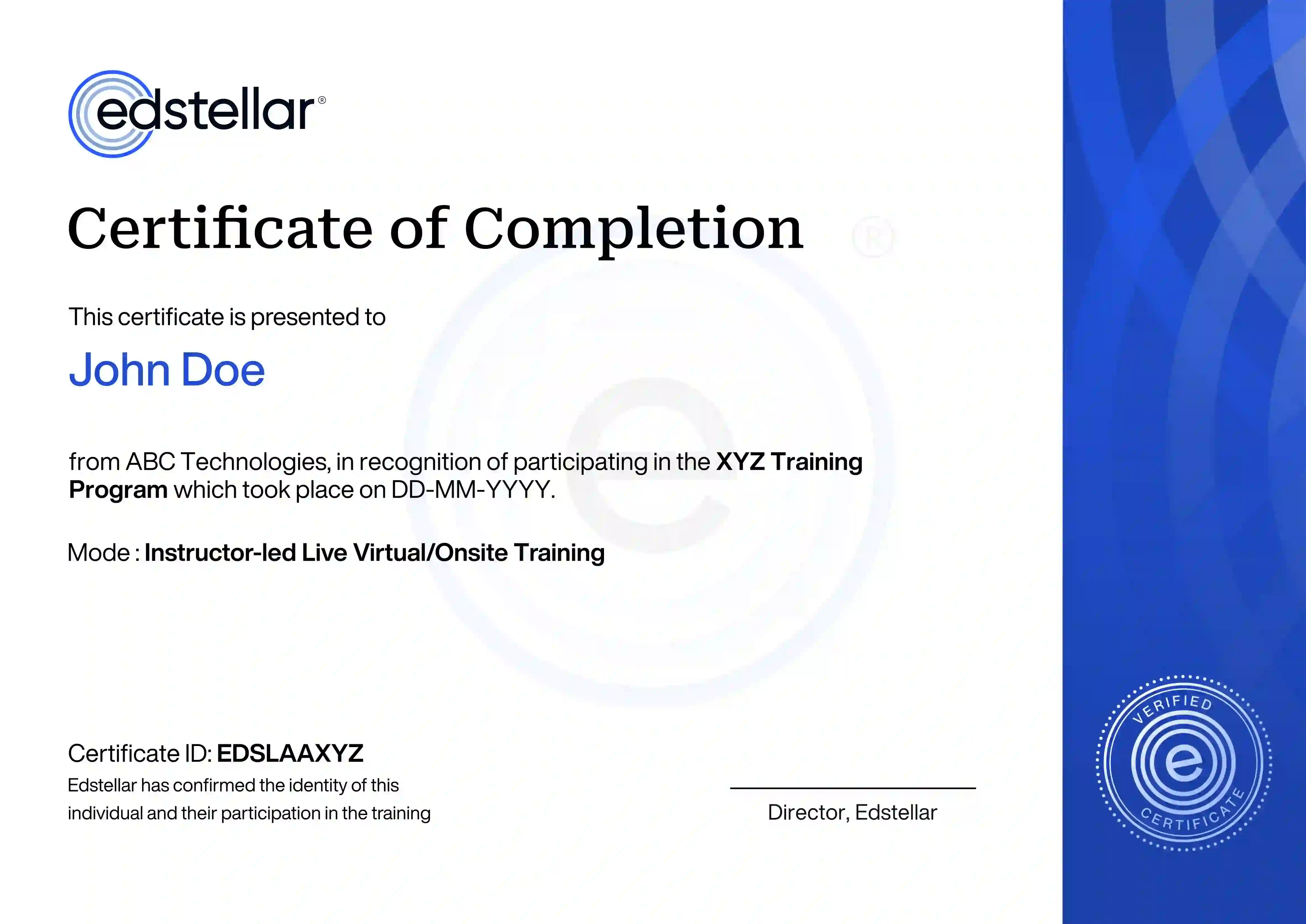
Recognition That Motivates Your Team

Frequently Asked Questions
Explore More Courses


.svg)
.svg)
.svg)

.svg)