Home
Corporate Training Courses
IT & Technical
Cybersecurity Training
Advanced Cybersecurity Threat Simulation Training

Drive Team Excellence with Advanced Cybersecurity Threat Simulation Corporate Training

Empower your teams with expert-led on-site, off-site, and virtual Advanced Cybersecurity Threat Simulation Training through Edstellar, a premier corporate training provider for organizations globally. Designed to meet your specific training needs, this group training program ensures your team is primed to drive your business goals. Help your employees build lasting capabilities that translate into real performance gains.

Advanced Cybersecurity Threat Simulation is a structured discipline that simulates real-world cyberattacks by replicating adversary tactics, techniques, and procedures (TTPs) to assess and strengthen an organization's security posture. Applied across financial services, defense, healthcare, and critical infrastructure sectors, it enables security teams to identify vulnerabilities before malicious actors can exploit them. The training provides comprehensive hands-on exposure to red teaming, purple teaming, adversary emulation, and threat hunting using industry-standard frameworks such as MITRE ATT&CK and TIBER-EU.

Edstellar's Advanced Cybersecurity Threat Simulation Instructor-led course offers virtual/onsite training options to meet professionals' diverse needs. This flexibility ensures that professionals and teams can engage in learning experiences that best suit their logistical and learning preferences. What sets the Edstellar course apart is its emphasis on practical experience, with hands-on projects and real-world scenarios that bring Advanced Cybersecurity Threat Simulation concepts to life. Edstellar equips professionals with the skills and confidence to apply Advanced Cybersecurity Threat Simulation technologies effectively in their security operations projects.

Get Customized Expert-led Training for Your Teams
Customized Training Delivery
Scale Your Training: Small to Large Teams
In-person Onsite, Live Virtual or Hybrid Training Modes
Plan from 2000+ Industry-ready Training Programs
Experience Hands-On Learning from Industry Experts
Delivery Capability Across 100+ Countries & 10+ Languages
""""

Key Skills Employees Gain from instructor-led Advanced Cybersecurity Threat Simulation Training

Advanced Cybersecurity Threat Simulation skills corporate training will enable teams to apply their learnings at work effectively.

  • Adversary Emulation Planning
  • Red Team Operations
  • Threat Detection and Validation
  • Purple Team Collaboration
  • Exploit Development and Analysis.
  • Threat Intelligence Integration
  • Post-Simulation Reporting and Remediation

Key Learning Outcomes of Advanced Cybersecurity Threat Simulation Training Workshop for Employees

Upon completing Edstellar’s Advanced Cybersecurity Threat Simulation workshop, employees will gain valuable, job-relevant insights and develop the confidence to apply their learning effectively in the professional environment.

  • Design adversary emulation plans using the MITRE ATT&CK framework to simulate real-world threats.
  • Execute red team engagements to test enterprise security through advanced attack techniques.
  • Evaluate detection and response using SIEM, EDR, and XDR, improving security coverage.
  • Develop exploit payloads and test vulnerabilities in controlled lab environments.
  • Conduct purple team exercises to enhance collaboration and strengthen defenses.
  • Analyze attack patterns using threat intelligence and cyber kill chain models.
  • Implement threat hunting using behavioral analytics and proactive detection methods.
  • Build realistic simulation environments for safe and effective cyber testing.
  • Assess phishing and social engineering risks to improve human-layer security.
  • Create post-simulation reports with insights and remediation strategies for leadership.

Key Benefits of the Advanced Cybersecurity Threat Simulation Group Training with Instructor-led Face to Face and Virtual Options

Attending our Advanced Cybersecurity Threat Simulation group training classes provides your team with a powerful opportunity to build skills, boost confidence, and develop a deeper understanding of the concepts that matter most. The collaborative learning environment fosters knowledge sharing and enables employees to translate insights into actionable work outcomes.

  • Build advanced red team skills using MITRE ATT&CK-based adversary emulation.
  • Enhance threat detection by tuning SIEM, EDR, and XDR through simulations.
  • Strengthen purple team collaboration for continuous security improvements.
  • Integrate threat intelligence into simulations for real-world attack scenarios.
  • Apply industry frameworks like TIBER-EU and CBEST for compliant testing.
  • Improve security posture through continuous simulations and data-driven remediation.

Topics and Outline of Advanced Cybersecurity Threat Simulation Training

Our virtual and on-premise Advanced Cybersecurity Threat Simulation training curriculum is structured into focused modules developed by industry experts. This training for organizations provides an interactive learning experience that addresses the evolving demands of the workplace, making it both relevant and practical.

  1. Cybersecurity Threat Simulation Overview
    • Definition, scope, and evolution of threat simulation disciplines
    • Differences between penetration testing, red teaming, and adversary emulation
    • Business drivers and organizational value of threat simulation programs
  2. Threat Landscape and Adversary Profiling
    • Understanding advanced persistent threats (APTs) and nation-state actors
    • Cybercriminal ecosystems: ransomware groups, initial access brokers, and hacktivists
    • Adversary profiling using open-source intelligence (OSINT) and threat feeds
  3. Ethical and Legal Framework for Threat Simulation
    • Rules of engagement (RoE) documentation and scope definition
    • Legal considerations: Computer Fraud and Abuse Act, GDPR, and sector-specific regulations
    • Authorization processes, non-disclosure agreements, and stakeholder communication
  4. Lab Environment Setup and Tooling
    • Building isolated simulation lab environments on-premises and in the cloud
    • Essential red team toolkits: Cobalt Strike, Metasploit, Sliver, and Havoc C2
    • Safety controls and environment segmentation for responsible simulation
  1. Introduction to MITRE ATT&CK
    • MITRE ATT&CK framework structure: tactics, techniques, and sub-techniques
    • Enterprise, Mobile, and ICS ATT&CK matrices explained
    • Using ATT&CK Navigator for threat modeling and simulation planning
  2. Threat Intelligence for Simulation Design
    • Sources of threat intelligence: ISAC feeds, VirusTotal, Mandiant, and CrowdStrike
    • Indicator of compromise (IOC) and TTP extraction from threat reports
    • Translating threat intelligence into actionable simulation scenarios
  3. Adversary Emulation Plan Development
    • Components of a structured adversary emulation plan
    • Mapping target adversary TTPs to simulation exercise objectives
    • Prioritizing TTPs based on organizational threat profile and risk exposure
  4. ATT&CK-Based Detection Coverage Mapping
    • Assessing existing detection controls against ATT&CK technique coverage
    • Identifying detection blind spots and priority gap areas
    • Building a detection roadmap aligned with emulation exercise findings
  1. Passive and Active Reconnaissance
    • OSINT collection techniques: Shodan, Maltego, WHOIS, and social media profiling
    • Active network reconnaissance: port scanning, service enumeration, and banner grabbing
    • DNS enumeration, subdomain discovery, and certificate transparency log analysis
  2. Social Engineering and Phishing Simulation
    • Spear-phishing email campaign design and payload delivery techniques
    • Vishing, smishing, and pretexting scenario development
    • Measuring phishing susceptibility and reporting user click-through analytics
  3. Exploitation of External Attack Surfaces
    • Web application vulnerabilities: SQL injection, XSS, and authentication bypass
    • VPN, RDP, and remote access service exploitation techniques
    • Supply chain and third-party access vector targeting strategies
  4. Initial Access Payload Development
    • Crafting custom malicious document macros and weaponized file payloads
    • HTML smuggling and drive-by download attack simulation
    • Initial access broker (IAB) replication techniques in simulation environments
  1. Privilege Escalation Techniques
    • Local and domain privilege escalation on Windows and Linux platforms
    • Exploiting misconfigurations: unquoted service paths, SUID abuse, and weak ACLs
    • Token impersonation, pass-the-hash, and Kerberoasting techniques
  2. Lateral Movement Strategies
    • Pass-the-ticket, pass-the-hash, and over-pass-the-hash methodologies
    • Living-off-the-land (LotL) techniques using built-in OS tools
    • Remote service exploitation, WMI, and PSExec-based lateral movement
  3. Persistence Mechanisms
    • Registry-based, scheduled task, and service installation persistence
    • Boot and pre-OS persistence: bootkit and firmware implant concepts
    • Cloud and SaaS persistence: OAuth token abuse and cloud credential theft
  4. Command and Control (C2) Infrastructure
    • Designing and deploying covert C2 communication channels
    • Domain fronting, redirectors, and C2 traffic obfuscation techniques
    • Detection evasion techniques for C2 beaconing and callback patterns
  1. Data Discovery and Collection Techniques
    • Identifying high-value data targets: credentials, PII, IP, and financial records
    • Automated data collection using PowerShell, Python, and custom scripts
    • Active Directory enumeration for sensitive object discovery
  2. Exfiltration Methods and Covert Channels
    • HTTP/S, DNS, and ICMP-based data exfiltration techniques
    • Cloud storage exfiltration: OneDrive, Dropbox, and AWS S3 abuse scenarios
    • Steganography and encrypted covert channel exfiltration approaches
  3. Ransomware and Destructive Attack Simulation
    • Simulating ransomware deployment: encryption routines, staging, and detonation
    • Data destruction and wiper malware simulation in isolated environments
    • Business impact analysis of simulated destructive cyberattack scenarios
  4. Measuring Simulation Impact and Dwell Time
    • Calculating mean time to detect (MTTD) and mean time to respond (MTTR)
    • Dwell time analysis and attacker persistence assessment methodologies
    • Quantifying the financial and operational impact of simulated breach scenarios
  1. Security Monitoring and Log Analysis
    • SIEM architecture, log ingestion, and correlation rule design
    • Endpoint Detection and Response (EDR) telemetry analysis and tuning
    • Network traffic analysis using Zeek, Suricata, and Wireshark for threat detection
  2. Detection Engineering
    • Writing SIGMA and Yara rules for detecting ATT&CK-aligned behaviors
    • Developing and testing detection use cases against simulated attack data
    • Detection-as-code: version-controlled detection rule management and deployment
  3. Incident Response During Simulation
    • Triage and containment procedures for simulated attack scenarios
    • Digital forensics: memory, disk, and network artifact collection and analysis
    • Chain-of-custody documentation and evidence handling best practices
  4. Deception Technologies
    • Honeypots, honeytokens, and canary file deployment strategies
    • Active defense techniques: deception-based adversary detection and tracking
    • Integrating deception infrastructure into threat simulation environments
  1. Purple Team Methodology and Framework
    • Defining purple team roles, objectives, and exercise design principles
    • Structuring collaborative red-blue simulation sessions for maximum impact
    • Purple team maturity models and capability improvement frameworks
  2. Designing and Running Purple Team Exercises
    • Scoping and scheduling the purple team exercise cadence and objectives
    • Real-time TTP execution and detection validation workflows
    • Feedback loops, documentation, and findings capture during live exercises
  3. Detection Gap Analysis and Control Tuning
    • Mapping simulation findings to detection coverage gaps systematically
    • Tuning SIEM correlation rules and EDR policies based on exercise results
    • Prioritizing security control investments based on purple team exercise data
  4. Continuous Purple Team Programs
    • Building a sustainable, recurring purple team program within an organization
    • Integrating purple team findings into security roadmap and budget planning
    • Metrics, KPIs, and reporting frameworks for purple team program success
  1. Cloud Attack Surface Assessment
    • Cloud-specific attack vectors: misconfigured storage, IAM privilege escalation, and metadata API abuse
    • Multi-cloud threat simulation: AWS, Azure, and GCP attack scenario design
    • Cloud-native threat intelligence and adversary TTP mapping
  2. Simulating Cloud Intrusions
    • Cloud credential theft: SSRF exploitation and EC2 instance metadata attacks
    • Cross-account privilege escalation and role chaining in cloud environments
    • Kubernetes and container escape simulation techniques
  3. Hybrid and Active Directory Attacks
    • Azure AD and on-premises Active Directory hybrid attack paths
    • Pass-the-PRT, Golden SAML, and federation trust abuse techniques
    • DCSync, skeleton key, and domain trust escalation simulations
  4. Cloud Forensics and Incident Response
    • Cloud-native logging: AWS CloudTrail, Azure Monitor, and GCP Audit Logs analysis
    • Cloud incident response playbooks and containment procedures
    • Evidence preservation and forensic artifact collection in cloud environments
  1. Regulatory Threat Simulation Standards
    • TIBER-EU framework: structure, phases, and implementation requirements
    • CBEST (UK) and iCAST (Hong Kong) threat-led penetration testing standards
    • DORA (EU Digital Operational Resilience Act) and its simulation obligations
  2. Scoping Threat-Led Penetration Testing Engagements
    • Defining critical functions and systems for regulatory simulation exercises
    • Engagement scoping, documentation, and regulatory body communication
    • Managing third-party threat intelligence providers in regulatory engagements
  3. Execution and Oversight of Regulatory Simulations
    • Conducting TIBER-EU generic threat intelligence and targeted threat intelligence phases
    • Red team test execution oversight, checkpoints, and regulatory reporting
    • Post-test remediation planning and regulatory finding closure processes
  4. Compliance Reporting and Evidence Packaging
    • Structuring executive summary and technical findings reports for regulators.
    • Evidence documentation standards for regulatory submission and audit
    • Communicating simulation outcomes and remediation timelines to regulators
  1. End-to-End Simulation Exercise
    • Full-scope red team simulation: reconnaissance through impact in a capstone lab
    • Applying adversary emulation plans against a realistic enterprise environment.
    • Real-time documentation of attack chains, TTPs, and evidence collection
  2. Post-Simulation Analysis and Debrief
    • Structured debrief facilitation for red, blue, and purple teams
    • Correlating simulation attack paths with actual detection and response outcomes
    • Scoring and benchmarking simulation results against industry maturity baselines
  3. Threat Simulation Report Writing
    • Structuring executive, management, and technical report tiers
    • Risk-rating findings using CVSS, DREAD, and custom severity scoring models
    • Writing clear, actionable remediation recommendations aligned to business risk
  4. Building a Threat Simulation Program
    • Designing a recurring, scalable organizational threat simulation program
    • Integrating simulation outcomes into security strategy and board-level reporting
    • Threat simulation program governance, resourcing, and continuous improvement planning

Who Can Take the Advanced Cybersecurity Threat Simulation Training Course

The Advanced Cybersecurity Threat Simulation training program can also be taken by professionals at various levels in the organization.

  • Cybersecurity Engineer
  • Security Analyst
  • Ethical Hacker
  • Penetration Tester
  • SOC Analyst
  • Security Architect

Prerequisites for Advanced Cybersecurity Threat Simulation Training

Professionals should have a solid understanding of networking fundamentals and operating system internals, including familiarity with common penetration testing concepts and tools such as Metasploit and Nmap, as well as foundational knowledge of cybersecurity frameworks and threat intelligence principles, to take the Advanced Cybersecurity Threat Simulation training course.

Request a Quote for your Corporate Training Requirements

Valid number

Delivering Training for Organizations across 100 Countries and 10+ Languages

Corporate Group Training Delivery Modes
for Advanced Cybersecurity Threat Simulation Training

At Edstellar, we understand the importance of impactful and engaging training for employees. As a leading Advanced Cybersecurity Threat Simulation training provider, we ensure the training is more interactive by offering Face-to-Face onsite/in-house or virtual/online sessions for companies. This approach has proven to be effective, outcome-oriented, and produces a well-rounded training experience for your teams.

Virtual Advanced Cybersecurity Threat Simulation Training

Edstellar's Advanced Cybersecurity Threat Simulation virtual/online training sessions bring expert-led, high-quality training to your teams anywhere, ensuring consistency and seamless integration into their schedules.

With global reach, your employees can get trained from various locations
The consistent training quality ensures uniform learning outcomes
Participants can attend training in their own space without the need for traveling
Organizations can scale learning by accommodating large groups of participants
Interactive tools can be used to enhance learning engagement
On-site Advanced Cybersecurity Threat Simulation Training

Edstellar's Advanced Cybersecurity Threat Simulation inhouse face to face instructor-led training delivers immersive and insightful learning experiences right in the comfort of your office.

Higher engagement and better learning experience through face-to-face interaction
Workplace environment can be tailored to learning requirements
Team collaboration and knowledge sharing improves training effectiveness
Demonstration of processes for hands-on learning and better understanding
Participants can get their doubts clarified and gain valuable insights through direct interaction
Off-site Advanced Cybersecurity Threat Simulation Training

Edstellar's Advanced Cybersecurity Threat Simulation offsite face-to-face instructor-led group training offer a unique opportunity for teams to immerse themselves in focused and dynamic learning environments away from their usual workplace distractions.

Distraction-free environment improves learning engagement
Team bonding can be improved through activities
Dedicated schedule for training away from office set up can improve learning effectiveness
Boosts employee morale and reflects organization's commitment to employee development

Explore Our Customized Pricing Package
for
Advanced Cybersecurity Threat Simulation Corporate Training

Looking for pricing details for onsite, offsite, or virtual instructor-led Advanced Cybersecurity Threat Simulation training? Get a customized proposal tailored to your team’s specific needs.

Request a Group Training Quote
""
How Many Team Members Need Training?
Please select an option or fill in the custom field.
"'

Is Your Corporate Training Requirement Only for Advanced Cybersecurity Threat Simulation?

Please select at least one course.
""
Add the List of Training Workshops
search icon

      Please select the course

      No. of Courses selected: 0

      Clear

      Upload a CSV

      Send us your Training Requirements in 3 Easy steps

      1. 1
      2. 2
        Add the required training workshops
      3. 3
        Upload to get a quick quote or email it to contact@edstellar.com

      ""

      Looking for a Complete Package?

      Looking for a one-time pricing option for all your annual training requirements?

      View Corporate Training Packages
      ""
      Select the Option that Best Describes Your Corporate Training Requirement

      Please select an option or choose from the recurring options.
      ""
      Verify and Submit Your Request

      Review Your Corporate Training Selection Summary

      Training Program: Advanced Cybersecurity Threat Simulation Training

      1. No of Team Members

      2. Selected Training Preference

      3. Selected Recurring Sessions

      1

      Review your Requirements

      Training Workshops Selected :


        Excel
        File has been
        successfully uploaded.
        Fill the form to submit
 your details
        Submit Your Professional Contact Information
        Valid number
        We've received your enquiry. Our team will be in touch soon.
        Oops! Something went wrong while submitting the form.
        Starter
        120 licences

        Tailor-Made Trainee Licenses with Our Exclusive Training Packages!

        View Package

        64 hours of group training (includes VILT/In-person On-site)

        Tailored for SMBs

        Growth
        320 licences

        Tailor-Made Trainee Licenses with Our Exclusive Training Packages!

        View Package

        160 hours of group training (includes VILT/In-person On-site)

        Ideal for growing SMBs

        Enterprise
        800 licences

        Tailor-Made Trainee Licenses with Our Exclusive Training Packages!

        View Package

        400 hours of group training (includes VILT/In-person On-site)

        Designed for large corporations

        Custom
        Unlimited licenses

        Tailor-Made Trainee Licenses with Our Exclusive Training Packages!

        View Package

        Unlimited duration

        Designed for large corporations

        Edstellar: Your Go-to Advanced Cybersecurity Threat Simulation Training Company

        Experienced Trainers

        Our trainers bring years of industry expertise to ensure the training is practical and impactful.

        Quality Training

        With a strong track record of delivering training worldwide, Edstellar maintains its reputation for its quality and training engagement.

        Industry-Relevant Curriculum

        Our course is designed by experts and is tailored to meet the demands of the current industry.

        Customizable Training

        Our course can be customized to meet the unique needs and goals of your organization.

        Comprehensive Support

        We provide pre and post training support to your organization to ensure a complete learning experience.

        Multilingual Training Capabilities

        We offer training in multiple languages to cater to diverse and global teams.

        Testimonials

        What Our Clients Say

        We pride ourselves on delivering exceptional training solutions. Here's what our clients have to say about their experiences with Edstellar.

        "Partnering with Edstellar for Advanced Cybersecurity Threat Simulation training significantly improved our security operations. Our Red Team, SOC, and Security teams enhanced detection capabilities and reduced mean time to detect by over 40%. Edstellar is a reliable training partner."

        Daniel Okafor

        Director of Cybersecurity Operations,

        Global Financial Services Enterprise

        "Edstellar's virtual Advanced Cybersecurity Threat Simulation training strengthened our security resilience and purple team collaboration. Our teams improved detection validation using real-world adversary techniques and enhanced SIEM tuning processes."

        Sophia Lindqvist

        Head of Offensive Security,

        Multinational Technology and Defense Corporation

        "Edstellar's onsite Advanced Cybersecurity Threat Simulation training delivered strong results. Our teams applied hands-on skills immediately and identified critical detection gaps through adversary simulation. A trusted partner for cybersecurity growth."

        Ravi Krishnamurthy

        Chief Information Security Officer,

        Healthcare and Critical Infrastructure Group

        “Edstellar’s IT & Technical training programs have been instrumental in strengthening our engineering teams and building future-ready capabilities. The hands-on approach, practical cloud scenarios, and expert guidance helped our teams improve technical depth, problem-solving skills, and execution across multiple projects. We’re excited to extend more of these impactful programs to other business units.”

        Aditi Rao

        L&D Head,

        A Global Technology Company

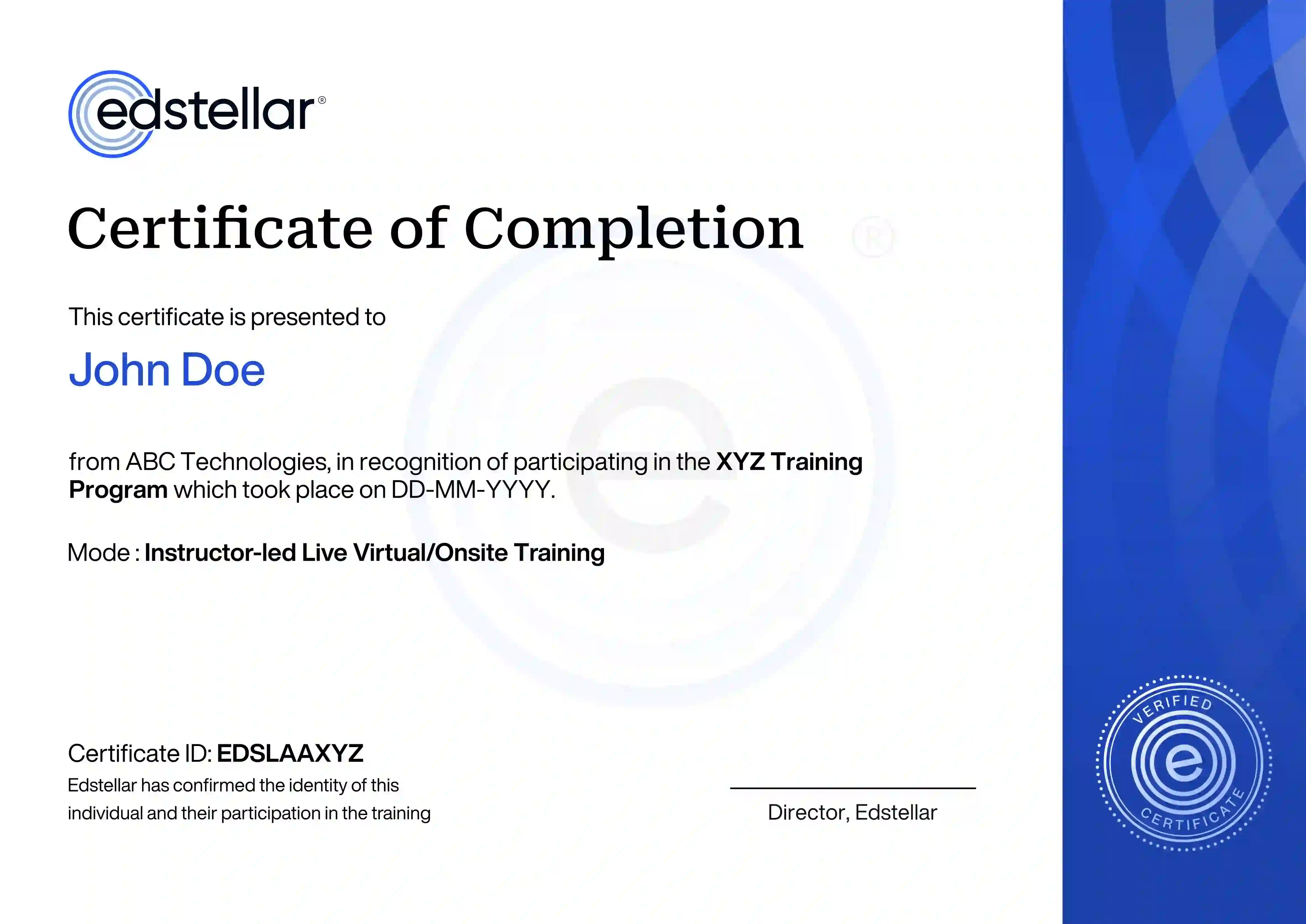
        Get Your Team Members Recognized with Edstellar’s Course Certificate

        Upon successful completion of the training course offered by Edstellar, employees receive a course completion certificate, symbolizing their dedication to ongoing learning and professional development.

        This certificate validates the employee's acquired skills and is a powerful motivator, inspiring them to enhance their expertise further and contribute effectively to organizational success.

        Certificate of Excellence