.svg "edstellar")

AI Automation Mastery Corporate Training Program for Employees
Equip your teams to design, build, and run reliable AI automations with Edstellar's instructor-led, fully customized AI Automation Mastery training, delivered onsite or online worldwide, so your organization turns manual work into dependable, production-ready AI workflows.
(Virtual / On-site / Off-site)
.svg)
AI automation is the practice of using artificial intelligence, especially large language models, to carry out and orchestrate real work: reading and routing information, generating and checking content, making decisions inside a workflow, and connecting to your existing tools through APIs and low-code platforms. AI Automation Mastery training teaches your teams to map a workflow, engineer reliable prompts, connect models to tools and data, and ship automations that are accurate, observable, and safe to run in production. It matters now because the teams that can turn AI from a demo into a dependable process move faster and spend less on repetitive work than those still doing it by hand.
As organizations race to put AI to work beyond the chat window, this program helps your teams build automations that hold up under real conditions instead of breaking in production. Empower your people with expert-led on-site, off-site, and virtual sessions delivered by Edstellar, a premier corporate training provider serving organizations worldwide in-person and virtually across popular languages. Built around your goals, the program turns AI automation skills into lasting capabilities that lift performance across your operations, engineering, support, and data teams.
By the end of the program, your teams can identify the highest-value processes to automate, engineer prompts that behave reliably, integrate LLMs with your systems through APIs and low-code tools, and govern automations with the right controls, logging, and lifecycle practices. The result is faster cycle times, fewer manual errors, lower operating cost, and a workforce that can scale AI automation safely rather than depending on one or two experts.
.svg)

- Map a business process and identify where AI automation delivers the highest value and lowest risk.
- Engineer clear, reliable prompts and reduce hallucination and inconsistency in production use.
- Connect large language models to your tools, data, and systems using APIs and low-code platforms.
- Build data-aware automations that retrieve, ground, and act on your organization's own information.
- Add observability, testing, and guardrails so automations run safely and predictably at scale.
- Govern the full lifecycle of an automation, from build and review to monitoring, security, and updates.
- Foundations of AI Automation
- What AI automation is, where LLMs fit, and how it differs from rules-only automation
- Spotting high-value, low-risk processes to automate across your organization
- The anatomy of an AI automation: inputs, model, tools, data, and outputs
- Mapping a workflow end to end before you build it
- Setting success criteria, accuracy targets, and acceptable failure modes
- Prompt Engineering and Reliable AI Behavior
- Writing clear, structured prompts that produce consistent results
- Patterns for reasoning, extraction, classification, and generation tasks
- Reducing hallucination, drift, and inconsistency in production
- Testing prompts and handling edge cases and failure gracefully
- Versioning and maintaining prompts as part of an automation
- Tools, Platforms, APIs, and Integration
- Connecting LLMs to your applications through APIs
- Building automations on low-code and no-code orchestration platforms
- Chaining steps, calling external tools, and passing data between them
- Authentication, rate limits, cost control, and error handling
- Choosing the right build approach for each use case
- Data-Aware Automation, Scaling, and Control
- Grounding automations in your own data with retrieval and context
- Keeping outputs accurate, current, and traceable to a source
- Adding logging, monitoring, and observability to running automations
- Scaling from a single workflow to many across teams
- Measuring performance, cost, and business impact
- Governance, Security, and Lifecycle Management
- Setting guardrails, approvals, and human-in-the-loop checkpoints
- Handling sensitive data, access control, and privacy in AI automations
- Managing risk, compliance, and responsible-AI practices
- Maintaining, updating, and retiring automations over time
- Building an internal operating model so AI automation scales safely
- Automation Engineers
- AI Engineers
- Workflow Automation Specialists
- Digital Transformation Managers
- IT Operations Managers
There are no strict prerequisites for this program. It suits operations, engineering, support, data, and product teams, along with the technical and business leads who own their workflows, at any level of experience. A basic comfort with using everyday software and a familiarity with the processes your team wants to automate help participants move faster, and Edstellar tailors the depth, tools, and examples to your teams' roles, your tech stack, and the automations your organization wants to build.


.webp "Virtual AI Automation Mastery Training")
.webp "On-site AI Automation Mastery Training")
.webp "Off-site AI Automation Mastery Training")
64 hours of group training (includes VILT/In-person On-site)
Tailored for SMBs
160 hours of group training (includes VILT/In-person On-site)
Ideal for growing SMBs
Tailor-Made Trainee Licenses with Our Exclusive Training Packages!
400 hours of group training (includes VILT/In-person On-site)
Designed for large corporations
Tailor-Made Trainee Licenses with Our Exclusive Training Packages!
Unlimited duration
Designed for large corporations
Experienced Trainers
Our trainers are drawn from a vetted global network and bring years of industry expertise, keeping every session practical and impactful.
Proven Quality
With a strong global track record, Edstellar is known for quality and engaging delivery.
Industry-Relevant Curriculum
Our programs are built by experts to match the demands of today's industry.
Fully Customizable
Every program can be tailored to your organization's goals.
Comprehensive Support
We provide pre- and post-session support for a complete learning experience.
Global Multi-Location & Multilingual Training Delivery
We deliver in multiple languages to support diverse global teams.
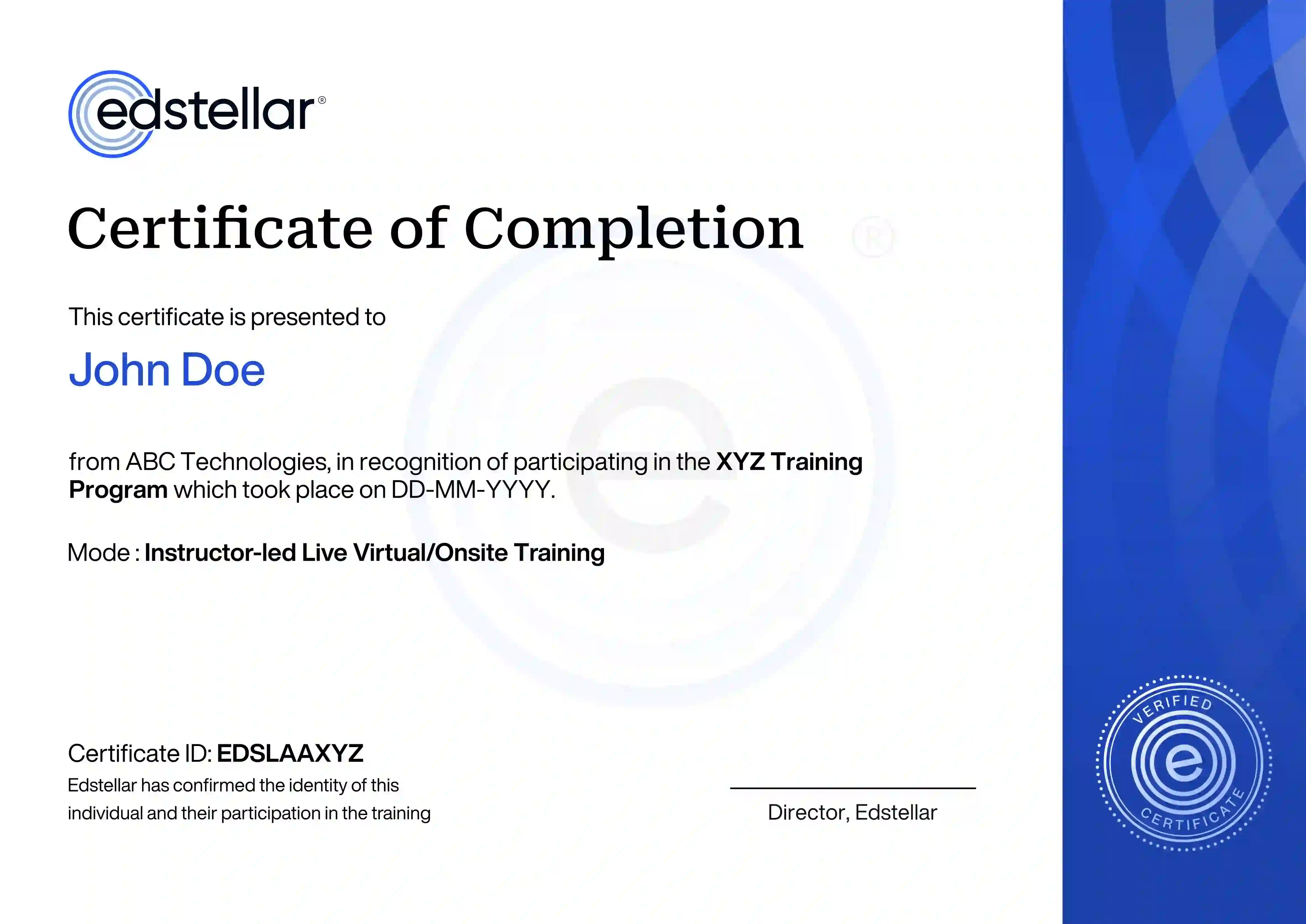
Recognition That Motivates Your Team

Frequently Asked Questions
Explore More Courses


.svg)
.svg)
.svg)

.svg)