.svg "edstellar")

NFT Development and Strategy Corporate Training Program for Employees
Edstellar's instructor-led NFT Development and Strategy training equips professionals to design, build, and launch NFT projects end-to-end. Participants master ERC-721 and ERC-1155 standards, Solidity contracts, metadata and IPFS, minting UX, marketplace integration, royalties, and go-to-market strategy for collectibles, gaming assets, memberships, and real-world utility.
(Virtual / On-site / Off-site)
.svg)
Drive Team Excellence with NFT Development and Strategy Corporate Training
NFT Development and Strategy covers the full lifecycle of creating, launching, and scaling non-fungible token projects on public blockchains. NFTs represent verifiable ownership of digital and real-world assets including art, collectibles, gaming items, memberships, music, identity, and tokenized real-world goods. The training provides comprehensive knowledge of NFT standards, Solidity development, metadata and storage, minting UX, marketplace integration, royalties, advanced patterns like dynamic and soulbound tokens, and go-to-market strategy to deliver successful, utility-driven NFT projects.
Edstellar's NFT Development and Strategy Instructor-led course offers virtual/onsite training options to meet professionals' diverse needs. This flexibility ensures that professionals and teams can engage in learning experiences that best suit their logistical and learning preferences. What sets the Edstellar course apart is its emphasis on practical experience, with hands-on smart contract development, real-world minting projects, and go-to-market case studies that bring NFT concepts to life. Edstellar equips professionals with the skills and confidence to ship NFT products effectively in their enterprise, creative, or product teams.
.svg)

- ERC-721 and ERC-1155 Smart Contracts
- Solidity Development
- Metadata and IPFS Storage
- Minting UX and Allowlists
- Marketplace Integration
- Royalties and Creator Economics
- NFT Go-to-Market Strategy
- Master NFT token standards and smart contract architectures by understanding ERC-721, ERC-1155, and their extensions, enabling developers to select, implement, and optimize the right standard for collectibles, gaming, memberships, and utility-driven NFT projects.
- Gain expertise in Solidity development with Foundry and Hardhat, OpenZeppelin libraries, access control, upgradability patterns, and gas optimization techniques to build secure and cost-efficient NFT contracts.
- Develop proficiency in NFT metadata and storage strategies using IPFS, Arweave, and on-chain storage, ensuring metadata permanence, discoverability, and compatibility with major marketplaces and explorers.
- Learn comprehensive minting UX strategies including public and allowlist mints, Merkle-tree gating, signature mints, reveal mechanics, and gas-efficient launches for fair and successful drops.
- Build practical skills in marketplace integrations, royalty enforcement, and post-mint mechanics including staking, evolving traits, and token-gated experiences across Ethereum and Layer 2 networks.
- Master NFT go-to-market and strategy, including community building, tokenomics design, legal and compliance considerations, and long-term roadmap execution for sustainable digital asset projects.
- What Are NFTs
- Definition and properties
- Fungible vs non-fungible tokens
- Ownership and provenance
- Historical milestones
- NFT Use Cases
- Art and collectibles
- Gaming and virtual items
- Memberships and access
- Real-world assets and identity
- Blockchain Foundations
- EVM basics
- Transactions and gas
- Wallets and signatures
- Block explorers
- NFT Ecosystem Landscape
- Ethereum and L2 NFT markets
- Solana, Polygon, Bitcoin Ordinals
- Major marketplaces
- Creator and collector tools
- NFT Market Dynamics
- Primary vs secondary markets
- Floor price and volume metrics
- Rarity and trait analysis
- Market cycle patterns
- Legal and Ethical Considerations
- IP ownership and licensing
- Copyright and attribution
- Consumer protection
- Environmental debates
- ERC-721 Standard
- Core interface and functions
- tokenId and ownership model
- Approvals and transfers
- Events and indexing
- ERC-1155 Multi-Token Standard
- Fungible and semi-fungible tokens
- Batch operations
- Gaming and edition use cases
- Migration from ERC-721
- ERC-721A and Gas-Optimized Variants
- Azuki ERC-721A design
- Batch minting cost savings
- Trade-offs and considerations
- Other optimized forks
- Royalty Standard ERC-2981
- Royalty info interface
- Default vs per-token royalties
- Marketplace adoption
- Enforcement strategies
- Advanced NFT Standards
- ERC-4907 rental NFTs
- ERC-6551 token-bound accounts
- ERC-5192 soulbound tokens
- ERC-5484 credentials
- Cross-Chain NFT Standards
- Solana Metaplex standard
- Bitcoin Ordinals and inscriptions
- Tezos and Flow NFTs
- Cross-chain bridging approaches
- Solidity Fundamentals
- Types, mappings, and storage
- Functions, modifiers, events
- Inheritance and interfaces
- Error handling and require
- Development Tooling
- Foundry setup and workflows
- Hardhat projects and scripts
- Remix for prototyping
- Testnets and faucets
- OpenZeppelin Contracts
- ERC-721 and ERC-1155 implementations
- AccessControl and Ownable
- ReentrancyGuard patterns
- Pausable and upgradeable bases
- Access Control Patterns
- Owner-only functions
- Role-based permissions
- Multisig administration
- Timelock controllers
- Gas Optimization
- Storage vs memory
- Packed structs
- Custom errors
- Unchecked blocks
- Testing and Deployment
- Unit and fuzz tests
- Fork testing
- Verification on Etherscan
- Multi-network deployment
- NFT Metadata Schema
- OpenSea metadata standard
- Name, description, image fields
- Attributes and traits
- External URL and animations
- IPFS Fundamentals
- Content addressing and CIDs
- Pinning services (Pinata, Web3.Storage)
- Gateway access patterns
- Availability considerations
- Arweave for Permanent Storage
- One-time payment model
- Uploading assets
- Bundlr and Irys integration
- Trade-offs vs IPFS
- On-Chain Storage Patterns
- SVG and base64 encoding
- Generative on-chain art
- Cost and size considerations
- Rendering strategies
- Reveal Mechanics
- Pre-reveal placeholder metadata
- Post-reveal base URI updates
- Provenance hashes
- Randomness for fair reveals
- Dynamic and Upgradeable Metadata
- Mutable metadata patterns
- Chainlink Functions integration
- Off-chain reveal APIs
- Event-driven traits
- Mint Types and Models
- Public open mint
- Allowlist and presale
- Dutch auction and bonding curves
- Free mint and claim
- Merkle Tree Allowlists
- Generating Merkle roots
- On-chain proof verification
- Tiered allowlists
- Updates and gas efficiency
- Signature-Based Minting
- EIP-712 typed signatures
- Backend signer workflows
- Nonce management
- KYC-gated mints
- Mint Safeguards
- Per-wallet and per-transaction caps
- Rate limiting bots
- Reentrancy protection
- Contract vs EOA restrictions
- Gas and Cost Strategies
- Batch minting savings
- L2 minting (Base, Polygon)
- Gasless mint relayers
- Credit card and fiat onramps
- Frontend Minting UX
- Wallet connection (RainbowKit, Web3Modal)
- Ethers.js and viem integration
- Transaction status feedback
- Error and edge case handling
- NFT Marketplace Landscape
- OpenSea and Seaport protocol
- Blur pro trader platform
- Magic Eden multi-chain
- Rarible protocol and SDK
- Listing and Order Types
- Fixed-price listings
- Auctions and bids
- Collection offers
- Trait offers and bidding
- Seaport and Order Protocols
- Seaport 1.5 and 1.6 features
- Advanced order types
- Custom validators
- Integration patterns
- Royalty Implementation
- EIP-2981 in contracts
- Marketplace enforcement
- Operator Filter Registry
- Royalty sustainability debates
- Transfer Hooks and Lockups
- _beforeTokenTransfer logic
- Transfer restrictions
- Staking locks
- Soulbound behaviors
- Building a Custom Marketplace
- Order matching engines
- Indexing with subgraphs
- Fee routing
- Safety and front-running
- Dynamic NFTs
- State-driven traits
- Chainlink Functions integration
- Oracle-based updates
- Use cases in sports and events
- Generative On-Chain Art
- Art Blocks patterns
- p5.js and Solidity rendering
- Seed and randomness
- Gas and composition limits
- Soulbound and Non-Transferable
- Credential and identity use cases
- ERC-5192 implementation
- Revocation patterns
- Trust and signaling
- Token-Bound Accounts (ERC-6551)
- NFT as smart account
- Composition and inventory
- Use cases in gaming
- Registry deployment
- NFT Staking and Utility
- Staking contracts
- Reward distribution
- Token-gated content and access
- Membership tiers
- Fractionalization and Pooling
- NFTX and fractional protocols
- Liquidity and pricing
- Governance of pooled NFTs
- Risk considerations
- Project Strategy Framework
- Mission and value proposition
- Target audience definition
- Competitive analysis
- Long-term roadmap
- Collection Design Decisions
- Supply and scarcity
- Pricing and tiers
- Trait rarity curves
- Revenue projections
- Utility and Holder Benefits
- Access and experiences
- Recurring rewards
- IP licensing to holders
- Community governance
- Community Building
- Discord and Twitter strategy
- Moderation and safety
- Events and AMAs
- Ambassador programs
- Distribution and Allowlists
- Fair distribution models
- Allowlist strategy
- Partnership airdrops
- Anti-bot measures
- Post-Mint Roadmap
- Milestone planning
- Token and product expansion
- Community governance handoff
- Longevity and engagement
- IP and Licensing
- CC0 and licensing options
- NFT License frameworks
- Commercial rights transfer
- Holder-vs-creator IP
- Regulatory Considerations
- Securities law exposure
- KYC and AML rules
- MiCA and global regulations
- Consumer protection
- Taxation
- Creator and royalty income
- Holder capital gains
- Record-keeping tools
- Jurisdictional nuances
- Security Best Practices
- Multi-sig treasury
- Key management
- Phishing and social engineering
- Discord and Twitter hardening
- Smart Contract Audits
- Pre-deployment audit scope
- Selecting audit firms
- Bug bounty programs
- Post-mortem practices
- Incident Response
- Rug-pull prevention
- Wallet compromise response
- Communication playbooks
- Recovery and refund strategies
- Pre-Launch Preparation
- Collection freeze and QA
- Infrastructure load testing
- Community ramp-up
- Partnership announcements
- Launch Day Execution
- Real-time monitoring
- Support and communications
- Sell-out and waitlist handling
- Post-launch reveal
- Secondary Market Growth
- Listing and liquidity
- Marketplace promotion
- Floor price dynamics
- Holder distribution strategies
- Analytics and KPIs
- Holder count and retention
- Volume and royalty revenue
- Engagement metrics
- Tools (Dune, NFTGo, Nansen)
- Brand and Enterprise NFT Use Cases
- Loyalty programs and memberships
- Ticketing and events
- Phygital and RWA
- Luxury and fashion
- Future of NFTs
- AI-generated NFTs
- Identity and credentials
- Real-world asset tokenization
- Interoperability and standards
- Blockchain Developer
- Smart Contract Engineer
- Product Manager
- Web3 Strategist
- Digital Marketing Lead
- Founder and Entrepreneur
Professionals should have a basic understanding of blockchain concepts, familiarity with JavaScript or a programming language, and general knowledge of Web3 wallets, Ethereum, and smart contracts, to take the NFT Development and Strategy training course.


.webp "Virtual NFT Development and Strategy Training")
.webp "On-site NFT Development and Strategy Training")
.webp "Off-site NFT Development and Strategy Training")
64 hours of group training (includes VILT/In-person On-site)
Tailored for SMBs
160 hours of group training (includes VILT/In-person On-site)
Ideal for growing SMBs
Tailor-Made Trainee Licenses with Our Exclusive Training Packages!
400 hours of group training (includes VILT/In-person On-site)
Designed for large corporations
Tailor-Made Trainee Licenses with Our Exclusive Training Packages!
Unlimited duration
Designed for large corporations
Experienced Trainers
Our trainers are drawn from a vetted global network and bring years of industry expertise, keeping every session practical and impactful.
Proven Quality
With a strong global track record, Edstellar is known for quality and engaging delivery.
Industry-Relevant Curriculum
Our programs are built by experts to match the demands of today's industry.
Fully Customizable
Every program can be tailored to your organization's goals.
Comprehensive Support
We provide pre- and post-session support for a complete learning experience.
Global Multi-Location & Multilingual Training Delivery
We deliver in multiple languages to support diverse global teams.
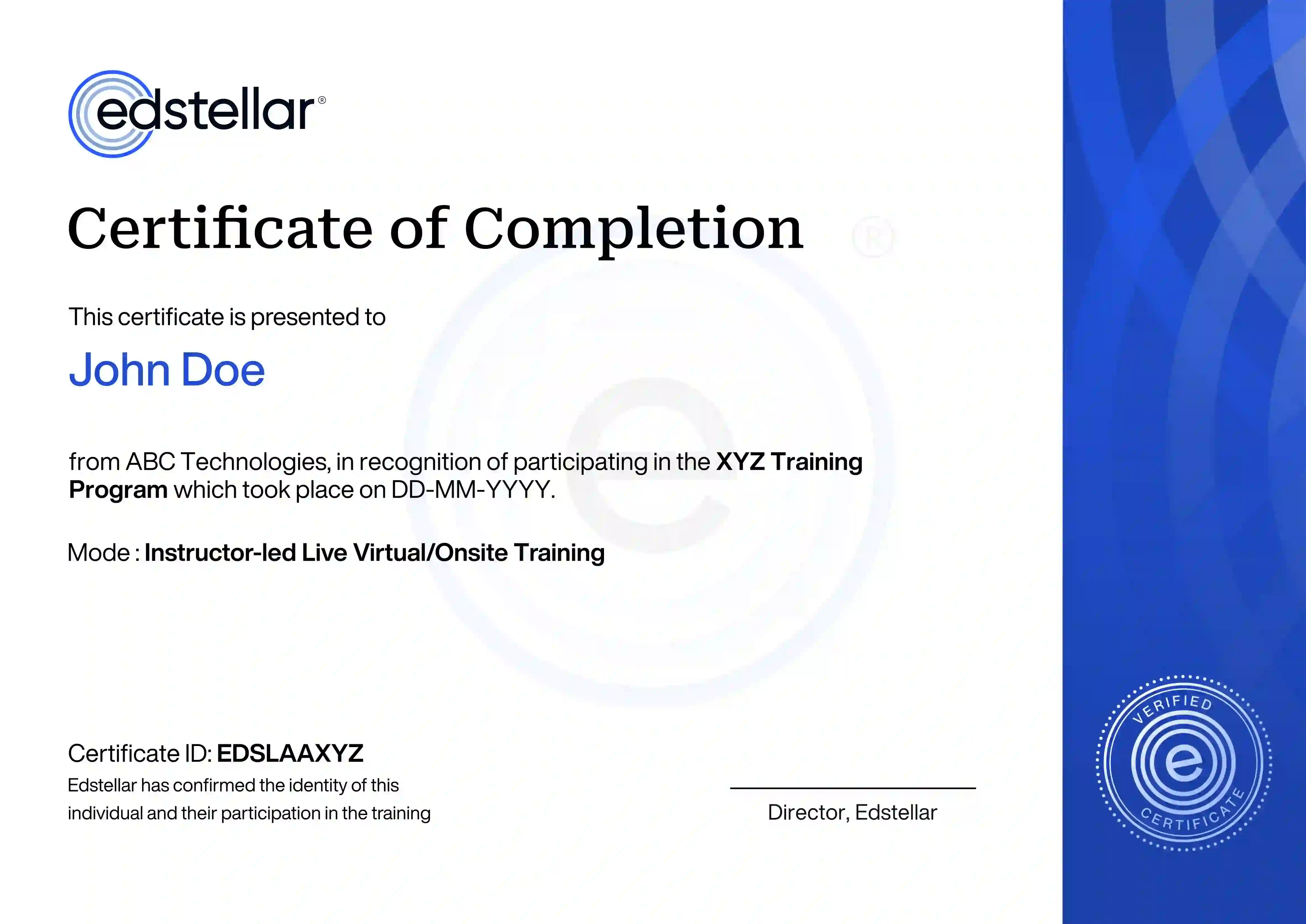
Recognition That Motivates Your Team

Explore More Courses


.svg)
.svg)
.svg)

.svg)