.svg "edstellar")

Burnout Prevention and Recovery Corporate Training Program for Employees
Edstellar's instructor-led Burnout Prevention and Recovery training equips professionals to recognize early warning signs, manage stress, and sustain energy at work. Participants master mindfulness, boundary-setting, workload prioritization, and resilience-building techniques to prevent burnout and restore wellbeing across teams and individuals.
(Virtual / On-site / Off-site)
.svg)
Drive Team Excellence with Burnout Prevention and Recovery Corporate Training
Burnout Prevention and Recovery is a structured wellbeing discipline that combines psychology, neuroscience, and workplace practices to help professionals recognize, prevent, and recover from chronic workplace exhaustion. Recognized by the WHO as an occupational phenomenon, burnout affects productivity, engagement, retention, and mental health across industries. The training provides comprehensive knowledge of burnout dimensions, stress physiology, mindfulness, boundary-setting, energy management, resilience building, and organizational practices to safeguard individual and team wellbeing.
Edstellar's Burnout Prevention and Recovery Instructor-led course offers virtual/onsite training options to meet professionals' diverse needs. This flexibility ensures that professionals and teams can engage in learning experiences that best suit their logistical and learning preferences. What sets the Edstellar course apart is its emphasis on practical experience, with hands-on exercises, guided reflections, and real-world workplace scenarios that bring burnout prevention concepts to life. Edstellar equips professionals with the skills and confidence to apply burnout prevention and recovery practices effectively in their daily work and leadership.
.svg)

- Stress Recognition and Awareness
- Mindfulness and Self-Regulation
- Energy and Recovery Management
- Healthy Boundary Setting
- Workload Prioritization
- Resilience Building
- Sustainable Wellbeing Practices
- Master the definition and neuroscience of burnout by understanding its dimensions, progression stages, and organizational drivers, enabling participants to identify personal and team risk factors early and intervene before chronic exhaustion sets in.
- Gain expertise in mindfulness, breathwork, and nervous-system regulation techniques, emphasizing their application to daily routines, high-pressure moments, and recovery windows to restore focus, calm, and emotional balance at work.
- Develop proficiency in workload prioritization, energy management, and deep-work practices, ensuring that professionals allocate time to high-impact tasks while protecting rest and recovery across the workweek.
- Learn comprehensive boundary-setting strategies for work hours, digital communication, meetings, and interpersonal dynamics, enabling assertive conversations that protect wellbeing without damaging relationships or performance.
- Build practical skills in resilience, self-compassion, and cognitive reframing, using evidence-based techniques from positive psychology and ACT to recover quickly from setbacks and maintain motivation.
- Master sustainable lifestyle and team practices, including sleep hygiene, nutrition, movement, and psychologically safe manager conversations, to build a lasting culture of wellbeing and burnout prevention.
- Defining Burnout
- WHO definition and context
- Three dimensions (exhaustion, cynicism, inefficacy)
- Burnout vs stress vs depression
- Modern workplace relevance
- History and Research
- Origins of burnout research
- Maslach Burnout Inventory
- Current global statistics
- Industry-specific trends
- Causes and Drivers
- Workload and role ambiguity
- Lack of control and autonomy
- Insufficient reward and recognition
- Values misalignment
- Personal and Professional Impact
- Physical health consequences
- Mental and emotional toll
- Relationship and family effects
- Career and performance impact
- Organizational Cost of Burnout
- Productivity and engagement loss
- Attrition and hiring costs
- Healthcare and absenteeism
- Innovation and culture damage
- Stigma and Openness
- Breaking the silence
- Normalizing conversations
- Role of leadership modeling
- Creating safe dialogue
- Physical Signals
- Chronic fatigue and sleep issues
- Headaches and tension
- Digestive and immune changes
- Appetite and weight shifts
- Emotional Signals
- Irritability and impatience
- Anxiety and low mood
- Cynicism and detachment
- Emotional numbness
- Cognitive Signals
- Difficulty concentrating
- Memory lapses
- Decision fatigue
- Persistent self-doubt
- Behavioral Signals
- Procrastination and avoidance
- Withdrawal from colleagues
- Reduced performance
- Unhealthy coping behaviors
- Self-Assessment Tools
- Maslach Burnout Inventory overview
- Daily check-in prompts
- Energy and mood journaling
- Peer feedback loops
- Stages of Burnout
- Honeymoon and onset of stress
- Chronic stress phase
- Burnout and habitual burnout
- Recovery pathways
- Stress Physiology
- Fight, flight, freeze response
- Cortisol and adrenaline cycles
- Autonomic nervous system basics
- Acute vs chronic stress
- Allostatic Load
- Cumulative stress impact
- Body systems affected
- Long-term health outcomes
- Measuring load indicators
- The Recovery Equation
- Stress-recovery balance principle
- Active vs passive recovery
- Micro, daily, weekly cycles
- Role of positive stress (eustress)
- Nervous System Regulation
- Polyvagal theory basics
- Vagal tone and resilience
- Co-regulation in teams
- Self-soothing techniques
- Neuroplasticity and Habits
- Brain change through practice
- Habit formation science
- Cue-routine-reward loops
- Sustaining new behaviors
- Measurable Recovery Metrics
- Heart rate variability (HRV)
- Sleep quality indicators
- Energy and mood tracking
- Wearable and digital tools
- Mindfulness Fundamentals
- Definition and origins
- Scientific benefits overview
- Common myths addressed
- Everyday mindfulness moments
- Breathwork Techniques
- Box breathing
- Physiological sigh
- 4-7-8 breathing
- Coherent breathing
- Guided Meditation Styles
- Focused attention
- Open monitoring
- Loving-kindness practice
- Body scan technique
- Emotion Labeling and Awareness
- Naming to tame principle
- Emotion wheel usage
- Noticing triggers
- Non-judgmental observation
- Micro-Practices for Work
- One-minute resets
- Mindful transitions between tasks
- STOP and RAIN techniques
- Mindful meetings and emails
- Building a Daily Practice
- Starting small and consistent
- Habit stacking methods
- Apps and guided resources
- Overcoming common obstacles
- Priority Frameworks
- Eisenhower matrix
- MoSCoW prioritization
- 80/20 Pareto principle
- Value vs effort mapping
- Energy-Based Scheduling
- Chronotype awareness
- Peak and trough cycles
- Matching tasks to energy
- Ultradian rhythms
- Deep Work Practices
- Distraction elimination
- Focus blocks and rituals
- Flow state triggers
- Single-tasking discipline
- Managing Interruptions
- Notification hygiene
- Communication batching
- Meeting audits
- Focus-time signaling
- Delegation and Saying No
- Capacity awareness
- Effective delegation frameworks
- Graceful declines
- Renegotiating commitments
- Recovery Breaks and Rituals
- Micro-break strategies
- Lunchtime decompression
- End-of-day shutdown rituals
- Weekend and vacation design
- Understanding Boundaries
- Types of boundaries (time, energy, emotional)
- Boundaries vs barriers
- Cultural and generational factors
- Common boundary challenges
- Work-Hour Boundaries
- Defining work-life edges
- Protecting evenings and weekends
- After-hours communication rules
- Vacation disconnection practices
- Digital and Communication Limits
- Email and chat norms
- Response time expectations
- Do-not-disturb configurations
- Healthy device usage
- Meeting Boundaries
- Meeting-free blocks
- Declining non-essential meetings
- Shortening meeting defaults
- Walking and async alternatives
- Assertive Communication
- DEAR MAN technique
- I-statements
- Saying no with grace
- Handling pushback
- Relationship Boundaries at Work
- Managing difficult colleagues
- Upward boundary setting
- Peer support limits
- Caregiver compassion fatigue
- Resilience Fundamentals
- Definition and components
- Protective factors
- Resilience as a skill
- Bounce-back vs bounce-forward
- Cognitive Reframing
- Identifying thought patterns
- Challenging cognitive distortions
- Reframing techniques
- Growth mindset application
- Self-Compassion Practices
- Kristen Neff's three elements
- Inner critic softening
- Self-compassion break
- Loving-kindness for self
- Emotional Regulation Tools
- Window of tolerance
- Grounding techniques
- Urge surfing
- Opposite action practices
- Post-Traumatic Growth
- Meaning-making after setbacks
- Gratitude and appreciation
- Journaling and reflection
- Strength identification
- Social Support Networks
- Nurturing personal relationships
- Workplace allies
- Professional help resources
- Community and belonging
- Sleep Science and Hygiene
- Sleep stages and cycles
- Circadian rhythm basics
- Sleep environment design
- Pre-sleep routines
- Troubleshooting Sleep
- Insomnia strategies
- Light, caffeine, and alcohol
- Napping best practices
- When to seek help
- Nutrition Fundamentals
- Energy-stabilizing eating
- Hydration importance
- Gut-brain connection
- Mindful eating practices
- Movement and Exercise
- Cardio and strength basics
- Movement snacks throughout the day
- Desk stretches and mobility
- Finding enjoyable activity
- Micro-Recovery at Work
- Breathing breaks
- Walking meetings
- Nature and light exposure
- Social connection breaks
- Caffeine, Alcohol, and Substances
- Smart caffeine use
- Alcohol and sleep interaction
- Avoiding unhealthy coping
- Professional support awareness
- Psychological Safety
- Definition and importance
- Google Project Aristotle insights
- Creating safe team norms
- Speaking-up behaviors
- Workload Transparency
- Team capacity planning
- Workload redistribution
- Realistic goal setting
- Sprint and quarter pacing
- Manager Check-Ins
- Wellbeing conversations
- Active listening skills
- Signs a team member needs help
- Escalation and referral paths
- Team Rituals and Culture
- Team agreements
- Celebration and recognition
- Retrospectives and feedback
- Flexible work norms
- Leading by Example
- Leader self-care modeling
- Taking visible time off
- Sharing vulnerability appropriately
- Reinforcing healthy norms
- HR and Program Design
- Employee Assistance Programs
- Wellness benefits and stipends
- Mental health days policy
- Measuring program effectiveness
- Personal Recovery Plan
- Assessing current state
- Setting realistic goals
- Daily, weekly, quarterly practices
- Accountability mechanisms
- Habit Formation
- Tiny habits methodology
- Tracking and streaks
- Environment design
- Identity-based change
- Relapse Prevention
- Identifying triggers
- Early warning protocols
- Recovery from setbacks
- Support network activation
- Purpose and Meaning
- Values clarification
- Aligning work to purpose
- Meaningful contributions
- Career sustainability
- Life Transitions and Change
- Managing major life events
- Parenting and caregiving demands
- Career pivots
- Retirement transitions
- Continuous Learning and Support
- Recommended books and apps
- Coaching and therapy options
- Peer and community groups
- Annual wellbeing reviews
- Individual Contributors
- Team Leaders
- People Managers
- HR and L\&D Professionals
- Wellness Program Coordinators
- Executives and Senior Leaders
Professionals do not require any specific technical background, and openness to self-reflection, willingness to discuss workplace wellbeing, and a basic interest in personal development are sufficient to take the Burnout Prevention and Recovery training course.


.webp "Virtual Burnout Prevention and Recovery Training")
.webp "On-site Burnout Prevention and Recovery Training")
.webp "Off-site Burnout Prevention and Recovery Training")
64 hours of group training (includes VILT/In-person On-site)
Tailored for SMBs
160 hours of group training (includes VILT/In-person On-site)
Ideal for growing SMBs
Tailor-Made Trainee Licenses with Our Exclusive Training Packages!
400 hours of group training (includes VILT/In-person On-site)
Designed for large corporations
Tailor-Made Trainee Licenses with Our Exclusive Training Packages!
Unlimited duration
Designed for large corporations
Experienced Trainers
Our trainers are drawn from a vetted global network and bring years of industry expertise, keeping every session practical and impactful.
Proven Quality
With a strong global track record, Edstellar is known for quality and engaging delivery.
Industry-Relevant Curriculum
Our programs are built by experts to match the demands of today's industry.
Fully Customizable
Every program can be tailored to your organization's goals.
Comprehensive Support
We provide pre- and post-session support for a complete learning experience.
Global Multi-Location & Multilingual Training Delivery
We deliver in multiple languages to support diverse global teams.
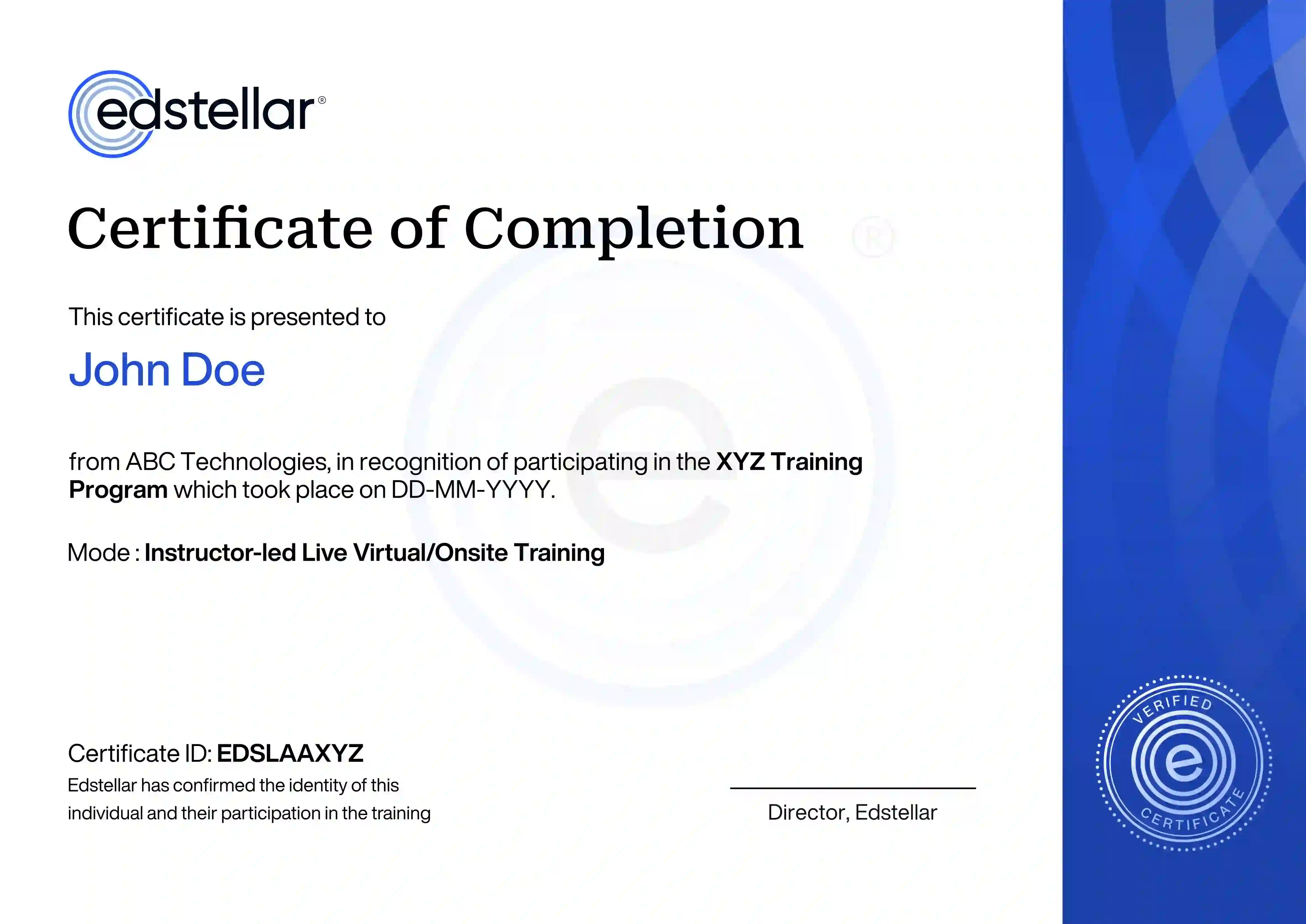
Recognition That Motivates Your Team

Explore More Courses


.svg)
.svg)
.svg)

.svg)