Corporate ArcGIS Enterprise on Kubernetes Training Course
Edstellar's instructor-led ArcGIS Enterprise on Kubernetes training course empowers teams with advanced Kubernetes container orchestration skills to deploy and manage geospatial solutions effectively. Employees must streamline workflows, optimize resource utilization, and ensure scalability within their ArcGIS deployments.
(Virtual / On-site / Off-site)
Available Languages
English, Español, 普通话, Deutsch, العربية, Português, हिंदी, Français, 日本語 and Italiano
Drive Team Excellence with ArcGIS Enterprise on Kubernetes Corporate Training
ArcGIS Enterprise on Kubernetes expertise needed to efficiently deploy and manage geospatial solutions using Kubernetes container orchestration. The ArcGIS Enterprise on Kubernetes training course is essential for organizations seeking to modernize their geospatial infrastructure, improve operational efficiency, and adapt to dynamic computing environments. will learn to implement Kubernetes for ArcGIS deployment, streamline workflows, utilize containerization for scalability, develop automation for deployment processes, apply security measures, and seamlessly integrate ArcGIS with Kubernetes environments.
Edstellar's instructor-led ArcGIS Enterprise on Kubernetes training course offers a unique blend of theoretical knowledge and practical application, delivered through virtual/onsite sessions by industry experts with years of experience in the domain. The course is highlighted by its expert practical exercises and a customizable curriculum tailored to meet your organization's specific needs.

Skills Your Employees Will Gain
These are the core, hands-on capabilities your team builds during the program.
- Kubernetes Container OrchestrationKubernetes Container Orchestration is the automated management of containerized applications. this skill is important for devops and cloud engineering roles, ensuring efficient deployment, scaling, and maintenance of applications.
- Geospatial Workflow OptimizationGeospatial Workflow Optimization involves enhancing processes for managing spatial data. This skill is important for roles in GIS, urban planning, and environmental analysis, ensuring efficiency and accuracy.
- Automation ScriptingAutomation Scripting involves writing code to automate repetitive tasks, enhancing efficiency and accuracy. This skill is important for IT roles, as it streamlines processes and reduces errors.
- Integration with KubernetesIntegration With Kubernetes involves deploying and managing applications in containerized environments. This skill is important for DevOps and cloud engineering roles, ensuring scalability, reliability, and efficient resource management.
- Container Security ManagementContainer Security Management involves protecting containerized applications and their environments from vulnerabilities and threats. This skill is important for DevOps and cloud engineers to ensure secure deployments and maintain compliance.
- Monitoring and Logging UtilizationMonitoring And Logging Utilization involves tracking system performance and logging data for analysis. This skill is important for IT roles to ensure system reliability, troubleshoot issues, and optimize performance.
What Your Team Will Achieve After This Training
- Apply Kubernetes container orchestration techniques to effectively deploy and manage ArcGIS Enterprise solutions in cloud-native environments
- Analyze geospatial workflows to identify optimization opportunities and enhance resource utilization within ArcGIS deployments on Kubernetes
- Develop automation scripts to streamline the deployment and maintenance processes of ArcGIS Enterprise on Kubernetes, improving operational efficiency
- Integrate ArcGIS with Kubernetes environments to facilitate seamless migration and interoperability, ensuring compatibility with existing infrastructure
- Implement best practices for container security and resource management in geospatial deployments, enhancing the reliability and resilience of ArcGIS solutions on Kubernetes
Topics & Program Outline
The curriculum is organized into focused modules built by industry experts and delivered virtually or on-premise. Interactive sessions reflect the evolving demands of the workplace, keeping the learning both relevant and practical.
- Understanding ArcGIS and its evolution in cloud computing
- Historical background of ArcGIS adoption in cloud environments
- Overview of the transition from traditional to cloud-native architectures
- Defining cloud-native operational goals for ArcGIS
- Identifying key objectives such as scalability, resilience, and agility
- Understanding the importance of cloud-native principles in achieving operational efficiency
- Exploring the process of creating cloud-native solutions with ArcGIS
- Overview of the steps involved in migrating ArcGIS to a cloud-native architecture
- Best practices for designing and implementing cloud-native solutions with ArcGIS
- Overview of complete cloud-native solution offerings
- Introduction to cloud-native products and services
- Understanding how offerings align with cloud-native principles
- Factors to consider when adopting ArcGIS as a cloud-native solution
- Assessing organizational readiness for cloud adoption
- Identifying potential challenges and mitigation strategies
- Strategies for selecting the right approach to deploying ArcGIS Enterprise in a cloud-native environment
- Evaluating different deployment options such as IaaS, PaaS, and SaaS
- Considering factors such as cost, scalability, and flexibility in decision-making
- Introduction to containerization concepts and their relevance to ArcGIS
- Understanding the basics of containers, Docker, and container orchestration
- Exploring the benefits of containerization for ArcGIS deployment
- Understanding Kubernetes cluster architecture and its role in ArcGIS deployment
- Overview of Kubernetes architecture components such as pods, nodes, and controllers
- Understanding how Kubernetes orchestrates containerized applications
- Exploring various Kubernetes objects utilized in ArcGIS deployment
- Overview of Kubernetes resources such as Deployments, Services, and ConfigMaps
- Practical examples of defining and managing Kubernetes objects for ArcGIS deployment
- Identifying and setting up ArcGIS Enterprise on Kubernetes prerequisites
- Understanding hardware and software requirements for ArcGIS Enterprise deployment
- Preparing infrastructure components such as compute, storage, and networking
- Analyzing architectural views of prerequisite infrastructure components
- Visualizing the architecture of a Kubernetes-based ArcGIS deployment
- Understanding how prerequisite components interact within the deployment environment
- Exploring options for Kubernetes environments suitable for ArcGIS deployment
- Overview of Kubernetes deployment models such as on-premises, cloud, and hybrid
- Evaluating different Kubernetes distributions and managed services for ArcGIS deployment
- Understanding the architecture of ArcGIS Enterprise microservices
- Introduction to ArcGIS Enterprise components such as ArcGIS Server, Portal for ArcGIS, and ArcGIS Data Store
- Mapping microservices to Kubernetes containers and pods for deployment
- Importance and configuration of persistent storage in ArcGIS Enterprise on Kubernetes
- Understanding storage requirements for ArcGIS data and application files
- Configuring persistent volumes and storage classes in Kubernetes for ArcGIS deployment
- Step-by-step guide to setting up ArcGIS Enterprise on both Windows and Linux environments
- Detailed instructions for installing and configuring ArcGIS components in Windows and Linux environments
- Best practices for optimizing performance and security during deployment
- Key setup workflow
- Overview of the essential steps involved in setting up ArcGIS Enterprise on Kubernetes
- Sequential guide covering tasks such as configuring Kubernetes clusters, deploying ArcGIS components, and configuring networking
- Exploring different deployment account roles and their functions
- Understanding the roles and permissions required for deploying and managing ArcGIS on Kubernetes
- Assigning appropriate roles to users or service accounts based on their responsibilities
- Understanding the relationship between deployment accounts and their respective functions
- Mapping deployment account roles to specific tasks within the deployment workflow
- Ensuring accountability and traceability in deployment activities
- Overview of the architecture of ArcGIS Enterprise on Kubernetes and its licensing requirements
- Understanding the distributed nature of ArcGIS Enterprise components in a Kubernetes environment
- Exploring licensing options and considerations for ArcGIS Enterprise deployment on Kubernetes
- Troubleshooting common issues encountered during the deployment process
- Identifying and resolving common deployment errors and misconfigurations
- Leveraging troubleshooting tools and techniques for diagnosing deployment issues
- Comparing different deployment processes for ArcGIS Enterprise on Kubernetes
- Evaluating alternative deployment methodologies and their suitability for different use cases
- Considering factors such as complexity, scalability, and resource efficiency in deployment decisions
- Introduction to familiar admin workflows within the ArcGIS Enterprise portal
- Overview of common administrative tasks performed through the Enterprise portal interface
- Understanding the role of the Enterprise portal in managing ArcGIS deployments on Kubernetes
- Overview of admin tools specific to managing ArcGIS Enterprise on Kubernetes
- Introduction to specialized admin tools and utilities for Kubernetes-based ArcGIS deployments
- Understanding the capabilities and limitations of admin tools compared to traditional Enterprise portal features
- Comparison of admin tools available within ArcGIS Enterprise for Kubernetes deployment
- Evaluating different admin tools based on their functionality, user experience, and integration with Kubernetes
- Understanding the Enterprise Admin API and its role in system framework exposure
- Overview of the Enterprise Admin API and its capabilities for managing ArcGIS deployments on Kubernetes
- Exploring API endpoints and methods for administering ArcGIS Enterprise resources
- Exploring GIS services and Deployment objects within ArcGIS Enterprise on Kubernetes
- Understanding the structure and properties of GIS services and Deployment objects in Kubernetes
- Mapping GIS services to Kubernetes pods and managing their lifecycle
Who Should Attend?
This program suits professionals at many levels across the organization, including:
- DevOps Engineers
- GIS Specialists
- GIS Technicians
- IT Professionals
- Cloud Engineers
- Geospatial Developers
- Software Engineers
- Data Scientists
- System Administrators
- Network Administrators
- Infrastructure Specialists
- Managers
What are the Prerequisites?
Employees with a basic understanding of ArcGIS software and containerization technologies can take up the ArcGIS Enterprise on Kubernetes training course.
Choose the Format That Fits Your Team
We design training your teams actually engage with, and deliver it the way that suits you best. Through a vetted global trainer network, Edstellar runs sessions in 10+ languages with consistent quality anywhere.


.webp)
Virtual / online: expert-led live sessions delivered anywhere, with consistency and easy scheduling.
.webp)
On-site (in-house): immersive, instructor-led learning at your office.
.webp)
Off-site: focused, instructor-led group learning away from everyday workplace distractions.
Get a Proposal Shaped to Your Needs
Need pricing for onsite, offsite, or virtual delivery? Get a proposal tailored to your team's needs.
64 hours of group training (includes VILT/In-person On-site)
Tailored for SMBs
Tailor-Made Trainee Licenses with Our Exclusive Training Packages!
160 hours of group training (includes VILT/In-person On-site)
Ideal for growing SMBs
Tailor-Made Trainee Licenses with Our Exclusive Training Packages!
400 hours of group training (includes VILT/In-person On-site)
Designed for large corporations
Tailor-Made Trainee Licenses with Our Exclusive Training Packages!
Unlimited duration
Designed for large corporations
What Sets Edstellar Apart
Experienced Trainers
Our trainers are drawn from a vetted global network and bring years of industry expertise, keeping every session practical and impactful.
Proven Quality
With a strong global track record, Edstellar is known for quality and engaging delivery.
Industry-Relevant Curriculum
Our programs are built by experts to match the demands of today's industry.
Fully Customizable
Every program can be tailored to your organization's goals.
Comprehensive Support
We provide pre- and post-session support for a complete learning experience.
Global Multi-Location & Multilingual Training Delivery
We deliver in multiple languages to support diverse global teams.
Hear from Organizations We've Trained
"Attending the ArcGIS Enterprise on Kubernetes training was transformational for my professional development. As a Lead Network Architect, the deep dive into industry best practices gave me the confidence to tackle complex coverage of practical simulations were immediately applicable to my work. I now handle complex technical scenarios with enhanced confidence and systematic efficiency. This course has become foundational to my continued success.”
Karen Hall
Lead Network Architect,
Container Orchestration Platform Provider
"This ArcGIS Enterprise on Kubernetes course equipped me with comprehensive practical applications expertise that I've seamlessly integrated into our strategic practice. The hands-on modules covering expert-led workshops and hands-on solutions that consistently deliver measurable business results. This expertise enabled us to secure a transformative contract with a Fortune 100 organization, validating the immediate impact of this training program.”
Martin Novak
Lead Cloud Security Engineer,
Enterprise Kubernetes Solutions Provider
"This ArcGIS Enterprise on Kubernetes course provided our team with comprehensive strategic frameworks capabilities we immediately put into practice. As a Senior GCP Specialist managing complex professional expertise projects, significantly enhanced our delivery capacity. Our team's capability maturity level increased by three full stages within six months. The training fundamentally improved our team's performance metrics and overall efficiency.”
Samir Haddad
Senior GCP Specialist,
Microservices Infrastructure Company
“Edstellar’s IT & Technical training programs have been instrumental in strengthening our engineering teams and building future-ready capabilities. The hands-on approach, practical cloud scenarios, and expert guidance helped our teams improve technical depth, problem-solving skills, and execution across multiple projects. We’re excited to extend more of these impactful programs to other business units.”
Aditi Rao
L&D Head,
A Global Technology Company
Recognition That Motivates Your Team
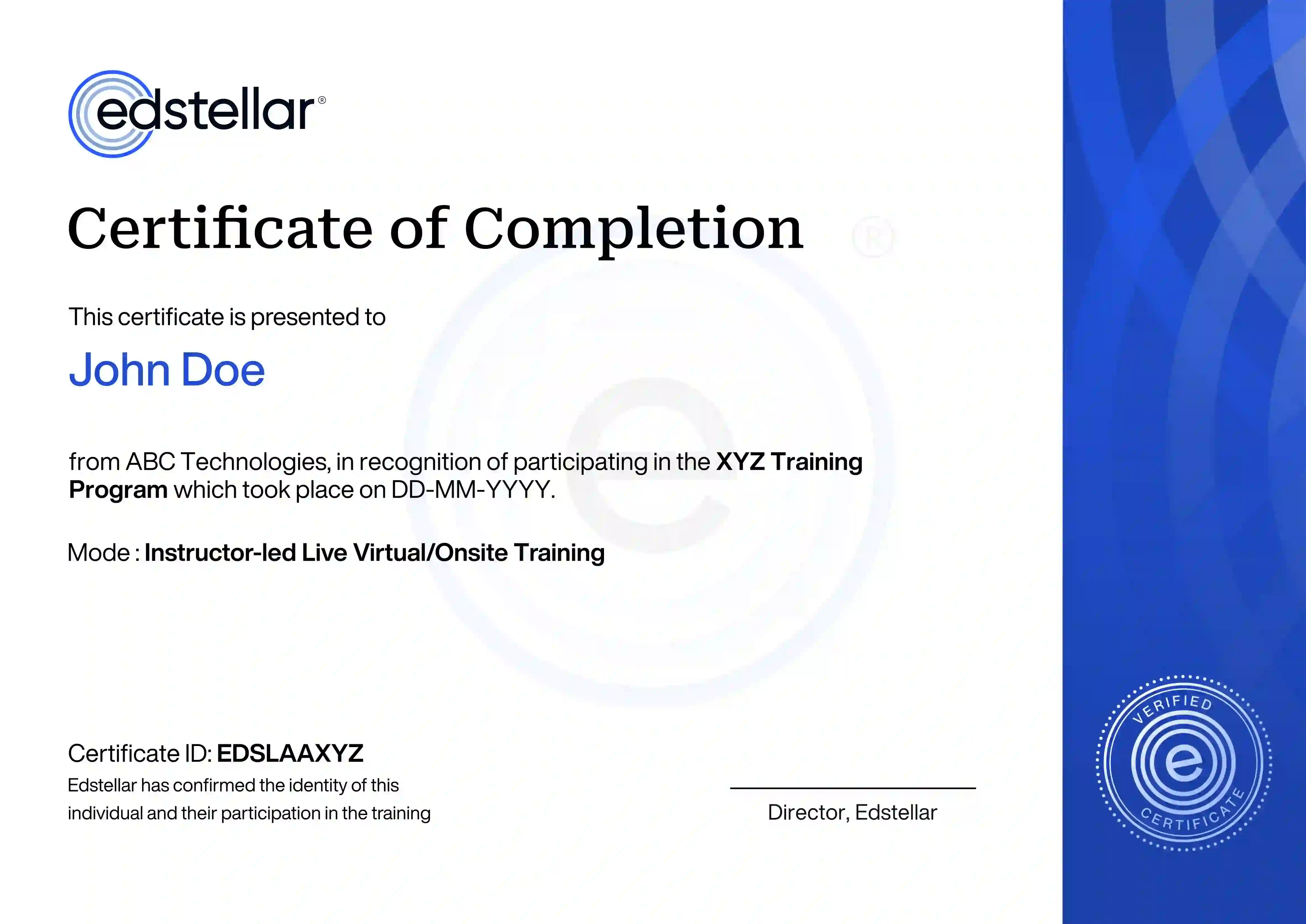
Upon successful completion of the training course offered by Edstellar, employees receive a course completion certificate, symbolizing their dedication to ongoing learning and professional development.
This certificate validates the employee's acquired skills and is a powerful motivator, inspiring them to enhance their expertise further and contribute effectively to organizational success.


Other Related Corporate Training Courses
Explore More Courses
Edstellar is a one-stop instructor-led corporate training and coaching solution that addresses organizational upskilling and talent transformation needs globally.
Marketing Excellence
Operational Excellence
Finance Excellence
HR Excellence
IT Excellence
Customer Service
Leadership Excellence
Quality Management
Software
How it WorksFAQ'sCorporate Training
CatalogStellar AI
Skill MatrixHRMS Integration
Who we ServeCEO RetreatsPricingTraining DeliveryPartner with Edstellar
CareersContact us