Corporate GDAL Tools Training Course
Edstellar's GDAL Tools instructor-led training course equips employees with the skills to process, analyze, and manage geospatial data using GDAL utilities. Teams will learn to manipulate raster and vector data, automate geospatial workflows, and perform advanced georeferencing. Empower your teams to unlock the full potential of geospatial data.
(Virtual / On-site / Off-site)
Available Languages
English, Español, 普通话, Deutsch, العربية, Português, हिंदी, Français, 日本語 and Italiano
Drive Team Excellence with GDAL Tools Corporate Training
Empower your teams with expert-led on-site, off-site, and virtual GDAL Tools Training through Edstellar, a premier corporate training provider for organizations globally. Designed to meet your specific training needs, this group training program ensures your team is primed to drive your business goals. Help your employees build lasting capabilities that translate into real performance gains.
GDAL (Geospatial Data Abstraction Library) is an open-source library for reading, writing, and processing geospatial data in various formats. GDAL tools are significant in an organization because they can enhance data interoperability by supporting a wide array of geospatial formats, enabling seamless exchange between systems. These tools improve efficiency by automating data processing tasks, reducing manual effort, and significantly increasing productivity. GDAL Tools training ensures that staff can effectively manage and manipulate diverse geospatial data formats, enhancing overall data management capabilities.
The GDAL Tools instructor-led training course provided by Edstellar can be customized to meet team requirements. The virtual/onsite GDAL Tools training course led by expert trainers ensures employees are equipped with the skills to effectively utilize GDAL tools, automate geospatial workflows, and enhance efficiency.

Key Skills Employees Gain from instructor-led GDAL Tools Training
GDAL Tools skills corporate training will enable teams to effectively apply their learnings at work.
- Data ProcessingData Processing involves collecting, organizing, and analyzing data to extract meaningful insights. This skill is important for roles in data analysis, business intelligence, and research, as it drives informed decision-making and enhances operational efficiency.
- Raster ManipulationRaster Manipulation is the process of editing and transforming raster images, crucial for graphic designers and digital artists. This skill is important for creating visually compelling content and ensuring high-quality visuals in projects.
- Vector HandlingVector Handling is the ability to manipulate and analyze vector data in various formats. this skill is important for roles in GIS, data science, and game development, as it enables effective spatial analysis and visualization.
- GeoreferencingGeoreferencing is the process of aligning spatial data to a coordinate system. This skill is important for GIS analysts and cartographers, ensuring accurate mapping and analysis.
- Image OrthorectificationImage Orthorectification is the process of correcting aerial or satellite images for topographic relief, lens distortion, and camera tilt. This skill is important for GIS analysts and remote sensing specialists, as it ensures accurate spatial data for mapping and analysis.
- Spatial QueryingSpatial Querying is the ability to retrieve and analyze geographic data based on spatial relationships. This skill is important for roles in GIS, urban planning, and environmental science, enabling informed decision-making.
Key Learning Outcomes of GDAL Tools Training Workshop for Employees
Upon completing Edstellar’s GDAL Tools workshop, employees will gain valuable, job-relevant insights and develop the confidence to apply their learning effectively in the professional environment.
- Analyze the functionalities and applications of GDAL/OGR geospatial data processing tools
- Apply knowledge of command line syntax and GDAL's data model to work with raster and vector data
- Evaluate different raster formats and choose appropriate tools for reading, writing, and reprojection
- Utilize GDAL commands to convert elevation data formats, generate slope/aspect maps, and create hillshade visualizations
- Process aerial and satellite imagery using GDAL for orthorectification, mosaicking, and digital surface model (DSM) creation
- Develop workflows for preprocessing satellite data, including radiometric/geometric corrections, atmospheric correction, and creating band composites
- Implement advanced techniques like raster algebra (map algebra operations) and georeferencing using ground control points (GCPs)
- Manage connections to WMS servers, download WMS layers, and integrate them into your geospatial analysis
Key Benefits of the GDAL Tools Group Training
Attending our GDAL Tools group training classes provides your team with a powerful opportunity to build skills, boost confidence, and develop a deeper understanding of the concepts that matter most. The collaborative learning environment fosters knowledge sharing and enables employees to translate insights into actionable work outcomes.
- Equips the team with the techniques to install and use GDAL/OGR for geospatial data processing tasks
- Develops required skills in employees to understand raster and vector data models and work with various data formats
- Empowers employees to process raster data including reprojection, resampling, and creating derived products like slope/aspect maps and hillshades
- Provides insights into handling aerial and satellite imagery, including orthorectification, mosaicking, and DSM generation
- Cultivates ideas in teams for preprocessing satellite data using techniques like atmospheric correction and band manipulation
- Develops the skills required to perform advanced raster analysis using raster algebra and georeferencing techniques
- Empowers employees to work with web map services (WMS), download data, and integrate it into their analysis
- Equips the team with the techniques to process vector data, including reprojection, transformation, and working with CSV files for spatial analysis
Topics and Outline of GDAL Tools Training
Our virtual and on-premise GDAL Tools training curriculum is structured into focused modules developed by industry experts. This training for organizations provides an interactive learning experience that addresses the evolving demands of the workplace, making it both relevant and practical.
- Overview of GDAL/OGR
- History and development of GDAL/OGR
- Core functionalities
- Use cases and applications
- Installing GDAL/OGR
- Installation on Windows, macOS, and Linux
- Setting up environment variables
- Verifying installation
- Command line basics
- Understanding the command line interface
- Basic command syntax
- Common command line options
- Understanding GDAL's data model
- Raster vs vector data
- Data models and structures
- Metadata and attributes
- Introduction to raster data
- Raster data formats
- Key concepts: pixels, bands, and resolution
- Applications of raster data
- Reading and writing raster formats
- Supported raster formats
- Reading raster files
- Writing and exporting raster data
- Reprojecting raster data
- Coordinate systems and projections
- Using gdalwarp for reprojection
- Practical examples of reprojection
- Resampling and warping raster data
- Resampling methods: nearest neighbor, bilinear, cubic
- Warping techniques and applications
- Using gdal_translate and gdalwarp commands
- Introduction to elevation data
- Types of elevation data: DEM, DTM, DSM
- Sources of elevation data
- Applications of elevation data
- Converting elevation data formats
- Supported formats
- Using GDAL for format conversion
- Practical examples of format conversion
- Generating slope and aspect maps
- Understanding slope and aspect
- Tools and commands for generating maps
- Interpreting and visualizing slope and aspect maps
- Creating hillshades
- Concept of hillshade
- Using GDAL to create hillshade maps
- Enhancing hillshade visualizations
- Introduction to aerial and satellite imagery
- Types and sources of imagery
- Acquisition methods
- Applications
- Orthorectification of images
- Importance of orthorectification
- Tools and techniques for orthorectification
- Using GDAL for orthorectification
- Mosaicking images
- Concept of image mosaicking
- Tools and commands for mosaicking
- Practical examples of creating mosaics
- Creating digital surface models (DSMs) from imagery
- Difference between DSM and DEM
- Tools and techniques for generating DSMs
- Using GDAL to create and visualize DSMs
- Preprocessing satellite imagery
- Radiometric and geometric corrections
- Atmospheric correction techniques
- Tools and commands for preprocessing
- Atmospheric correction
- Importance of atmospheric correction
- Techniques for atmospheric correction
- Using GDAL for atmospheric correction
- Creating composites from satellite imagery
- Understanding band combinations
- Tools and commands for creating composites
- Practical examples of composite creation
- Merging individual bands into a composite
- Understanding band combinations
- Using GDAL to merge bands
- Visualizing composite images
- Apply histogram stretch and color correction
- Introduction to histogram stretching
- Applying linear and non-linear stretches
- Color balancing and correction techniques
- Pan sharpening
- Introduction to pan sharpening
- Techniques for pan sharpening
- Using GDAL for pan sharpening
- Raster algebra
- Fundamentals of raster algebra
- Using GDAL for raster calculations
- Implementing map algebra operations
- Georeferencing
- Importance of georeferencing
- Georeferencing images with corner coordinates
- Using ground control points (GCPs) for georeferencing
- Practical exercises on georeferencing
- Introduction to Web Map Service (WMS)
- Concept of WMS
- Applications of WMS
- Key WMS providers
- Connecting to WMS servers
- Tools and commands for connecting to WMS servers
- Practical examples of WMS connections
- Downloading and using WMS layers
- Tools and commands for downloading WMS layers
- Practical examples of using WMS layers
- Overview of vector data
- Concept of vector data
- Types of vector data
- Applications of vector data
- Reading and writing vector formats
- Supported vector formats
- Tools and commands for reading and writing vector data
- Practical examples of vector data handling
- Reprojecting vector data
- Concept of vector reprojection
- Tools and commands for reprojection
- Practical examples of vector reprojection
- Vector data transformations
- Common vector data transformations
- Tools and commands for transformations
- Practical examples of vector transformations
- Importing and exporting CSV files
- Concept of CSV files
- Tools and commands for importing and exporting
- Practical examples of CSV file handling
- Converting CSV to vector formats
- Tools and commands for conversion
- Practical examples of CSV to vector conversion
- Spatially enabling CSV data
- Concept of spatially enabled data
- Tools and commands for enabling spatial data
- Practical examples of spatially enabling CSV files
- Working with virtual files
- Introduction to GDAL virtual files
- Concept of virtual files (VRT)
- Creating and using VRT files
- Practical examples of VRT file usage
- Introduction to geoprocessing
- Concept of geoprocessing
- Applications of geoprocessing
- Common geoprocessing tasks
- Performing spatial queries with OGR
- Concept of spatial queries
- Tools and commands for spatial queries
- Practical examples of spatial querying
- Advanced geoprocessing techniques
- Overview of advanced techniques
- Tools and commands for advanced geoprocessing
- Practical examples of advanced geoprocessing
- Automating workflows with batch processing
- Concept of batch processing
- Applications of batch processing
- Tools and commands for batch processing
- Writing batch scripts for GDAL/OGR commands
- Overview of scripting languages
- Practical examples of batch scripts
- Scheduling and managing batch processes
Who Can Take the GDAL Tools Training Course
The GDAL Tools training program can also be taken by professionals at various levels in the organization.
- GIS Analysts
- Geospatial Data Scientists
- Cartographers
- Data Engineers
- Remote Sensing Specialists
- GIS Technicians
- Environmental Data Analysts
- Spatial Data Scientists
- Research Scientists
- Surveyors
- Urban Data Analysts
- Managers
Prerequisites for GDAL Tools Training
Employees with a basic understanding of raster and vector data processing can take up the GDAL Tools training course.
Corporate Group Training Delivery Modes
for GDAL Tools Training
At Edstellar, we understand the importance of impactful and engaging training for employees. As a leading GDAL Tools training provider, we ensure the training is more interactive by offering Face-to-Face onsite/in-house or virtual/online sessions for companies. This approach has proven to be effective, outcome-oriented, and produces a well-rounded training experience for your teams.
.webp)
Edstellar's GDAL Tools virtual/online training sessions bring expert-led, high-quality training to your teams anywhere, ensuring consistency and seamless integration into their schedules.
.webp)
Edstellar's GDAL Tools inhouse training delivers immersive and insightful learning experiences right in the comfort of your office.
.webp)
Edstellar's GDAL Tools offsite group training offer a unique opportunity for teams to immerse themselves in focused and dynamic learning environments away from their usual workplace distractions.
Explore Our Customized Pricing Package
for
GDAL Tools Corporate Training
Looking for pricing details for onsite, offsite, or virtual instructor-led GDAL Tools training? Get a customized proposal tailored to your team’s specific needs.
64 hours of group training (includes VILT/In-person On-site)
Tailored for SMBs
Tailor-Made Trainee Licenses with Our Exclusive Training Packages!
160 hours of group training (includes VILT/In-person On-site)
Ideal for growing SMBs
Tailor-Made Trainee Licenses with Our Exclusive Training Packages!
400 hours of group training (includes VILT/In-person On-site)
Designed for large corporations
Tailor-Made Trainee Licenses with Our Exclusive Training Packages!
Unlimited duration
Designed for large corporations
Edstellar: Your Go-to GDAL Tools Training Company
Experienced Trainers
Our trainers bring years of industry expertise to ensure the training is practical and impactful.
Quality Training
With a strong track record of delivering training worldwide, Edstellar maintains its reputation for its quality and training engagement.
Industry-Relevant Curriculum
Our course is designed by experts and is tailored to meet the demands of the current industry.
Customizable Training
Our course can be customized to meet the unique needs and goals of your organization.
Comprehensive Support
We provide pre and post training support to your organization to ensure a complete learning experience.
Multilingual Training Capabilities
We offer training in multiple languages to cater to diverse and global teams.
What Our Clients Say
We pride ourselves on delivering exceptional training solutions. Here's what our clients have to say about their experiences with Edstellar.
"Attending the GDAL Tools training was transformational for my professional development. As a Senior Software Engineer, the deep dive into strategic frameworks gave me the confidence to tackle complex challenges head-on. The coverage of real-world case studies were immediately applicable to my work. I've been able to drive meaningful innovation and improvement within my department. This course has become foundational to my continued success.”
Werner Crawford
Senior Software Engineer,
Digital Innovation Platform
"The GDAL Tools training enhanced my ability to architect and implement sophisticated technical mastery strategies. Understanding practical applications through intensive expert-led workshops exercises proved invaluable for client enterprise initiatives. Our solution delivery efficiency and quality have increased substantially across the board. The detailed exploration of practical simulations provided methodologies I leverage in every engagement.”
Wu Yun
Senior Software Engineer,
Global Technology Solutions Provider
"As a Senior Software Engineer leading strategic implementation operations, the GDAL Tools training provided our team with essential industry best practices expertise at scale. The comprehensive modules on interactive complete operational footprint. Our team delivered record-breaking results in the subsequent quarter, exceeding all targets. This course has proven invaluable for driving our organizational transformation and sustained excellence.”
Srinivas Raju
Senior Software Engineer,
Technology Consulting Services Company
“Edstellar’s IT & Technical training programs have been instrumental in strengthening our engineering teams and building future-ready capabilities. The hands-on approach, practical cloud scenarios, and expert guidance helped our teams improve technical depth, problem-solving skills, and execution across multiple projects. We’re excited to extend more of these impactful programs to other business units.”
Aditi Rao
L&D Head,
A Global Technology Company
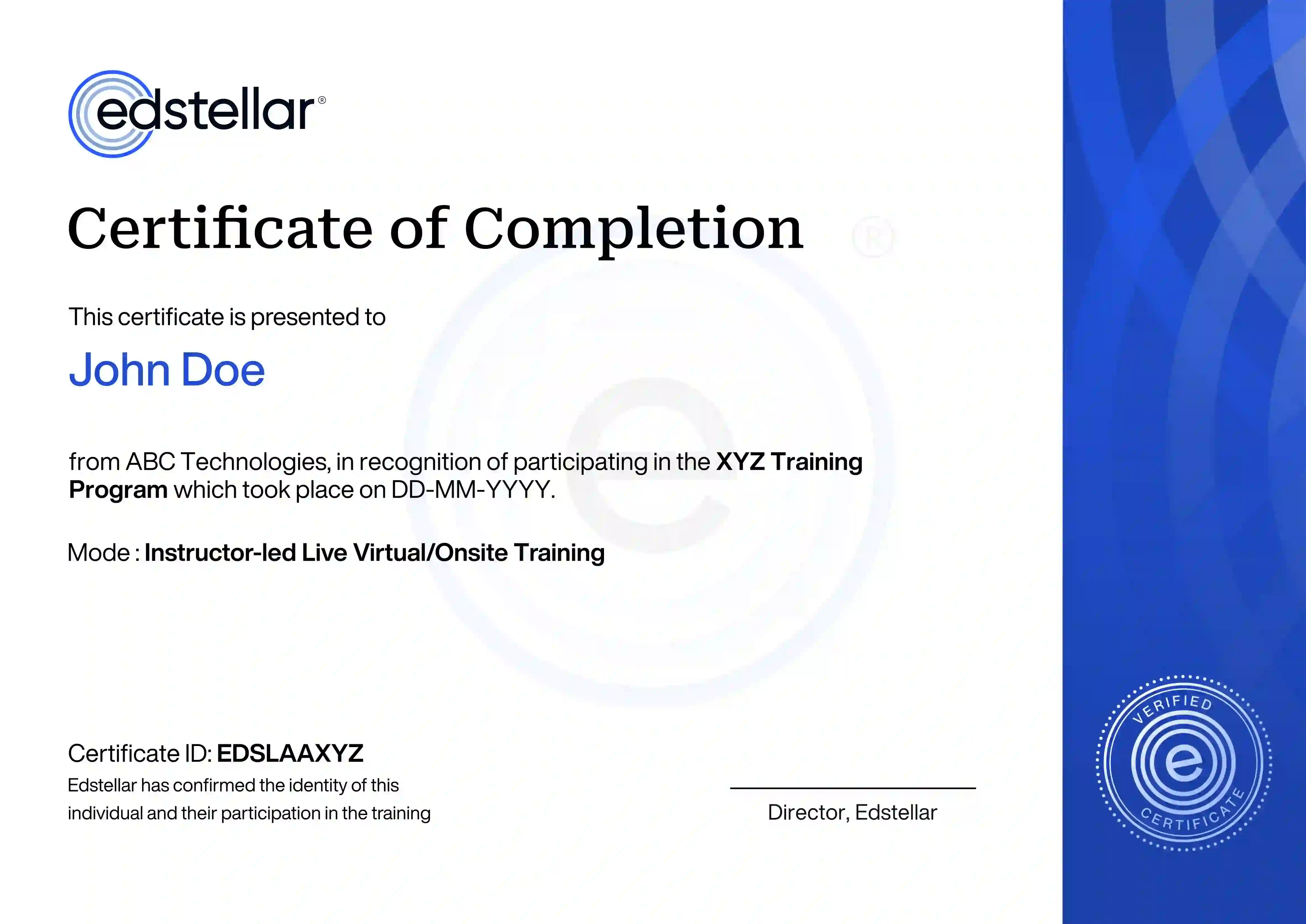
Get Your Team Members Recognized with Edstellar’s Course Certificate
Upon successful completion of the training course offered by Edstellar, employees receive a course completion certificate, symbolizing their dedication to ongoing learning and professional development.
This certificate validates the employee's acquired skills and is a powerful motivator, inspiring them to enhance their expertise further and contribute effectively to organizational success.


We have Expert Trainers to Meet Your GDAL Tools Training Needs
The instructor-led training is conducted by certified trainers with extensive expertise in the field. Participants will benefit from the instructor's vast knowledge, gaining valuable insights and practical skills essential for success in Access practices.
Other Related Corporate Training Courses
Explore More Courses
Edstellar is a one-stop instructor-led corporate training and coaching solution that addresses organizational upskilling and talent transformation needs globally. Edstellar offers 2000+ tailored programs across disciplines that include Technical, Behavioral, Management, Compliance, Leadership and Social Impact.
FAQs
BlogSitemap