Join 25 Global CEOs (Exclusive CEO Retreat) - Leading the Change - Mallorca, Spain · 20th–24th May 2026
Know More
X

Drive Team Excellence with Corporate Social Responsibility Training

Empower your teams with expert-led on-site, off-site, and virtual Corporate Social Responsibility Training through Edstellar, a premier corporate training provider for organizations globally. Designed to meet your specific training needs, this group training program ensures your team is primed to drive your business goals. Help your employees build lasting capabilities that translate into real performance gains.

Corporate Social Responsibility (CSR) is a business model where companies integrate social and environmental concerns into their operations and interactions with stakeholders, aiming to operate ethically and contribute positively to societal well-being. It is essential for organizations as it enhances their reputation, boosts stakeholder trust, and drives sustainable business practices that align with global standards of ethical conduct. Corporate Social Responsibility (CSR) training course equips employees with the necessary skills and knowledge to implement these principles effectively, ensuring the organization meets and exceeds the ethical expectations of modern consumers and society.

Edstellar's instructor-led Corporate Social Responsibility (CSR) training course offers a unique blend of theoretical knowledge and practical applications, conducted through virtual/onsite formats by seasoned experts with deep domain knowledge. The course is designed to be highly interactive and customizable, ensuring that it meets the specific needs of each organization and adds real value to their CSR efforts.

Get Customized Expert-led Training for Your Teams
Customized Training Delivery
Scale Your Training: Small to Large Teams
In-person Onsite, Live Virtual or Hybrid Training Modes
Plan from 2000+ Industry-ready Training Programs
Experience Hands-On Learning from Industry Experts
Delivery Capability Across 100+ Countries & 10+ Languages
""""

Key Skills Employees Gain from instructor-led Corporate Social Responsibility Training

Corporate Social Responsibility (CSR) skills corporate training will enable teams to effectively apply their learnings at work.

  • Ethical Practices
    Ethical Practices involve adhering to moral principles and standards in decision-making. This skill is important for roles in management, finance, and healthcare to ensure trust, compliance, and integrity.
  • Stakeholder Engagement
    Stakeholder Engagement is the ability to effectively communicate and collaborate with individuals or groups affected by a project. this skill is important for project managers, as it fosters trust, aligns goals, and ensures successful outcomes.
  • Sustainability Reporting
    Sustainability Reporting is the practice of disclosing an organization's environmental, social, and governance impacts. this skill is important for roles in corporate sustainability, as it ensures transparency, accountability, and informed decision-making, fostering trust with stakeholders.
  • Social Impact Assessment
    Social Impact Assessment evaluates the potential effects of projects on communities. This skill is important for roles in urban planning, environmental management, and policy-making, ensuring sustainable development and community well-being.
  • Community Development
    Community Development is the process of empowering communities to improve their social, economic, and environmental conditions. This skill is important for roles in social work, urban planning, and nonprofit management, as it fosters collaboration, enhances quality of life, and drives sustainable growth.
  • Environmental Stewardship
    Environmental Stewardship is the responsible management of natural resources to protect ecosystems. this skill is important for roles in sustainability, conservation, and environmental policy, ensuring a healthier planet.

Key Learning Outcomes of Corporate Social Responsibility Training Workshop for Employees

Upon completing Edstellar’s Corporate Social Responsibility workshop, employees will gain valuable, job-relevant insights and develop the confidence to apply their learning effectively in the professional environment.

  • Analyze the impact of CSR activities on the business and the community to identify improvements and increase the effectiveness of future initiatives
  • Integrate ethical considerations into daily decision-making processes, using knowledge of ethical philosophies and corporate governance to guide actions
  • Evaluate CSR programs using performance metrics and social accounting tools to assess their impact and ensure alignment with international standards like the GRI
  • Apply CSR strategies to develop and implement initiatives aligning with business objectives and societal needs, enhancing corporate reputation and stakeholder trust
  • Lead cross-functional teams in collaborative projects to improve corporate social responsibility outcomes, promoting a culture of ethical behavior and social engagement

Key Benefits of the Corporate Social Responsibility Group Training with Instructor-led Face to Face and Virtual Options

Attending our Corporate Social Responsibility group training classes provides your team with a powerful opportunity to build skills, boost confidence, and develop a deeper understanding of the concepts that matter most. The collaborative learning environment fosters knowledge sharing and enables employees to translate insights into actionable work outcomes.

  • Learn how to simultaneously align CSR strategies with business objectives to drive sustainability and profitability
  • Enhance your leadership and communication skills, enabling you to champion CSR initiatives within your organization and beyond
  • Explore innovative CSR practices that address emerging global challenges, preparing your organization for future trends and regulations
  • Develop skills in managing stakeholder relationships effectively, ensuring that CSR efforts are recognized and valued internally and externally
  • Equip yourself with practical tools for measuring and reporting on the effectiveness of CSR initiatives using standards such as the Global Reporting Initiative (GRI)

Topics and Outline of Corporate Social Responsibility Training

Our virtual and on-premise Corporate Social Responsibility training curriculum is structured into focused modules developed by industry experts. This training for organizations provides an interactive learning experience that addresses the evolving demands of the workplace, making it both relevant and practical.

  1. Corporations as a part of society
    • The historical role of corporations
    • Corporations and their social responsibilities
    • The interdependence of business and community
  2. Profit making as the primary motive
    • Defining corporate profitability
    • Balancing profit with social responsibilities
    • Ethical considerations in profit maximization
  3. Effect of the organization on society
    • Direct and indirect social impacts
    • Corporate activities and community well-being
    • Assessing the societal footprint of business operations
  4. Sustainability in operations
    • Implementing sustainable practices
    • Challenges in sustainable management
  5. Carrying accountability
    • Accountability mechanisms in corporations
    • The importance of corporate accountability to stakeholders
  6. Maintaining transparency
    • Transparency in corporate reporting
    • The role of transparency in building trust
    • Methods to enhance transparency in business processes
  7. Business case for and against the CSR
    • Arguments supporting CSR initiatives
    • Criticisms and challenges of implementing CSR
    • Balancing business interests with social responsibilities
  8. The social contract
    • Overview of the social contract theory
    • Implications of the social contract for businesses
    • The evolving nature of the social contract in modern business environments
  1. Strategies for sustainable development
    • Impact of modern sustainability policies
    • Strategies recommended for sustainable development
  2. Our common future
    • Exploring the core themes of 'Our Common Future'
    • The role of business in achieving a sustainable future
    • Long-term impacts of sustainability practices on business and environment
  3. Components of sustainability: Societal influence, environmental impact, etc.
    • Understanding the three pillars of sustainability: Economic, Environmental, and Social
    • How businesses can influence societal and environmental components?
  4. Model of corporate sustainability
    • Various models of corporate sustainability
    • Evaluating the effectiveness of different sustainability models
    • Integrating sustainability into corporate strategy
  5. Distributable sustainability
    • Concept and importance of distributable sustainability
    • Challenges in implementing distributable sustainability
  6. GRI standard
    • Introduction to the Global Reporting Initiative (GRI) standards
    • Benefits of adopting GRI standards for sustainability reporting
    • How to implement GRI standards in corporate reporting?
  1. Friedman model
    • Overview of Milton Friedman’s views on CSR
    • Criticisms and support for the Friedman model
  2. Ackerman model
    • Understanding Ackerman’s model of CSR
    • Application of Ackerman’s model in various industries
    • Benefits and limitations of the Ackerman model
  3. Environmental Integrity and Community Model
    • Defining the Environmental Integrity and Community Model
    • Examples of successful implementation
    • Strategies for integrating environmental and community concerns into CSR
  4. Corporate Citizenship Model
    • Exploring the concept of Corporate Citizenship
    • Role of corporations as citizens in their communities
    • Impact of Corporate Citizenship on stakeholder relationships
  5. New Model of CSR
    • Introduction to emerging models of CSR
    • How are new models addressing current and future challenges?
  1. Degree of social responsibility
    • Defining levels of social responsibility in businesses
    • Factors influencing the degree of responsibility undertaken
    • Comparative analysis of different degrees of social responsibility
  2. Rejection strategy
    • Understanding the rejection strategy in CSR
    • Examples of companies that use the rejection strategy
    • Implications and consequences of a rejection strategy
  3. Adversary strategy
    • Exploring the adversary approach to CSR
    • Impact on corporate reputation and stakeholder relations
  4. Resistance strategy
    • Definition and rationale behind the resistance strategy
    • How businesses resist external pressures on CSR?
    • Long-term effects of employing a resistance strategy
  5. Compliance strategy
    • Compliance as a CSR strategy
    • Regulatory frameworks and compliance requirements
    • Benefits and challenges of the compliance strategy
  6. Accommodation strategy
    • The concept and implementation of accommodation in CSR
    • Examples of accommodation strategy in action
    • Evaluating the effectiveness of accommodation strategies
  7. Proaction strategy
    • Introduction to proactive CSR strategies
    • Benefits of adopting a proactive approach to CSR
  8. CSR Continuum
    • Overview of the CSR continuum
    • Mapping business practices along the continuum
    • Strategies for moving towards more proactive CSR positions
  1. Deontological ethics
    • Basics of deontological ethics and its application in business
    • Ethical decision-making based on duty and obligation
    • Examples of deontological ethics in corporate scenarios
  2. Utilitarianism
    • Understanding utilitarianism in corporate ethics
    • How utilitarian principles guide business decisions?
  3. Ethical relativism
    • The concept of ethical relativism and its impact on global business operations
    • Challenges in applying ethical relativism in diverse cultural contexts
    • Comparing ethical relativism with universal ethical standards
  4. Ethical objectivism
    • Defining ethical objectivism in a corporate setting
    • Implementing objective ethical standards in business operations
    • The role of ethical objectivism in corporate governance
  5. Components of corporate behavior
    • Identifying key components that influence corporate behavior
    • How are these components reflected in daily business activities?
    • Techniques for improving ethical behavior in organizations
  6. The pyramid of corporate behavior
    • Diagramming the hierarchy of corporate behavior
    • Interrelation between different levels of the pyramid
    • Strategic implications of the pyramid structure
  7. Role of corporate culture
    • The influence of corporate culture on ethical behavior
    • Cultivating a culture that supports ethical practices
  8. Whistle blowing
    • The role of whistleblowing in maintaining ethical standards
    • Policies to protect and encourage whistleblowers
    • Impact of whistleblowing on corporate ethics and compliance
  1. The link between corporate governance and CSR
    • Exploring the synergies between corporate governance practices and CSR initiatives
    • Impact of good governance on CSR effectiveness
  2. The triple bottom line
    • Defining the concept of the triple bottom line: People, Planet, Profit
    • Methods for evaluating corporate performance across these three areas
    • Benefits of adopting the triple-bottom-line approach
  3. Goals of corporate governance
    • Key objectives of corporate governance in modern businesses
    • Aligning governance goals with corporate missions and CSR strategies
    • Strategies to achieve effective governance
  4. Tools of corporate governance
    • Overview of tools and mechanisms used in corporate governance
    • Evaluating the effectiveness of governance tools in enforcing corporate policies
    • Implementing tools that enhance transparency and accountability
  5. Consequences of poor corporate governance
    • Identifying the risks associated with inadequate governance structures
    • Measures to prevent governance-related issues
  1. Environmental responsibility
    • Understanding corporate responsibilities toward environmental stewardship
    • Strategies for reducing environmental footprints
  2. Ethical responsibility
    • The role of ethics in CSR
    • Developing ethical guidelines for corporate behavior
    • Challenges in upholding ethical standards
  3. Philanthropic responsibility
    • The importance of philanthropy in corporate strategy
    • Examples of successful philanthropic initiatives
    • Assessing the impact of philanthropic efforts on community and business
  4. Economic responsibility
    • Defining the economic responsibilities of businesses
    • Balancing profitability with social and environmental duties
  5. Legal responsibility
    • Legal frameworks governing corporate behavior
    • Ensuring compliance with local, national, and international laws
    • Consequences of legal non-compliance
  1. Determinants of good performance
    • Criteria for assessing corporate performance in CSR
    • Tools and metrics for measuring performance
    • Continuous improvement in performance metrics
  2. Performance from different perspectives
    • Stakeholder views on corporate performance
    • Balancing varied interests in performance evaluations
    • Strategies for inclusive stakeholder engagement
  3. Performance metrics
    • Key indicators used to measure CSR performance
    • Integrating performance metrics into regular business reviews
    • Using metrics to drive improvements in CSR
  4. Social accounting
    • Principles of social accounting
    • Implementing social accounting practices
    • Benefits and challenges of social accounting
  5. Model for social performance
    • Frameworks for evaluating social performance
    • Comparing different models of social performance assessment
  6. The balanced scorecard
    • Adapting the balanced scorecard for CSR
    • Aligning CSR objectives with business strategy using the balanced scorecard
  7. Environmental audit
    • Conducting environmental audits
    • Using audit results to improve environmental performance
    • Regulatory and voluntary aspects of environmental audits
  1. High influence of moral values
    • The increasing importance of moral values in global business
    • Examples of moral value-driven decision making
    • Balancing moral values with business objectives
  2. Impact of cultural tendencies
    • How cultural differences affect CSR practices?
    • Adapting CSR strategies to diverse cultural settings
    • Examples of culturally adapted CSR initiatives
  3. CSR in the global business community
    • The role of multinational corporations in global CSR
    • Challenges and opportunities in implementing global CSR strategies
    • Examples of effective global CSR initiatives
  4. Effect of aware public
    • Public awareness and its impact on CSR practices
    • Strategies for engaging an informed public in CSR initiatives
    • The role of media and social networks in shaping public perceptions of CSR
  5. Balance between economic growth and inequality
    • The relationship between economic growth and social inequality
    • CSR as a tool to address inequality
    • Successful CSR strategies that promote both growth and equity
  1. Profit maximization
    • Aligning CSR strategies with profit maximization goals
    • Balancing ethical considerations with financial objectives
  2. Managers and business ethics
    • The role of managers in upholding business ethics
    • Training and development for ethical leadership
    • Challenges managers face in ethical decision-making
  3. Organizational culture and styles of leadership
    • The impact of organizational culture on CSR
    • Leadership styles that promote effective CSR
  4. Strategic planning
    • The importance of strategic planning in CSR
    • Integrating CSR into corporate strategic plans
    • Tools and techniques for effective CSR strategic planning
  5. Planned and emergent CSR strategy
    • Understanding planned vs. emergent strategies in CSR
    • Examples of both strategy types in action
    • Adapting CSR strategies in response to changing conditions
  6. Agency theory
    • Exploring the implications of agency theory on CSR
    • Aligning interests of agents and principals in CSR
    • Overcoming agency problems through effective CSR governance
  7. Information asymmetry
    • Dealing with information asymmetry in CSR
    • Strategies to ensure transparency and information flow
    • The role of information in stakeholder engagement
  1. Role of human resource in the economic activity of the business
    • The contribution of human resources to economic outcomes
    • Ethical considerations in human resource management
    • Integrating human rights into business operations
  2. Environmental activity affecting human element
    • The impact of environmental practices on human rights
    • Strategies to mitigate negative impacts on the workforce and community
  3. Direct and indirect contact of the organization with a human element
    • Analyzing the direct and indirect interactions of businesses with people
    • The responsibilities of businesses in these interactions
    • Policies to protect and promote human rights in business operations
  4. Respecting human rights
    • Principles of human rights in business
    • Implementing human rights policies effectively
    • Monitoring and reporting on human rights compliance
  1. Emerging trends in CSR
    • The impact of technological advancements on CSR
    • Future directions in CSR research and practice
  2. Challenges faced during CSR activity
    • Common obstacles in implementing CSR initiatives
    • Strategies to overcome these challenges
  3. Corporate social innovation
    • The concept of social innovation in the corporate sector
    • Examples of social innovations that have transformed communities
    • The role of creativity and entrepreneurship in CSR
  4. Shared value creation
    • Creating shared value as a CSR strategy
    • The benefits and challenges of the shared value approach

Who Can Take the Corporate Social Responsibility Training Course

The Corporate Social Responsibility training program can also be taken by professionals at various levels in the organization.

  • CSR Specialists
  • HR Professionals
  • Community Engagement Officers
  • Compliance Officers
  • PR Specialists
  • NGO Workers
  • Sustainability Officers
  • Environmental Scientists
  • Social Workers
  • Volunteer Coordinators
  • Philanthropy Officers
  • Managers

Prerequisites for Corporate Social Responsibility Training

There are no prerequisites for the Corporate Social Responsibility (CSR) training course.

Request a Quote for your Corporate Training Requirements

Valid number

Delivering Training for Organizations across 100 Countries and 10+ Languages

Corporate Group Training Delivery Modes
for Corporate Social Responsibility Training

At Edstellar, we understand the importance of impactful and engaging training for employees. As a leading Corporate Social Responsibility training provider, we ensure the training is more interactive by offering Face-to-Face onsite/in-house or virtual/online sessions for companies. This approach has proven to be effective, outcome-oriented, and produces a well-rounded training experience for your teams.

Virtual Social Responsibility (CSR) Training

Edstellar's Corporate Social Responsibility virtual/online training sessions bring expert-led, high-quality training to your teams anywhere, ensuring consistency and seamless integration into their schedules.

With global reach, your employees can get trained from various locations
The consistent training quality ensures uniform learning outcomes
Participants can attend training in their own space without the need for traveling
Organizations can scale learning by accommodating large groups of participants
Interactive tools can be used to enhance learning engagement
On-site Social Responsibility (CSR) Training

Edstellar's Corporate Social Responsibility inhouse face to face instructor-led training delivers immersive and insightful learning experiences right in the comfort of your office.

Higher engagement and better learning experience through face-to-face interaction
Workplace environment can be tailored to learning requirements
Team collaboration and knowledge sharing improves training effectiveness
Demonstration of processes for hands-on learning and better understanding
Participants can get their doubts clarified and gain valuable insights through direct interaction
Off-site Social Responsibility (CSR) Training

Edstellar's Corporate Social Responsibility offsite face-to-face instructor-led group training offer a unique opportunity for teams to immerse themselves in focused and dynamic learning environments away from their usual workplace distractions.

Distraction-free environment improves learning engagement
Team bonding can be improved through activities
Dedicated schedule for training away from office set up can improve learning effectiveness
Boosts employee morale and reflects organization's commitment to employee development

Explore Our Customized Pricing Package
for
Corporate Social Responsibility Corporate Training

Looking for pricing details for onsite, offsite, or virtual instructor-led Corporate Social Responsibility training? Get a customized proposal tailored to your team’s specific needs.

Request a Group Training Quote
""
How Many Team Members Need Training?
Please select an option or fill in the custom field.
"'

Is Your Corporate Training Requirement Only for Social Responsibility?

Please select at least one course.
""
Add the List of Training Workshops
search icon

      Please select the course

      No. of Courses selected: 0

      Clear

      Upload a CSV

      Send us your Training Requirements in 3 Easy steps

      1. 1
      2. 2
        Add the required training workshops
      3. 3
        Upload to get a quick quote or email it to contact@edstellar.com

      ""

      Looking for a Complete Package?

      Looking for a one-time pricing option for all your annual training requirements?

      View Corporate Training Packages
      ""
      Select the Option that Best Describes Your Corporate Training Requirement

      Please select an option or choose from the recurring options.
      ""
      Verify and Submit Your Request

      Review Your Corporate Training Selection Summary

      Training Program: Social Responsibility (CSR) Training

      1. No of Team Members

      2. Selected Training Preference

      3. Selected Recurring Sessions

      1

      Review your Requirements

      Training Workshops Selected :


        Excel
        File has been
        successfully uploaded.
        Fill the form to submit
 your details
        Submit Your Professional Contact Information
        Valid number
        We've received your enquiry. Our team will be in touch soon.
        Oops! Something went wrong while submitting the form.
        Starter
        120 licences

        Tailor-Made Trainee Licenses with Our Exclusive Training Packages!

        View Package

        64 hours of group training (includes VILT/In-person On-site)

        Tailored for SMBs

        Growth
        320 licences

        Tailor-Made Trainee Licenses with Our Exclusive Training Packages!

        View Package

        160 hours of group training (includes VILT/In-person On-site)

        Ideal for growing SMBs

        Enterprise
        800 licences

        Tailor-Made Trainee Licenses with Our Exclusive Training Packages!

        View Package

        400 hours of group training (includes VILT/In-person On-site)

        Designed for large corporations

        Custom
        Unlimited licenses

        Tailor-Made Trainee Licenses with Our Exclusive Training Packages!

        View Package

        Unlimited duration

        Designed for large corporations

        Edstellar: Your Go-to Corporate Social Responsibility Training Company

        Experienced Trainers

        Our trainers bring years of industry expertise to ensure the training is practical and impactful.

        Quality Training

        With a strong track record of delivering training worldwide, Edstellar maintains its reputation for its quality and training engagement.

        Industry-Relevant Curriculum

        Our course is designed by experts and is tailored to meet the demands of the current industry.

        Customizable Training

        Our course can be customized to meet the unique needs and goals of your organization.

        Comprehensive Support

        We provide pre and post training support to your organization to ensure a complete learning experience.

        Multilingual Training Capabilities

        We offer training in multiple languages to cater to diverse and global teams.

        Testimonials

        What Our Clients Say

        We pride ourselves on delivering exceptional training solutions. Here's what our clients have to say about their experiences with Edstellar.

        "Attending the Social Responsibility (CSR) training was transformational for my professional development. As a Senior Software Engineer, the deep dive into advanced methodologies gave me the confidence to tackle complex challenges of interactive labs were immediately applicable to my work. I now handle complex technical scenarios with enhanced confidence and systematic efficiency. This course has become foundational to my continued success.”

        Karen Grant

        Senior Software Engineer,

        IT Services and Solutions Provider

        "The Social Responsibility (CSR) training enhanced my ability to architect and implement sophisticated technical mastery strategies. Understanding strategic frameworks through intensive hands-on exercises exercises proved invaluable for strategic initiatives. Our project success rate and profitability increased dramatically within the quarter. The detailed exploration of practical simulations provided methodologies I leverage in every engagement.”

        Akos Szabo

        Senior Software Engineer,

        Technology Consulting Services Company

        "This Social Responsibility (CSR) course provided our team with comprehensive practical applications capabilities we immediately put into practice. As a Senior Software Engineer managing complex technical mastery significantly enhanced our delivery capacity. We completed our comprehensive digital transformation initiative significantly ahead of schedule. The training fundamentally improved our team's performance metrics and overall efficiency.”

        Rekha Pal

        Senior Software Engineer,

        Global Technology Solutions Provider

        “Edstellar’s Social Impact training programs have helped our organization strengthen its commitment to responsible practices, sustainability, and community well-being. The sessions offer actionable insights, structured sustainability frameworks, and real-world case studies that empower teams to embed ethical practices, create measurable social value, and drive meaningful, long-term impact across business operations.”

        Leena Thomas

        Head of Sustainability & CSR,

        A Global Industrial Group

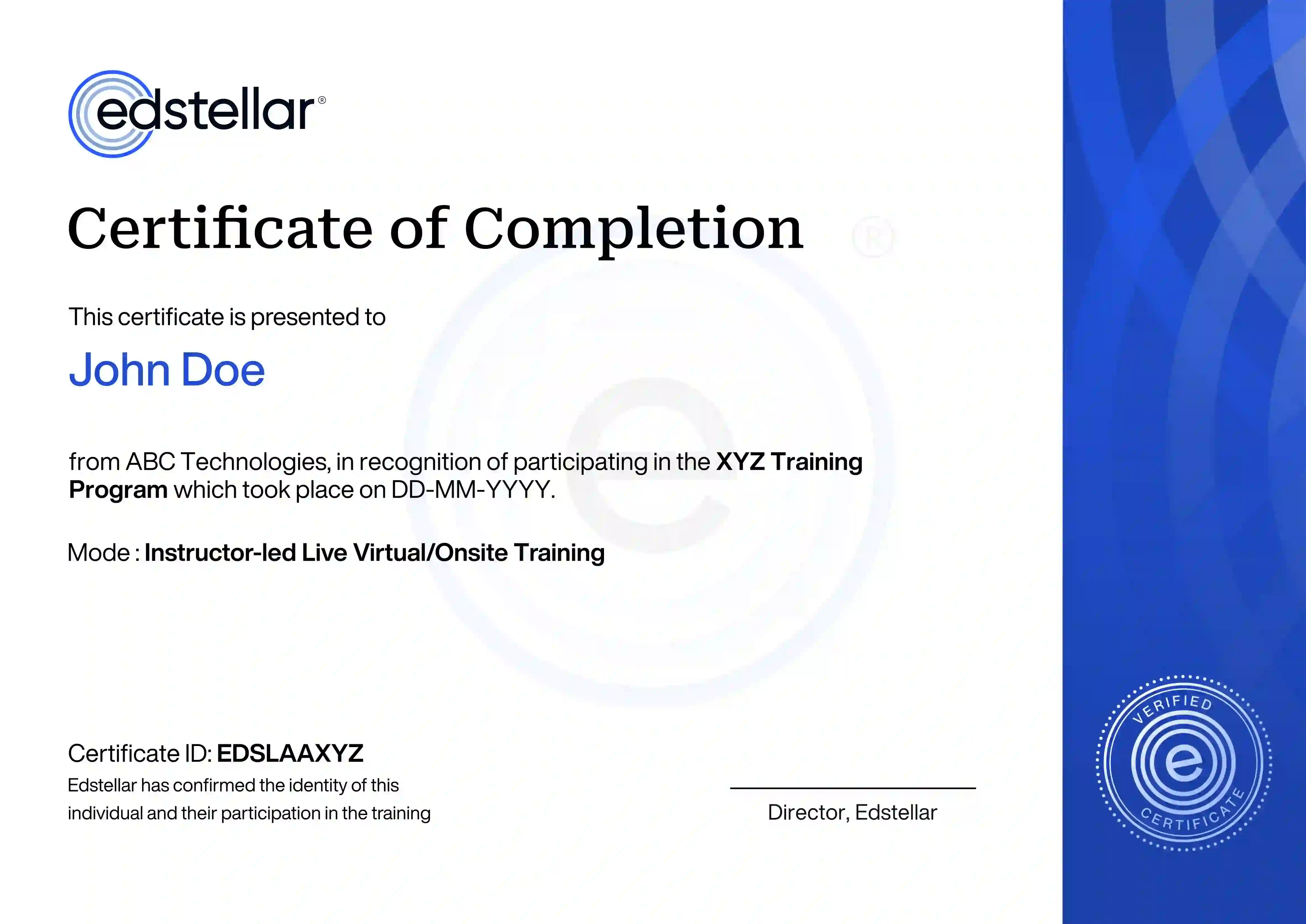
        Get Your Team Members Recognized with Edstellar’s Course Certificate

        Upon successful completion of the training course offered by Edstellar, employees receive a course completion certificate, symbolizing their dedication to ongoing learning and professional development.

        This certificate validates the employee's acquired skills and is a powerful motivator, inspiring them to enhance their expertise further and contribute effectively to organizational success.

        Certificate of Excellence

        We have Expert Trainers to Meet Your Corporate Social Responsibility Training Needs

        The instructor-led training is conducted by certified trainers with extensive expertise in the field. Participants will benefit from the instructor's vast knowledge, gaining valuable insights and practical skills essential for success in Access practices.

        Total Quality Management (TQM) Trainer in Alexandria
        Ayman
        Alexandria, Egypt
        Trainer since
        January 1, 2010

        Other Related Corporate Training Courses