.svg "edstellar")
.webp)
AutoCAD Electrical Corporate Training Program for Employees
Edstellar's instructor-led AutoCAD Electrical training equips your electrical engineering teams to design control systems and wiring schematics end to end, from project files and wire numbering to PLC I/O, custom symbols, and automated reports, customized to your standards and delivered onsite or virtually.

(Virtual / On-site / Off-site)
.svg)
AutoCAD Electrical is Autodesk's specialized toolset, built on AutoCAD, for designing and documenting electrical control systems. It adds electrical-specific tools, automatic wire numbering and component tagging, an extensive library of schematic and panel symbols, PLC I/O modules, and one-click reporting, so engineers can produce accurate control-circuit and wiring diagrams far faster than with general drafting software. Because so much industrial automation, machinery, and panel design depends on consistent, error-free electrical documentation, teams that work fluently in AutoCAD Electrical keep projects coordinated, standards-compliant, and on schedule.
As manufacturers and engineering firms automate more of their machinery and infrastructure, this program helps your teams design control systems and wiring schematics accurately and efficiently in AutoCAD Electrical. Empower your people with expert-led on-site, off-site, and virtual sessions delivered by Edstellar, a premier corporate training provider serving organizations worldwide in-person and virtually across popular languages. Built around your goals, the program turns AutoCAD Electrical skills into lasting capabilities that lift performance across your electrical design, controls, and engineering teams.
By the end of the program, your team can set up and manage project files, draw and number electrical schematics, tag and edit components, place PLC modules and I/O points, create and reuse custom symbols, and generate reports and audits automatically. The result is faster design cycles, fewer wiring errors, consistent documentation across projects, and an electrical engineering team confident across the full AutoCAD Electrical workflow.
.svg)

- Set up and manage AutoCAD Electrical projects, WDF files, and project-wide settings.
- Draw electrical schematics with automatic wire numbering and component tagging.
- Design, connect, and validate control circuits, interlocks, and safety logic.
- Place and configure PLC modules and I/O points and link them to external data.
- Create, save, and share custom electrical symbols and customized menus.
- Generate reports, audits, and project documentation automatically.
- Interface and Navigation
- Introduction to electrical CAD software and its benefits over traditional CAD
- Understanding the main working area and customizing toolbars and dockable windows
- Using the status bar for quick access to tools
- Navigating menu bars, ribbons, and shortcut commands for efficiency
- Accessing help and learning resources
- Projects and WDF Files
- Initial setup, options, and defining project properties and settings
- Organizing project data and files
- Structure and importance of the WDF file in projects
- Editing and managing WDF file properties
- Adding, deleting, and organizing files with project-wide configurations
- Schematics, Wire Numbers, and Tags
- Setting up wire numbering properties and applying automatic numbering
- Basic tagging strategies and custom tag formats for different components
- Updating and managing tags across a project
- Design principles for control circuits: drawing and connecting components
- Advanced schematic features for control logic, interlocks, and safety circuits
- Editing tools, batch editing, and debugging schematic errors
- PLC Modules and I/O Points
- Selecting, inserting, and customizing PLC models and unit parameters
- Strategies for efficient PLC placement
- Inserting, organizing, and labeling I/O points in schematics
- Linking I/O points to external data sources
- Automating I/O assignments with spreadsheets and verifying imported data
- Symbols, Menus, and Databases
- Drawing and saving symbols with embedded intelligence
- Consistent symbol naming and maintaining naming conventions
- Adding custom symbols to menus and customizing menu layouts for the team
- Sharing and exporting customized menus
- Linking symbols to database information and maintaining database entries
- Reports, Audits, and Exports
- Overview of report generation tools and customizing report contents and layout
- Saving, sharing, and scheduling report configurations
- Automating report updates with project changes
- Exporting reports for external use
- Running audits to identify errors and analyzing results for corrective action
- Electrical Engineers
- CAD Technicians
- Electrical Designers
- Draftsmen
- IT Professionals
- Project Engineers
- Control Systems Engineers
- Electrical Technicians
- Systems Engineers
- Product Designers
- Manufacturing Engineers
- Managers
Participants should be comfortable with the basics of AutoCAD and general drafting, and have a working understanding of electrical or controls concepts such as schematics, wiring, and components. Familiarity with reading electrical diagrams is helpful, but no prior AutoCAD Electrical experience is required to get the most from the AutoCAD Electrical training course.


.webp "Virtual AutoCAD Electrical Training")
.webp "On-site AutoCAD Electrical Training")
.webp "Off-site AutoCAD Electrical Training")
64 hours of group training (includes VILT/In-person On-site)
Tailored for SMBs
160 hours of group training (includes VILT/In-person On-site)
Ideal for growing SMBs
Tailor-Made Trainee Licenses with Our Exclusive Training Packages!
400 hours of group training (includes VILT/In-person On-site)
Designed for large corporations
Tailor-Made Trainee Licenses with Our Exclusive Training Packages!
Unlimited duration
Designed for large corporations
Experienced Trainers
Our trainers are drawn from a vetted global network and bring years of industry expertise, keeping every session practical and impactful.
Proven Quality
With a strong global track record, Edstellar is known for quality and engaging delivery.
Industry-Relevant Curriculum
Our programs are built by experts to match the demands of today's industry.
Fully Customizable
Every program can be tailored to your organization's goals.
Comprehensive Support
We provide pre- and post-session support for a complete learning experience.
Global Multi-Location & Multilingual Training Delivery
We deliver in multiple languages to support diverse global teams.
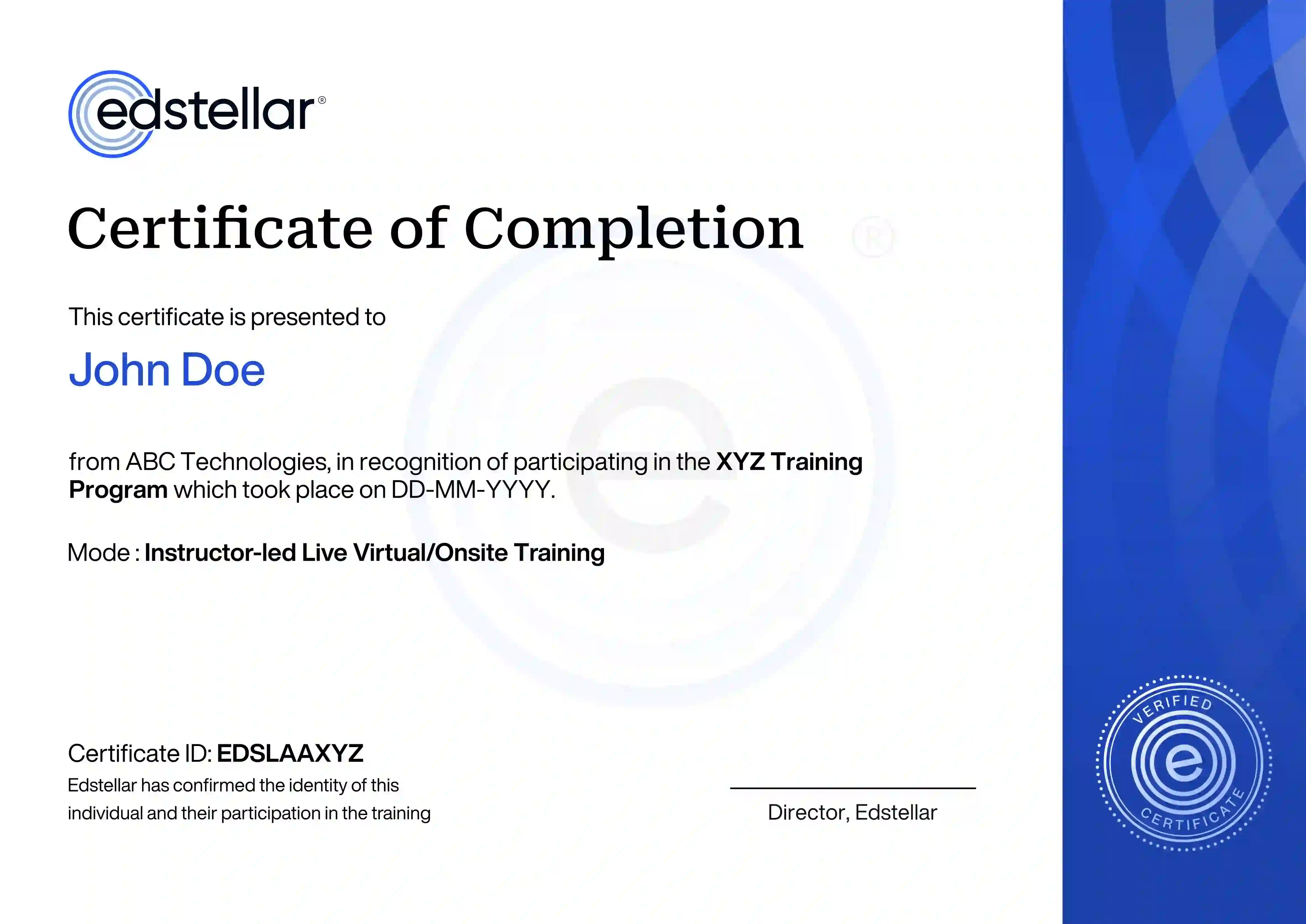
Recognition That Motivates Your Team


Frequently Asked Questions
Other Related Corporate Training Courses


Explore More Courses


.svg)
.svg)
.svg)

.svg)