Corporate Developing Applications with Oracle Application Express (APEX) Training Course
Edstellar's instructor-led Developing Applications with Oracle Application Express (APEX) training course empowers teams with low-code development skills to swiftly create and deploy web-based applications directly within the Oracle Database. Enhance your team's skills to design scalable, secure applications with minimal coding with our training.
(Virtual / On-site / Off-site)
Available Languages
English, Español, 普通话, Deutsch, العربية, Português, हिंदी, Français, 日本語 and Italiano
Oracle Application Express (APEX) is a dynamic low-code development platform that enables users to swiftly construct and deploy web-based applications directly within the Oracle Database environment. Developing Applications with Oracle Application Express (APEX) training course provides an understanding of APEX's features and architecture, guiding employees through every stage of the application development process, from initial installation to advanced customization and deployment. The course ensures streamlined application development processes, heightened user experiences, and sustained innovation, positioning organizations for success in their respective industries.
Edstellar's instructor-led Developing Applications with Oracle Application Express (APEX) training course offers virtual/onsite training options from industry experts with domain expertise. The course is distinguished by its expertly tailored curriculum, which includes practical, hands-on learning experiences designed to meet specific organizational needs.

Skills Your Employees Will Gain
These are the core, hands-on capabilities your team builds during the program.
- Oracle APEXOracle APEX is a low-code development platform for building web applications. This skill is important for developers and database administrators to streamline app creation and enhance productivity.
- Web DevelopmentWeb Development is the process of building and maintaining websites. this skill is important for roles like web developer and UI/UX designer, as it ensures effective online presence.
- Application DesignApplication Design is the process of creating software applications that meet user needs and business goals. this skill is important for developers and ux/ui designers to ensure functionality, usability, and aesthetic appeal in software solutions.
- User Interface (UI) DesignUser Interface (UI) Design involves creating visually appealing and user-friendly interfaces for software and applications. This skill is important for enhancing user experience, ensuring usability, and driving engagement in digital products.
- Database ManagementDatabase Management is the process of storing, organizing, and retrieving data efficiently. This skill is important for roles like data analysts and database administrators, ensuring data integrity and accessibility.
- Data ModelingData Modeling is the process of creating visual representations of data structures and relationships. This skill is important for data analysts and database developers to ensure accurate data management and analysis.
What Your Team Will Achieve After This Training
- Apply Oracle APEX's features to design responsive, user-friendly web applications that meet the specific needs of your business environment
- Develop automated data entry and processing solutions to streamline workflows, reduce manual errors, and increase efficiency in database management
- Implement advanced security measures in application design to safeguard sensitive data and ensure compliance with industry regulations
- Utilize Oracle APEX's integration capabilities to seamlessly connect new applications with existing databases and IT systems, enhancing data consistency and accessibility
- Analyze and optimize the performance of database applications to handle increased data volumes and user traffic without compromising speed or user experience
Topics & Program Outline
The curriculum is organized into focused modules built by industry experts and delivered virtually or on-premise. Interactive sessions reflect the evolving demands of the workplace, keeping the learning both relevant and practical.
- Overview of Oracle APEX features and architecture
- Introduction to APEX and its development environment
- Architecture of Oracle APEX: Components and workflow
- Key features and benefits of using Oracle APEX
- Understanding database applications
- Definition and components of database applications
- The role of databases in application development
- Different types of database applications and their uses
- Installing Oracle APEX
- System requirements and prerequisites for installation
- Step-by-step installation guide
- Troubleshooting common installation issues
- Accessing the development environment
- Logging into Oracle APEX
- Navigating the initial setup
- Overview of developer roles and permissions
- Exploring the UI and tools
- Introduction to the user interface components
- Tools and resources available in Oracle APEX
- Customizing the development environment
- Setting up the workspace
- Creating and managing workspaces
- Workspace resources and management tools
- Integrating external data sources
- Using the create application wizard
- Steps to create a new application
- Customizing application settings in the wizard
- Adding and removing application features
- Overview of application features in APEX
- How to add or remove features?
- Impact of feature modifications on application performance
- Creating a database app from a file
- Importing data files to create applications
- Supported file formats and limitations
- Data mapping and transformation during import
- Using an application blueprint
- Understanding application blueprints
- How to implement a blueprint in a project?
- Modifying and customizing blueprints
- Copying an existing database application
- Steps to copy an application within APEX
- Considerations for copying applications between environments
- Managing dependencies and connections in copied applications
- Creating an application for mobile devices
- Designing applications for mobile usability
- Mobile-specific features in Oracle APEX
- Testing and optimizing mobile applications
- Configuring application attributes
- Key attributes and their configurations
- Impact of attribute settings on application behavior
- Advanced configuration options
- Managing application groups
- Defining and using application groups
- Benefits of organizing applications into groups
- Access control and management within groups
- Using application and workspace utilities
- Available utilities in Oracle APEX
- Enhancing application functionality with utilities
- Adding pages to an application
- Types of pages and their purposes
- Step-by-step process for adding pages
- Customizing page properties
- Creating dialog pages
- Designing effective dialog pages
- Interaction patterns and user engagement
- Handling data submission and responses
- Branching with dialog pages
- Understanding page branching
- Configuring branches for user navigation
- Dynamic branching based on user input
- Copying database application pages
- How to duplicate pages within an application?
- Adjusting properties and settings after copying
- Ensuring consistency and functionality in copied pages
- Deleting database application pages
- Procedures for safely deleting pages
- Considerations for data and dependency impacts
- Restoring deleted pages
- Locking and unlocking pages
- Reasons to lock or unlock application pages
- Managing page access during development
- Effects of locking on team collaboration
- Navigating the Page Designer UI
- Layout and components of Page Designer
- Accessing different tools and options
- Customizing the Page Designer interface
- Managing page attributes
- Key page attributes and their effects
- Advanced attribute configurations for performance optimization
- Running a page from page designer
- Testing and previewing pages within the designer
- Debugging tools and techniques
- Iterative development and testing cycles
- Using the runtime developer toolbar
- Tools available in the runtime toolbar
- Real-time debugging and page analysis
- Enhancing development efficiency with toolbar features
- Copying and deleting an application page
- Procedures for copying and deleting pages
- Considerations for maintaining application integrity
- Managing application size and complexity
- Creating a report using the wizard
- Steps to build reports in APEX
- Customizing report layouts and features
- Integrating reports with application data
- Managing cards on a page
- Designing and using card layouts
- Customizing card appearance and functionality
- Creating and editing faceted search pages
- Implementing faceted search for enhanced data exploration
- Customizing facets and search criteria
- Performance considerations for large datasets
- Customizing interactive grids and reports
- Advanced configurations for interactive elements
- Techniques for engaging and informative displays
- Handling large data sets and complex interactions
- Managing classic reports
- Traditional reporting in Oracle APEX
- Customizations and extensions for classic reports
- Transitioning from classic to modern reporting tools
- Viewing and printing reports
- Configuring reports for optimal viewing
- Print settings and export options
- Ensuring compatibility across devices and formats
- Understanding form types
- Overview of form types in Oracle APEX
- Selecting the appropriate form type for specific needs
- Custom form designs and applications
- Creating a form using the wizard
- Steps to create forms with the APEX wizard
- Field and data type considerations
- Enhancing forms with custom validations and actions
- Creating master details forms
- Designing master-detail relationships in forms
- Managing data integrity and user workflow
- Advanced techniques for complex data structures
- Validating user inputs
- Importance of input validation in forms
- Implementing server-side and client-side validations
- Handling validation errors and user feedback
- Working with BLOBs
- Managing binary large objects in forms and reports
- Uploading, storing, and retrieving BLOBs
- Performance and security considerations for BLOB data
- Managing page-level items
- Adding and configuring items on application pages
- Dynamic item behaviors based on user interactions
- Adding dynamic actions, buttons, and trees
- Creating interactive elements within applications
- Configuring actions for real-time user response
- Designing hierarchical structures with tree controls
- Creating navigation menus, breadcrumbs, and tabs
- Designing intuitive navigation schemes
- Customizing and styling navigation elements
- Using computations, validations, and processes
- Implementing logic and calculations within applications
- Validating data and user inputs at various stages
- Automating processes to enhance application functionality
- Working with shared components
- Utilizing shared components across multiple applications
- Managing component libraries and repositories
- Enhancing reusability and consistency
- Extending application functions
- Integrating third-party services and APIs
- Custom coding and plugins for extended functionality
- Techniques for scaling applications beyond standard capabilities
- Controlling access to applications, pages, and components
- Setting up roles and permissions
- Secure access management practices
- Auditing and logging access for compliance
- Configuring user identity (authentication and authorization)
- Implementing authentication mechanisms
- Customizing authorization schemes
- Integrating with enterprise identity management systems
- Identifying performance issues
- Tools and techniques for performance monitoring
- Diagnosing common performance bottlenecks
- Strategies for optimizing application speed and responsiveness
- Logging and reporting
- Configuring logs for application events
- Creating reports from log data
- Using logs for troubleshooting and audits
- Creating custom reports
- Designing reports for specific organizational needs
- Advanced reporting features in Oracle APEX
- Automating report generation and distribution
- Testing and debugging applications
- Debugging tools and techniques in Oracle APEX
- Understanding the deployment process
- Overview of deployment strategies
- Pre-deployment checklist and preparations
- Common challenges in application deployment
- Creating, managing, and upgrading custom applications
- Lifecycle management of APEX applications
- Upgrade paths and version control
- Building the applications and components
- Assembly of application components
- Ensuring compatibility and performance during build
- Testing and quality assurance before deployment
- Publishing the database application URL
- Configuring application access for users
- Security considerations for public URLs
- Exporting applications and components
- Procedures for exporting APEX applications
- Handling dependencies and external components
- Backup strategies and versioning
- Importing and installing exported files
- Steps to import applications into different environments
- Conflict resolution and data integrity checks
- Deploying an application remotely
- Remote deployment techniques and tools
- Managing deployments across distributed systems
- Ensuring consistency and performance in remote environments
- Identifying common issues
- Catalog of frequent development and deployment problems
- Diagnostic tools and techniques
- Preventative measures and proactive troubleshooting
- Resolving application errors
- Steps to diagnose and fix application errors
- Handling errors in different application layers
- Documentation and support resources for troubleshooting
- Optimizing application performance
- Techniques for improving application speed and efficiency
- Tools for performance analysis and tuning
- Managing user feedback and incidents
- Setting up systems for user feedback collection
- Responding to user-reported issues
- Integrating feedback into development cycles
- Upgrading and maintaining applications
- Procedures for application upgrades and maintenance
- Managing application lifecycle post-deployment
- Ensuring application reliability and user satisfaction
Who Should Attend?
This program suits professionals at many levels across the organization, including:
- Application Developers
- Database Developers
- Web Developers
- Software Engineers
- IT Professionals
- Front-end Developers
- Backend Developers
- Data Analysts
- Systems Integrators
- BI Developers
- Software Architects
- Managers
What are the Prerequisites?
Employees with experience in application development and familiarity with Oracle SQL Database can take up the Developing Applications with Oracle Application Express (APEX) training course.
Choose the Format That Fits Your Team
We design training your teams actually engage with, and deliver it the way that suits you best. Through a vetted global trainer network, Edstellar runs sessions in 10+ languages with consistent quality anywhere.


.webp)
Virtual / online: expert-led live sessions delivered anywhere, with consistency and easy scheduling.
.webp)
On-site (in-house): immersive, instructor-led learning at your office.
.webp)
Off-site: focused, instructor-led group learning away from everyday workplace distractions.
Get a Proposal Shaped to Your Needs
Need pricing for onsite, offsite, or virtual delivery? Get a proposal tailored to your team's needs.
64 hours of group training (includes VILT/In-person On-site)
Tailored for SMBs
Tailor-Made Trainee Licenses with Our Exclusive Training Packages!
160 hours of group training (includes VILT/In-person On-site)
Ideal for growing SMBs
Tailor-Made Trainee Licenses with Our Exclusive Training Packages!
400 hours of group training (includes VILT/In-person On-site)
Designed for large corporations
Tailor-Made Trainee Licenses with Our Exclusive Training Packages!
Unlimited duration
Designed for large corporations
What Sets Edstellar Apart
Experienced Trainers
Our trainers are drawn from a vetted global network and bring years of industry expertise, keeping every session practical and impactful.
Proven Quality
With a strong global track record, Edstellar is known for quality and engaging delivery.
Industry-Relevant Curriculum
Our programs are built by experts to match the demands of today's industry.
Fully Customizable
Every program can be tailored to your organization's goals.
Comprehensive Support
We provide pre- and post-session support for a complete learning experience.
Global Multi-Location & Multilingual Training Delivery
We deliver in multiple languages to support diverse global teams.
Recognition That Motivates Your Team
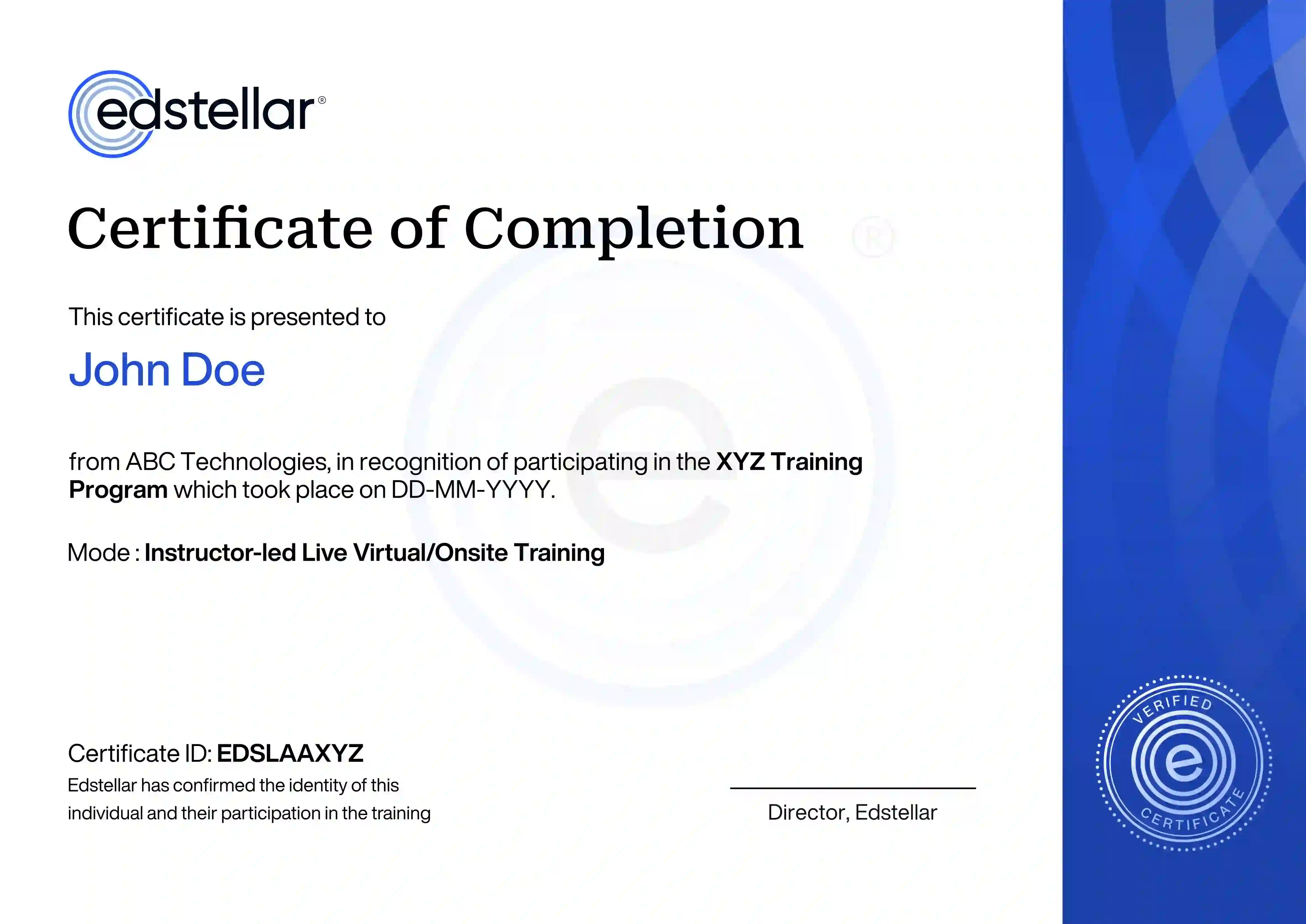
Upon successful completion of the training course offered by Edstellar, employees receive a course completion certificate, symbolizing their dedication to ongoing learning and professional development.
This certificate validates the employee's acquired skills and is a powerful motivator, inspiring them to enhance their expertise further and contribute effectively to organizational success.


Other Related Corporate Training Courses
Explore More Courses
Edstellar is a one-stop instructor-led corporate training and coaching solution that addresses organizational upskilling and talent transformation needs globally.
Marketing Excellence
Operational Excellence
Finance Excellence
HR Excellence
IT Excellence
Customer Service
Leadership Excellence
Quality Management
Software
How it WorksFAQ'sCorporate Training
CatalogStellar AI
Skill MatrixHRMS Integration
Who we ServeCEO RetreatsPricingTraining DeliveryPartner with Edstellar
CareersContact us