Drive Team Excellence with SAP Automation Using RPA Corporate Training

Empower your teams with expert-led on-site, off-site, and virtual SAP Automation Using RPA Training through Edstellar, a premier corporate training provider for organizations globally. Designed to meet your specific training needs, this group training program ensures your team is primed to drive your business goals. Help your employees build lasting capabilities that translate into real performance gains.

SAP Automation Using RPA combines the power of SAP systems with Robotic Process Automation (RPA) technology to automate repetitive tasks, streamline workflow processes, and enhance organizational efficiency. SAP Automation Using RPA training course equips teams with the skills to leverage automation tools effectively, ensuring they stay competitive and agile in today's dynamic business terrain.

Edstellar's instructor-led SAP Automation Using RPA training course delivered by industry experts with extensive domain experience has a tailored curriculum that addresses the unique needs of modern organizations. The course offers virtual/onsite training, ensuring employees gain practical insights and hands-on experience implementing RPA solutions within SAP environments.

Get Customized Expert-led Training for Your Teams
Customized Training Delivery
Scale Your Training: Small to Large Teams
In-person Onsite, Live Virtual or Hybrid Training Modes
Plan from 2000+ Industry-ready Training Programs
Experience Hands-On Learning from Industry Experts
Delivery Capability Across 100+ Countries & 10+ Languages
""""

Key Skills Employees Gain from instructor-led SAP Automation Using RPA Training

SAP Automation Using RPA skills corporate training will enable teams to effectively apply their learnings at work.

  • SAP Integration
    Sap Integration is the process of connecting SAP systems with other applications to streamline data flow and enhance business processes. This skill is important for roles in IT, business analysis, and operations, as it ensures seamless communication and efficiency across systems, driving informed decision-making and operational excellence.
  • Robotic Process Automation
    Robotic Process Automation involves using software robots to automate repetitive tasks. This skill is important for roles in IT, finance, and operations to enhance efficiency and reduce errors.
  • Workflow Automation
    Workflow Automation is the use of technology to streamline and automate repetitive tasks, enhancing efficiency. This skill is important for roles in project management and operations, as it reduces errors and saves time.
  • Process Optimization
    Process Optimization is the practice of enhancing workflows to improve efficiency and reduce costs. This skill is important for roles in operations, manufacturing, and project management, as it drives productivity and quality.
  • Task Automation
    Task Automation is the use of technology to perform repetitive tasks without human intervention. This skill is important for roles in IT, operations, and project management to enhance efficiency, reduce errors, and save time.
  • Error Handling
    Error Handling is the process of anticipating, detecting, and resolving errors in software or systems. This skill is important for developers and IT professionals to ensure reliability, enhance user experience, and maintain system integrity.

Key Learning Outcomes of SAP Automation Using RPA Training Workshop for Employees

Upon completing Edstellar’s SAP Automation Using RPA workshop, employees will gain valuable, job-relevant insights and develop the confidence to apply their learning effectively in the professional environment.

  • Analyze and interpret General Ledger reports to gain insights into the financial health and performance of the organization
  • Apply SAP General Ledger Accounting techniques to efficiently manage and track financial transactions within the organization's GL system
  • Develop effective strategies for automating repetitive tasks such as parking and posting documents, reversals, and automatic clearing to streamline workflow processes
  • Enhance Accounts Receivable operations by proficiently managing customer transactions, invoicing, payments, and credit management, improving cash flow and customer relationships
  • Implement SAP Cash and Bank Accounting methods to accurately record cash transactions, manage cheques, and reconcile bank statements, ensuring financial accuracy and compliance

Key Benefits of the SAP Automation Using RPA Group Training

Attending our SAP Automation Using RPA group training classes provides your team with a powerful opportunity to build skills, boost confidence, and develop a deeper understanding of the concepts that matter most. The collaborative learning environment fosters knowledge sharing and enables employees to translate insights into actionable work outcomes.

  • Equip yourself with practical skills to seamlessly integrate RPA solutions into SAP environments, reducing manual effort and enhancing productivity
  • Learn techniques in SAP Automation Using RPA, empowering professionals to streamline complex SAP processes through automation and efficiency
  • Develop a deep understanding of RPA implementation strategies tailored to SAP systems, enabling you to drive innovation and optimization within your organization
  • Equip teams with the expertise needed to tackle the challenges of SAP Automation, promoting a culture of innovation and continuous improvement within your organization
  • Explore the potential of SAP Automation Using RPA to drive digital transformation initiatives, positioning your organization for success in today's rapidly evolving business terrain

Topics and Outline of SAP Automation Using RPA Training

Our virtual and on-premise SAP Automation Using RPA training curriculum is structured into focused modules developed by industry experts. This training for organizations provides an interactive learning experience that addresses the evolving demands of the workplace, making it both relevant and practical.

  1. General ledger master
    • Creation of GL accounts
    • Editing GL account details
  2. General ledger parking and postings
    • Parking documents in the GL
    • Posting documents to the GL
  3. Reversals
    • Manual reversal of posted documents
    • Automatic reversal of documents
  4. Automatic clearing
    • Clearing open items automatically
    • Configuring automatic clearing rules
  5. Recurring entries
    • Setting up recurring entry documents
    • Automatic posting of recurring entries
  6. Taxes
    • Configuring tax codes
    • Posting tax-related transactions
  7. General ledger reports
    • Generating balance sheets
    • Profit and loss statements
  1. Cash journals
    • Recording cash transactions
    • Reconciling cash journals
  2. Cheque management
    • Issuing and processing cheques
    • Tracking cheque payments
  3. House bank masters
    • Setting up house bank accounts
    • Managing bank master data
  4. Bank reconciliations
    • Reconciling bank statements
    • Clearing open items in bank reconciliations
  1. Vendor master
    • Creation and maintenance of vendor records
    • Editing vendor master data
  2. Vendor invoice posting
    • Processing invoices from vendors
    • Posting vendor invoices to accounts payable
  3. Vendor credit memo
    • Recording credit memos from vendors
    • Applying credit memos to outstanding invoices
  4. Vendor down payment
    • Processing down payments to vendors
    • Recording down payment transactions
  5. Vendor down payment clearing
    • Clearing open items related to vendor down payments
    • Managing the down payment clearing process
  6. Vendor outgoing payment
    • Processing outgoing payments to vendors
    • Issuing payments through various methods
  7. Partial payment against an invoice
    • Partially clearing open items in accounts payable
    • Managing partial payments effectively
  8. Residual payment
    • Clearing residual amounts in vendor transactions
    • Handling residual payment scenarios
  9. Automatic payment run
    • Configuring and executing automatic payment programs
    • Streamlining vendor payment processes
  10. Withholding tax (TDS)
    • Setting up and managing withholding tax for vendors
    • Calculating and posting withholding tax amounts
  11. Vendor reports
    • Generating vendor aging reports
    • Analyzing vendor payment history
  1. Customer master
    • Creation and maintenance of customer records
    • Editing customer master data
  2. Customer invoice posting
    • Processing invoices for customers
    • Posting customer invoices to accounts receivable
  3. Customer credit memo
    • Recording credit memos for customers
    • Applying credit memos to outstanding invoices
  4. Customer down payment
    • Processing down payments from customers
    • Recording down payment transactions
  5. Customer down payment clearing
    • Clearing open items related to customer down payments
    • Managing the down payment clearing process
  6. Customer incoming payment
    • Processing incoming payments from customers
    • Receiving payments through various methods
  7. Partial payment against an invoice
    • Partially clearing open items in accounts receivable
    • Managing partial payments effectively
  8. Residual payment
    • Clearing residual amounts in customer transactions
    • Handling residual payment scenarios
  9. Customer reports
    • Generating customer ageing reports
    • Analyzing customer payment history
  1. Asset master
    • Creation and maintenance of asset records
    • Editing asset master data
  2. Asset procurement (Direct)
    • Directly procuring assets into the system
    • Recording asset acquisitions without MM involvement
  3. Asset procurement (Through MM)
    • Procuring assets through Material Management (MM)
    • Linking asset acquisitions to procurement processes
  4. Asset retirements
    • Retiring assets from service
    • Recording asset retirements and write-offs
  5. Asset scrapping
    • Scrapping obsolete or damaged assets
    • Handling asset disposal in the system
  6. Depreciation run
    • Running depreciation calculations
    • Posting depreciation expenses to the general ledger
  1. Define a company
    • Creating and configuring company structures
    • Setting up company-specific parameters
  2. Define a company code
    • Establishing company code settings
    • Configuring company code-specific details
  3. Assign company code to company
    • Linking company codes to respective companies
    • Ensuring proper organizational hierarchy
  4. Define chart of accounts
    • Defining chart of accounts structures
    • Configuring account groups and hierarchies
  5. Assign company code to chart of accounts
    • Associating company codes with an appropriate chart of accounts
    • Enabling consistency in financial reporting
  6. Setup account groups and their number ranges
    • Configuring account groups for master data
    • Assigning number ranges to account groups
  7. Assign fiscal year variant to company code
    • Linking fiscal year variants to company codes
    • Defining fiscal year-specific settings
  8. Assign posting period variant to company code
    • Mapping posting period variants to company codes
    • Specifying posting period-related parameters
  9. Document number ranges for the company code
    • Defining document number ranges for company code transactions
    • Ensuring unique document numbering for financial transactions
  10. Assign field status variant to company code
    • Setting up field status variants for master data
    • Assigning field status variants to company codes
  11. Define employee tolerance
    • Configuring tolerance levels for employee transactions
    • Setting up tolerance limits for financial postings
  12. Define retained earnings account
    • Specifying accounts for retained earnings
    • Managing retained earnings in financial statements
  13. Document types
    • Defining document types for various transactions
    • Configuring document type attributes and controls
  14. Posting keys
    • Defining posting keys for financial transactions
    • Assigning posting keys to transaction types
  15. Validation and substitution
    • Setting up validation rules for financial transactions
    • Configuring substitution rules for automated data entry
  16. General ledger account introduction
    • Understanding the role of GL accounts in financial transactions
    • Configuring GL account settings and parameters
  17. Reconciliation accounts
    • Defining reconciliation accounts for sub ledger integration
    • Managing reconciliation processes between GL and sub ledgers
  18. Expense and revenue GL accounts
    • Setting up expense and revenue accounts
    • Allocating transactions to appropriate GL accounts
  19. Account assignment model
    • Creating account assignment models for recurring transactions
    • Streamlining transaction processing with predefined models
  20. Setup tolerance for customers and vendors
    • Defining tolerance limits for customer and vendor transactions
    • Ensuring accuracy and control in financial postings
  21. Customer account groups
    • Configuring customer account groups for master data
    • Defining customer-specific attributes and settings
  22. Create number ranges for customer accounts
    • Establishing number ranges for customer account IDs
    • Ensuring uniqueness and sequence in customer account numbering
  23. Assign number ranges to customer groups
    • Linking number ranges to specific customer account groups
    • Enabling automatic assignment of customer account IDs
  24. Customer master record
    • Creating and maintaining customer master data
    • Managing customer information and transactions
  25. Create vendor groups
    • Configuring vendor groups for master data
    • Defining vendor-specific attributes and settings
  26. Create number ranges for vendor accounts
    • Establishing number ranges for vendor account IDs
    • Ensuring uniqueness and sequence in vendor account numbering
  27. Assign number ranges to vendor groups
    • Linking number ranges to specific vendor account groups
    • Enabling automatic assignment of vendor account IDs
  28. Create vendor master
    • Creating and maintaining vendor master data
    • Managing vendor information and transactions
  29. Create underpayment account and overpayment accounts
    • Setting up accounts for handling underpayments and overpayments
    • Managing discrepancies in payment transactions
  30. Create a cash discount account
    • Establishing accounts for recording cash discounts
    • Managing cash discount transactions effectively
  31. Payment within tolerance (incoming)
    • Processing incoming payments within defined tolerance limits
    • Handling variances in payment amounts
  32. Payment within tolerance (outgoing)
    • Processing outgoing payments within defined tolerance limits
    • Ensuring accuracy and control in payment processing
  33. Configure the Automatic Payment Program
    • Setting up parameters and criteria for automatic payment runs
    • Automating payment processing for efficiency and accuracy
  34. Financial statement version
    • Defining financial statement layouts and formats
    • Customizing financial statements to meet reporting requirements
  35. House bank configuration
    • Configuring house bank accounts and settings
    • Managing bank relationships and transactions
  36. Manual bank reconciliation
    • Performing manual reconciliation of bank statements
    • Matching transactions and resolving discrepancies
  37. Asset number ranges
    • Establishing number ranges for asset master data
    • Ensuring uniqueness and sequence in asset numbering
  38. Depreciation areas
    • Defining depreciation areas for asset accounting
    • Configuring depreciation methods and settings
  39. Asset general ledger account determination
    • Mapping asset transactions to appropriate GL accounts
    • Integrating asset accounting with general ledger
  40. Depreciation keys
    • Defining depreciation keys for asset depreciation
    • Configuring depreciation calculation methods
  41. New GL and document-splitting concepts
    • Understanding new GL functionality and benefits
    • Implementing document-splitting for enhanced reporting and analysis

Who Can Take the SAP Automation Using RPA Training Course

The SAP Automation Using RPA training program can also be taken by professionals at various levels in the organization.

  • SAP Developers
  • RPA Developers
  • Automation Specialists
  • Systems Analysts
  • IT Professionals
  • Business Process Analysts
  • Workflow Developers
  • IT Support Specialists
  • Data Analysts
  • Systems Integrators
  • Solution Architects
  • Managers

Prerequisites for SAP Automation Using RPA Training

Employees with a basic understanding of Robotic Process Automation concepts and familiarity with SAP systems can take up the SAP Automation Using RPA training course.

Request a Quote for your Corporate Training Requirements

Valid number

Delivering Training for Organizations across 100 Countries and 10+ Languages

Corporate Group Training Delivery Modes
for SAP Automation Using RPA Training

At Edstellar, we understand the importance of impactful and engaging training for employees. As a leading SAP Automation Using RPA training provider, we ensure the training is more interactive by offering Face-to-Face onsite/in-house or virtual/online sessions for companies. This approach has proven to be effective, outcome-oriented, and produces a well-rounded training experience for your teams.

 Virtual trainig

Edstellar's SAP Automation Using RPA virtual/online training sessions bring expert-led, high-quality training to your teams anywhere, ensuring consistency and seamless integration into their schedules.

With global reach, your employees can get trained from various locations
The consistent training quality ensures uniform learning outcomes
Participants can attend training in their own space without the need for traveling
Organizations can scale learning by accommodating large groups of participants
Interactive tools can be used to enhance learning engagement
 On-site trainig

Edstellar's SAP Automation Using RPA inhouse training delivers immersive and insightful learning experiences right in the comfort of your office.

Higher engagement and better learning experience through face-to-face interaction
Workplace environment can be tailored to learning requirements
Team collaboration and knowledge sharing improves training effectiveness
Demonstration of processes for hands-on learning and better understanding
Participants can get their doubts clarified and gain valuable insights through direct interaction
 Off-site trainig

Edstellar's SAP Automation Using RPA offsite group training offer a unique opportunity for teams to immerse themselves in focused and dynamic learning environments away from their usual workplace distractions.

Distraction-free environment improves learning engagement
Team bonding can be improved through activities
Dedicated schedule for training away from office set up can improve learning effectiveness
Boosts employee morale and reflects organization's commitment to employee development

Explore Our Customized Pricing Package
for
SAP Automation Using RPA Corporate Training

Looking for pricing details for onsite, offsite, or virtual instructor-led SAP Automation Using RPA training? Get a customized proposal tailored to your team’s specific needs.

Request a Group Training Quote
""
How Many Team Members Need Training?
Please select an option or fill in the custom field.
"'

Is Your Corporate Training Requirement Only for SAP Automation Using RPA?

Please select at least one course.
""
Add the List of Training Workshops
search icon

      Please select the course

      No. of Courses selected: 0

      Clear

      Upload a CSV

      Send us your Training Requirements in 3 Easy steps

      1. 1
      2. 2
        Add the required training workshops
      3. 3
        Upload to get a quick quote or email it to contact@edstellar.com

      ""

      Looking for a Complete Package?

      Looking for a one-time pricing option for all your annual training requirements?

      View Corporate Training Packages
      ""
      Select the Option that Best Describes Your Corporate Training Requirement

      Please select an option or choose from the recurring options.
      ""
      Verify and Submit Your Request

      Review Your Corporate Training Selection Summary

      Training Program: SAP Automation Using RPA Training

      1. No of Team Members

      2. Selected Training Preference

      3. Selected Recurring Sessions

      1

      Review your Requirements

      Training Workshops Selected :


        Excel
        File has been
        successfully uploaded.
        Fill the form to submit
 your details
        Submit Your Professional Contact Information
        Valid number
        We've received your enquiry. Our team will be in touch soon.
        Oops! Something went wrong while submitting the form.
        Starter
        120 licences

        Tailor-Made Trainee Licenses with Our Exclusive Training Packages!

        View Package

        64 hours of group training (includes VILT/In-person On-site)

        Tailored for SMBs

        Growth
        320 licences

        Tailor-Made Trainee Licenses with Our Exclusive Training Packages!

        View Package

        160 hours of group training (includes VILT/In-person On-site)

        Ideal for growing SMBs

        Enterprise
        800 licences

        Tailor-Made Trainee Licenses with Our Exclusive Training Packages!

        View Package

        400 hours of group training (includes VILT/In-person On-site)

        Designed for large corporations

        Custom
        Unlimited licenses

        Tailor-Made Trainee Licenses with Our Exclusive Training Packages!

        View Package

        Unlimited duration

        Designed for large corporations

        Edstellar: Your Go-to SAP Automation Using RPA Training Company

        Experienced Trainers

        Our trainers bring years of industry expertise to ensure the training is practical and impactful.

        Quality Training

        With a strong track record of delivering training worldwide, Edstellar maintains its reputation for its quality and training engagement.

        Industry-Relevant Curriculum

        Our course is designed by experts and is tailored to meet the demands of the current industry.

        Customizable Training

        Our course can be customized to meet the unique needs and goals of your organization.

        Comprehensive Support

        We provide pre and post training support to your organization to ensure a complete learning experience.

        Multilingual Training Capabilities

        We offer training in multiple languages to cater to diverse and global teams.

        Testimonials

        What Our Clients Say

        We pride ourselves on delivering exceptional training solutions. Here's what our clients have to say about their experiences with Edstellar.

        "The SAP Automation Using RPA course revolutionized how I approach my daily responsibilities. As a Senior Software Engineer, understanding strategic frameworks was essential, and this training delivered beyond real-world experience. These specialized skills have positioned me for significant advancement opportunities within my organization. The instructor's insights on expert-led workshops have proven instrumental in my professional advancement.”

        Daniel Walker

        Senior Software Engineer,

        RPA Technology Provider

        "This SAP Automation Using RPA course was precisely what I needed to design robust technical mastery architectures. The hands-on approach to interactive labs and seamless integration with practical simulations was projects using advanced techniques from this training. Our solution delivery efficiency and quality have increased substantially across the board. The comprehensive curriculum has elevated my solution delivery capabilities significantly.”

        Kristian Berg

        Senior Software Engineer,

        Workflow Automation Solutions Firm

        "The SAP Automation Using RPA training transformed our team's entire approach to operational excellence management and execution. As a Senior Software Engineer, the extensive coverage of practical applications, hands-on concepts to enhanced capabilities. Our team delivered record-breaking results in the subsequent quarter, exceeding all targets. Our team's productivity and solution quality have improved measurably, validating this investment.”

        Kishore Dutta

        Senior Software Engineer,

        Business Process Automation Platform

        “Edstellar’s IT & Technical training programs have been instrumental in strengthening our engineering teams and building future-ready capabilities. The hands-on approach, practical cloud scenarios, and expert guidance helped our teams improve technical depth, problem-solving skills, and execution across multiple projects. We’re excited to extend more of these impactful programs to other business units.”

        Aditi Rao

        L&D Head,

        A Global Technology Company

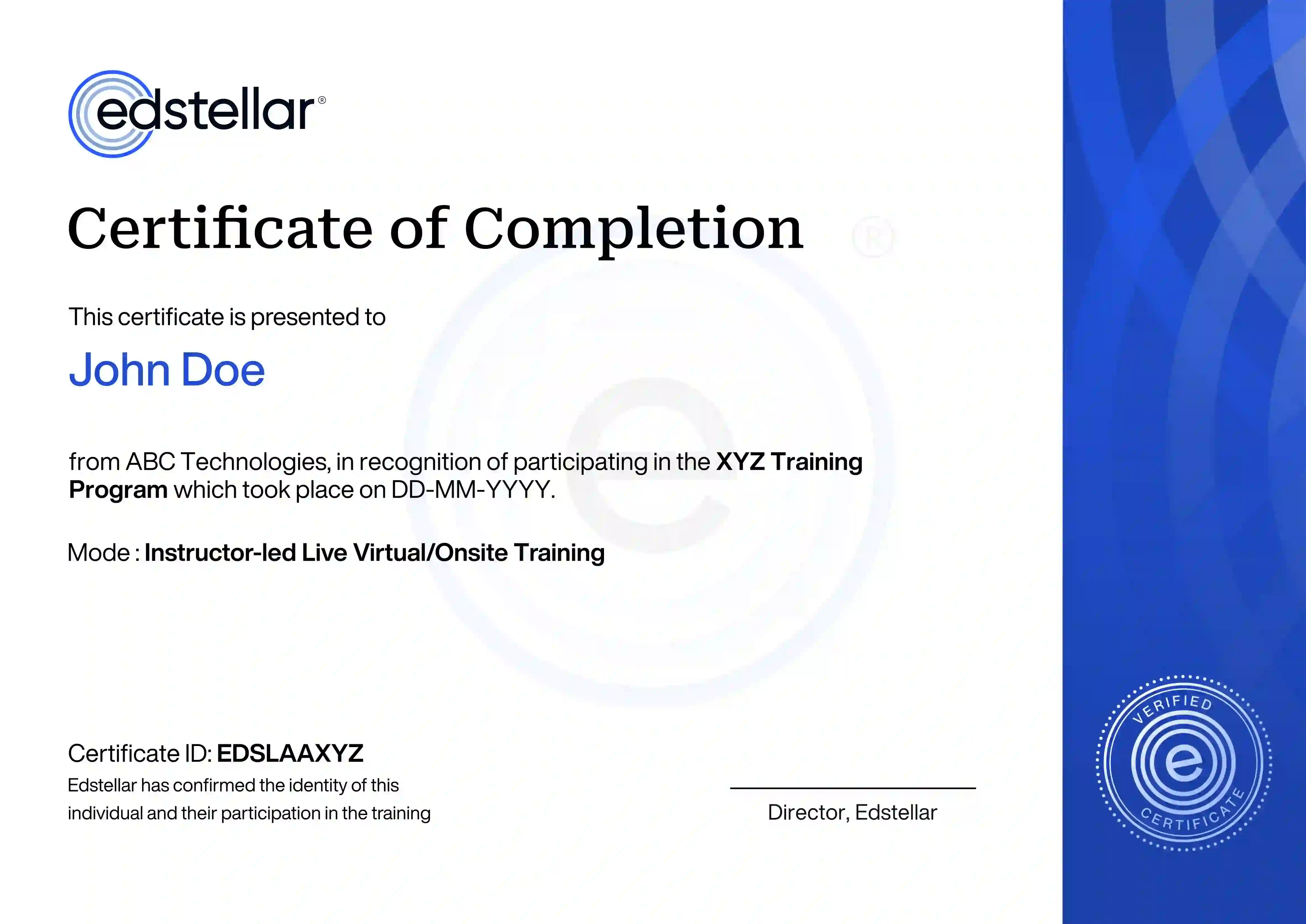
        Get Your Team Members Recognized with Edstellar’s Course Certificate

        Upon successful completion of the training course offered by Edstellar, employees receive a course completion certificate, symbolizing their dedication to ongoing learning and professional development.

        This certificate validates the employee's acquired skills and is a powerful motivator, inspiring them to enhance their expertise further and contribute effectively to organizational success.

        Certificate of Excellence

        We have Expert Trainers to Meet Your SAP Automation Using RPA Training Needs

        The instructor-led training is conducted by certified trainers with extensive expertise in the field. Participants will benefit from the instructor's vast knowledge, gaining valuable insights and practical skills essential for success in Access practices.

        Other Related Corporate Training Courses