Corporate SQL Advanced level for Analysts Training Course
Edstellar's SQL Advanced level for Analysts instructor-led training course equips employees with advanced SQL querying techniques, data retrieval, manipulation, and analytical skills necessary for complex data analysis and reporting tasks. Upskill your team to enhance their data analytics skills with our comprehensive training course.
(Virtual / On-site / Off-site)
Available Languages
English, Español, 普通话, Deutsch, العربية, Português, हिंदी, Français, 日本語 and Italiano
Drive Team Excellence with SQL Advanced level for Analysts Corporate Training
Empower your teams with expert-led on-site, off-site, and virtual SQL Advanced level for Analysts Training through Edstellar, a premier corporate training provider for organizations globally. Designed to meet your specific training needs, this group training program ensures your team is primed to drive your business goals. Help your employees build lasting capabilities that translate into real performance gains.
Advanced SQL uses complex queries and techniques to manipulate and retrieve data from relational databases. SQL Advanced level for Analysts provides analysts with an in-depth understanding of advanced SQL techniques and practices. It is necessary to equip teams with the skills to handle intricate data analysis tasks, generate sophisticated reports, and enhance database performance to derive valuable insights from large datasets. The SQL Advanced level for Analysts training enables employees to handle complex data structures, utilize advanced functions, and develop stored procedures to extract, manipulate, and analyze data effectively.
The SQL Advanced level for Analysts instructor-led training course provided by Edstellar can be customized to meet team requirements. The virtual/onsite course, led by expert trainers, ensures employees master optimization strategies and explore complex database operations.

Key Skills Employees Gain from instructor-led SQL Advanced level for Analysts Training
SQL Advanced level for Analysts skills corporate training will enable teams to effectively apply their learnings at work.
- Query Optimization Query Optimization is the process of enhancing database queries to improve performance and efficiency. This skill is important for data analysts and database administrators to ensure fast data retrieval, reduce resource consumption, and enhance overall system performance.
- Advanced Joins Advanced Joins refer to complex SQL techniques used to combine data from multiple tables. This skill is important for data analysts and database developers to extract meaningful insights and optimize queries efficiently.
- Window Functions Window Functions are SQL features that perform calculations across a set of table rows related to the current row. this skill is important for data analysts and engineers to efficiently analyze trends and patterns in large datasets.
- Subquery Mastery Subquery Mastery involves crafting and optimizing nested queries within SQL to retrieve complex data efficiently. This skill is important for data analysts and database developers, as it enhances data retrieval accuracy and performance, enabling informed decision-making.
- Data Aggregation Data Aggregation is the process of collecting and summarizing data from various sources. This skill is important for data analysts and business intelligence roles to derive insights and inform decision-making.
- Transaction ControlTransaction Control is the ability to manage and oversee financial transactions effectively, ensuring accuracy and compliance. this skill is important for roles in finance, accounting, and auditing, as it helps maintain integrity and trust in financial reporting.
Key Learning Outcomes of SQL Advanced level for Analysts Training Workshop for Employees
Upon completing Edstellar’s SQL Advanced level for Analysts workshop, employees will gain valuable, job-relevant insights and develop the confidence to apply their learning effectively in the professional environment.
- Analyze and filter data using WHERE clauses with complex conditions, operators, and functions
- Sort query results effectively using the ORDER BY clause with proper understanding of precedence and hierarchy
- Apply various SQL functions (character, numeric, datetime) for data manipulation and conversion
- Create complex queries with aggregate functions (COUNT, SUM, AVG, MIN, MAX) and GROUP BY clauses for data summarization and grouping
- Implement different join types (inner, outer, various SQL99 joins) to combine data from multiple tables
- Utilize subqueries for complex data retrieval tasks, including single-row and multi-row subqueries with appropriate operators
- Analyze and combine query results using set operations (UNION, UNION ALL, INTERSECT, MINUS/EXCEPT)
- Manage transactions effectively using COMMIT, ROLLBACK, and SAVEPOINT statements for data consistency
Key Benefits of the SQL Advanced level for Analysts Group Training
Attending our SQL Advanced level for Analysts group training classes provides your team with a powerful opportunity to build skills, boost confidence, and develop a deeper understanding of the concepts that matter most. The collaborative learning environment fosters knowledge sharing and enables employees to translate insights into actionable work outcomes.
- Empowers employees with the skills to write complex queries using advanced filtering techniques with WHERE clause
- Develops the required skills in employees to effectively sort and organize query results using the ORDER BY clause
- Provides insights into various SQL functions (character, numeric, datetime) for data manipulation and conversion tasks
- Equips the team with the techniques to create insightful data summaries using aggregate functions (COUNT, SUM, AVG, MIN, MAX) and GROUP BY clauses
- Cultivates ideas in employees for strategically joining tables using different join types (inner, outer, various SQL99 joins) for data analysis
- Develops the skills to write subqueries to answer complex data retrieval questions, including single-row and multi-row applications
- Empowers employees with the techniques to combine and manipulate query results using set operations (UNION, UNION ALL, INTERSECT, MINUS/EXCEPT)
- Provides insights into managing transactions with COMMIT, ROLLBACK, and SAVEPOINT statements to ensure data consistency
Topics and Outline of SQL Advanced level for Analysts Training
Our virtual and on-premise SQL Advanced level for Analysts training curriculum is structured into focused modules developed by industry experts. This training for organizations provides an interactive learning experience that addresses the evolving demands of the workplace, making it both relevant and practical.
- Syntax rules
- Basic SQL syntax
- Syntax conventions
- Selecting all columns
- Using SELECT *
- Advantages and drawbacks
- Projection
- Specifying columns
- Renaming columns
- Arithmetical operations
- Addition, subtraction, multiplication, division
- Order of operations
- Column aliases
- Assigning aliases
- Usage in SELECT statements
- Literals
- Numeric literals
- String literals
- Concatenation
- Using CONCAT function
- Using '+' operator
- WHERE clause
- Basic WHERE clause
- Multiple conditions
- Comparison operators
- Equal to (=)
- Not equal to (<>)
- Greater than(>)
- Less than(<)
- Greater than or equal to(>=)
- Less than or equal to(<=)
- Using with NULL values
- LIKE condition
- Pattern matching
- Using wildcards
- BETWEEN AND condition
- Including endpoints
- Combining with other conditions
- IS NULL condition
- Checking for NULL values
- Using IS NOT NULL
- IN condition
- Specifying multiple values
- Subqueries with IN
- Logical operators (AND, OR, NOT)
- Combining conditions
- Using NOT operator
- Multiple conditions and order
- Precedence of operators
- Using parentheses
- DISTINCT clause
- Eliminating duplicates
- Usage in SELECT queries
- ORDER BY clause
- Sorting in ascending order
- Sorting in descending order
- Sorting by multiple columns
- Sorting hierarchy
- Using multiple columns
- Single-row vs multi-row functions
- Difference and usage
- Examples of each
- Character, numeric, DateTime functions
- Common character functions
- Numeric and DateTime functions
- Explicit and implicit conversion
- Explicit CAST and CONVERT
- Implicit conversions
- Conversion functions
- TO_CHAR, TO_NUMBER, TO_DATE
- Format specifiers
- Nested functions
- Combining functions
- Order of execution
- Dual table
- Purpose and usage
- Oracle vs other databases
- Current date and time functions
- SYSDATE, CURRENT_TIMESTAMP
- Time zone considerations
- Aggregate functions
- COUNT, SUM, AVG, MIN, MAX
- Using DISTINCT with aggregates
- Handling NULL values
- Ignoring NULLs in aggregate functions
- COALESCE and NVL functions
- GROUP BY clause
- Grouping data
- Using with multiple columns
- Grouping by multiple columns
- Hierarchical grouping
- Rollup and Cube options
- Filtering aggregated data with HAVING
- Using aggregate results
- Multiple HAVING conditions
- Multidimensional grouping (ROLLUP and CUBE)
- Creating subtotals
- Generating multiple levels of aggregation
- Identifying summaries (GROUPING)
- GROUPING function usage
- Identifying groupings
- GROUPING SETS operator
- Combining multiple GROUP BY operations
- Custom groupings
- Types of joins
- Inner join
- Outer join
- NATURAL JOIN
- Matching columns automatically
- Potential pitfalls
- Table aliases
- Assigning aliases
- Using aliases in queries
- Oracle join conditions
- Using (+) notation
- Oracle-specific joins
- SQL99 joins (INNER, LEFT, RIGHT, FULL)
- Standard SQL joins
- Differences and advantages
- Cartesian product
- Definition and examples
- Avoiding unintended results
- Subquery conditions
- Where to use subqueries
- Nesting subqueries
- Single-row vs multi-row subqueries
- Difference in result set
- Use cases
- Single-row subquery operators
- Comparison operators
- IN, ANY, ALL
- Aggregate functions in subqueries
- Using aggregates in subqueries
- Grouping and filtering
- Multi-row subquery operators (IN, ALL, ANY)
- Comparing multiple values
- Using with aggregate functions
- UNION
- Combining result sets
- Removing duplicates
- UNION ALL
- Combining all rows
- Including duplicates
- INTERSECT
- Common rows between queries
- Usage scenarios
- MINUS/EXCEPT
- Rows in the first query but not the second
- Use cases and examples
- COMMIT
- Saving changes
- Transaction finalization
- ROLLBACK
- Undoing changes
- Transaction cancellation
- SAVEPOINT statements
- Creating savepoints
- Rolling back to savepoints
- Sequences
- Creating sequences
- Usage in tables
- Synonyms
- Creating and managing synonyms
- Advantages of using synonyms
- Views
- Creating views
- Using views in queries
- Tree construction (CONNECT BY PRIOR and START WITH)
- Creating hierarchical data
- Querying hierarchical data
- SYS_CONNECT_BY_PATH function
- Retrieving path in a hierarchy
- Usage examples
- CASE expression
- Simple and searched CASE
- Using in SELECT, WHERE, and ORDER BY
- DECODE expression
- Replacing multiple IF-THEN-ELSE
- Using in SELECT statements
- Time zones
- Understanding time zones
- Time zone offsets
- TIMESTAMP data types
- Storing date and time
- Precision options
- DATE vs TIMESTAMP
- Differences and usage scenarios
- Conversion between types
- Time zone conversions
- Converting between time zones
- Handling daylight saving time
- Partitioning data
- Logical and physical partitioning
- Partitioning strategies
- Window functions
- Understanding window frames
- ROW_NUMBER, RANK, DENSE_RANK
- Rank functions
- Ranking data
- Partitioned ranking
- Reporting functions
- Generating reports
- PIVOT and UNPIVOT
- LAG/LEAD functions
- Accessing previous or next row values
- Use cases
- FIRST/LAST functions
- Accessing first or last row values
- Ordering and filtering
- Reverse percentile functions
- Percentile calculations
- Inverse percentile functions
- Hypothetical rank functions
- HYPOTHETICAL_RANK
- Simulating ranking functions
- WIDTH_BUCKET functions
- Binning data
- Grouping into buckets
- Statistical functions
- MEAN, MEDIAN, MODE
- Variance and standard deviation
Who Can Take the SQL Advanced level for Analysts Training Course
The SQL Advanced level for Analysts training program can also be taken by professionals at various levels in the organization.
- Data Analysts
- SQL Developers
- Business Analysts
- Database Administrators
- Data Engineers
- IT Professionals
- Systems Analysts
- Data Scientists
- BI Analysts
- Research Analysts
- ETL Developers
- Managers
Prerequisites for SQL Advanced level for Analysts Training
There are no specific prerequisites for SQL Advanced level for Analysts training. However, it is beneficial to have a basic understanding of SQL querying and database concepts.
Corporate Group Training Delivery Modes
for SQL Advanced level for Analysts Training
At Edstellar, we understand the importance of impactful and engaging training for employees. As a leading SQL Advanced level for Analysts training provider, we ensure the training is more interactive by offering Face-to-Face onsite/in-house or virtual/online sessions for companies. This approach has proven to be effective, outcome-oriented, and produces a well-rounded training experience for your teams.
.webp)
Edstellar's SQL Advanced level for Analysts virtual/online training sessions bring expert-led, high-quality training to your teams anywhere, ensuring consistency and seamless integration into their schedules.
.webp)
Edstellar's SQL Advanced level for Analysts inhouse training delivers immersive and insightful learning experiences right in the comfort of your office.
.webp)
Edstellar's SQL Advanced level for Analysts offsite group training offer a unique opportunity for teams to immerse themselves in focused and dynamic learning environments away from their usual workplace distractions.
Explore Our Customized Pricing Package
for
SQL Advanced level for Analysts Corporate Training
Looking for pricing details for onsite, offsite, or virtual instructor-led SQL Advanced level for Analysts training? Get a customized proposal tailored to your team’s specific needs.
64 hours of group training (includes VILT/In-person On-site)
Tailored for SMBs
Tailor-Made Trainee Licenses with Our Exclusive Training Packages!
160 hours of group training (includes VILT/In-person On-site)
Ideal for growing SMBs
Tailor-Made Trainee Licenses with Our Exclusive Training Packages!
400 hours of group training (includes VILT/In-person On-site)
Designed for large corporations
Tailor-Made Trainee Licenses with Our Exclusive Training Packages!
Unlimited duration
Designed for large corporations
Edstellar: Your Go-to SQL Advanced level for Analysts Training Company
Experienced Trainers
Our trainers bring years of industry expertise to ensure the training is practical and impactful.
Quality Training
With a strong track record of delivering training worldwide, Edstellar maintains its reputation for its quality and training engagement.
Industry-Relevant Curriculum
Our course is designed by experts and is tailored to meet the demands of the current industry.
Customizable Training
Our course can be customized to meet the unique needs and goals of your organization.
Comprehensive Support
We provide pre and post training support to your organization to ensure a complete learning experience.
Multilingual Training Capabilities
We offer training in multiple languages to cater to diverse and global teams.
What Our Clients Say
We pride ourselves on delivering exceptional training solutions. Here's what our clients have to say about their experiences with Edstellar.
"The SQL Advanced level for Analysts training exceeded my expectations in every way. As a Principal Microservices Architect, I gained comprehensive knowledge of practical applications that transformed my incredibly practical and immediately applicable. I've confidently led multiple high-visibility initiatives leveraging this comprehensive knowledge. The instructor's expertise in interactive labs made complex concepts crystal clear and actionable.”
Everette Marshall
Principal Microservices Architect,
Data Management Platform
"The SQL Advanced level for Analysts training enhanced my ability to architect and implement sophisticated professional expertise strategies. Understanding strategic frameworks through intensive practical simulations exercises proved services initiatives. Our project success rate and profitability increased dramatically within the quarter. The detailed exploration of expert-led workshops provided methodologies I leverage in every engagement.”
Yin Wen
Senior Backend Architect,
Database Administration Services Firm
"The SQL Advanced level for Analysts training transformed our team's entire approach to strategic implementation management and execution. As a Lead Database Architect, the extensive coverage of industry best these proven concepts to optimized processes. Our department achieved a remarkable 50% improvement in operational efficiency metrics. Our team's productivity and solution quality have improved measurably, validating this investment.”
Wafiq Issam
Lead Database Architect,
Structured Query Platform Company
“Edstellar’s IT & Technical training programs have been instrumental in strengthening our engineering teams and building future-ready capabilities. The hands-on approach, practical cloud scenarios, and expert guidance helped our teams improve technical depth, problem-solving skills, and execution across multiple projects. We’re excited to extend more of these impactful programs to other business units.”
Aditi Rao
L&D Head,
A Global Technology Company
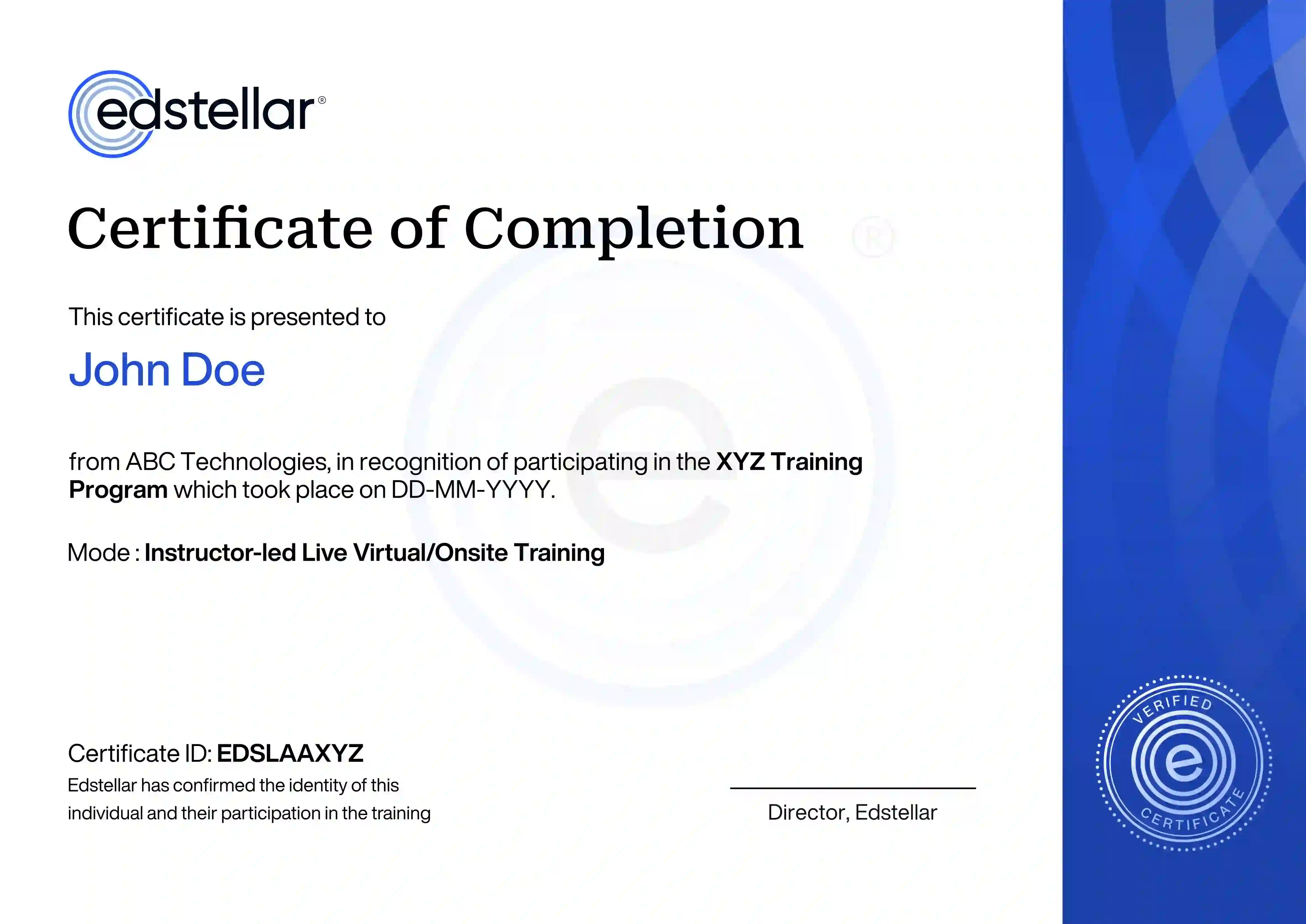
Get Your Team Members Recognized with Edstellar’s Course Certificate
Upon successful completion of the training course offered by Edstellar, employees receive a course completion certificate, symbolizing their dedication to ongoing learning and professional development.
This certificate validates the employee's acquired skills and is a powerful motivator, inspiring them to enhance their expertise further and contribute effectively to organizational success.


We have Expert Trainers to Meet Your SQL Advanced level for Analysts Training Needs
The instructor-led training is conducted by certified trainers with extensive expertise in the field. Participants will benefit from the instructor's vast knowledge, gaining valuable insights and practical skills essential for success in Access practices.
Other Related Corporate Training Courses
Explore More Courses
Edstellar is a one-stop instructor-led corporate training and coaching solution that addresses organizational upskilling and talent transformation needs globally. Edstellar offers 2000+ tailored programs across disciplines that include Technical, Behavioral, Management, Compliance, Leadership and Social Impact.
FAQs
BlogSitemap