Drive Team Excellence with Oracle Linux 8: System Administration Corporate Training

Oracle is a Linux distribution designed and supported by Oracle Corporation for enterprise-class use. Oracle Linux 8: System Administration provides detailed insights into various aspects of system administration that ensure the secure and reliable operation of enterprise-grade systems. By following effective system administration practices, professionals can promptly identify and resolve issues, minimize downtime, and ensure the continuous availability of services and applications. The Oracle Linux 8: System Administration training program enables professionals to manage and maintain Oracle Linux 8 systems efficiently and effectively.

The Oracle Linux 8: System Administration instructor-led training course provided by Edstellar can be customized to meet the teams’ requirements. The virtual/onsite Oracle Linux 8: System Administration training course led by expert trainers ensures professionals are well-equipped to handle various system administration tasks and will have the necessary skills to optimize, secure, and maintain Oracle Linux 8 environments to meet the needs of their organizations.

Get Customized Expert-led Training for Your Teams
Customized Training Delivery
Scale Your Training: Small to Large Teams
In-person Onsite, Live Virtual or Hybrid Training Modes
Plan from 2000+ Industry-ready Training Programs
Experience Hands-On Learning from Industry Experts
Delivery Capability Across 100+ Countries & 10+ Languages
""""

Skills Your Employees Will Gain

These are the core, hands-on capabilities your team builds during the program.

  • Installation
    Installation is the process of setting up equipment or systems for operation. This Skill is important for roles in engineering, IT, and construction, ensuring functionality and safety.
  • Configuration
    Configuration is the process of setting up systems or software to meet specific requirements. This Skill is important for IT roles, ensuring optimal performance and functionality.
  • Package management
    Package Management is the process of handling software packages, including installation, updates, and removal. This skill is important for DevOps and system administrators to ensure efficient software deployment and maintenance.
  • System monitoring
    System Monitoring involves continuously observing and analyzing system performance and health. This skill is important for IT professionals to ensure reliability, optimize resources, and prevent downtime.
  • Network configuration
    Network Configuration involves setting up and managing network devices to ensure optimal connectivity and performance. This skill is important for IT professionals, as it ensures reliable communication, security, and efficient data transfer within organizations.
  • Security
    Security refers to the measures taken to protect systems, networks, and data from unauthorized access or attacks. This Skill is important for IT roles to ensure data integrity and safeguard sensitive information.

What Your Team Will Achieve After This Training

  • Apply basic Linux commands for file system navigation, user management, and package management
  • Analyze the file system hierarchy and understand basic commands for system administration
  • Install Oracle Linux 8 on a system, configuring disk partitioning and file systems
  • Evaluate different SSH authentication methods (password vs. key-based) for secure remote connections
  • Troubleshoot boot issues by modifying GRUB bootloader configuration and accessing boot parameters
  • Manage systemd services using systemctl commands and explore unit file structure
  • Automate tasks using cron jobs and systemd timers for scheduled system administration activities
  • Maintain system health by managing kernel parameters, exploring system filesystems (proc & sysfs), and configuring udev rules

Topics & Program Outline

The curriculum is organized into focused modules built by industry experts and delivered virtually or on-premise. Interactive sessions reflect the evolving demands of the workplace, keeping the learning both relevant and practical.

  1. Introduction to Oracle Linux 8: System Administration
    • Demonstration
  2. Exploring the Gateway Machine
    • Exploring the Gateway Machine
  3. Exploring the host02 VM
    • File system exploration
    • Network configuration
  4. Exploring the host03 VM
    • User management
    • Package management
  5. Logging off from your Gateway Machine
    • Logging out commands
    • Session termination
  1. Introduction to Oracle Linux
    • Oracle Linux history
    • Key features
  2. Oracle Linux
    • File system hierarchy
    • Basic commands
  3. Viewing Kernel Information
    • Kernel version
    • System architecture
  1. Installing Oracle Linux 8
    • Pre-installation requirements
    • Installation process
  2. Installation destination
    • Disk partitioning
    • File system selection
    • Demonstration: Installing Oracle Linux 8
  1. OpenSSH
    • SSH key generation
    • Secure file transfer
  2. System installation
    • Installing OpenSSH
    • Service management
  3. Connecting to a remote server by using SSH
    • Remote connection setup
    • Authentication methods
  4. Configuring OpenSSH to connect without a password
    • Key-based authentication
    • SSH configuration file
  1. The GRUB Bootloader
    • Boot process overview
    • Configuration files
  2. GRUB 2 bootloader configuration
    • Configuration commands
    • Boot entry management
    • Exploring the GRUB 2 bootloader
    • Booting different kernels
    • Rebuilding the initramfs
    • Accessing the GRUB menu to select different kernels and to modify boot parameters
  1. Introduction to systemd
    • systemd features
    • Service management
  2. The Service Unit File
    • Unit file structure
    • Service dependencies
    • Grub menu and command line
    • Exploring systemd units
    • Working with systemd service units
  1. Managing time
    • Time synchronization
    • Time zones
  2. Automating system tasks
    • Cron jobs
    • Scheduled tasks
    • Configuring date and time
    • Configuring Chrony
    • Automating tasks with Chron
    • Automating tasks using systemd timers
  1. Kernel and device configuration
    • Kernel parameters
    • Hardware information
    • The sysfs file system
    • Demo 8-1: Update or upgrade using DNF
    • Using loadable kernel modules
    • Exploring the /proc file system
    • Exploring the sysfs file system
    • Using the sysctl utility
    • Exploring and configuring udev rules
  1. Package management
    • Software repositories
    • Dependency resolution
  2. Using DNF to install, upgrade, or remove packages
    • Package management commands
    • Repository management
  3. Using the RPM utility
    • RPM package management
    • Package verification
  4. Accessing the Oracle Linux Yum Server
    • Repository configuration
    • Yum repository management
  5. Creating a local Yum repository
    • Repository setup
    • Package syncing
  6. Using the DNF utility
    • Advanced DNF commands
    • Package listing and searching
  7. Using DNF modules
    • Module streams
    • Module management
  1. Oracle Ksplice
    • Ksplice overview
    • Patchless updates
  2. Ksplice web interface: System status detail
    • Interface navigation
    • System health monitoring
  3. Installing the Ksplice offline client and kernel updates
    • Offline update process
    • Kernel patching
  4. Ksplice online updates
    • Online update process
    • Live kernel patching
  1. User and group administration
    • User management
    • Group management
  2. Group account administration
    • Group creation
    • Group membership management
  3. Install and use oracle/ local case file
    • Case file creation
    • File management
  4. Administering user accounts
    • User creation
    • User permissions
  5. Administering group accounts
    • Group settings
    • Group permissions
  6. Implementing user private groups
    • Private group creation
    • File access control
  7. Configuring password aging
    • Password policy setup
    • User password management
  8. Restricting the use of the su command
    • su command configuration
    • User access control
  9. Allowing the use of the sudo command
    • sudo configuration
    • sudo command usage
  1. Partitions, file systems, and swap
    • Disk management
    • File system types
  2. Removing partitions and additional swap space
    • Partition removal
    • Swap space configuration
  3. File system types
    • File system overview
    • File system creation
  4. Listing the current disk partitions
    • Disk partition information
    • Disk partition management
  5. Partitioning a storage device
    • Partitioning tools
    • Partition creation
  6. Creating ext4 file systems
    • ext4 file system creation
    • File system tuning
  7. Increasing swap space
    • Swap file creation
    • Swap space management
  1. Network configuration
    • Network setup
    • Network troubleshooting
  2. The nmcli radio object
    • Network interface control
    • Radio object management
  3. Configuring the ethl network interface
    • Interface configuration
    • Network settings
  4. Using the nmcli utility
    • nmcli command usage
    • Network profile management
  5. Using the nmtui utility
    • nmtui command usage
    • Text-based network configuration
  6. Using the ip utility
    • ip command usage
    • Network interface management
  1. Network security
    • Firewall management
    • Network security policies
  2. Starting firewalld
    • Firewall activation
    • Firewall management
  3. Exploring firewalld
    • firewalld configuration
    • firewalld zones and services
  4. Configuring firewalld
    • Rule configuration
    • Service configuration
  5. Configuring nftables
    • nftables overview
    • nftables configuration
  1. Oracle on Oracle
    • Oracle software stack
    • Oracle-specific configurations
  2. Oracle-related shell limits
    • Shell configuration
    • Resource limits
  3. Installing and running Oracle Database Preinstall
    • Preinstall package installation
    • Database setup
  4. Preparing disks for ASM use
    • Disk preparation
    • ASM configuration
  5. Installing and configuring ASMLib
    • ASMLib setup
    • Disk management with ASMLib
  6. Reverting changes made to host02
    • Configuration rollback
    • System restoration
  1. System monitoring and management
    • System health monitoring
    • Performance optimization
  2. Top utility
    • top command usage
    • Process management
  3. OSWatcher Analyzer (OSWbba)
    • OSWatcher setup
    • System analysis
  4. Using sosreport to collect system information
    • sosreport usage
    • System information collection
  5. Using standard Linux performance monitoring tools
    • Performance monitoring tools
    • Resource usage analysis
  6. Installing and using OSWatcher
    • OSWatcher installation
    • System monitoring
  7. Using OSWatcher Analyzer
    • Analyzer setup
    • System health analysis
  1. System logging
    • Logging configuration
    • Log file management
  2. Configuring log rotation (logrotate)
    • Log rotation setup
    • Log file compression
  3. Configuring system logging
    • rsyslog configuration
    • Logging policies
  4. Using rsyslog templates
    • Template configuration
    • Log file formatting
  5. Using logwatch
    • logwatch setup
    • Log analysis
  6. Using systemd-journald
    • journald configuration
    • Journal log management
  1. Troubleshooting
    • System diagnosis
    • Problem resolution techniques
  2. Transferring utilities from Gateway & System utility commands fail
    • Utility transfer troubleshooting
    • System command failure analysis

Who Should Attend?

This program suits professionals at many levels across the organization, including:

  • System Administrators
  • Linux Administrators
  • IT Professionals
  • Network Administrators
  • Database Administrators
  • Infrastructure Engineers
  • IT Support Engineers
  • Cloud Engineers
  • DevOps Engineers
  • System Engineers
  • Network Engineers
  • Managers

What are the Prerequisites?

Professionals with a basic understanding of the Linux operating system and its core functionalities, familiarity with Linux command line operations and text editing with editors such as vi or nano, knowledge of general computing concepts and tasks, including file management and software installation, experience with navigating through Linux file systems and setting file permissions, understanding of networking fundamentals, such as IP addressing, DNS, and DHCP, and an eagerness to learn and the ability to follow step-by-step instructions for hands-on labs and exercises can take up the Oracle Linux 8: System Administration training course.

Request a Quote for your Corporate Training Requirements

Valid number

Delivering Training for Organizations across 100 Countries and 10+ Languages

Choose the Format That Fits Your Team

We design training your teams actually engage with, and deliver it the way that suits you best. Through a vetted global trainer network, Edstellar runs sessions in 10+ languages with consistent quality anywhere.

Virtual Oracle Linux 8: System Administration Training

Virtual / online: expert-led live sessions delivered anywhere, with consistency and easy scheduling.

We deliver anywhere worldwide
Standardized content for consistent outcomes
Join from own workspace, no travel
We scale to large groups across sites
Interactive tools keep remote learners engaged
On-site Oracle Linux 8: System Administration Training

On-site (in-house): immersive, instructor-led learning at your office.

Our trainers run face-to-face at your office
We tailor setup/content to your workplace and tools
Group exercises drive collaboration
Live demos +  hands-on practice
Direct trainer access to clarify doubts
Off-site Oracle Linux 8: System Administration Training

Off-site: focused, instructor-led group learning away from everyday workplace distractions.

We host your teams at a venue of your preferred choice
Built-in group activities for bonding
Full uninterrupted schedule for focus/retention
Boosts morale and signals commitment

Get a Proposal Shaped to Your Needs

Need pricing for onsite, offsite, or virtual delivery? Get a proposal tailored to your team's needs.

Request a Group Training Quote
""
How Many Team Members Need Training?
Please select an option or fill in the custom field.
"'

Is Your Corporate Training Requirement Only for Oracle Linux 8: System Administration?

Please select at least one course.
""
Add the List of Training Workshops
search icon

      Please select the course

      No. of Courses selected: 0

      Clear

      Upload a CSV

      Send us your Training Requirements in 3 Easy steps

      1. 1
      2. 2
        Add the required training workshops
      3. 3
        Upload to get a quick quote or email it to contact@edstellar.com

      ""

      Looking for a Complete Package?

      Looking for a one-time pricing option for all your annual training requirements?

      View Corporate Training Packages
      ""
      Select the Option that Best Describes Your Corporate Training Requirement

      Please select an option or choose from the recurring options.
      ""
      Verify and Submit Your Request

      Review Your Corporate Training Selection Summary

      Training Program: Oracle Linux 8: System Administration Training

      1. No of Team Members

      2. Selected Training Preference

      3. Selected Recurring Sessions

      1

      Review your Requirements

      Training Workshops Selected :


        Excel
        File has been
        successfully uploaded.
        Fill the form to submit
 your details
        Submit Your Professional Contact Information
        Valid number
        We've received your enquiry. Our team will be in touch soon.
        Oops! Something went wrong while submitting the form.
        Starter
        120 licences

        Tailor-Made Trainee Licenses with Our Exclusive Training Packages!

        View Package

        64 hours of group training (includes VILT/In-person On-site)

        Tailored for SMBs

        Growth
        320 licences

        Tailor-Made Trainee Licenses with Our Exclusive Training Packages!

        View Package

        160 hours of group training (includes VILT/In-person On-site)

        Ideal for growing SMBs

        Enterprise
        800 licences

        Tailor-Made Trainee Licenses with Our Exclusive Training Packages!

        View Package

        400 hours of group training (includes VILT/In-person On-site)

        Designed for large corporations

        Custom
        Unlimited licenses

        Tailor-Made Trainee Licenses with Our Exclusive Training Packages!

        View Package

        Unlimited duration

        Designed for large corporations

        What Sets Edstellar Apart

        Experienced Trainers

        Our trainers are drawn from a vetted global network and bring years of industry expertise, keeping every session practical and impactful.

        Proven Quality

        With a strong global track record, Edstellar is known for quality and engaging delivery.

        Industry-Relevant Curriculum

        Our programs are built by experts to match the demands of today's industry.

        Fully Customizable

        Every program can be tailored to your organization's goals.

        Comprehensive Support

        We provide pre- and post-session support for a complete learning experience.

        Global Multi-Location & Multilingual Training Delivery

        We deliver in multiple languages to support diverse global teams.

        Hear from Organizations We've Trained

        "This Oracle Linux 8: System Administration course was exactly what I needed to advance my career. As a Principal Android Engineer, mastering industry best practices has become crucial for my success. The in-depth frameworks I use daily. My ability to architect solutions and solve complex problems has improved substantially. The real-world examples and deep dive into expert-led workshops were particularly valuable for my professional growth.”

        Ashley James

        Principal Android Engineer,

        Mission-Critical Database Services

        "This Oracle Linux 8: System Administration course equipped me with comprehensive strategic frameworks expertise that I've seamlessly integrated into our professional services practice. The hands-on modules covering real-world case I now confidently design solutions that consistently deliver measurable business results. Our client satisfaction scores improved by 35% across all accounts, validating the immediate impact of this training program.”

        Xue Lei

        Senior Frontend Engineer,

        Enterprise Data Platform Provider

        "As a Senior React Native Developer overseeing professional expertise initiatives, the Oracle Linux 8: System Administration training significantly elevated our team's capabilities. The course expertly covered transformed our operational effectiveness. Our stakeholder satisfaction and NPS scores reached unprecedented all-time highs. Our department has achieved remarkable improvements, demonstrating this course's lasting organizational impact.”

        Chitra Senthil

        Senior React Native Developer,

        Enterprise Database Solutions Provider

        “Edstellar’s IT & Technical training programs have been instrumental in strengthening our engineering teams and building future-ready capabilities. The hands-on approach, practical cloud scenarios, and expert guidance helped our teams improve technical depth, problem-solving skills, and execution across multiple projects. We’re excited to extend more of these impactful programs to other business units.”

        Aditi Rao

        L&D Head,

        A Global Technology Company

        Recognition That Motivates Your Team

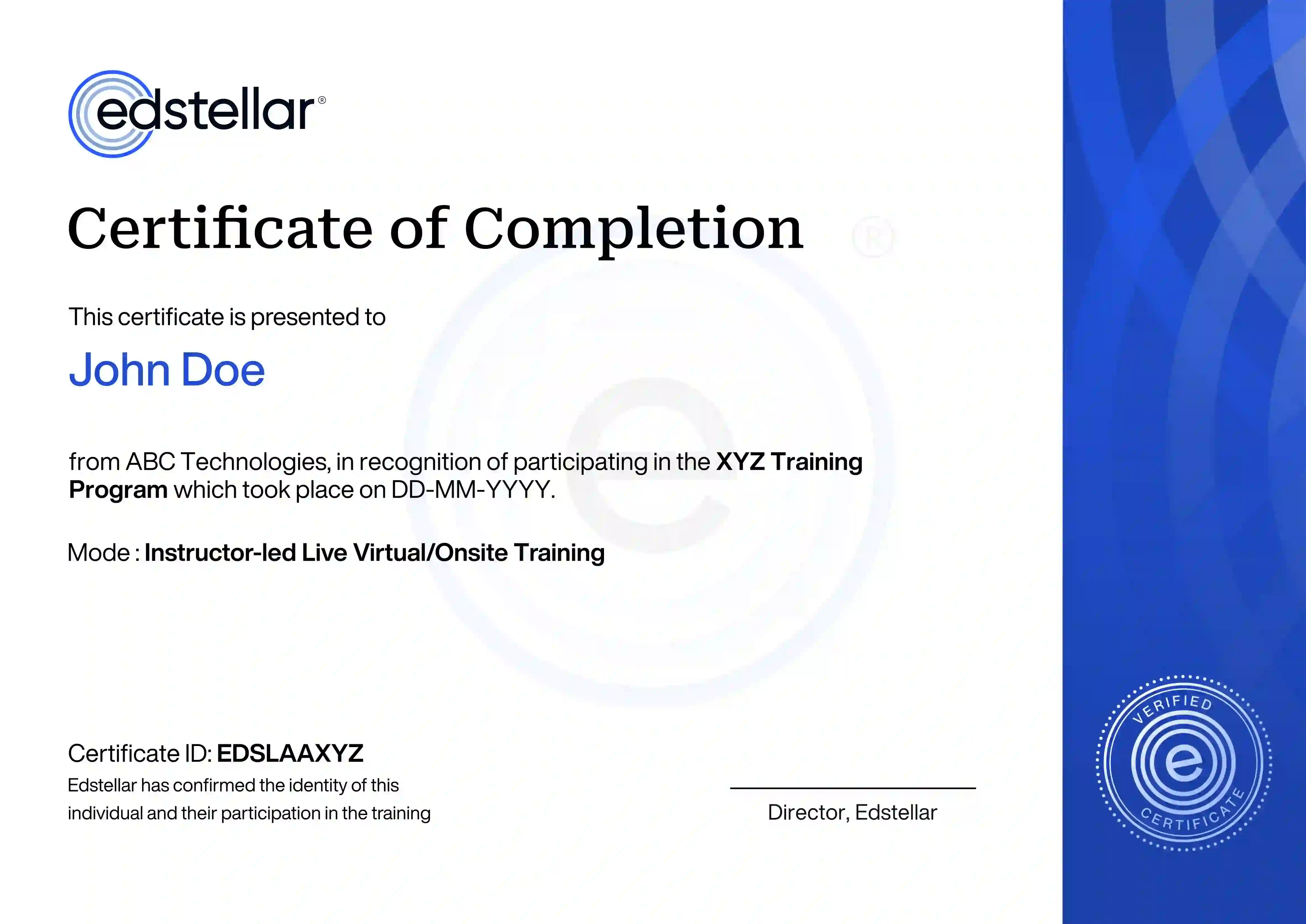
        Upon successful completion of the training course offered by Edstellar, employees receive a course completion certificate, symbolizing their dedication to ongoing learning and professional development.

        This certificate validates the employee's acquired skills and is a powerful motivator, inspiring them to enhance their expertise further and contribute effectively to organizational success.

        Recognition That Motivates Your Team
        Other Related Corporate Training Courses