Corporate Rundeck Training Course
Edstellar’s Rundeck instructor-led training course equips employees with the skills to utilize Rundeck automation and orchestration effectively. Employees will learn to troubleshoot and debug configurations and customize node management. Upskill your team to optimize Rundeck configurations for performance and scalability.
(Virtual / On-site / Off-site)
Available Languages
English, Español, 普通话, Deutsch, العربية, Português, हिंदी, Français, 日本語 and Italiano
Drive Team Excellence with Rundeck Corporate Training
Empower your teams with expert-led on-site, off-site, and virtual Rundeck Training through Edstellar, a premier corporate training provider for organizations globally. Designed to meet your specific training needs, this group training program ensures your team is primed to drive your business goals. Help your employees build lasting capabilities that translate into real performance gains.
Rundeck is an open-source automation and orchestration tool developed to streamline IT operations by automating routine tasks. It's crucial for organizations as it enhances efficiency, reduces errors, and promotes collaboration by providing a centralized control mechanism for managing and executing tasks across complex infrastructure. Training in Rundeck generally equips users with the skills to effectively utilize the platform's features, enabling them to streamline operations, improve productivity, and optimize resource utilization within their organization.
Edstellar's virtual/onsite Rundeck training course offers customization and employs cutting-edge methodologies. Our trainers are renowned for their expertise in Rundeck instructor-led training course and have vast experience guiding teams through the complexities of Rundeck.

Key Skills Employees Gain from instructor-led Rundeck Training
Rundeck skills corporate training will enable teams to effectively apply their learnings at work.
- AutomationAutomation is the use of technology to perform tasks with minimal human intervention. This Skill is important for roles in engineering, IT, and manufacturing to enhance efficiency, reduce errors, and save time.
- OrchestrationOrchestration is the coordination of complex processes and systems to achieve seamless integration. This skill is important for roles in IT, project management, and operations, ensuring efficiency and effectiveness.
- Workflow ManagementWorkflow Management is the process of optimizing and coordinating tasks to enhance efficiency and productivity. This skill is important for roles like project managers and operations specialists, as it ensures timely project completion and resource allocation.
- Task SchedulingTask Scheduling is the ability to prioritize and allocate time effectively for various tasks. this skill is important for project managers to ensure timely project delivery and resource optimization.
- Job ExecutionJob Execution refers to the ability to effectively implement tasks and projects within a specified timeframe and quality standards. This skill is important for roles like project managers and team leaders, as it ensures goals are met efficiently and resources are utilized optimally.
- ScriptingScripting is the ability to write code that automates tasks or processes. this skill is important for roles in software development, data analysis, and IT, enhancing efficiency and accuracy.
Key Learning Outcomes of Rundeck Training Workshop for Employees
Upon completing Edstellar’s Rundeck workshop, employees will gain valuable, job-relevant insights and develop the confidence to apply their learning effectively in the professional environment.
- Analyze automation requirements within organizational workflows to identify opportunities for Rundeck implementation
- Design Rundeck projects tailored to specific use cases, considering resource allocation and configuration management
- Execute job definitions efficiently, scheduling tasks and managing dependencies to optimize workflow execution
- Troubleshoot Rundeck configurations and executions, diagnosing errors and implementing effective solutions
- Integrate Rundeck with existing tools and systems, ensuring seamless interoperability and data exchange
- Customize node management in Rundeck, configuring nodes and implementing filtering strategies for targeted job execution
Key Benefits of the Rundeck Group Training
Attending our Rundeck group training classes provides your team with a powerful opportunity to build skills, boost confidence, and develop a deeper understanding of the concepts that matter most. The collaborative learning environment fosters knowledge sharing and enables employees to translate insights into actionable work outcomes.
- Equips the team with the techniques to automate routine tasks and workflows
- Empowers employees with the skills to improve operational efficiency and reduce manual errors
- Develops required skills in employees to effectively manage complex IT environments
- Provides teams with insights into optimizing Rundeck for specific business needs and workflows
- Instills ideas in employees for enhancing collaboration and communication within IT teams
Topics and Outline of Rundeck Training
Our virtual and on-premise Rundeck training curriculum is structured into focused modules developed by industry experts. This training for organizations provides an interactive learning experience that addresses the evolving demands of the workplace, making it both relevant and practical.
- Overview of automation principles and benefits
- Reduced human error and improved consistency
- Increased efficiency and productivity
- Improved scalability and agility
- Enhanced visibility and control over IT processes
- Introduction to Rundeck's role in automation and orchestration
- Workflow design and execution capabilities
- Scheduling and triggering automated tasks
- Job dependency management and chaining
- Comparison with other automation tools in the market
- Feature comparison
- Target audience and use case suitability
- Deployment options
- Pricing models and licensing considerations
- Community support and ecosystem strength
- Use cases and examples of Rundeck implementation
- Application deployment and configuration management
- Server and infrastructure provisioning
- Patching and vulnerability management
- Data processing and ETL workflows
- System requirements and prerequisites
- Operating system compatibility
- Hardware resource requirements
- Software dependencies
- Installation methods:
- Package manager installation steps
- Docker deployment configuration options
- Manual installation process overview
- Cloud platform deployment considerations
- Initial setup and configuration wizard walkthrough
- Defining basic configuration settings
- Creating the initial administrative user
- Selecting a database backend
- Configuration file overview and customization options
- Location and structure of configuration files
- Available configuration settings for various functionalities
- Editing and customizing configuration options
- Best practices for secure configuration management
- Project creation and organization in Rundeck
- Defining project purposes and access controls
- Creating hierarchical project structures
- Grouping related jobs and resources within projects
- Sharing and collaboration features for project teams
- Defining project resources
- Types of nodes
- Node sources for managing node inventory
- Assigning tags and labels for node categorization
- Configuration management within Rundeck projects
- Integrating Rundeck with configuration management tools
- Utilizing project-specific configurations for jobs
- Version control for configuration files within projects
- Best practices for project structure and layout
- Organizing projects for scalability and maintainability
- Defining clear naming conventions for resources
- Utilizing project templates for faster setup
- Documenting project purpose and configuration details
- Job definition components
- Script execution details
- Job options
- Notification settings
- Security considerations
- Scheduling job executions
- Defining recurring schedules
- Triggering jobs manually
- Handling time zone considerations
- Parameterizing job inputs for dynamic execution
- Defining job parameters and their data types
- Providing default values for optional parameters
- Using job parameters to customize job behavior
- Dependency management and job chaining techniques
- Specifying job dependencies
- Defining execution order for dependent jobs
- Handling job failures and retries within chains
- Utilizing conditional branching based on job execution results
- Building complex workflows with chained job dependencies
- Adding and managing nodes in Rundeck
- Manual node registration process
- Importing nodes from external sources
- Grouping nodes for targeted job execution
- Managing node lifecycles
- Node sources
- File-based node sources
- Ad-hoc node sources for temporary or dynamic nodes
- LDAP integration
- External system integrations for node discovery
- Node attributes and metadata management
- Defining custom attributes for nodes
- Utilizing node attributes for job filtering and targeting
- Inheriting attributes from parent nodes in hierarchies
- Managing sensitive node attributes securely
- Node filtering strategies for targeted job execution
- Including and excluding nodes based on attributes
- Combining multiple filtering criteria for precise targeting
- Using regular expressions for complex node selection
- Dynamic filtering based on job execution context
- Leveraging node filters to optimize job performance
- Built-in command types
- Script execution
- Ad-hoc commands
- Workflow commands
- Node-to-node commands
- URL commands
- Creating and managing custom commands in Rundeck
- Defining custom script executions with specific parameters
- Integrating with external tools and plugins
- Utilizing pre-built scripts or templates
- Version control and testing procedures
- Security considerations
- Command execution options
- Parallelism
- Node targeting
- Timeout settings
- Success and failure conditions
- Error handling and logging for command executions
- Defining retry logic for failed commands
- Capturing and analyzing error messages for troubleshooting
- Integrating with external monitoring systems for alerts
- Configuring different log levels for detailed tracking
- Monitoring job executions in real-time
- Viewing job status dashboards with progress updates
- Tracking individual node execution details within jobs
- Utilizing logs and output streams for real-time insights
- Execution lifecycle
- Understanding job states
- Identifying reasons for job failures and retries
- Terminating or stopping ongoing job executions
- Managing concurrent job executions on the Rundeck server
- Job execution details and status reports
- Viewing detailed logs and output from each job execution
- Analyzing job execution statistics
- Downloading job execution history data
- Generating custom reports for specific job
- Troubleshooting common execution errors and issues
- Diagnosing node connectivity problems
- Resolving script execution errors and permission issues
- Handling timeouts and resource limitations
- Debugging complex workflow execution failures
- Utilizing Rundeck logs and debugging tools for troubleshooting
- Activity log overview and analysis
- Understanding the different types of logged activities
- Filtering and searching activity logs
- Utilizing timestamps and user information
- Correlating activity logs with other system logs
- Generating activity reports and metrics
- Defining custom reports for specific activities
- Scheduling automated report generation for periodic analysis
- Utilizing visualizations
- Sharing activity reports with stakeholders
- Interpreting activity trends and patterns
- Analyzing user activity patterns
- Identifying periods of peak job execution
- Detecting anomalies or suspicious activity
- Customizing activity logging settings and retention policies
- Configuring the level of detail logged
- Defining log rotation policies to manage log volume
- Archiving or exporting activity logs
- Ensuring data security and privacy
- Advanced configuration options for Rundeck
- Security settings
- Resource management
- Integration settings
- Job execution settings
- Logging and auditing configuration
- Performance tuning and optimization techniques
- Identifying performance bottlenecks in Rundeck execution
- Optimizing job scheduling and resource allocation
- Utilizing caching mechanisms for frequently accessed data
- Configuring resource pools for dedicated workloads
- Scaling Rundeck for large deployments
- Horizontal scaling with additional Rundeck servers
- Load balancing strategies
- Utilizing external databases
- High availability and failover configuration
- Setting up redundant Rundeck servers for fault tolerance
- Utilizing clustering or load balancing techniques for failover
- Minimizing downtime during server outages or maintenance
- Disaster recovery strategies for Rundeck infrastructure
- User management
- Adding, modifying, and deleting user accounts
- Defining user roles and assigning permissions
- Utilizing groups for managing user access controls
- Integrating with external authentication sources
- Enforcing password complexity and security policies
- Role-Based Access Control (RBAC) in Rundeck
- Defining granular permissions
- Controlling access to projects, jobs, and resources
- Restricting user actions based on their roles
- Configuring authentication methods
- Utilizing local user accounts managed within Rundeck
- Integrating with LDAP
- Implementing SAML Single Sign-On (SSO)
- Configuring security protocols for authentication
- Auditing user activity and access logs
- Tracking user login attempts and access history
- Monitoring job executions initiated by specific users
- Identifying unauthorized access attempts
- Generating reports for user activity audits
- Complying with security regulations and data privacy requirements
- Understanding node filtering concepts and mechanisms
- Including and excluding nodes based on attributes and tags
- Using logical operators
- Regular expressions
- Dynamic filtering
- Leveraging inheritance
- Creating and managing node filters for job execution
- Defining reusable filter expressions
- Saving and sharing node filters with other users
- Utilizing templates
- Organizing and versioning node filters
- Dynamic node filtering based on attributes and tags
- Filtering nodes based on dynamic job parameters
- Utilizing scripting languages
- Ensuring filter expressions are efficient and scalable
- Advanced node filtering strategies for complex environments
- Combining multiple filtering criteria
- Utilizing nested filters for hierarchical node structures
- Filtering based on node relationships and dependencies
- Building filters to target specific operating systems
- Leveraging external data sources
Who Can Take the Rundeck Training Course
The Rundeck training program can also be taken by professionals at various levels in the organization.
- DevOps Engineers
- System Administrators
- IT Professionals
- Automation Engineers
- Cloud Engineers
- Infrastructure Engineers
- Operations Engineers
- IT Support Engineers
- System Engineers
- Site Reliability Engineers
- Build and Release Engineers
- Managers
Prerequisites for Rundeck Training
Employees with a basic understanding of Elasticsearch/Rundeck, JSON, Linux and Windows can take up the Rundeck training course.
Corporate Group Training Delivery Modes
for Rundeck Training
At Edstellar, we understand the importance of impactful and engaging training for employees. As a leading Rundeck training provider, we ensure the training is more interactive by offering Face-to-Face onsite/in-house or virtual/online sessions for companies. This approach has proven to be effective, outcome-oriented, and produces a well-rounded training experience for your teams.
.webp)
Edstellar's Rundeck virtual/online training sessions bring expert-led, high-quality training to your teams anywhere, ensuring consistency and seamless integration into their schedules.
.webp)
Edstellar's Rundeck inhouse training delivers immersive and insightful learning experiences right in the comfort of your office.
.webp)
Edstellar's Rundeck offsite group training offer a unique opportunity for teams to immerse themselves in focused and dynamic learning environments away from their usual workplace distractions.
Explore Our Customized Pricing Package
for
Rundeck Corporate Training
Looking for pricing details for onsite, offsite, or virtual instructor-led Rundeck training? Get a customized proposal tailored to your team’s specific needs.
64 hours of group training (includes VILT/In-person On-site)
Tailored for SMBs
Tailor-Made Trainee Licenses with Our Exclusive Training Packages!
160 hours of group training (includes VILT/In-person On-site)
Ideal for growing SMBs
Tailor-Made Trainee Licenses with Our Exclusive Training Packages!
400 hours of group training (includes VILT/In-person On-site)
Designed for large corporations
Tailor-Made Trainee Licenses with Our Exclusive Training Packages!
Unlimited duration
Designed for large corporations
Edstellar: Your Go-to Rundeck Training Company
Experienced Trainers
Our trainers bring years of industry expertise to ensure the training is practical and impactful.
Quality Training
With a strong track record of delivering training worldwide, Edstellar maintains its reputation for its quality and training engagement.
Industry-Relevant Curriculum
Our course is designed by experts and is tailored to meet the demands of the current industry.
Customizable Training
Our course can be customized to meet the unique needs and goals of your organization.
Comprehensive Support
We provide pre and post training support to your organization to ensure a complete learning experience.
Multilingual Training Capabilities
We offer training in multiple languages to cater to diverse and global teams.
What Our Clients Say
We pride ourselves on delivering exceptional training solutions. Here's what our clients have to say about their experiences with Edstellar.
"The Rundeck training provided me with comprehensive capabilities that elevated my expertise. As a Senior Software Engineer, I needed to understand industry best practices deeply, and this course delivered perfectly. The interactive labs gave me hands-on experience with industry best practices. My productivity and technical capabilities have increased dramatically since applying these concepts. Highly recommend for anyone serious about this field.”
Dave Dixon
Senior Software Engineer,
Technology Consulting Services Company
"The Rundeck training enhanced my ability to architect and implement sophisticated strategic implementation strategies. Understanding advanced methodologies through intensive expert-led workshops exercises proved invaluable for client projects. initiatives. Our solution delivery efficiency and quality have increased substantially across the board. The detailed exploration of hands-on exercises provided methodologies I leverage in every engagement.”
Francesco Esposito
Senior Software Engineer,
Global Technology Solutions Provider
"The Rundeck training gave our team advanced practical applications expertise that revolutionized our strategic implementation approach. As a Senior Software Engineer, understanding real-world case studies and interactive labs across our entire portfolio. We've successfully deployed these methodologies across all regional operations centers. This training has become foundational to our team's strategic capabilities and continued growth.”
Gopal Dey
Senior Software Engineer,
Digital Innovation Platform
“Edstellar’s IT & Technical training programs have been instrumental in strengthening our engineering teams and building future-ready capabilities. The hands-on approach, practical cloud scenarios, and expert guidance helped our teams improve technical depth, problem-solving skills, and execution across multiple projects. We’re excited to extend more of these impactful programs to other business units.”
Aditi Rao
L&D Head,
A Global Technology Company
Get Your Team Members Recognized with Edstellar’s Course Certificate
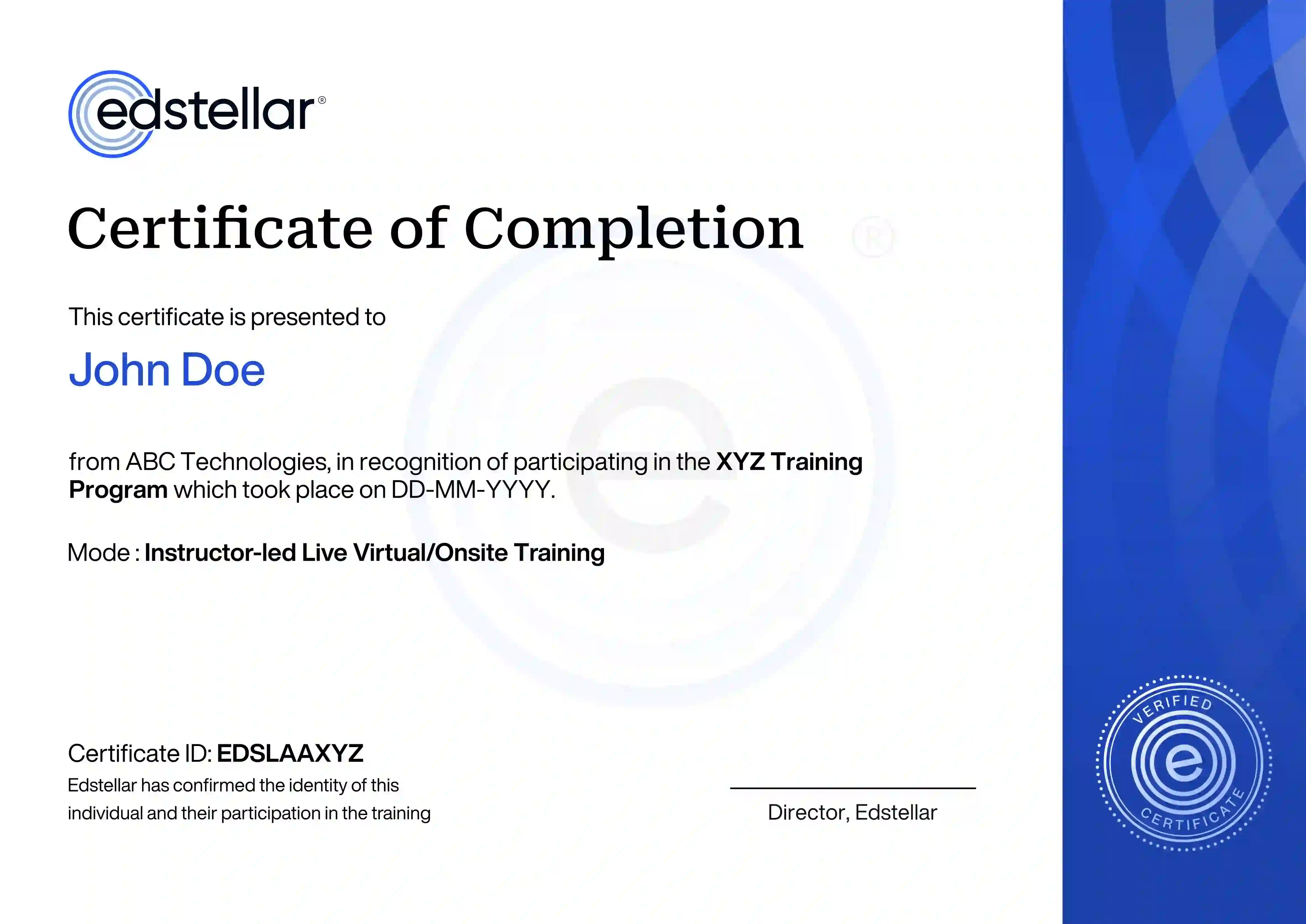
Upon successful completion of the training course offered by Edstellar, employees receive a course completion certificate, symbolizing their dedication to ongoing learning and professional development.
This certificate validates the employee's acquired skills and is a powerful motivator, inspiring them to enhance their expertise further and contribute effectively to organizational success.


We have Expert Trainers to Meet Your Rundeck Training Needs
The instructor-led training is conducted by certified trainers with extensive expertise in the field. Participants will benefit from the instructor's vast knowledge, gaining valuable insights and practical skills essential for success in Access practices.
Other Related Corporate Training Courses
Explore More Courses
Edstellar is a one-stop instructor-led corporate training and coaching solution that addresses organizational upskilling and talent transformation needs globally. Edstellar offers 2000+ tailored programs across disciplines that include Technical, Behavioral, Management, Compliance, Leadership and Social Impact.
FAQs
BlogSitemap