

Environmental Sustainability Essentials Corporate Training
Learn what sustainability means for your team's work: climate drivers, carbon basics, and ESG reporting, practiced in live guided labs.
Your team builds a working understanding of environmental sustainability and the confidence to act on it. Employees learn climate drivers, carbon accounting basics, and ESG reporting essentials through guided labs led by practitioners, then build a practical action plan for their own footprint. Each session is tuned to your operations, data, and reporting needs.
Instructor-led group trainingVirtual / on-site / hybrid10 languagesDelivered in English, Spanish, Mandarin, German, Arabic, Portuguese, Hindi, French, Japanese, Italian100+ countriesWe have delivered in United States, United Kingdom, India, Canada, Germany, France, Netherlands, UAE, Saudi Arabia, Singapore, Australia, Japan, Brazil, South Africa and 90+ more countries
How we build a sustainability-ready team
EDSTELLAR ENVIRONMENTAL SUSTAINABILITY CAPABILITY MODEL
Assess sustainability awareness
Skill checks map your team's carbon literacy, data readiness, and reporting baseline.
Standardize the basics
Align scopes, emission factors, and evidence habits before any reporting begins.
Practice with hands-on labs
Build carbon ledgers, audit operations, and draft disclosures in guided labs.
Measure readiness to act
Review action plans and reports against standards and stakeholder expectations.
Scale the program
Roll out action plans and reporting routines across teams and locations.



Need more than one program?Get a group quote
Trusted as a Leading Corporate Training Provider by
















Program Overview: What is Environmental Sustainability Essentials?
Environmental Sustainability Essentials is Edstellar's instructor-led program for business teams who are new to sustainability but own the goals. Participants learn sustainability foundations, carbon and emissions literacy, energy, waste, and water essentials, ESG reporting standards, and stakeholder engagement. The program turns sustainability from a vague mandate into practical, everyday work.
Training is hands-on from the first module. Participants build carbon literacy by working with real emissions data, then run energy, waste, and water exercises that mirror their own facilities in guided labs. Instructors coach the team through ESG reporting practice and stakeholder communication, reviewing every exercise with direct feedback. The program closes with a capstone where each team delivers its own sustainability essentials action plan.
Most teams face growing sustainability pressure with no shared vocabulary: targets set without baselines, reports assembled at the last minute, and initiatives that stall after launch. This program teaches your team to measure what matters, report credibly, and communicate progress to stakeholders. Every skill is practiced on realistic scenarios, so the learning survives contact with your operations.
The capstone is a working action plan, not a slide deck: the team prioritizes its own emissions, waste, and energy opportunities, sets measurable targets, and assigns owners and timelines. They defend the plan against realistic stakeholder pushback, the kind that kills initiatives in real companies. Your team returns with a plan leadership can fund and a shared language for the work ahead.
Six modules and 24 hours: sustainability foundations, carbon basics, energy, waste, and water levers, ESG reporting standards, stakeholder communication. Every module pairs concepts with a guided lab, so each idea is practiced before the next is introduced. It closes with a capstone where the team builds its own sustainability essentials action plan.
Delivery is hybrid across virtual and onsite sessions, scheduled around your calendar. Cohorts train as one group or split into batches, with session materials and lab guides included for every participant.
What's Included in this Workshop for Your Enterprise Teams
- 1
Sustainability foundations labs
Connect climate drivers and ESG basics to your team's work.
- 2
Carbon literacy labs
Build mini ledgers with scopes and emission factors.
- 3
Operations lever audits
Find energy, waste, and water actions in sample profiles.
- 4
Reporting practice
Map requirements and check claims for greenwashing risk.
- 5
Capstone action plan
Deliver a practical plan for your own footprint.
- Instructor-led delivery across virtual, onsite, and hybrid
- Guided labs in every module with instructor coaching
- Capstone action plan, reviewed with your team
- Flexible scheduling around your calendar
- Lab guides and reusable sustainability templates included
- Group size and batches set along with you
Build your team's skills. Anywhere in the world.
Real-world use cases
from day one
Instructor-led training
for your teams
Delivered globally
in 100+ countries


Enterprise Training Solutions Customized for Your Company
One partner for instructor-led corporate training, delivered the way your teams work.
Request a Training Quote- Customized Training Delivery
- Scale Your Training: Small to Large Teams
- In-person Onsite, Live Virtual or Hybrid Training Modes
- Plan from 2000+ Industry-ready Training Programs
- Data Analysis Exercises, Led by Industry Experts
Environmental Sustainability Essentials Course Topics and Program Outline
A tailored 24-hour, six-module program: one learning journey from sustainability foundations to a capstone action plan. Guided labs run throughout, so every concept is practiced with instructor coaching.
Built by Edstellar with sustainability trainers
Built by sustainability practitioners who run carbon accounting workshops, reporting sessions, and ESG training programs in production, shaped around your operations and use cases.
Skill checks baseline your team's sustainability awareness, carbon literacy, and reporting exposure before training begins.
Live instruction covers climate drivers, ESG basics, and carbon accounting across 6.5 focused hours.
Guided labs audit operations, build carbon ledgers, and map reporting standards with instructor coaching.
Your team builds a full sustainability essentials action plan in 9.5 hours, reviewed against standards and stakeholder needs.
From sustainability foundations to a capstone action plan, every skill is practiced in guided labs.
Delivered as
Delivered as a hybrid program of live instruction and guided labs, scheduled around your team's calendar in flexible batches.

Map your organization's footprint: identify the three activities with the largest environmental impact for your team.
learnClimate change drivers and business relevance
ESG essentials: environment, social, governance
The business case: risk, brand, and opportunity
Roles and responsibilities across the team
Build a mini carbon ledger in a guided lab: enter activity data, apply emission factors, and check totals.
learnGHG Protocol scopes 1, 2, and 3 explained
Activity data and emission factors
Reading carbon footprints and benchmarks
Common errors in emissions reporting
Audit a sample operations profile: find five reduction opportunities and rank them by cost, effort, and impact.
practiceEnergy use profiles and efficiency basics
Waste streams, segregation, and circular thinking
Water use, metering, and conservation actions
Prioritizing levers with cost and effort filters
Map a sample program against reporting standard requirements and flag gaps in evidence and documentation.
practiceGRI, ISSB, and CSRD essentials for teams
Materiality: what matters and to whom
Evidence collection and documentation habits
Avoiding greenwashing in claims and statements
Draft a stakeholder communication pack: one dashboard page and three claims-checked statements for a program update.
applyMapping stakeholders and their questions
Claims, targets, and net-zero language
Building simple sustainability dashboards
Disclosure calendars and review routines
Present a complete essentials action plan: baseline, priority levers, reporting calendar, and owners to a panel for review.
applyBaseline: footprint summary for your team
Priority levers with owners and timelines
Reporting calendar and evidence routines
Action plan presentation and defense
Customize this program tailored to your team?
Tell us your training needs: what your team already works with, the level they’re at, and the topics you want them to focus on. We’ll adjust the modules, duration and hands-on labs, and send you a customized outline for your group.
Key Skills and Outcomes Your Team Will Gain
Seven job-ready outcomes your team will demonstrate by the end of the program. Each competency is practiced in guided labs and reviewed in the capstone build.
Explain climate and ESG basics
Connect climate change, ESG, and sustainability to your team's day-to-day work.
Read carbon footprints with ease
Interpret scopes 1, 2, and 3 and the activity data behind them.
Build basic emissions inventories
Assemble activity data and emission factors into working carbon ledgers.
Audit energy, waste, and water
Find practical reduction opportunities in operations profiles and rank them.
Apply ESG reporting standards
Map GRI, ISSB, and CSRD essentials to real evidence and documentation.
Communicate progress credibly
Draft claims-checked statements and stakeholder dashboards.
Build a sustainability action plan
Assemble baseline, levers, reporting calendar, and owners into one plan.
Teams that Benefit from this Environmental Sustainability Essentials Group Training
This group training is built for teams that want shared sustainability fluency and practical next steps. Content adapts to each cohort's roles, operations, and reporting context, so every batch practices the workflows it owns, from carbon basics to action planning.
Give every team member shared sustainability fluency.
Sustainability teams build a common language on climate drivers, carbon basics, and reporting essentials, so programs start from one baseline.
Workflow friction
- Uneven sustainability knowledge in teams
- Reporting standards feeling out of reach
- Goals set without an action plan
How the program helps
- Shared carbon literacy across the team
- Reporting basics mapped to your standards
- Action plans built in guided labs
Practice use cases
- Carbon ledger labs
- Reporting basics labs
- Action plan labs
Spot energy, waste, and water wins on the floor.
Operations and facilities staff learn to audit their own footprint and rank reduction levers by cost, effort, and impact.
Workflow friction
- Energy and waste costs rising yearly
- No baseline to measure against
- Actions scattered across teams
How the program helps
- Operations audits done in guided labs
- Lever rankings built for your sites
- Quick wins identified with owners
Practice use cases
- Operations audit labs
- Lever ranking labs
- Baseline build labs
Roll out sustainability learning with confidence.
HR and L&D teams learn the essentials vocabulary and structure to support company-wide sustainability programs and onboarding.
Workflow friction
- Training asks outpacing HR expertise
- Inconsistent messaging across sites
- Engagement hard to sustain
How the program helps
- Essentials vocabulary for HR programs
- Onboarding content shaped with you
- Cohort plans for wider rollouts
Practice use cases
- Onboarding labs
- Program rollout labs
- Messaging clinics
Communicate progress without greenwashing risk.
Marketing and communications staff learn claims checks, stakeholder mapping, and disclosure routines that keep statements credible.
Workflow friction
- Greenwashing risk in every claim
- Stakeholders asking harder questions
- Progress data hard to source
How the program helps
- Claims-checked statement drafting
- Stakeholder maps for campaigns
- Disclosure routines that scale
Practice use cases
- Claims check labs
- Stakeholder map labs
- Dashboard labs
Cohorts train as a cross-functional workforce, with each small group aligned on shared sustainability basics and reporting habits.
Prerequisites: This program benefits operations, facilities, HR, marketing, and sustainability teams that want shared fluency and practical next steps. Familiarity with basic spreadsheets helps but is not required, and no prior sustainability experience is needed. We adapt each cohort's labs to your operations, data, and reporting context.
Team Member to Sustainability Program Contributor
Tracks how team members progress from sustainability basics to confident reporting and action planning across the program's learn, practice, and apply phases.
A program that grows with sustainability careers, from first carbon ledger to confident action planning and credible communication.
Different Teams, Locations, Time Zones, or Languages? We've Got You Covered.
Whether your teams are spread across countries, time zones, languages, or experience levels, we deliver tailored training programs that ensure a consistent learning experience across your global workforce.
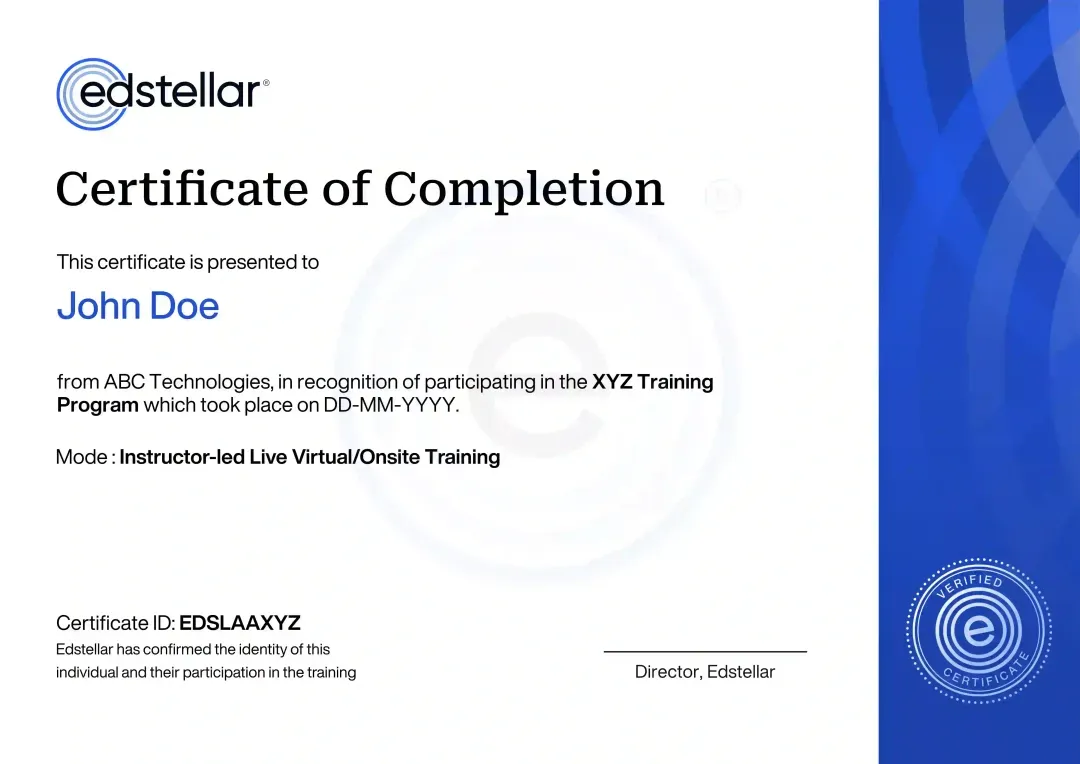
Certificate of Training Completion.
On successful completion, employees receive an Edstellar course completion certificate, recognizing their commitment to ongoing learning and professional development. It validates the skills they have built and motivates them to keep growing and contribute to organizational success.
Earned, not attended. Awarded on completion of all hands-on labs and the capstone project.
Training Delivery Modes: Onsite, Virtual and Hybrid
Recordings and lab guides are shared on your LMS so the team can revisit each concept after the live sessions.
Onsite Training
Instructor-led sessions at your offices with guided labs on your team's real operations data. Teams workshop levers and action plans together while the instructor coaches each group.
- Instructor-led delivery at your offices
- Labs built on your team's real operations data
- Cross-functional workshops on action plans
- Group size and batches set along with you

Live Virtual Training
Instructor-led sessions delivered live online with the same guided labs and capstone reviews. Teams collaborate in breakout groups on ledgers and action plans while the instructor monitors progress.
- Live instructor-led sessions delivered online
- Breakout labs for small-group sustainability work
- Same capstone action plan and reviews
- Recordings and lab guides shared after sessions

Hybrid Training
Instructor-led sessions mix onsite and virtual delivery with guided labs throughout. Teams build carbon ledgers and action plans while the instructor coaches and reviews work. Hybrid keeps scheduling flexible without losing live interaction.
- Live instruction across onsite and virtual sessions
- Guided labs with instructor coaching and reviews
- Real sustainability workflows throughout
- Flexible scheduling without losing live interaction

Need a customized training format that works for your team?
Our training delivery is customized to your team's schedule, full days, half days, sessions spread across weeks, or modular formats. Share your preferred timeline, and we'll plan the training around it.
Frequently Asked Questions
Share your team size, sustainability goals, and delivery preference, and we will send a tailored quote with batch options.
Yes. Book a discovery call to walk through your sustainability goals, operations, and timelines with an advisor.
Yes. Live virtual sessions include the same guided labs and capstone reviews, with breakout groups for small-team work.
Yes. Onsite delivery runs labs on your team's real operations data, with group size and batches set along with you.
The program runs 24 hours of instructor-led training across six modules, scheduled in flexible batches around your calendar.
Question not answered here?
Put it in the request. A training specialist answers it directly, within one business day.
Where this Training Fits in Your Team's learning path.
This path starts with environmental sustainability essentials, the shared base for everything after it. Your team learns the core issues, then measures emissions, runs an ISO 14001 system, and finally builds a sustainable business strategy.
LEARN SUSTAINABILITY BASICS
Environmental Sustainability Essentials Training
Learn the core environmental issues: climate, resources, pollution and nature, and why they matter.
MEASURE EMISSIONS
Carbon Accounting & GHG Protocol (Scope 1, 2 & 3) Training
Measure Scope 1, 2 and 3 emissions under the GHG Protocol.
RUN AN ENVIRONMENTAL SYSTEM
ISO 14001 Environmental Management System Training
Run an ISO 14001 environmental management system to control environmental impacts.
TRANSFORM THE BUSINESS
Sustainable Business Strategy & Transformation Training
Build sustainability into business strategy and the transformation needed to deliver it.
Why Choose Edstellar as Your Environmental Sustainability Essentials Training Provider
When comparing providers, Edstellar is the training partner teams choose for sustainability expertise and 5+ years of corporate training experience. Our methodology blends concise instruction with guided labs, and we share each trainer profile before booking. The result is confident teams with a plan they can act on.

EXPERT TRAINERS
YEARS DELIVERING
ORGANIZATIONS TRAINED
CERTIFIED
Tailored
Every cohort's labs, examples, and templates are tuned to your operations, sites, and sustainability goals.
Proven Methodology
A structured assess, learn, practice, and apply journey moves teams from sustainability basics to a full action plan.
Practice-Based Learning
Guided labs run in every module, so teams build ledgers, audits, and plans instead of just reading about them.
Expert Trainers
Sessions are led by sustainability practitioners with production experience in carbon accounting and ESG programs.
Global Scale
Coordinated hybrid and virtual delivery trains regional teams in batches on one shared sustainability standard.
Measurable Outcomes
Skill checks, reviewed labs, and a defended capstone plan make capability gains visible to leadership.
Build Shared Sustainability Fluency Through Practical Baselines and Owned Actions
Edstellar introduces sustainability through environmental footprints, basic carbon calculations, operational improvements, reporting, and credible communication. Teams work with sample activity data and recognizable workplace choices before creating an action plan. The final review checks whether proposed priorities, owners, and reporting evidence connect to a clear baseline rather than broad statements of intent.
- Step 01
Consult
We explore team responsibilities and sustainability awareness, identifying uncertainty around emissions, resource-use priorities, simple calculations, reporting evidence, and credible communication of progress.
- Step 02
Plan
We establish footprint and carbon foundations before energy, waste, and water audits, then reporting and stakeholder communication within an essentials action plan.
- Step 03
Align
We align sustainability-foundations facilitation with operations, facilities, HR, and marketing teams, introducing calculations gradually and connecting concepts to the environmental activities each role influences.
- Step 04
Customize
We tailor sample activity records, operational profiles, and program updates to familiar workplaces, keeping emission factors, data limits, and responsibility for proposed changes visible.
- Step 05
Execute
Participants build mini carbon ledgers, rank reduction opportunities, and check communication claims, receiving feedback on calculation accuracy, practical priorities, and evidence supporting reported progress.
- Step 06
Evaluate
We assess the action plan for a credible baseline, feasible priority levers, named owners, and a reporting calendar and communication pack consistent with the available evidence.
Also from Edstellar
Talent assessments
Psychometric, behavioral, leadership and 360-degree assessment.
→Training needs analysis
Needs analysis, gap identification, and a training roadmap.
→L&D consulting
Learning strategy, content, technology and ROI measurement.
→OD consulting
Org design, succession planning and cultural change.
→Managed training services
Training outsourcing, vendor management, logistics and administration.
→Coaching solutions
Executive and manager coaching that keeps skills in use.
Start an RFP shaped to your needs.
Answer three quick questions about team size, scope, and how often you need the program run, then send the request from the last step. Everything you choose travels with it, so you only fill this in once.
How many team members need training?
Environmental Sustainability Essentials Training Packages & Pricing
Where L&D holds an annual budget, license packages price the whole year at once instead of raising a purchase order per workshop. Hours and licenses are pooled across teams, programs and locations, so unused capacity is not stranded in one department.
Starter
120
trainee licenses64 hours of group training
Tailored for SMBs
Growth
320
trainee licenses160 hours of group training
Ideal for growing SMBs
Enterprise
800
trainee licenses400 hours of group training
Designed for large corporations
Custom
Unlimited
trainee licensesDuration set by the rollout
Multi-region and multi-year
Training Packages & Pricing
Choose the training format that works for your team. Pricing is customized based on your requirements, cohort size, and delivery needs.
Request a Quote for Environmental Sustainability Essentials Training for Your Team
Share your team size, sustainability goals, operations context, and timelines to receive a tailored training plan and quote. Book a discovery call to discuss your goals; we confirm availability and respond with a proposal.