Corporate Microsoft Team Foundation Server (TFS) Training Course
Edstellar's Microsoft Team Foundation Server (TFS) instructor-led training course equips employees with integrated tools and technologies for enhanced collaboration and project management by combining version control, issue tracking, and application lifecycle management capabilities. Empower teams to unleash the potential of TFS with our training.
(Virtual / On-site / Off-site)
Available Languages
English, Español, 普通话, Deutsch, العربية, Português, हिंदी, Français, 日本語 and Italiano
Drive Team Excellence with Microsoft Team Foundation Server (TFS) Corporate Training
Team Foundation Server (TFS) is a Microsoft product that provides version control, reporting, requirement management, automated building, testing, and release management capabilities. TFS allows teams to manage and monitor changes to their codebase efficiently. Additionally, it provides comprehensive project management capabilities, enhancing collaboration, planning, and monitoring of tasks and progress. Microsoft Team Foundation Server (TFS) training ensures that teams can leverage TFS to its fullest potential, leading to increased productivity, reduced errors, and faster time-to-market for software projects.
The Microsoft Team Foundation Server (TFS) instructor-led training course provided by Edstellar can be customized to meet the teams’ requirements. The virtual/onsite Microsoft Team Foundation Server (TFS) training course led by expert trainers empowers teams to enhance collaboration, optimize software development processes, and improve code quality.

Skills Your Employees Will Gain
These are the core, hands-on capabilities your team builds during the program.
- Source ControlSource Control is the practice of managing changes to code and files in software development. This skill is important for developers to ensure collaboration, maintain code integrity, and track project history effectively.
- Work Item TrackingWork Item Tracking is the process of monitoring and managing tasks, issues, and progress in projects. This skill is important for project managers and software developers to ensure timely delivery and effective collaboration.
- Build AutomationBuild Automation is the process of automating the creation of software builds and their associated tasks. this skill is important for developers and DevOps engineers as it enhances efficiency, reduces errors, and accelerates delivery.
- Release ManagementRelease Management is the process of planning, scheduling, and controlling software builds and deployments. This skill is important for IT roles to ensure smooth software delivery and minimize disruptions.
- Code ReviewsCode Reviews involve systematically examining code written by peers to identify errors, improve quality, and ensure adherence to standards. This skill is important for software developers as it enhances code quality, fosters collaboration, and accelerates learning, ultimately leading to more robust and maintainable software.
- Branching StrategiesBranching Strategies involve managing code versions in software development. This skill is important for developers to ensure efficient collaboration, maintain code quality, and streamline project workflows.
What Your Team Will Achieve After This Training
- Plan and manage iterative development cycles (sprints) using TFS features (backlog grooming, sprint planning)
- Manage user access and permissions within TFS to ensure data security and project control based on user roles
- Assign work items and tasks to team members within TFS, tracking progress and dependencies for clear accountability
- Evaluate project requirements and map them to user stories and work items within TFS for effective backlog management
- Utilize version control functionalities in TFS to manage code changes, collaborate on development tasks, and maintain code history
- Conduct automated builds and Continuous Integration (CI) using TFS to streamline development, testing, and deployment processes
- Collaborate with team members through work item discussions and forums within TFS, fostering communication and knowledge sharing
- Generate reports on project progress, team performance, and code coverage using TFS reporting tools to identify potential issues and optimize workflows
Topics & Program Outline
The curriculum is organized into focused modules built by industry experts and delivered virtually or on-premise. Interactive sessions reflect the evolving demands of the workplace, keeping the learning both relevant and practical.
- Overview of Microsoft Visual Studio
- History and evolution
- Key features and capabilities
- Introduction to Team Foundation Server (TFS)
- Overview and architecture
- Integration with Visual Studio and other Microsoft tools
- Exploring Visual Studio Team Services (VSTS)
- Features and benefits
- Comparison between on-premises TFS and cloud-based VSTS
- Setting up Visual Studio and TFS environments
- Installation and configuration of Visual Studio
- Setting up TFS server or connecting to VSTS
- Understanding TFS deployment options
- On-premises vs. cloud-based deployment
- Hardware and software requirements
- Planning TFS architecture
- Single-server vs. multi-server deployment
- High availability and disaster recovery
- Licensing and editions
- TFS 2018 licensing overview
- Choosing the right edition for your organization
- Step-by-step TFS installation process
- Pre-installation checks and configurations
- TFS installation wizard walkthrough
- Post-installation configurations
- Configuring TFS services and accounts
- Verifying TFS installation and functionality
- Troubleshooting TFS installation issues
- Common installation errors and resolutions
- Debugging and resolving installation problems
- Upgrading from previous TFS versions
- Pre-upgrade considerations and backup
- Upgrading TFS to version 2018
- Planning TFS upgrade
- Understanding upgrade paths and compatibility
- Pre-upgrade backup and data migration strategies
- Performing the TFS 2018 upgrade
- Upgrading TFS server and databases
- Post-upgrade verification and testing
- Rollback and recovery options
- Rollback procedures in case of upgrade failure
- Data recovery and restoration strategies
- Upgrading TFS build and release definitions
- Migrating build and release configurations to TFS 2018
- Verifying and testing upgraded build and release definitions
- Understanding TFS instances and collections
- Definition and structure of TFS instances and collections
- Managing multiple TFS instances and collections
- Managing TFS services and applications
- Starting, stopping, and restarting TFS services
- Monitoring TFS services and applications
- Backup and restore strategies for TFS instances
- Performing full and incremental backups
- Restoring TFS instances from backups
- Managing TFS databases
- Configuring, monitoring, and optimizing TFS databases
- Backup, restore, and maintenance of TFS databases
- Monitoring and troubleshooting TFS instances
- Monitoring TFS performance and health
- Troubleshooting and resolving common TFS instance issues
- Importance of TFS backups
- Understanding data protection and recovery
- Risks of data loss and system failure
- TFS backup strategies and configurations
- Defining backup schedules and retention policies
- Configuring backup storage and locations
- Performing TFS backups
- Full, differential, and transactional backups
- Verifying backup integrity and consistency
- TFS restore procedures
- Performing complete and partial restores
- Validating restored data and configurations
- Understanding team projects in TFS
- Definition, structure, and purpose of team projects
- Creating and organizing team projects
- Configuring team project settings and permissions
- Defining project settings and configurations
- Managing user roles, permissions, and access levels
- Managing team project artifacts and repositories
- Creating and managing source code repositories
- Version control, branching, and merging strategies
- Team Project administration and maintenance
- Managing project collections and settings
- Archiving, deleting, and restoring team projects
- Overview of TFS security model
- Understanding permissions, roles, and groups
- Security principles and best practices
- Configuring project-level security settings
- Assigning and managing user permissions
- Creating and managing security groups and roles
- Implementing security policies and controls
- Enforcing access controls and restrictions
- Auditing and monitoring security events and activities
- Troubleshooting security issues and challenges
- Resolving common security configuration errors
- Implementing security enhancements and updates
- Managing security for diverse user roles
- Implementing security for stakeholders, administrators, and contributors
- Assigning permissions based on user responsibilities and access levels
- Implementing security policies and compliance controls
- Enforcing data protection and privacy regulations
- Configuring security features to meet organizational policies and standards
- Auditing and monitoring security activities
- Tracking and reviewing security events and access logs
- Implementing auditing tools and reports for security compliance
- Troubleshooting advanced security issues
- Resolving complex permission conflicts and access issues
- Implementing security patches and updates to address vulnerabilities
- Understanding TFS version control
- Overview of TFS version control system and concepts
- Understanding changesets, branches, and merges
- Configuring and managing version control repositories
- Creating and organizing source control folders and structures
- Implementing branching strategies and policies
- Performing common version control operations
- Checking out, checking in, and shelving changes
- Resolving conflicts and managing versions
- Integrating external repositories and tools
- Configuring TFS with Git repositories
- Integrating third-party version control tools and extensions
- Implementing version control best practices
- Establishing code review and quality assurance processes
- Implementing continuous integration and delivery pipelines
- Introduction to TFS extensions and marketplace
- Overview of TFS extensions and their benefits
- Exploring the TFS marketplace and available extensions
- Installing and configuring TFS extensions
- Installing extensions from the marketplace
- Configuring and managing installed extensions
- Developing and customizing TFS extensions
- Creating custom extensions using TFS SDK and APIs
- Implementing custom features and integrations
- Managing and updating extensions
- Monitoring extension usage and performance
- Updating and maintaining extensions for compatibility and security
- Understanding work items in TFS/VSTS
- Definition and types of work items
- Anatomy of a work item and its attributes
- Creating and managing work items
- Creating new work items in TFS/VSTS
- Assigning work items to team members and tracking progress
- Linking and tracing work items
- Establishing relationships between work items
- Tracing work items to source code changes and test cases
- Customizing work item templates
- Customizing work item fields, states, and workflows to fit project needs
- Creating custom work item queries and reports
- Understanding TFS process templates
- Overview of process templates and their components
- Customizing and extending process templates
- Modifying and updating process templates
- Modifying existing work item types and process configurations
- Updating and managing process template versions and releases
- Creating and customizing process templates
- Creating new process templates from scratch
- Implementing custom features and workflows in process templates
- Applying process templates to projects
- Assigning and applying process templates to Team Projects
- Configuring and managing process settings and configurations
- Introduction to TFS reporting features
- Overview of TFS reporting capabilities and tools
- Understanding data warehouse and reporting services in TFS
- Configuring and customizing TFS reports
- Creating and customizing standard reports
- Configuring and managing data sources and report parameters
- Developing and implementing custom reports
- Developing custom reports using SQL Server Reporting Services (SSRS)
- Integrating and embedding custom reports in TFS
- Analyzing and interpreting TFS reports
- Interpreting key performance indicators (KPIs) and metrics
- Utilizing reports to monitor project progress and performance
- Understanding TFS build and release management
- Overview of TFS build and release concepts and processes
- Understanding build agents, controllers, and pipelines
- Configuring and managing build infrastructure
- Setting up and configuring build servers and agents
- Creating and managing build definitions and pipelines
- Implementing continuous integration and delivery
- Configuring automated build triggers and schedules
- Setting up continuous integration and delivery pipelines
- Managing and monitoring build and release processes
- Monitoring build and release activities and logs
- Troubleshooting and resolving common build and release issues
Who Should Attend?
This program suits professionals at many levels across the organization, including:
- Software Developers
- DevOps Engineers
- Build Engineers
- QA Testers
- Systems Analysts
- Release Coordinators
- Technical Leads
- Development Team Members
- Project Coordinators
- IT Specialists
- Application Developers
- Managers
What are the Prerequisites?
Employees with a basic understanding of installing server products, such as operating systems and SQL servers, and experience working on Visual Studio can take up the Microsoft Team Foundation Server (TFS) training course.
Choose the Format That Fits Your Team
We design training your teams actually engage with, and deliver it the way that suits you best. Through a vetted global trainer network, Edstellar runs sessions in 10+ languages with consistent quality anywhere.


.webp)
Virtual / online: expert-led live sessions delivered anywhere, with consistency and easy scheduling.
.webp)
On-site (in-house): immersive, instructor-led learning at your office.
.webp)
Off-site: focused, instructor-led group learning away from everyday workplace distractions.
Get a Proposal Shaped to Your Needs
Need pricing for onsite, offsite, or virtual delivery? Get a proposal tailored to your team's needs.
64 hours of group training (includes VILT/In-person On-site)
Tailored for SMBs
Tailor-Made Trainee Licenses with Our Exclusive Training Packages!
160 hours of group training (includes VILT/In-person On-site)
Ideal for growing SMBs
Tailor-Made Trainee Licenses with Our Exclusive Training Packages!
400 hours of group training (includes VILT/In-person On-site)
Designed for large corporations
Tailor-Made Trainee Licenses with Our Exclusive Training Packages!
Unlimited duration
Designed for large corporations
What Sets Edstellar Apart
Experienced Trainers
Our trainers are drawn from a vetted global network and bring years of industry expertise, keeping every session practical and impactful.
Proven Quality
With a strong global track record, Edstellar is known for quality and engaging delivery.
Industry-Relevant Curriculum
Our programs are built by experts to match the demands of today's industry.
Fully Customizable
Every program can be tailored to your organization's goals.
Comprehensive Support
We provide pre- and post-session support for a complete learning experience.
Global Multi-Location & Multilingual Training Delivery
We deliver in multiple languages to support diverse global teams.
Hear from Organizations We've Trained
"Attending the Microsoft Team Foundation Server (TFS) training was transformational for my professional development. As a Senior Software Engineer, the deep dive into advanced methodologies gave me the confidence to hands-on exercises were immediately applicable to my work. These specialized skills have positioned me for significant advancement opportunities within my organization. This course has become foundational to my continued success.”
Warren Grant
Senior Software Engineer,
Technology Consulting Services Company
"This Microsoft Team Foundation Server (TFS) course was precisely what I needed to design robust professional expertise architectures. The hands-on approach to expert-led workshops and seamless integration with projects using advanced techniques from this training. We've successfully expanded our service portfolio based on these enhanced capabilities. The comprehensive curriculum has elevated my solution delivery capabilities significantly.”
Laurentiu Stan
Senior Software Engineer,
IT Services and Solutions Provider
"The Microsoft Team Foundation Server (TFS) training transformed our team's entire approach to operational excellence management and execution. As a Senior Software Engineer, the extensive coverage of practical these proven concepts to optimized processes. We've successfully deployed these methodologies across all regional operations centers. Our team's productivity and solution quality have improved measurably, validating this investment.”
Rashad Bashir
Senior Software Engineer,
Enterprise Software Development Firm
“Edstellar’s IT & Technical training programs have been instrumental in strengthening our engineering teams and building future-ready capabilities. The hands-on approach, practical cloud scenarios, and expert guidance helped our teams improve technical depth, problem-solving skills, and execution across multiple projects. We’re excited to extend more of these impactful programs to other business units.”
Aditi Rao
L&D Head,
A Global Technology Company
Recognition That Motivates Your Team
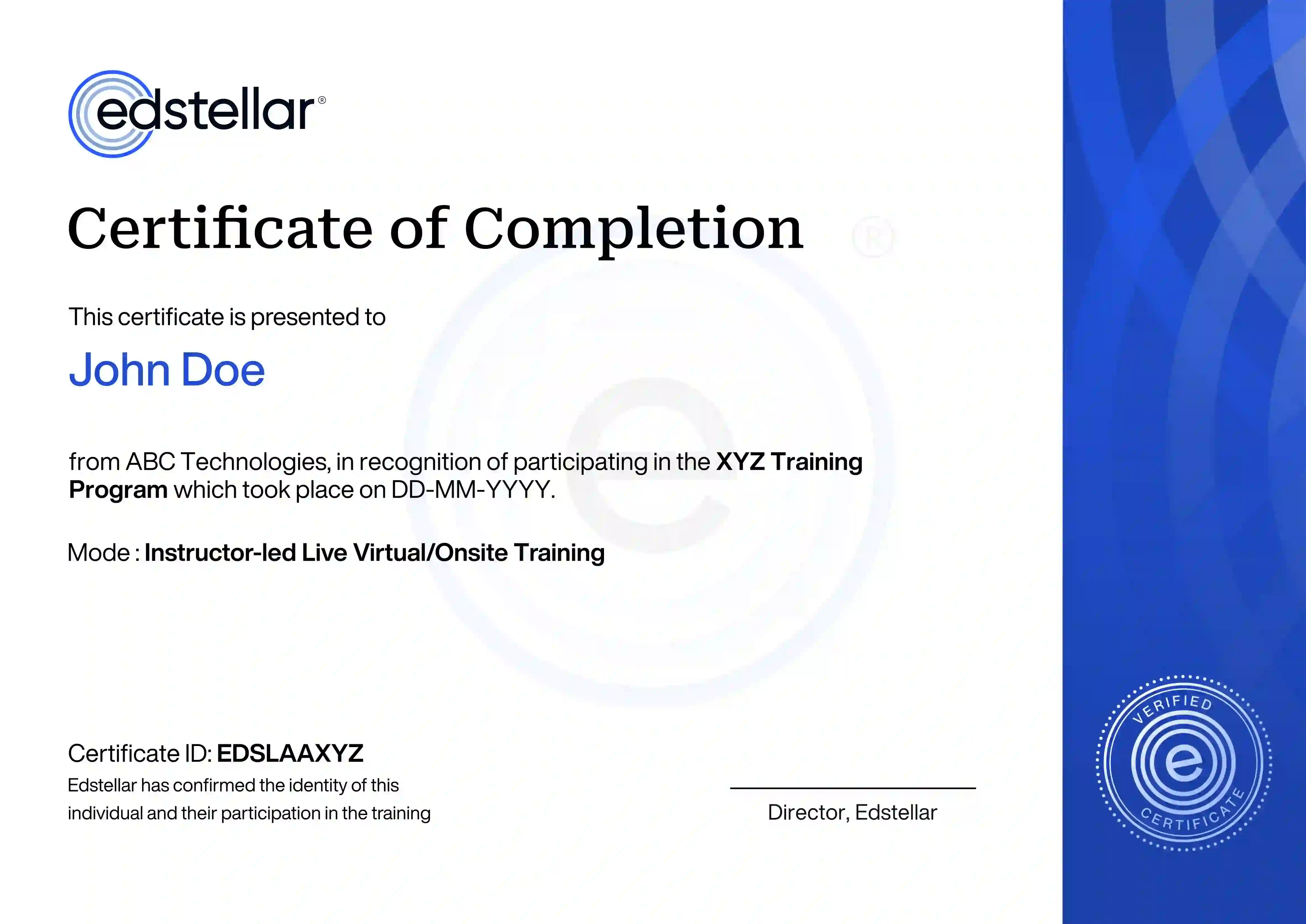
Upon successful completion of the training course offered by Edstellar, employees receive a course completion certificate, symbolizing their dedication to ongoing learning and professional development.
This certificate validates the employee's acquired skills and is a powerful motivator, inspiring them to enhance their expertise further and contribute effectively to organizational success.


Other Related Corporate Training Courses
Explore More Courses
Edstellar is a one-stop instructor-led corporate training and coaching solution that addresses organizational upskilling and talent transformation needs globally.
Marketing Excellence
Operational Excellence
Finance Excellence
HR Excellence
IT Excellence
Customer Service
Leadership Excellence
Quality Management
Software
How it WorksFAQ'sCorporate Training
CatalogStellar AI
Skill MatrixHRMS Integration
Who we ServeCEO RetreatsPricingTraining DeliveryPartner with Edstellar
CareersContact us