.svg "edstellar")

Ansible Corporate Training Program for Employees
Edstellar's instructor-led Ansible training equips your teams to automate configuration, provisioning, and application deployment with Ansible playbooks, customized to your infrastructure and delivered onsite or virtually.

(Virtual / On-site / Off-site)
.svg)
Equip Your DevOps Teams to Automate Infrastructure with Ansible
Ansible is an open-source IT automation and configuration management tool that lets teams automate provisioning, configuration, application deployment, and orchestration using simple, human-readable YAML playbooks, with no agents to install on managed nodes. It connects over SSH to configure servers, deploy applications, and orchestrate complex multi-tier workflows from a single control node, replacing slow, error-prone manual steps with consistent, repeatable automation. As organizations scale cloud and hybrid infrastructure, teams that can write and run Ansible playbooks turn fragile manual operations into reliable, version-controlled automation.
As organizations adopt DevOps and scale hybrid and cloud infrastructure, this program helps your teams automate configuration, deployment, and orchestration with Ansible across real production workflows. Empower your people with expert-led on-site, off-site, and virtual sessions delivered by Edstellar, a premier corporate training provider serving organizations worldwide in-person and virtually across popular languages. Fully customized to your goals, the program turns Ansible skills into lasting capabilities that lift performance across your DevOps, infrastructure, and operations teams.
By the end of the program, your team can write, structure, and run Ansible playbooks and roles that automate server configuration, application deployment, and multi-tier orchestration across your environment. The result is faster, consistent deployments, fewer configuration errors, and infrastructure operations that scale without scaling headcount.
.svg)

- Install and configure Ansible and manage inventories of hosts across on-premises and cloud environments.
- Write clear, idempotent playbooks in YAML to automate configuration and application deployment tasks.
- Use Ansible modules, variables, facts, conditionals, loops, and handlers to build flexible automation.
- Organize reusable automation with roles and Ansible Galaxy, and templatize configuration with Jinja2.
- Secure sensitive data with Ansible Vault and apply best practices for safe, repeatable automation.
- Orchestrate multi-tier deployments and integrate Ansible into CI/CD pipelines and DevOps workflows.
- Getting Started with Ansible
- What Ansible is: agentless automation, control node, and managed nodes
- Installing and configuring Ansible and the SSH connection model
- Building and managing static and dynamic inventories
- Ad-hoc commands and core Ansible modules
- The ansible.cfg configuration file and best practices
- Building Automation with Playbooks
- YAML syntax and playbook structure
- Tasks, plays, and targeting hosts
- Variables, facts, and registering results
- Conditionals, loops, and handlers
- Idempotency and writing reliable, repeatable plays
- Structuring Reusable Automation
- Structuring automation with roles
- Using Ansible Galaxy to share and reuse roles
- Jinja2 templating for dynamic configuration files
- Variable precedence, group_vars, and host_vars
- Tags, includes, and imports for modular playbooks
- Securing and Hardening Automation
- Protecting secrets with Ansible Vault
- Managing privilege escalation with become
- Error handling with blocks, rescue, and always
- Testing, linting, and debugging playbooks
- Best practices for production-grade automation
- Automating at Scale
- Orchestrating multi-tier and rolling deployments
- Automating cloud provisioning across AWS, Azure, and more
- Managing containers and integrating with Docker and Kubernetes
- Integrating Ansible into CI/CD pipelines
- An end-to-end infrastructure automation project
- System Administrators
- DevOps Engineers
- IT Engineers
- Network Engineers
- Automation Engineers
- Infrastructure Engineers
- IT Specialists
- Cloud Engineers
- System Engineers
- IT Operations Specialists
- Software Developers
- Managers
Participants should be comfortable working on the Linux command line and understand basic system administration concepts such as users, services, and SSH. Familiarity with networking fundamentals and a text editor is helpful, but no prior Ansible or programming experience is required to get the most from the Ansible training course.


.webp "Virtual Ansible Training")
.webp "On-site Ansible Training")
.webp "Off-site Ansible Training")
64 hours of group training (includes VILT/In-person On-site)
Tailored for SMBs
160 hours of group training (includes VILT/In-person On-site)
Ideal for growing SMBs
Tailor-Made Trainee Licenses with Our Exclusive Training Packages!
400 hours of group training (includes VILT/In-person On-site)
Designed for large corporations
Tailor-Made Trainee Licenses with Our Exclusive Training Packages!
Unlimited duration
Designed for large corporations
Experienced Trainers
Our trainers are drawn from a vetted global network and bring years of industry expertise, keeping every session practical and impactful.
Proven Quality
With a strong global track record, Edstellar is known for quality and engaging delivery.
Industry-Relevant Curriculum
Our programs are built by experts to match the demands of today's industry.
Fully Customizable
Every program can be tailored to your organization's goals.
Comprehensive Support
We provide pre- and post-session support for a complete learning experience.
Global Multi-Location & Multilingual Training Delivery
We deliver in multiple languages to support diverse global teams.
Recognition That Motivates Your Team
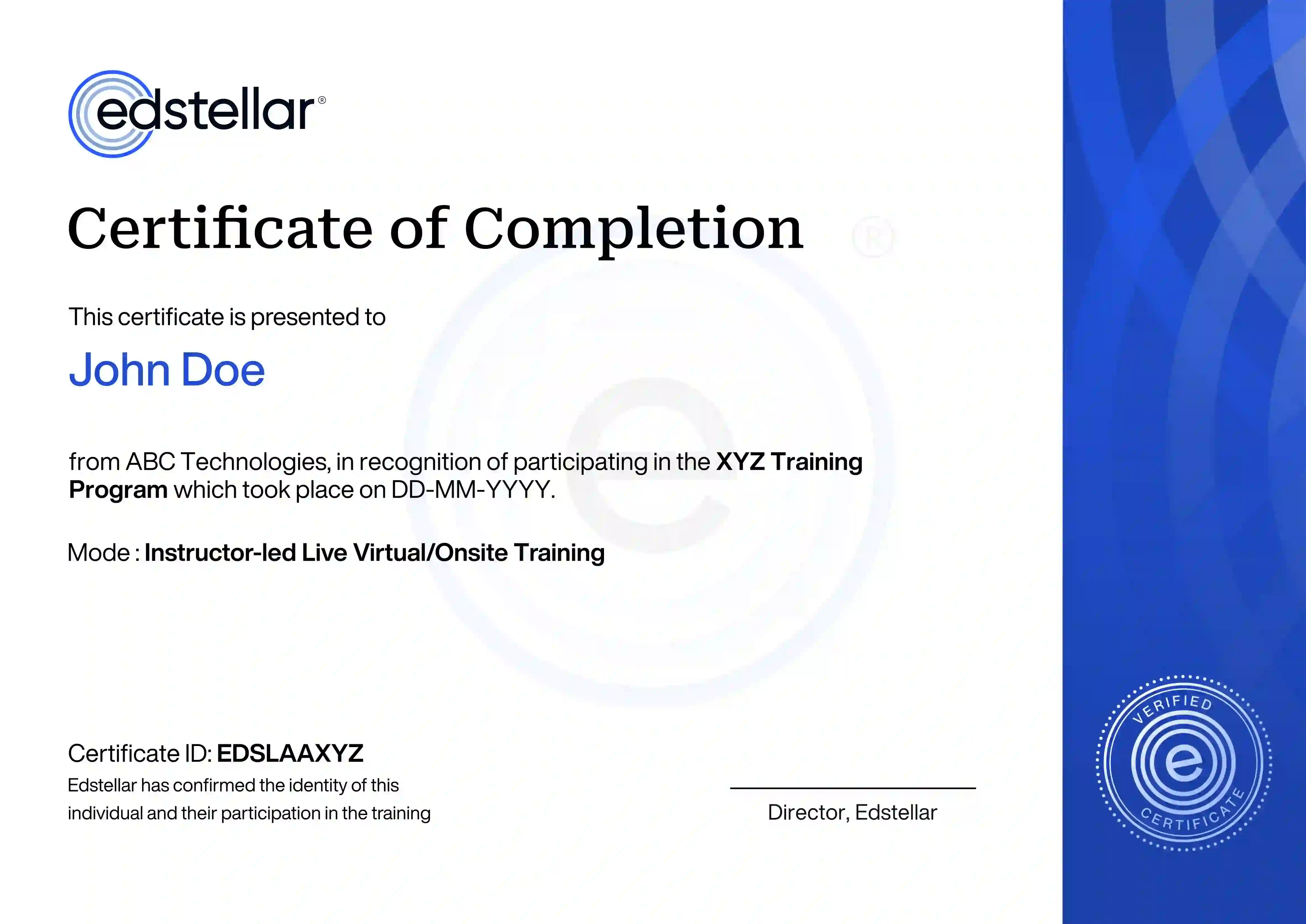



Frequently Asked Questions
Other Related Corporate Training Courses


Explore More Courses


.svg)
.svg)
.svg)

.svg)