An expert-curated list of the most in-demand skills in France, reviewed by a multilingual corporate trainer and business consultant with 16+ years of international experience in training, coaching, and people management.
France's labour market faces significant pressure across multiple sectors. Numeum reported 80,000+ unfilled digital jobs in 2025, while ANSSI documented a 30% surge in cyberattacks on French organisations. Healthcare vacancies totalled 60,000+ public hospital positions per DREES, and FFB reported 50,000+ unfilled construction roles. The France 2030 national investment plan deploys EUR 54 billion across digital, green energy, healthcare, and reindustrialisation, all requiring skilled workers.
As Europe's leading AI nation, home to Mistral AI and Hugging Face, France faces critical digital talent gaps. The nuclear revival programme (six EPR2 reactors planned) and offshore wind targets (40 GW by 2050) create energy engineering shortages that compound the existing workforce pressure. Whether you are asking what skills are in demand in France in the technology sector, healthcare, or construction, the answer is the same: urgency is everywhere.
This guide ranks the 10 most in-demand skills in France for 2025 and 2026, using a weighted methodology that prioritises local government data, French industry reports, and employer surveys. For each skill, you will find the policy evidence behind the demand, the industries driving it, and practical paths to closing the gap.
Sources Behind This Research
Every ranking in this guide is backed by data from French government bodies, industry federations, and established hiring platforms. We weighted France-specific sources more heavily than global reports, because local data reflects what is actually happening across the French labour market. Here is where the numbers come from.
Government
ANSSI (Agence Nationale de la Sécurité des Systèmes d'Information)
Panorama de la Menace Informatique 2024
Documented 30% increase in significant cyberattacks on French organisations and estimated 15,000+ unfilled cybersecurity positions. Primary source for cybersecurity skill ranking and policy investment evidence.
EUR 54 billion national investment plan covering digital sovereignty (EUR 1.8 billion), cybersecurity (EUR 1 billion), green industry (EUR 5.6 billion), and reindustrialisation (EUR 2 billion).
Reported 80,000+ unfilled digital jobs in France, a 12% year-on-year increase. The digital sector employs 800,000+ in France. Primary market demand signal for software development and cloud skills.
"The French job market is no longer looking only for technical expertise. Employers increasingly value people who can bridge perspectives, collaborate across cultures, and learn continuously. In many roles, the ability to adapt has become just as important as the ability to perform.
Nadezhda Chalykh
✓ Multilingual corporate trainer fluent in four languages with 16+ years of international experience in training, coaching, and people management across diverse cultures.
10 Key Skills in Demand Across France's Job Market
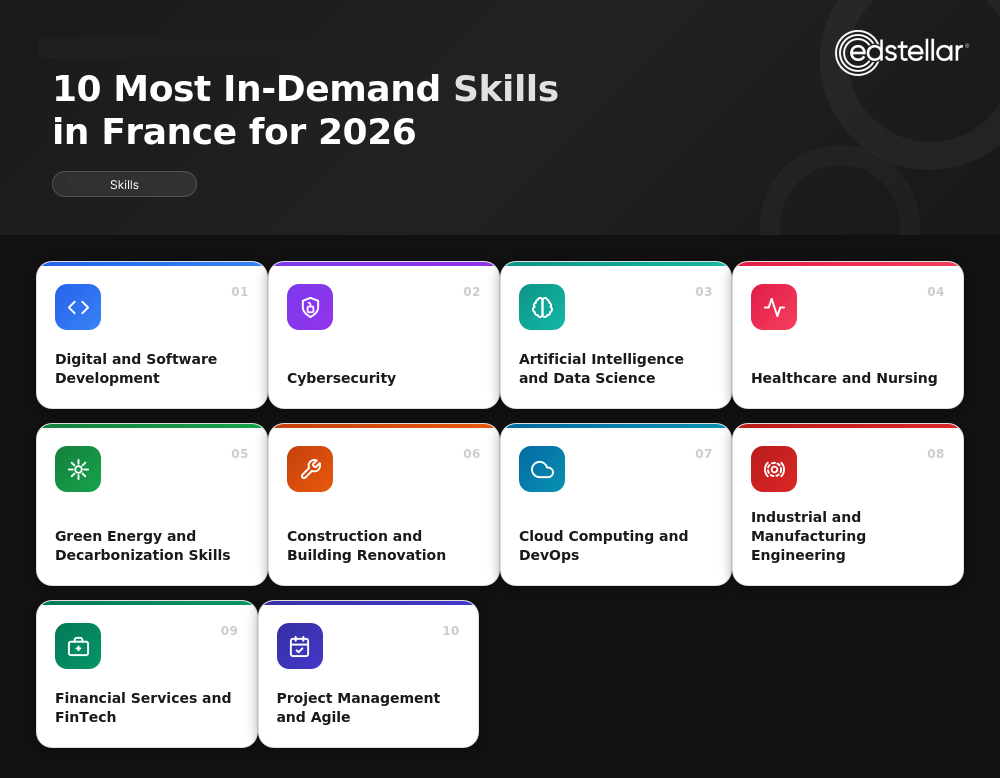
France's shortage list spans digital technology, cybersecurity, healthcare, energy transition, construction, industrial manufacturing, and financial services simultaneously. The skills below reflect where hiring pressure is highest in 2026, driven by the France 2030 investment plan, nuclear revival, and post-Brexit financial services growth.
1
Digital and Software Development
Research Score: 9.55/10
Software development and digital engineering sit at the top of France's skills shortage list, driven by the collision of two forces: 80,000+ unfilled digital jobs reported by Numeum in 2025 and the France 2030 plan deploying EUR 1.8 billion into digital sovereignty and technology infrastructure. The French government's "Stratégie Numérique" and its investment in homegrown cloud providers such as OVHcloud and Scaleway, combined with the ambition to build a world-class French Tech ecosystem, have created structural demand for software engineers, full-stack developers, and cloud-native architects that domestic university output cannot meet.
France's digital sector employs over 800,000 people and is growing at 5% per year, yet Numeum's 2025 barometer shows the vacancy rate climbing rather than falling. The gap is most acute at mid-to-senior levels, where engineers with three or more years of experience in cloud-native, APIs, and microservices architecture are particularly scarce. Average salaries for senior software engineers in Paris range from EUR 60,000 to EUR 95,000, with AI-adjacent roles commanding EUR 90,000 to EUR 130,000, reflecting how tight the market has become.
Priority sub-skills include full-stack development, Python and Java engineering, cloud-native architecture, APIs and microservices, and DevSecOps.
Key Sub-skills
Full-Stack DevelopmentPython and Java EngineeringCloud-Native ArchitectureAPIs and MicroservicesDevSecOps
Top Industries
Technology, Financial Services, Aeronautics and Defence, Retail and E-commerce, Public Sector Digital Transformation
ANSSI's Panorama de la Menace Informatique 2024 documented a 30% year-on-year increase in significant cyberattacks on French organisations, with ransomware attacks on hospitals and critical infrastructure generating national headlines. France is Europe's most targeted large economy for state-sponsored and criminal cyber operations, in part because of its nuclear programme, aerospace and defence sector (Airbus, Thales, Safran), and major financial services hub. ANSSI estimates 15,000+ cybersecurity positions remain unfilled, with demand growing at 25% per year.
The government's Plan de Renforcement de la Cybersécurité, backed by EUR 1 billion in the France 2030 framework, aims to triple the cybersecurity workforce and build 25 cybersecurity unicorns. The SecNumedu accreditation framework for cybersecurity education programmes has expanded significantly, but graduate output still represents a fraction of market need. When 72% of French organisations report a cybersecurity skills shortage and the regulatory environment is tightening under NIS2 compliance deadlines, the case for investing in cyber capability has never been stronger.
Key sub-skills include network and infrastructure security, cloud security, threat intelligence and SIEM, penetration testing, and governance, risk and compliance.
Key Sub-skills
Network and Infrastructure SecurityCloud SecurityThreat Intelligence and SIEMPenetration TestingGovernance, Risk and Compliance (GRC)
Top Industries
Government and Public Sector, Financial Services, Healthcare, Critical Infrastructure, Defence and Aeronautics
"Companies will no longer simply fill vacancies: they will invest in and prioritize profiles with critical skills to strengthen their competitiveness and innovation in a constantly evolving market."
Matthieu Imbert-Bouchard
Managing Director, Robert Half France · Lyon, France
3
Artificial Intelligence and Data Science
Research Score: 9.05/10
France has established genuine AI leadership that sets it apart from most European peers. Mistral AI, valued at EUR 6 billion in 2025, is headquartered in Paris. Hugging Face was co-founded by French researchers. INRIA, France's national computer science institute, operates one of Europe's strongest AI research programmes. The EUR 2.2 billion second phase of France's National AI Strategy, combined with the EUR 200 million expansion of the Jean Zay supercomputer, signals that the government views AI as a strategic economic asset rather than a technology experiment.
APEC reported that AI and data science roles grew 45% in executive job postings between 2024 and 2025, the highest growth rate of any professional category. Machine learning engineers command median salaries of EUR 80,000 to EUR 120,000, and the gap between PhD-level AI researcher supply and industry demand has become a genuine constraint on French AI company growth. France 2030 is funding AI retraining through the PIC, and Bpifrance is backing AI startups that in turn create further demand for ML engineers, data scientists, and AI ethicists.
Priority sub-skills include machine learning engineering, natural language processing, generative AI development, data science and statistical modelling, and AI ethics and responsible AI.
Key Sub-skills
Machine Learning EngineeringNatural Language ProcessingGenerative AI DevelopmentData Science and Statistical ModellingAI Ethics and Responsible AI
Top Industries
Technology, Financial Services, Healthcare, Retail and E-commerce, Aeronautics and Manufacturing
France's healthcare workforce crisis has two dimensions that reinforce each other: an acute shortage of hospital staff in cities and a structural "désert médical" problem affecting over 8 million people in rural and peri-urban areas who lack adequate access to a general practitioner. DREES reported 60,000+ vacant positions in public healthcare in 2025, of which approximately 25,000 are nursing roles. Vacancy rates in acute hospitals exceed 10%, and emergency services are regularly forced to operate below safe staffing ratios.
The Ségur de la Santé reform (2020–2025) increased healthcare salaries by up to EUR 183 per month and invested EUR 19 billion in public hospital infrastructure, signalling that the government recognises the severity of the crisis. But salary improvements have not been sufficient to offset the burnout and difficult working conditions that drive experienced nurses to leave the profession or reduce their hours. France's rapidly ageing population (20% of the population will be over 65 by 2030) means healthcare demand will continue rising as the supply problem remains unsolved.
Key sub-skills in demand include general and specialist nursing (Infirmier Diplômé d'État), emergency and ICU nursing, geriatric care, mental health care, and allied health professions including physiotherapy and radiology.
Key Sub-skills
General and Specialist Nursing (IDE)Emergency and ICU NursingGeriatric CareMental Health CareAllied Health Professions
Top Industries
Public Hospitals (AP-HP and CHU Network), Primary Care, Mental Health Services, EHPAD Care Homes, Emergency Services
France's Loi Énergie-Climat commits to carbon neutrality by 2050 and a 40% reduction in fossil fuel consumption by 2030. France 2030 allocates EUR 5.6 billion to decarbonization, green hydrogen, and offshore wind, while the nuclear revival plan (six new EPR2 reactors) represents the largest energy engineering programme France has attempted since the 1980s. ADEME's 2025 skills report identifies a gap of 30,000+ green and energy transition professionals needed immediately, with a longer-term requirement of 100,000+ additional workers for the full nuclear and offshore wind build-out by 2030.
The scale of the challenge is unprecedented. Building six EPR2 reactors requires welders, pipefitters, nuclear engineers, and nuclear safety specialists trained to exacting standards, and the pool of qualified professionals who remember how to build a nuclear plant from the original 1970s–1980s programme is shrinking through retirement. Offshore wind, solar PV, and green hydrogen each require their own specialist workforces. The MaPrimeRénov building renovation programme adds a further 30,000+ insulation, heat pump, and RGE-certified renovation specialists to the demand picture.
Priority sub-skills include nuclear engineering and operations, offshore wind engineering, building energy renovation with RGE certification, solar PV installation, and green hydrogen technology.
Key Sub-skills
Nuclear Engineering and OperationsOffshore Wind EngineeringBuilding Energy Renovation (RGE)Solar PV InstallationGreen Hydrogen Technology
Top Industries
Nuclear Energy (EDF, Framatome, Orano), Offshore Wind and Solar, Building Renovation, Green Hydrogen, Transport Electrification
Want Your France Training Investments to Deliver Results?
Edstellar's L&D consulting services help organisations move from ad-hoc training to structured capability development aligned with business priorities.
France's MaPrimeRénov programme targets 700,000 energy-efficient building renovations per year to meet Loi Énergie-Climat obligations, and the Grand Paris Express, Europe's largest public transport project at EUR 35 billion, has sustained intense construction activity across the Île-de-France region. The FFB reported 50,000+ unfilled construction positions in 2025, with construction trades consistently appearing in the top 15 of France Travail's "métiers en tension" hard-to-fill roles list year after year.
The most acute shortages are in the trades that the renovation and green energy programmes depend on most: electricians for EV charging infrastructure, plumbers and heating engineers for heat pump installation, and insulation specialists for the thermal renovation of France's 30+ million buildings. The Plan de Relance (EUR 100 billion national recovery plan) added further public infrastructure investment, from school renovations to hospital construction, competing for the same already-stretched workforce.
Key sub-skills in shortage include electrical installation, plumbing and heating, thermal insulation (ITE and ITI methods), carpentry and joinery, and civil engineering and earthworks.
Key Sub-skills
Electrical InstallationPlumbing and HeatingThermal Insulation (ITE and ITI)Carpentry and JoineryCivil Engineering and Earthworks
Top Industries
Residential Construction, Building Renovation and Retrofit, Infrastructure and Civil Engineering, Commercial Construction, Public Works
"We need to keep investing in the acquisition of digital skills, especially among young people and women. The message that 'with AI, we need fewer skills in France' is not at all Numeum's position."
Véronique Torner
President, Numeum · Île-de-France, France
7
Cloud Computing and DevOps
Research Score: 8.20/10
France's "Cloud au Centre" government strategy mandates cloud-first adoption across public sector organisations, creating immediate demand for cloud architects, engineers, and security specialists who understand both the technical requirements and the French regulatory environment around data sovereignty. CIGREF reported that 72% of large French enterprises cite cloud skills as a critical workforce gap, and France 2030 allocated EUR 667 million to cloud sovereignty infrastructure, with OVHcloud and Scaleway positioned as strategic national assets alongside the French sovereign cloud zones operated by AWS, Microsoft Azure, and Google Cloud.
The demand for DevOps engineers who can bridge development and operations has become particularly acute as French organisations accelerate digital transformation initiatives. Senior cloud architects in France earn EUR 75,000 to EUR 105,000, and professionals with multi-cloud certifications across AWS, Azure, and GCP command a premium. Numeum's 2025 barometer places cloud and DevOps skills consistently in the top five hardest-to-fill digital roles, alongside AI and cybersecurity.
Key sub-skills include Amazon Web Services, Microsoft Azure, Google Cloud Platform, DevOps and CI/CD pipeline management, and Kubernetes and Docker containerisation.
Key Sub-skills
Amazon Web Services (AWS)Microsoft AzureGoogle Cloud PlatformDevOps and CI/CDKubernetes and Docker
Top Industries
Technology, Financial Services, Government Digital, Telecommunications, Retail and E-commerce
France's "Industrie du Futur" programme, backed by the Alliance pour l'Industrie du Futur, is modernising French manufacturing through robotics, industrial IoT, and additive manufacturing. France 2030 allocates EUR 2 billion to industrial decarbonization and reindustrialisation, and the aeronautics sector is in a major hiring cycle: Airbus is ramping production toward 800 aircraft per year, Safran is expanding engine production, and Thales and Dassault Aviation are growing defence and aviation electronics teams. The UIMM reported 60,000+ annual industrial job openings with 30% going unfilled due to skills shortages.
The automotive sector adds another dimension to France's industrial engineering shortage. Stellantis and Renault are simultaneously electrifying their vehicle ranges and managing the retraining of combustion engine engineers into EV and battery technology specialists, creating a skills transition inside the existing workforce alongside external hiring needs. Defence budget increases are creating further demand across the defence industrial base.
Key sub-skills include industrial automation and robotics, additive manufacturing (3D printing), industrial IoT and predictive maintenance, lean manufacturing and Six Sigma, and systems engineering and CAD/CAM.
Key Sub-skills
Industrial Automation and RoboticsAdditive Manufacturing (3D Printing)Industrial IoT and Predictive MaintenanceLean Manufacturing and Six SigmaSystems Engineering and CAD/CAM
Top Industries
Aeronautics and Space, Automotive, Defence, Nuclear Manufacturing, Mechanical and Electrical Engineering
Paris has consolidated its position as Europe's leading financial centre following Brexit. Paris Europlace reported 7,500+ financial services jobs relocated to France since 2021, with Goldman Sachs, JPMorgan, HSBC, and Blackrock all significantly expanding their Paris operations. France now hosts 20+ international bank headquarters, and the La Défense business district has absorbed much of this expansion. The ACPR has expanded its supervisory workforce by 20% as the number of regulated entities authorised in France grows.
French FinTech is equally dynamic. Qonto, Alan, Alma, and Lydia have all raised major funding rounds and are scaling their engineering and product teams rapidly. The Digital Operational Resilience Act (DORA), which entered force in January 2025, has created urgent demand for professionals who combine financial services expertise with ICT risk management capability, particularly in risk management, DORA compliance, and cyber resilience roles.
Key sub-skills include risk management and regulatory compliance (MiFID II, DORA, EMIR), FinTech and payments development, quantitative finance and financial modelling, ESG and sustainable finance, and AML and financial crime compliance.
Key Sub-skills
Risk Management and Regulatory ComplianceFinTech and Payments DevelopmentQuantitative Finance and Financial ModellingESG and Sustainable FinanceAML and Financial Crime Compliance
Top Industries
Investment Banking, Asset Management, Insurance, Fintech and Payments, International Financial Services at La Défense
The Grand Paris Express at EUR 35 billion, France 2030 capital deployment across dozens of industrial and digital programmes, the Olympic legacy infrastructure, and the national digital transformation drive collectively represent the largest sustained project delivery challenge France has faced in decades. The PMI France chapter reported a 32% growth in membership between 2023 and 2025, and APEC identified project and programme management as one of the top five fastest-growing cadre (executive) job functions in France.
Agile methodology demand is particularly strong in the technology sector, where SAFe and Scrum-certified professionals command a 15–20% salary premium over non-certified peers. Public sector organisations implementing large-scale digital transformation programmes are increasingly adopting agile delivery models, creating demand for Agile coaches and transformation leads alongside traditional programme managers. The nuclear and energy sector, managing complex multi-decade projects, has its own acute need for project professionals trained in earned value management and technical programme oversight.
Key sub-skills include Agile and Scrum methodology, PMP and PRINCE2 certification, risk management and contingency planning, stakeholder and change management, and programme and portfolio management.
Key Sub-skills
Agile and Scrum MethodologyPMP and PRINCE2 CertificationRisk Management and Contingency PlanningStakeholder and Change ManagementProgramme and Portfolio Management
Top Industries
Technology and Digital, Infrastructure and Public Works, Financial Services, Healthcare, Aeronautics and Defence
"Skills-first hiring is no longer a niche approach reserved for tech startups or cutting-edge companies. In 2026, it is the pragmatic response to the realities of the French labour market: skills shortages, the accelerating obsolescence of knowledge, and the rise of non-traditional career paths."
Living and Working in France: EURES guide covering career opportunities, working conditions, and key employment sectors for professionals considering France.
Skills Demand Across France's Key Regions
France's skills demand varies across its regions, shaped by industrial clusters, government investment, and the concentration of specific sectors. Understanding these regional patterns helps corporate L&D teams target training investments where they will deliver the greatest impact.
Region
Key Industries
Top Shortage Skills
Île-de-France (Paris)
Technology, Financial Services (La Défense), Government, Healthcare
Aeronautics, Technology, Construction, Wine and Agriculture
Construction, Software Dev, Industrial Engineering, Green Energy
Île-de-France dominates technology, financial services, and cybersecurity hiring, with Paris and La Défense accounting for the majority of France's digital and financial roles. Auvergne-Rhône-Alpes around Lyon is France's second technology hub, with growing pharma, manufacturing, and fintech sectors. Occitanie around Toulouse is the epicentre of French aeronautics, anchored by Airbus, ATR, and Thales Alenia Space. Construction and healthcare shortages are distributed nationally, with the most acute pressure in Île-de-France, Hauts-de-France, and Nouvelle-Aquitaine where major infrastructure programmes are underway.
How to Develop These Skills in Demand in France
France's skills gaps span digital, healthcare, construction, energy, and financial services simultaneously. With 80,000+ unfilled digital jobs, 60,000+ healthcare vacancies, and 50,000+ construction positions open, no single hiring strategy can bridge the gap. Here is how to approach workforce development systematically.
Map team capabilities to France 2030 priorities. France's EUR 54 billion investment plan provides a clear roadmap for which skills will be in highest demand through the decade. Organisations that align their training investments with national priorities (digital sovereignty, nuclear revival, MaPrimeRénov, healthcare reform) position themselves for both talent retention and access to government co-funding mechanisms.
Design role-specific learning pathways. A cybersecurity analyst at a Paris bank needs different training than a cloud architect at OVHcloud or a nuclear engineer at EDF. Generic programmes waste budget. Pathway design that maps current competency to target capability for each role delivers measurable returns.
Use certifications as a foundation, not a ceiling. International certifications (AWS, Azure, PMP, PRINCE2, ISO 27001) carry strong weight in the French employer market, but certifications alone do not close operational gaps. The most effective programmes pair certification preparation with hands-on projects drawn from French industry scenarios, including NIS2 compliance, DORA readiness, and France 2030 programme delivery.
Separate skill problems from process problems. An engineering team underperforming on Airbus production targets may need automation training, or they may need better production scheduling. A digital team with security incidents may need threat detection skills, or they may need better tooling. Accurate root-cause analysis prevents wasted training investment.
Leverage the CPF and SkillNet-equivalent mechanisms. The Compte Personnel de Formation (CPF) gives every French employee a personal training budget. The Plan d'investissement dans les compétences (PIC) funds retraining in priority shortage areas. OPCO (Opérateurs de Compétences) sector skills bodies co-fund employer training programmes. These mechanisms reduce the net cost of structured workforce development significantly.
France's combination of France 2030 investment, nuclear revival, MaPrimeRénov renovation targets, and post-Brexit financial services growth signals that demand for these 10 skill areas will intensify through the decade. Organisations that build their training strategies around these priorities, supported by Edstellar's catalogue of over 2,000 instructor-led courses, will be better positioned to attract and retain the talent needed to compete.
Frequently Asked Questions
What skills are in demand in France?
The most in-demand skills in France for 2025 and 2026 cover both digital and industrial sectors. Digital and Software Development tops the list, followed by Cybersecurity, Artificial Intelligence and Data Science, Healthcare and Nursing, Green Energy and Decarbonization, Construction and Building Renovation, Cloud Computing and DevOps, Industrial and Manufacturing Engineering, Financial Services and FinTech, and Project Management. France 2030's EUR 54 billion investment plan is simultaneously driving demand across nearly all of these sectors.
What is the biggest skills shortage in France?
By volume and employer urgency, digital skills represent France's largest shortage, with Numeum reporting 80,000+ unfilled digital jobs in 2025. Healthcare follows closely with 60,000+ vacant public hospital positions including 25,000+ nursing roles. Cybersecurity is the most acute shortage by difficulty to fill, with 15,000+ unfilled positions and demand growing at 25% per year. Construction trades (50,000+ unfilled) and green energy professions (30,000+ gap identified by ADEME) add further breadth to France's skills challenge.
Which skills are in demand in France for foreigners?
France's "Métiers en Tension" list published by France Travail identifies roles where demand consistently exceeds domestic supply. Technology (software engineering, cybersecurity, AI), healthcare (nursing, general practice, specialist medicine), construction trades (electricians, plumbers, roofers), and industrial engineering are the most accessible sectors for international professionals. France's "Passeport Talent" visa and the EU Blue Card provide fast-track pathways for highly skilled workers in technology, research, and executive roles with qualifying salary levels.
What are the most in-demand jobs in France?
The most in-demand jobs in France in 2025 include software engineers and developers, cybersecurity analysts and engineers, AI and machine learning engineers, nurses (infirmiers diplômés d'état), cloud architects and DevOps engineers, nuclear engineers and operators, construction electricians and plumbers, industrial automation engineers, financial risk and compliance professionals, and project managers with Agile or PMP certification. France Travail's métiers en tension list and APEC's cadre employment surveys consistently identify these categories as having the highest vacancy-to-applicant ratios.
What tech skills are in demand in France?
The most in-demand tech skills in France include software development (full-stack, Python, Java), cybersecurity (GRC, cloud security, penetration testing), AI and machine learning (ML engineering, NLP, generative AI), cloud computing and DevOps (AWS, Azure, Kubernetes), and data science (SQL, Python for data, business intelligence). Numeum's 2025 barometer places all five of these categories in the top ten hardest-to-fill digital roles in France, with AI and cybersecurity generating the highest salary premiums.
Are construction skills in demand in France?
Yes, construction trades are among the most critically short skills in France. The FFB reported 50,000+ unfilled construction positions in 2025, with construction trades consistently in the top 15 of France Travail's métiers en tension list. The MaPrimeRénov programme's target of 700,000 building renovations per year and the Grand Paris Express (EUR 35 billion) are driving sustained demand that the current workforce cannot meet. Electricians, plumbers, insulation specialists, and civil engineers are the most acutely sought-after construction professionals.
What are the highest paying skills in France?
The highest-paying skills in France are concentrated in technology and financial services. AI and ML engineers earn EUR 80,000 to EUR 120,000 median, senior software engineers EUR 60,000 to EUR 95,000, and cloud architects EUR 75,000 to EUR 105,000 in Paris. Cybersecurity architects command EUR 70,000 to EUR 100,000. In financial services at La Défense, senior risk and DORA compliance professionals earn EUR 80,000 to EUR 130,000. Quantitative finance specialists in investment banking regularly exceed EUR 150,000 at senior levels.
Which field is in demand in France?
Digital technology, energy transition, and healthcare are the three fields with the most urgent and structural skills demand in France. The France 2030 plan is directing EUR 54 billion across these and adjacent sectors, signalling a decade-long investment cycle. Industrial engineering (aeronautics, automotive, defence) and financial services (post-Brexit Paris expansion) add further fields where qualified professionals are consistently in short supply relative to open roles.
Conclusion
France's skills landscape is defined by scale and ambition. The France 2030 plan is deploying EUR 54 billion across digital, energy, healthcare, and industrial sectors. The nuclear revival programme is the largest energy engineering challenge since the 1970s. MaPrimeRénov is targeting 700,000 building renovations per year. Paris has consolidated its position as Europe's financial capital. Each of these programmes generates its own skills requirements, and they are all running simultaneously.
The 10 skills profiled in this guide are grounded in data from Numeum, ANSSI, France 2030, DREES, ADEME, FFB, CIGREF, UIMM, Paris Europlace, and APEC. The organisations that close their skills gaps fastest will be the ones that attract top talent, retain expertise, and lead their industries through France's industrial, digital, and energy transformation.
Organisations looking to upskill their French workforce across these in-demand skills can also explore our detailed comparison of corporate training companies in France to find the right training partner based on industry focus, delivery format, and programme coverage.
Looking for a Corporate Training Partner?
Get a custom training plan from Edstellar's 5,000+ expert trainers. Virtual or onsite delivery across North America, Europe, Asia-Pacific, and beyond.
Nadezhda Chalykh is a multilingual corporate trainer and business consultant with over 16 years of international professional experience spanning training, coaching, advertising, client services, people management, and higher education lecturing.
Explore High-impact instructor-led training for your teams.
Unlock premium resources, tools, and frameworks designed for HR and learning professionals. Our L&D Hub gives you everything needed to elevate your organization's training approach.
.svg "edstellar")

.webp)


















.svg "Click Here to Follow on Medium")
.svg)




.svg)


.svg)
.svg)
.svg)

.svg)