Drive Team Excellence with AI Decision Support Systems Corporate Training

Empower your teams with expert-led on-site, off-site, and virtual AI Decision Support Systems Training through Edstellar, a premier corporate training provider for organizations globally. Designed to meet your specific training needs, this group training program ensures your team is primed to drive your business goals. Help your employees build lasting capabilities that translate into real performance gains.

AI Decision Support Systems combine machine learning, data analytics, and human-AI collaboration principles to augment and enhance organizational decision-making across functions. This training covers the complete lifecycle of AI DSS development, from data preparation and model selection to explainability, integration, deployment, and responsible governance, enabling participants to build impactful and trustworthy AI decision tools.

Edstellar's AI Decision Support Systems Instructor-led course offers virtual/onsite training options designed for data science, engineering, and business teams working at the intersection of AI and organizational decision-making. Through hands-on labs, real-world case studies, and collaborative projects, participants develop the technical and ethical capabilities needed to deliver high-value, production-ready AI decision support solutions.

Get Customized Expert-led Training for Your Teams
Customized Training Delivery
Scale Your Training: Small to Large Teams
In-person Onsite, Live Virtual or Hybrid Training Modes
Plan from 2000+ Industry-ready Training Programs
Experience Hands-On Learning from Industry Experts
Delivery Capability Across 100+ Countries & 10+ Languages
""""

Key Skills Employees Gain from Instructor-led AI Decision Support Systems Training

AI Decision Support Systems skills corporate training will enable teams to effectively apply their learnings at work.

  • Machine Learning Model Development
  • Explainable AI Implementation
  • Decision Support System Design
  • Natural Language Processing for DSS
  • Human-AI Collaboration Frameworks
  • AI System Deployment and Monitoring
  • Ethical AI Governance

Key Learning Outcomes of AI Decision Support Systems Training Workshop

Upon completing Edstellar’s AI Decision Support Systems workshop, employees will gain valuable, job-relevant insights and develop the confidence to apply their learning effectively in the professional environment.

  • Master the architecture and design principles of AI-powered decision support systems
  • Develop machine learning models tailored to structured business decision use cases
  • Build explainable AI solutions that provide transparent and interpretable decision insights
  • Apply NLP techniques to unstructured data for intelligent decision support applications
  • Gain skills to integrate, deploy, and monitor AI decision systems in production environments
  • Learn ethical AI governance practices to ensure fairness, accountability, and regulatory compliance

Key Benefits of the AI Decision Support Systems Group Training

Attending our AI Decision Support Systems group training classes provides your team with a powerful opportunity to build skills, boost confidence, and develop a deeper understanding of the concepts that matter most. The collaborative learning environment fosters knowledge sharing and enables employees to translate insights into actionable work outcomes.

  • Instructor-led AI Decision Support Systems training delivered onsite or virtually for corporate teams
  • Covers end-to-end DSS development: data preparation, modeling, integration, and deployment
  • Hands-on labs building machine learning models for real-world decision support use cases
  • Practical modules on explainable AI, transparency, and interpretability for business decisions
  • Natural language processing applications in AI-powered decision support systems
  • Human-AI collaboration frameworks and bias-aware system design principles
  • System integration, API design, and workflow automation for AI decision tools
  • Ethical AI governance, fairness monitoring, and regulatory compliance frameworks
  • Deployment and production monitoring strategies for AI decision support systems
  • Flexible scheduling with dedicated Edstellar support throughout the training engagement

Topics and Outline of AI Decision Support Systems Training

Our virtual and on-premise AI Decision Support Systems training curriculum is structured into focused modules developed by industry experts. This training for organizations provides an interactive learning experience that addresses the evolving demands of the workplace, making it both relevant and practical.

  1. Overview of Decision Support Systems
    • History and evolution of decision support systems
    • Types of DSS: data-driven, model-driven, and knowledge-driven
    • How AI enhances traditional decision support capabilities
    • Business value and use cases for AI-powered decision support
  2. AI and Machine Learning Fundamentals for DSS
    • Key AI and ML concepts relevant to decision support applications
    • Supervised, unsupervised, and reinforcement learning in DSS contexts
    • Role of predictive, prescriptive, and descriptive analytics in DSS
    • Overview of AI DSS architecture and component design
  3. Decision Science and Cognitive Foundations
    • Principles of decision science relevant to AI system design
    • How humans make decisions and where AI augmentation adds value
    • Cognitive biases that AI decision systems can help mitigate
    • The role of uncertainty and probability in AI-supported decisions
  4. AI DSS Design Principles and Requirements
    • Identifying business decision problems suitable for AI DSS solutions
    • Defining system requirements: inputs, outputs, and decision logic
    • Stakeholder analysis and user-centered AI DSS design
    • Balancing automation and human control in decision system design
  5. AI DSS Applications Across Industries
    • AI DSS use cases in finance: credit scoring and fraud detection
    • Healthcare AI decision support: diagnosis assistance and treatment planning
    • Supply chain and logistics decision support applications
    • AI DSS in HR: talent acquisition, retention, and workforce planning
  6. AI DSS Development Lifecycle Overview
    • Phases of AI DSS development from problem framing to deployment
    • Agile and iterative approaches to AI DSS development
    • Cross-functional team roles in AI DSS projects
    • Key challenges and success factors in AI DSS implementations
  1. Data Strategy for AI Decision Support
    • Identifying and evaluating data sources for AI DSS projects
    • Structured versus unstructured data in decision support applications
    • Data governance and access management for AI DSS data pipelines
    • Building a data strategy aligned with DSS business objectives
  2. Data Quality Assessment and Remediation
    • Common data quality issues: missing values, outliers, and inconsistencies
    • Data profiling and quality assessment techniques
    • Data cleaning and imputation strategies for AI DSS datasets
    • Establishing data quality monitoring for ongoing DSS pipelines
  3. Exploratory Data Analysis for Decision Problems
    • EDA techniques for understanding decision-relevant data distributions
    • Correlation analysis and feature relationship mapping
    • Visualization techniques for communicating data insights to stakeholders
    • Identifying data signals that support decision-making objectives
  4. Feature Engineering Fundamentals
    • Types of feature engineering: encoding, transformation, and creation
    • Handling categorical and numerical features for ML models
    • Time-based feature engineering for temporal decision problems
    • Domain knowledge integration in feature design for DSS
  5. Feature Selection and Dimensionality Reduction
    • Filter, wrapper, and embedded feature selection methods
    • Dimensionality reduction: PCA, t-SNE, and UMAP
    • Importance of feature selection for model interpretability
    • Avoiding overfitting through disciplined feature selection
  6. Data Pipeline Design for AI DSS
    • Building reproducible data preprocessing pipelines in Python
    • Pipeline versioning and data lineage tracking for AI DSS
    • Integrating real-time and batch data sources in DSS pipelines
    • Testing and validating data pipelines for production reliability
  1. Selecting the Right ML Approach for Decision Problems
    • Classification, regression, and ranking models for decision support
    • Algorithm selection criteria: interpretability, accuracy, and scalability
    • Ensemble methods for improving decision support model performance
    • Trade-offs between model complexity and explainability in DSS
  2. Training and Validating Decision Support Models
    • Train-test-validation split strategies for DSS model development
    • Cross-validation techniques for reliable model evaluation
    • Handling class imbalance in classification-based decision models
    • Evaluating models with business-aligned metrics beyond accuracy
  3. Hyperparameter Optimization
    • Grid search and random search for hyperparameter tuning
    • Bayesian optimization for efficient model tuning
    • AutoML frameworks for automated model optimization
    • Computational cost management in hyperparameter search
  4. Decision Tree and Rule-Based Models
    • Decision trees as interpretable decision support models
    • Random forests and gradient boosting for improved performance
    • Rule extraction from trained tree models for business rules
    • Visualizing and communicating tree-based decisions to stakeholders
  5. Probabilistic and Uncertainty-Aware Models
    • Probabilistic classification and confidence scoring in DSS
    • Bayesian networks for uncertainty representation in decisions
    • Calibration of model probability estimates for reliable decisions
    • Communicating uncertainty to decision-makers effectively
  6. Model Experimentation and Version Management
    • Experiment tracking with MLflow and similar platforms
    • Model versioning and artifact management for AI DSS projects
    • Reproducibility practices for AI decision support model development
    • Comparing model versions and selecting production candidates
  1. Why Explainability Matters in AI Decision Systems
    • Business and regulatory drivers for explainable AI in decision support
    • The black-box problem and its impact on decision trust and adoption
    • Types of explanations: global, local, and counterfactual
    • Explainability trade-offs: accuracy versus interpretability
  2. SHAP for Feature Importance and Explanation
    • SHAP values: theory and interpretation for decision support
    • Computing SHAP values for tree-based and deep learning models
    • SHAP summary plots, force plots, and dependency charts
    • Using SHAP explanations to communicate model decisions to users
  3. LIME for Local Model Explanations
    • LIME framework: local surrogate model approach
    • Applying LIME to tabular, text, and image-based decision models
    • Strengths and limitations of LIME for production AI DSS
    • Combining LIME and SHAP for comprehensive decision explanations
  4. Counterfactual Explanations and Actionable Insights
    • What counterfactual explanations are and how they support decisions
    • Generating actionable counterfactuals for AI-assisted decisions
    • DiCE and similar tools for counterfactual explanation generation
    • Presenting counterfactual insights to business decision-makers
  5. Inherently Interpretable Models
    • Logistic regression, decision trees, and scoring models as interpretable DSS
    • Rule-based systems and their role in transparent decision support
    • When to prefer interpretable models over complex black-box alternatives
    • Designing interpretability into AI DSS from the start
  6. Building Explanation UIs for Decision Systems
    • Designing user interfaces that present AI explanations effectively
    • Tailoring explanation depth and format for different user roles
    • Visualization techniques for AI decision factor communication
    • User testing and iterating on explanation design for decision support
  1. NLP Foundations for Decision Support Applications
    • Overview of NLP and its relevance to AI decision support systems
    • Text preprocessing: tokenization, stemming, and lemmatization
    • Text representation: bag-of-words, TF-IDF, and word embeddings
    • NLP use cases in business decision support and intelligence
  2. Sentiment Analysis and Opinion Mining for Decisions
    • Sentiment analysis for market, customer, and risk intelligence
    • Aspect-based sentiment analysis for granular decision insights
    • Using sentiment signals to augment structured decision models
    • Real-time sentiment monitoring dashboards for decision support
  3. Text Classification and Document Intelligence
    • Text classification models for automated document routing and prioritization
    • Named entity recognition for extracting decision-relevant information
    • Information extraction from contracts, reports, and regulatory documents
    • Building document intelligence pipelines for business decision support
  4. Conversational AI and Natural Language Interfaces
    • Chatbots and virtual assistants as decision support interfaces
    • Natural language query systems for data and model exploration
    • Designing intent recognition and dialogue management for DSS bots
    • Integrating conversational AI with backend decision models
  5. Large Language Models in Decision Support
    • How LLMs augment decision support with language understanding
    • Retrieval-augmented generation for knowledge-grounded decision support
    • Using LLMs for report generation, summarization, and scenario analysis
    • Risks and guardrails for LLM use in high-stakes decision systems
  6. Evaluating NLP Components in Decision Support Systems
    • Evaluation metrics for NLP components: F1, BLEU, and semantic similarity
    • Human evaluation frameworks for NLP decision support quality
    • Testing NLP robustness across diverse input conditions
    • Monitoring NLP component performance in production DSS
  1. Principles of Human-AI Collaboration
    • Frameworks for effective human-AI teaming in decision environments
    • When to automate versus when to keep humans in the loop
    • The role of AI as a decision augmentor versus decision replacer
    • Building trust between human decision-makers and AI systems
  2. Designing Human-in-the-Loop Decision Workflows
    • Identifying decision points requiring human review in AI workflows
    • Escalation logic for low-confidence and high-stakes AI decisions
    • Designing effective interfaces for human review of AI recommendations
    • Feedback collection from human reviewers for model improvement
  3. Cognitive Biases in Human-AI Decision Making
    • Automation bias: over-reliance on AI recommendations
    • Algorithm aversion: resistance to AI decision support
    • Anchoring and framing effects in AI-assisted decision contexts
    • Design strategies to mitigate human-AI cognitive biases
  4. AI Decision Accountability and Oversight
    • Defining accountability structures for AI-assisted decisions
    • Audit trails and logging for AI decision oversight
    • Override mechanisms and human veto rights in AI decision systems
    • Regulatory requirements for human oversight in AI-driven decisions
  5. Change Management for AI Decision System Adoption
    • Managing resistance and building acceptance of AI decision tools
    • Training and onboarding for AI DSS end users
    • Stakeholder communication strategies for AI decision system rollout
    • Measuring adoption and impact of AI decision systems post-deployment
  6. Organizational Design for AI-Augmented Decision Making
    • Redesigning decision processes to integrate AI effectively
    • Role evolution: decision-makers working alongside AI systems
    • Building AI literacy across decision-making functions
    • Creating centers of excellence for AI-assisted decision governance
  1. Architecture Patterns for AI Decision Systems
    • Monolithic, microservices, and event-driven architectures for AI DSS
    • Model serving patterns: REST APIs, batch, and streaming inference
    • Designing scalable AI DSS for enterprise decision environments
    • Latency and throughput considerations in AI decision system design
  2. API Design and Integration for AI DSS
    • RESTful API design principles for AI decision service endpoints
    • Integrating AI DSS with existing enterprise applications and ERP systems
    • Authentication, authorization, and security for AI decision APIs
    • API versioning and backward compatibility for AI decision services
  3. Real-Time Inference and Streaming Decision Support
    • Building real-time inference pipelines for time-sensitive decisions
    • Stream processing frameworks for continuous AI decision support
    • Latency optimization strategies for real-time AI decision systems
    • Use cases requiring real-time AI decision support in business
  4. UI and Dashboard Design for AI Decision Tools
    • Principles of user interface design for AI decision support tools
    • Visualizing AI recommendations and confidence levels effectively
    • Interactive dashboards for AI-assisted decision exploration
    • Accessibility and usability testing for AI DSS interfaces
  5. Testing and Quality Assurance for AI Decision Systems
    • Unit and integration testing strategies for AI DSS components
    • End-to-end testing of AI decision workflows in staging environments
    • Adversarial and robustness testing for AI decision models
    • Performance benchmarking and load testing for AI decision services
  6. CI/CD Pipelines for AI Decision Systems
    • Continuous integration practices for AI DSS code and models
    • Automated model evaluation gates in AI deployment pipelines
    • Canary and blue-green deployment strategies for AI decision models
    • Rollback mechanisms for AI decision system failures in production
  1. Ethical Principles for AI Decision Systems
    • Core ethical principles: fairness, accountability, transparency, and safety
    • Ethical frameworks: IEEE Ethically Aligned Design, EU AI Act principles
    • Ethical risk assessment for AI decision support applications
    • Building ethical review processes into AI DSS development
  2. Bias Detection and Fairness in AI Decisions
    • Types of bias in AI decision systems: data, algorithm, and deployment bias
    • Fairness metrics: demographic parity, equalized odds, and predictive parity
    • Tools for bias detection: Fairlearn, IBM AI Fairness 360
    • Bias mitigation strategies at pre-processing, in-processing, and post-processing stages
  3. Privacy and Data Protection in AI DSS
    • Privacy by design principles applied to AI decision system development
    • GDPR, CCPA, and data protection requirements for AI systems
    • Anonymization, differential privacy, and federated learning for DSS
    • Consent management and data subject rights in AI decision contexts
  4. AI Governance Frameworks and Compliance
    • Overview of AI governance frameworks: NIST AI RMF and ISO 42001
    • Mapping regulatory requirements to AI DSS governance controls
    • Establishing AI risk management processes for decision systems
    • Building an AI governance committee and oversight structure
  5. Responsible AI Documentation and Transparency
    • Model cards and datasheets for AI decision system documentation
    • Algorithmic impact assessments for high-stakes decision applications
    • Communicating AI decision system limitations to stakeholders
    • External auditing and certification for AI decision systems
  6. Incident Management for AI Decision Failures
    • Defining incident severity levels for AI decision system failures
    • Incident response workflows for AI decision system errors
    • Root cause analysis for AI decision failures and bias incidents
    • Corrective action planning and stakeholder communication post-incident
  1. Model Deployment Strategies for AI Decision Systems
    • Online versus batch deployment patterns for AI decision support
    • Containerization and orchestration for scalable AI DSS deployment
    • Cloud and on-premise deployment options for AI decision tools
    • Managing model dependencies and environment reproducibility
  2. Model Monitoring and Performance Tracking
    • Key metrics to monitor for AI decision system health in production
    • Data drift and model performance degradation detection
    • Setting alert thresholds and escalation protocols for model issues
    • Dashboards and observability tools for AI DSS monitoring
  3. Model Retraining and Lifecycle Management
    • Triggers for model retraining in AI decision support systems
    • Automated retraining pipelines and validation gates
    • Managing the transition from old to new model versions in production
    • Model deprecation and retirement strategies for AI DSS
  4. A/B Testing and Experimentation in Production
    • Designing A/B experiments to validate AI decision model improvements
    • Statistical significance and sample size planning for DSS experiments
    • Shadow mode testing for safe AI decision model evaluation
    • Analyzing and acting on A/B experiment results for AI DSS
  5. Scalability and Reliability Engineering for AI DSS
    • Horizontal and vertical scaling strategies for AI decision services
    • Redundancy and failover design for high-availability AI DSS
    • Load testing and capacity planning for AI decision workloads
    • SLA definition and management for AI decision support services
  6. Cost Management for AI Decision Systems
    • Estimating and managing compute costs for AI DSS in production
    • Cost optimization strategies: batching, caching, and model compression
    • Right-sizing infrastructure for AI decision workload patterns
    • Building cost visibility and attribution for AI decision services
  1. Multi-Objective and Constrained Decision Optimization
    • Multi-objective optimization in AI decision support design
    • Constraint handling in AI-driven decision recommendation systems
    • Pareto fronts and trade-off visualization for decision support
    • Real-world constrained decision problems and AI solution approaches
  2. Reinforcement Learning for Sequential Decision Support
    • Overview of reinforcement learning applied to sequential decision problems
    • Reward function design for business decision environments
    • Offline versus online reinforcement learning for decision support
    • Applications: pricing, inventory, and recommendation system optimization
  3. Knowledge Graphs and Reasoning in DSS
    • Knowledge graphs for structured decision context and relationship mapping
    • Graph-based reasoning for complex multi-factor decision support
    • Integrating knowledge graphs with ML models in DSS architectures
    • Use cases: regulatory compliance and supply chain risk reasoning
  4. Federated and Privacy-Preserving AI for Decision Systems
    • Federated learning principles for decentralized AI decision support
    • Privacy-preserving techniques: differential privacy and secure aggregation
    • Use cases for federated AI DSS in regulated industries
    • Trade-offs between privacy, accuracy, and system complexity
  5. Capstone Project: Building an End-to-End AI DSS
    • Project scoping: selecting a real-world decision support problem
    • Data pipeline, model development, and explainability implementation
    • System integration, deployment, and monitoring setup
    • Presenting the AI DSS to stakeholders with business impact framing
  6. Future Directions in AI Decision Support
    • Emerging AI technologies reshaping decision support capabilities
    • The evolving regulatory landscape for AI decision systems globally
    • AI DSS trends: autonomous agents, foundation models, and multimodal AI
    • Building an organizational roadmap for AI-augmented decision making

Who Can Take the AI Decision Support Systems Training Course

The AI Decision Support Systems training program can also be taken by professionals at various levels in the organization.

  • Data Scientists and ML Engineers
  • AI Product Managers
  • Business Analysts and Decision Scientists
  • Software Engineers Building AI-Powered Applications
  • Operations and Strategy Professionals Adopting AI Tools
  • IT Architects and Enterprise Architects

Prerequisites for AI Decision Support Systems Training

Professionals should have foundational knowledge of machine learning concepts and Python programming to take the AI Decision Support Systems training course.

Request a Quote for your Corporate Training Requirements

Valid number

Delivering Training for Organizations across 100 Countries and 10+ Languages

Corporate Group Training Delivery Modes
for AI Decision Support Systems Training

At Edstellar, we understand the importance of impactful and engaging training for employees. As a leading AI Decision Support Systems training provider, we ensure the training is more interactive by offering Face-to-Face onsite/in-house or virtual/online sessions for companies. This approach has proven to be effective, outcome-oriented, and produces a well-rounded training experience for your teams.

Virtual AI Decision Support Systems Training

Edstellar's AI Decision Support Systems virtual/online training sessions bring expert-led, high-quality training to your teams anywhere, ensuring consistency and seamless integration into their schedules.

With global reach, your employees can get trained from various locations
The consistent training quality ensures uniform learning outcomes
Participants can attend training in their own space without the need for traveling
Organizations can scale learning by accommodating large groups of participants
Interactive tools can be used to enhance learning engagement
On-site AI Decision Support Systems Training

Edstellar's AI Decision Support Systems inhouse face to face instructor-led training delivers immersive and insightful learning experiences right in the comfort of your office.

Higher engagement and better learning experience through face-to-face interaction
Workplace environment can be tailored to learning requirements
Team collaboration and knowledge sharing improves training effectiveness
Demonstration of processes for hands-on learning and better understanding
Participants can get their doubts clarified and gain valuable insights through direct interaction
Off-site AI Decision Support Systems Training

Edstellar's AI Decision Support Systems offsite face-to-face instructor-led group training offer a unique opportunity for teams to immerse themselves in focused and dynamic learning environments away from their usual workplace distractions.

Distraction-free environment improves learning engagement
Team bonding can be improved through activities
Dedicated schedule for training away from office set up can improve learning effectiveness
Boosts employee morale and reflects organization's commitment to employee development

Explore Our Customized Pricing Package
for
AI Decision Support Systems Corporate Training

Looking for pricing details for onsite, offsite, or virtual instructor-led AI Decision Support Systems training? Get a customized proposal tailored to your team’s specific needs.

Request a Group Training Quote
""
How Many Team Members Need Training?
Please select an option or fill in the custom field.
"'

Is Your Corporate Training Requirement Only for AI Decision Support Systems?

Please select at least one course.
""
Add the List of Training Workshops
search icon

      Please select the course

      No. of Courses selected: 0

      Clear

      Upload a CSV

      Send us your Training Requirements in 3 Easy steps

      1. 1
      2. 2
        Add the required training workshops
      3. 3
        Upload to get a quick quote or email it to contact@edstellar.com

      ""

      Looking for a Complete Package?

      Looking for a one-time pricing option for all your annual training requirements?

      View Corporate Training Packages
      ""
      Select the Option that Best Describes Your Corporate Training Requirement

      Please select an option or choose from the recurring options.
      ""
      Verify and Submit Your Request

      Review Your Corporate Training Selection Summary

      Training Program: AI Decision Support Systems Training

      1. No of Team Members

      2. Selected Training Preference

      3. Selected Recurring Sessions

      1

      Review your Requirements

      Training Workshops Selected :


        Excel
        File has been
        successfully uploaded.
        Fill the form to submit
 your details
        Submit Your Professional Contact Information
        Valid number
        We've received your enquiry. Our team will be in touch soon.
        Oops! Something went wrong while submitting the form.
        Starter
        120 licences

        Tailor-Made Trainee Licenses with Our Exclusive Training Packages!

        View Package

        64 hours of group training (includes VILT/In-person On-site)

        Tailored for SMBs

        Growth
        320 licences

        Tailor-Made Trainee Licenses with Our Exclusive Training Packages!

        View Package

        160 hours of group training (includes VILT/In-person On-site)

        Ideal for growing SMBs

        Enterprise
        800 licences

        Tailor-Made Trainee Licenses with Our Exclusive Training Packages!

        View Package

        400 hours of group training (includes VILT/In-person On-site)

        Designed for large corporations

        Custom
        Unlimited licenses

        Tailor-Made Trainee Licenses with Our Exclusive Training Packages!

        View Package

        Unlimited duration

        Designed for large corporations

        Edstellar: Your Go-to AI Decision Support Systems Training Company

        Experienced Trainers

        Our trainers bring years of industry expertise to ensure the training is practical and impactful.

        Quality Training

        With a strong track record of delivering training worldwide, Edstellar maintains its reputation for its quality and training engagement.

        Industry-Relevant Curriculum

        Our course is designed by experts and is tailored to meet the demands of the current industry.

        Customizable Training

        Our course can be customized to meet the unique needs and goals of your organization.

        Comprehensive Support

        We provide pre and post training support to your organization to ensure a complete learning experience.

        Multilingual Training Capabilities

        We offer training in multiple languages to cater to diverse and global teams.

        Testimonials

        What Our Clients Say

        We pride ourselves on delivering exceptional training solutions. Here's what our clients have to say about their experiences with Edstellar.

        "Edstellar's virtual AI Decision Support Systems training gave our data science team a structured approach to building decision tools that business stakeholders actually trust and use. Within three months of training, we deployed two AI decision support models in production, reducing manual review time by 55% and improving decision consistency by 38% across our operations team."

        Ananya Iyer

        Head of Data Science,

        A Global Financial Services Firm

        "The onsite AI Decision Support Systems training delivered by Edstellar was transformative for our AI and operations teams. The explainable AI and human-AI collaboration modules were directly applicable to our product workflows. Post-training, our team redesigned our recommendation engine with full explainability, increasing user adoption by 42% and reducing compliance review cycles significantly."

        Karthik Sundaram

        VP of AI Products,

        A Leading Technology Enterprise

        "We ran our entire AI engineering cohort through Edstellar's intensive AI Decision Support Systems program at an off-site location. The depth of coverage from model development to ethical governance was exceptional. Post-training, our AI DSS project delivery velocity increased by 30% and our systems now meet all internal governance requirements on first review, saving weeks of rework."

        Sneha Krishnaswamy

        Chief AI Officer,

        A Multinational Healthcare Technology Company

        "Edstellar's IT & Technical training programs have been instrumental in strengthening our engineering teams and building future-ready capabilities. The hands-on approach, practical cloud scenarios, and expert guidance helped our teams improve technical depth, problem-solving skills, and execution across multiple projects. We're excited to extend more of these impactful programs to other business units."

        Aditi Rao

        L&D Head,

        A Global Technology Company

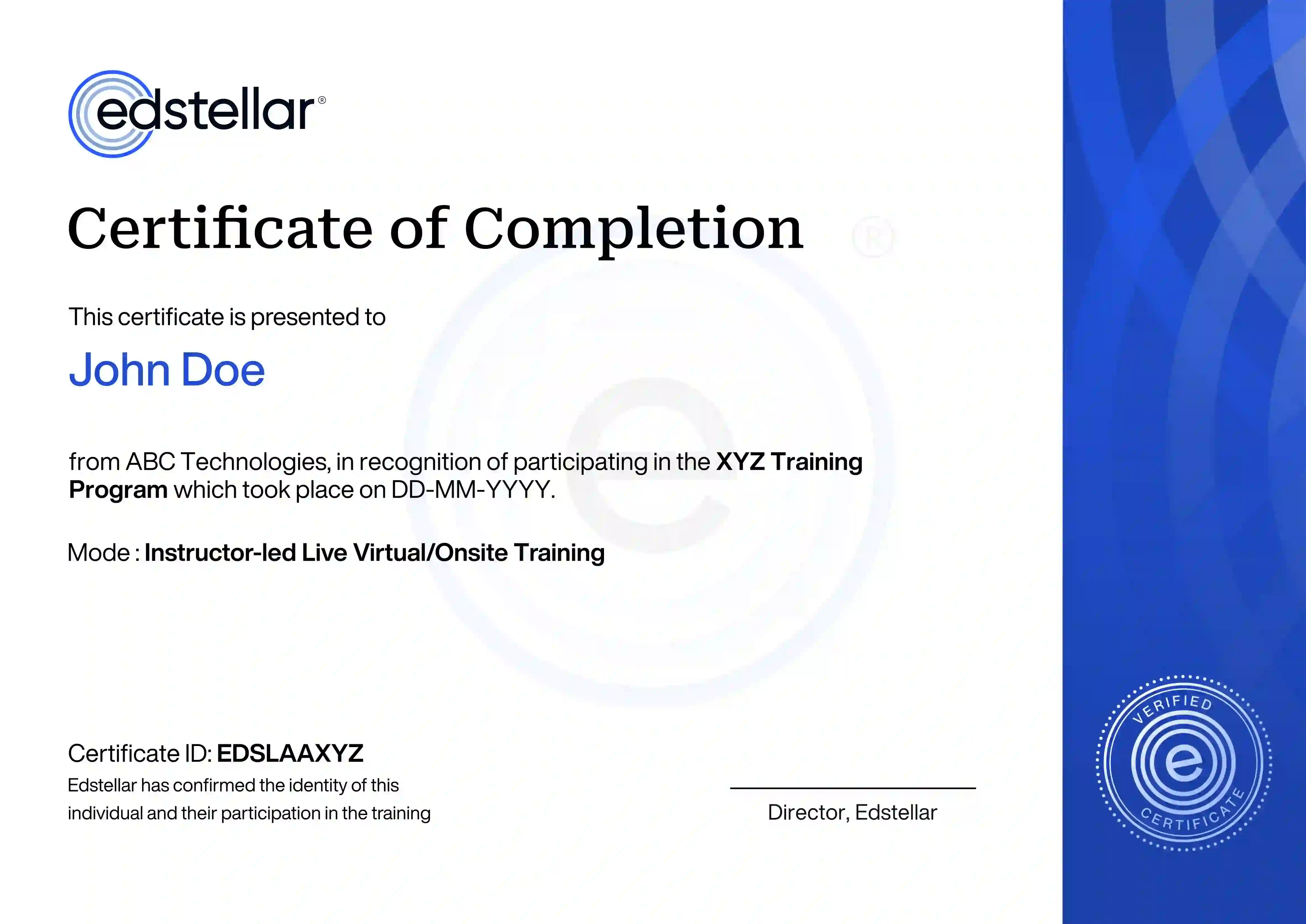
        Get Your Team Members Recognized with Edstellar’s Course Certificate

        Upon successful completion of the training course offered by Edstellar, employees receive a course completion certificate, symbolizing their dedication to ongoing learning and professional development.

        This certificate validates the employee's acquired skills and is a powerful motivator, inspiring them to enhance their expertise further and contribute effectively to organizational success.

        Certificate of Excellence

        Other Related Corporate Training Courses