Drive Team Excellence with ML Model Monitoring Corporate Training

Empower your teams with expert-led on-site, off-site, and virtual ML Model Monitoring Training through Edstellar, a premier corporate training provider for organizations globally. Designed to meet your specific training needs, this group training program ensures your team is primed to drive your business goals. Help your employees build lasting capabilities that translate into real performance gains.

ML Model Monitoring is a critical discipline for organizations that deploy machine learning models in production and need to ensure they remain accurate, reliable, fair, and compliant over time. This training covers the complete production monitoring lifecycle, including data and concept drift detection, performance metric tracking, alerting infrastructure, retraining pipelines, A/B testing, explainability monitoring, and fairness governance, equipping ML teams with the tools and practices needed to operate production ML systems with confidence.

Edstellar's ML Model Monitoring Instructor-led course offers virtual/onsite training options designed for ML engineering, data science, and MLOps teams. Through hands-on labs with real production monitoring tools, incident simulations, and case-driven exercises, participants develop the operational expertise needed to build and maintain robust ML monitoring systems that protect model performance and organizational trust.

Get Customized Expert-led Training for Your Teams
Customized Training Delivery
Scale Your Training: Small to Large Teams
In-person Onsite, Live Virtual or Hybrid Training Modes
Plan from 2000+ Industry-ready Training Programs
Experience Hands-On Learning from Industry Experts
Delivery Capability Across 100+ Countries & 10+ Languages
""""

Key Skills Employees Gain from Instructor-led ML Model Monitoring Training

ML Model Monitoring skills corporate training will enable teams to effectively apply their learnings at work.

  • Data and Concept Drift Detection
  • Model Performance Metrics Tracking
  • Monitoring Infrastructure Setup
  • Alerting and Incident Response
  • Model Retraining and Lifecycle Management
  • Fairness and Bias Monitoring
  • MLOps Observability Integration

Key Learning Outcomes of ML Model Monitoring Training Workshop

Upon completing Edstellar’s ML Model Monitoring workshop, employees will gain valuable, job-relevant insights and develop the confidence to apply their learning effectively in the professional environment.

  • Master data drift and concept drift detection techniques for maintaining model accuracy in production
  • Develop comprehensive ML model performance tracking and evaluation workflows
  • Build production monitoring infrastructure with dashboards, alerts, and observability tooling
  • Apply model retraining strategies and lifecycle management practices for sustained ML performance
  • Gain expertise in A/B testing and shadow deployment for safe production model updates
  • Learn fairness, bias, and compliance monitoring practices for responsible ML in production

Key Benefits of the ML Model Monitoring Group Training

Attending our ML Model Monitoring group training classes provides your team with a powerful opportunity to build skills, boost confidence, and develop a deeper understanding of the concepts that matter most. The collaborative learning environment fosters knowledge sharing and enables employees to translate insights into actionable work outcomes.

  • Instructor-led ML Model Monitoring training delivered onsite or virtually for corporate teams
  • End-to-end coverage of production ML model monitoring from metrics to incident response
  • Hands-on labs using industry monitoring tools including Evidently AI, Grafana, and Prometheus
  • Practical modules on data drift, concept drift, and model performance degradation detection
  • Alerting system design and incident response workflows for ML production environments
  • Model retraining triggers, automated pipelines, and lifecycle management strategies
  • A/B testing and shadow deployment techniques for safe model updates
  • Explainability and interpretability monitoring for production ML systems
  • Fairness, bias, and regulatory compliance monitoring frameworks
  • Flexible scheduling with dedicated Edstellar support throughout the training engagement

Topics and Outline of ML Model Monitoring Training

Our virtual and on-premise ML Model Monitoring training curriculum is structured into focused modules developed by industry experts. This training for organizations provides an interactive learning experience that addresses the evolving demands of the workplace, making it both relevant and practical.

  1. Why ML Model Monitoring Matters
    • The difference between traditional software monitoring and ML model monitoring
    • How model performance degrades silently in production environments
    • Business and regulatory drivers for robust ML monitoring programs
    • Real-world incidents caused by unmonitored model degradation
  2. The ML Monitoring Landscape
    • Key monitoring domains: data quality, model performance, and fairness
    • Monitoring in batch versus real-time ML deployment contexts
    • Overview of ML monitoring tools and platforms
    • Positioning ML monitoring within the broader MLOps lifecycle
  3. Types of ML Model Degradation
    • Data drift: changes in input feature distributions
    • Concept drift: changes in the relationship between features and targets
    • Model staleness: performance decay without observable input changes
    • Infrastructure and pipeline degradation affecting model outputs
  4. ML Monitoring Goals and KPIs
    • Defining monitoring objectives aligned with model business purpose
    • Key monitoring KPIs: accuracy, drift score, prediction latency, and error rate
    • Setting acceptable performance thresholds and guardrail metrics
    • Building a monitoring scorecard for ML production systems
  5. Monitoring Architecture Overview
    • Components of an ML monitoring system: collectors, analyzers, and alerters
    • Data collection patterns: logging, sampling, and event streaming
    • Storage and retention strategies for monitoring data
    • Integration of ML monitoring with existing DevOps observability stacks
  6. Monitoring Maturity and Roadmap
    • ML monitoring maturity levels from ad-hoc to automated and proactive
    • Assessing the current monitoring maturity of an ML organization
    • Incremental steps to improve ML monitoring capabilities over time
    • Building the business case for investing in ML model monitoring
  1. Understanding Data Drift in Production ML
    • Definition and types of data drift affecting production models
    • Root causes of data drift: seasonal patterns, market shifts, and data pipeline changes
    • Covariate shift, prior probability shift, and dataset shift taxonomy
    • Impact of undetected data drift on model predictions and business decisions
  2. Statistical Tests for Drift Detection
    • Kolmogorov-Smirnov test for numerical feature drift detection
    • Chi-squared test for categorical feature distribution monitoring
    • Population Stability Index for feature and prediction shift monitoring
    • Jensen-Shannon divergence and Wasserstein distance for drift quantification
  3. Advanced Drift Detection Algorithms
    • Maximum Mean Discrepancy for high-dimensional data drift detection
    • ADWIN and Page-Hinkley tests for sequential drift detection
    • Drift detection with classifier-based two-sample tests
    • Multivariate drift detection for correlated feature sets
  4. Concept Drift Detection Methods
    • Error rate-based concept drift detection approaches
    • Drift detection method (DDM) and early drift detection method (EDDM)
    • Gradual versus sudden concept drift and their detection implications
    • Distinguishing concept drift from data quality issues in practice
  5. Drift Monitoring with Evidently AI
    • Evidently AI architecture and report generation for drift monitoring
    • Data drift and data quality reports with Evidently
    • Target drift and prediction drift monitoring with Evidently
    • Integrating Evidently drift reports into MLOps monitoring pipelines
  6. Designing a Production Drift Monitoring System
    • Reference dataset selection and maintenance for drift baselines
    • Drift monitoring frequency: continuous, scheduled, and triggered approaches
    • Handling concept drift in models with no ground truth labels
    • Dashboard design for drift monitoring visibility and trend analysis
  1. Performance Metrics for Classification Models
    • Accuracy, precision, recall, and F1 in production classification monitoring
    • AUC-ROC and AUC-PR for threshold-independent performance tracking
    • Confusion matrix analysis for production error pattern identification
    • Calibration monitoring: reliability diagrams and expected calibration error
  2. Performance Metrics for Regression Models
    • MAE, RMSE, and MAPE for production regression model monitoring
    • Residual analysis patterns indicating model drift or bias
    • Quantile error tracking for heteroscedastic regression models
    • Business-aligned regression metrics: revenue impact and cost errors
  3. Performance Metrics for Ranking and Recommendation
    • NDCG, MAP, and MRR for recommendation model monitoring
    • Click-through rate and conversion rate as proxy performance signals
    • Diversity, novelty, and coverage metrics for recommendation health
    • A/B test metrics for validating recommendation model changes
  4. Ground Truth Collection and Delayed Feedback
    • Strategies for collecting ground truth labels for production models
    • Managing delayed labels in time-sensitive ML monitoring
    • Proxy label strategies when ground truth is unavailable
    • Label logging systems and feedback loop design for production ML
  5. Slice-Based Performance Monitoring
    • Identifying important data slices for segment-level performance tracking
    • Automated slice discovery tools for production model analysis
    • Detecting performance disparities across demographic and feature slices
    • Setting slice-level performance SLAs and alerts
  6. Performance Monitoring Dashboards
    • Designing effective model performance dashboards for ML teams
    • Time-series visualization of model performance metrics in production
    • Combining operational and ML metrics in unified monitoring views
    • Communicating model performance status to non-technical stakeholders
  1. Instrumentation and Logging for ML Systems
    • Logging prediction inputs, outputs, and metadata in ML services
    • Structured logging formats for ML monitoring data pipelines
    • Sampling strategies for cost-effective logging at scale
    • PII and sensitive data handling in ML monitoring logs
  2. Metrics Collection with Prometheus
    • Prometheus architecture: scrapers, exporters, and storage
    • Instrumenting ML services with Prometheus Python client
    • Defining custom metrics for ML model performance tracking
    • Prometheus query language (PromQL) for ML metric analysis
  3. Visualization with Grafana
    • Building ML model monitoring dashboards in Grafana
    • Key panels: prediction distribution, error rates, and drift scores
    • Grafana annotations for marking model deployments and incidents
    • Role-specific dashboard design for ML engineers and business users
  4. ML Monitoring Platforms
    • Overview of dedicated ML monitoring platforms: Evidently AI, WhyLabs, and Arize
    • Comparing ML monitoring platforms by capability and integration
    • Integrating ML monitoring platforms with existing MLOps toolchains
    • Open-source versus commercial monitoring tool selection criteria
  5. Distributed Tracing for ML Pipelines
    • Applying OpenTelemetry to trace ML prediction pipelines
    • End-to-end trace visibility from feature retrieval to prediction serving
    • Identifying latency bottlenecks in ML serving with distributed tracing
    • Correlating traces with model performance metrics for root cause analysis
  6. Monitoring Infrastructure as Code
    • Managing monitoring configuration with Terraform and Helm
    • Version controlling dashboards, alert rules, and monitoring configs
    • Automated provisioning of monitoring stacks for new ML deployments
    • Testing and validating monitoring infrastructure changes
  1. Designing ML-Specific Alerting Rules
    • Identifying metrics that require automated alerts in ML systems
    • Static and dynamic alert thresholds for ML performance and drift
    • Multi-condition alert rules for complex ML failure scenarios
    • Alert fatigue management and prioritization for ML monitoring teams
  2. Anomaly Detection for ML Metrics
    • Statistical methods for detecting metric anomalies in ML systems
    • Baseline and seasonality-adjusted alerting for ML performance signals
    • ML-based anomaly detection applied to model monitoring metrics
    • Correlating anomalies across multiple ML performance dimensions
  3. Alert Routing and Notification Systems
    • Integrating ML alerts with PagerDuty, Opsgenie, and Slack
    • On-call rotation scheduling for ML platform teams
    • Alert suppression, grouping, and maintenance window configuration
    • Escalation policies for unacknowledged ML monitoring alerts
  4. ML Incident Classification and Severity
    • Defining incident severity levels for ML model failures
    • Classifying incidents: model degradation, data quality, and serving failures
    • Business impact assessment for ML incident severity classification
    • SLA definitions and response time targets for ML incidents
  5. Incident Response Runbooks for ML Systems
    • Developing runbooks for common ML model monitoring incidents
    • First-response actions for detected model performance degradation
    • Escalation paths for data drift and concept drift incidents
    • Rollback and remediation procedures for ML model incidents
  6. Post-Incident Reviews for ML Systems
    • Structuring post-incident reviews for ML monitoring failures
    • Root cause analysis techniques for ML production incidents
    • Identifying monitoring gaps exposed by production incidents
    • Corrective actions and monitoring improvements from post-incident reviews
  1. Retraining Triggers and Decision Criteria
    • Scheduled, performance-based, and drift-triggered retraining strategies
    • Cost-benefit analysis for retraining frequency decisions
    • Setting automated retraining triggers based on monitoring signals
    • Human-in-the-loop approval workflows for model retraining decisions
  2. Automated Retraining Pipelines
    • Designing end-to-end automated retraining pipeline architecture
    • Data freshness requirements and training dataset construction for retraining
    • Automated model evaluation gates before retraining deployment
    • Continuous training versus continuous deployment distinctions
  3. Model Versioning and Registry Management
    • Model registry design for version management and governance
    • Model artifact storage and metadata management best practices
    • Promotion workflows from development to staging to production
    • Model lineage tracking for reproducibility and compliance
  4. Deployment Strategies for Retrained Models
    • Blue-green deployment for safe retrained model rollouts
    • Canary releases for gradual retrained model traffic shifting
    • Shadow mode deployment for side-by-side retrained model evaluation
    • Automated rollback triggers for retrained model deployment failures
  5. Model Deprecation and Retirement
    • Criteria for deprecating and retiring production ML models
    • Communication and coordination for model retirement decisions
    • Archiving model artifacts and monitoring data at retirement
    • Regulatory and compliance considerations for model retirement
  6. Continuous Training and MLOps Integration
    • Continuous training pipelines integrated with CI/CD for ML
    • Orchestrating retraining pipelines with Airflow and Kubeflow
    • Feedback loops from monitoring to training data improvement
    • Measuring retraining effectiveness through monitoring impact analysis
  1. A/B Testing Principles for ML Models
    • Designing controlled A/B experiments for ML model comparisons
    • Statistical significance, power, and sample size for ML A/B tests
    • Defining primary metrics and guardrail metrics for ML experiments
    • Ethical considerations in A/B testing ML models in production
  2. Traffic Splitting and Experiment Infrastructure
    • Percentage-based traffic routing for ML model variants
    • Feature flags for controlled ML model experiment rollouts
    • Experiment isolation strategies to prevent cross-contamination
    • Infrastructure tools for ML A/B experiment management
  3. Shadow Mode Deployment for Safe Model Validation
    • Shadow mode architecture: running challenger models without user impact
    • Capturing and comparing shadow model predictions against production
    • Latency and resource impact of shadow deployments
    • Promotion criteria from shadow to production for validated models
  4. Multi-Armed Bandit Approaches
    • Multi-armed bandit as an alternative to fixed A/B testing
    • Epsilon-greedy, UCB, and Thompson sampling strategies
    • Contextual bandits for personalized ML model selection
    • Trade-offs between A/B testing and bandit approaches in production
  5. Experiment Analysis and Decision Making
    • Frequentist versus Bayesian analysis for ML experiment results
    • Handling novelty effects and selection bias in ML experiments
    • Multi-metric decision frameworks for model selection post-experiment
    • Documenting experiment results and learnings in model registries
  6. Online Evaluation and User Feedback Integration
    • Implicit feedback signals: click-through rates and task completion
    • Explicit user feedback collection for ML model improvement
    • Linking online feedback to specific model versions and predictions
    • Feedback loop design for continuous model quality improvement
  1. Why Monitor Explainability in Production
    • Business and regulatory requirements for ongoing model explainability
    • How explanation drift signals concept drift and feature importance changes
    • Risks of explanation inconsistency in high-stakes ML decisions
    • Types of production explainability monitoring: global, local, and counterfactual
  2. SHAP-Based Feature Importance Monitoring
    • Tracking global feature importance shifts over time using SHAP
    • Monitoring local SHAP explanations for individual prediction audits
    • Alerting on significant changes in feature importance rankings
    • SHAP monitoring dashboards for production ML models
  3. Explanation Stability and Consistency
    • Measuring explanation stability across similar inputs over time
    • Consistency checks for explanations across model versions
    • Detecting explanation degradation caused by model retraining
    • User-facing explanation quality monitoring for decision support tools
  4. Counterfactual and Contrastive Explanation Monitoring
    • Monitoring counterfactual action distance for actionability tracking
    • Validity and proximity of counterfactual explanations over time
    • Detecting when counterfactual recommendations become infeasible
    • Regulatory requirements for explanation validity in financial AI
  5. Audit Trails for Explainable AI
    • Logging explanations alongside predictions for complete audit trails
    • Explanation versioning tied to model and data versions
    • Audit log design for regulatory compliance in AI decisions
    • Querying explanation logs for retrospective decision audits
  6. Operationalizing Explainability at Scale
    • Balancing explanation quality with computational cost in production
    • Sampling strategies for cost-effective explanation generation
    • Explanation caching and precomputation for high-throughput systems
    • Building explanation APIs for downstream consumers and audit teams
  1. Fairness Concepts and Metrics for Production ML
    • Definitions of fairness: demographic parity, equalized odds, and individual fairness
    • Choosing appropriate fairness metrics for different use case contexts
    • Fairness trade-offs and impossibility results in ML systems
    • Regulatory requirements for fairness monitoring in high-stakes domains
  2. Production Bias Detection and Monitoring
    • Measuring prediction bias across protected and demographic groups
    • Disparate impact analysis for production ML model outputs
    • Tools for bias monitoring: Fairlearn and IBM AI Fairness 360
    • Automated alerts for detected bias threshold violations
  3. Bias Drift Monitoring Over Time
    • Tracking fairness metric trends over model lifetime
    • How bias can emerge or worsen after model retraining
    • Segment-level monitoring for bias pattern identification
    • Integrating bias drift into the model retraining decision framework
  4. Compliance Monitoring for Regulated Industries
    • GDPR, EU AI Act, and sector-specific compliance requirements for ML
    • Right-to-explanation monitoring and audit trail requirements
    • Anti-discrimination regulation compliance in credit and hiring models
    • Building a compliance monitoring framework for regulated ML deployments
  5. Content Safety and Toxicity Monitoring
    • Monitoring for harmful, toxic, or unsafe model outputs in production
    • Toxicity scoring tools for generative and language model outputs
    • Adversarial input detection for ML model safety
    • Escalation workflows for detected content safety violations
  6. Responsible AI Reporting and Governance
    • Building a responsible AI monitoring report for executive stakeholders
    • Model card maintenance and refresh cadence for production models
    • Governance committee review processes for bias and fairness findings
    • External auditing and independent review for high-stakes ML systems
  1. MLOps Monitoring Architecture Patterns
    • Centralized versus federated ML monitoring architecture approaches
    • Monitoring patterns for batch, real-time, and edge ML deployments
    • Multi-model and multi-team monitoring infrastructure design
    • Scaling monitoring infrastructure with the growth of the ML model fleet
  2. Building a Model Health Score
    • Combining drift, performance, fairness, and latency into a model health score
    • Weighting health dimensions based on business and regulatory priorities
    • Threshold-based health score alerting and escalation
    • Model health score dashboards for ML portfolio management
  3. Monitoring for Large Model Fleets
    • Strategies for monitoring hundreds of production ML models efficiently
    • Automated monitoring configuration for new model deployments
    • Prioritizing monitoring depth based on model business criticality
    • Cross-model correlation analysis for systemic issue detection
  4. Cost Management for ML Monitoring
    • Estimating and managing compute and storage costs for monitoring
    • Sampling strategies to reduce monitoring data volume and cost
    • Right-sizing monitoring infrastructure for different model tiers
    • Monitoring cost attribution and chargeback for ML platform teams
  5. Monitoring Culture and Team Practices
    • Building a monitoring-first culture in ML engineering teams
    • Defining monitoring ownership and accountability across roles
    • Monitoring review cadences and team rituals for ML health
    • Training ML engineers in monitoring practices and incident response
  6. Capstone: Designing an Enterprise ML Monitoring System
    • End-to-end project: design a comprehensive monitoring system for a model fleet
    • Implementing drift detection, alerting, and performance dashboards
    • Configuring retraining triggers and lifecycle management workflows
    • Presenting monitoring architecture and operational runbooks to stakeholders

Who Can Take the ML Model Monitoring Training Course

The ML Model Monitoring training program can also be taken by professionals at various levels in the organization.

  • ML Engineers and Data Scientists
  • MLOps and DevOps Engineers
  • AI Platform and Infrastructure Engineers
  • Data Engineers Supporting ML Pipelines
  • AI Product Managers
  • Analytics Engineers and Data Architects

Prerequisites for ML Model Monitoring Training

Professionals should have experience in machine learning model development and Python programming to take the ML Model Monitoring training course.

Request a Quote for your Corporate Training Requirements

Valid number

Delivering Training for Organizations across 100 Countries and 10+ Languages

Corporate Group Training Delivery Modes
for ML Model Monitoring Training

At Edstellar, we understand the importance of impactful and engaging training for employees. As a leading ML Model Monitoring training provider, we ensure the training is more interactive by offering Face-to-Face onsite/in-house or virtual/online sessions for companies. This approach has proven to be effective, outcome-oriented, and produces a well-rounded training experience for your teams.

Virtual ML Model Monitoring Training

Edstellar's ML Model Monitoring virtual/online training sessions bring expert-led, high-quality training to your teams anywhere, ensuring consistency and seamless integration into their schedules.

With global reach, your employees can get trained from various locations
The consistent training quality ensures uniform learning outcomes
Participants can attend training in their own space without the need for traveling
Organizations can scale learning by accommodating large groups of participants
Interactive tools can be used to enhance learning engagement
On-site ML Model Monitoring Training

Edstellar's ML Model Monitoring inhouse face to face instructor-led training delivers immersive and insightful learning experiences right in the comfort of your office.

Higher engagement and better learning experience through face-to-face interaction
Workplace environment can be tailored to learning requirements
Team collaboration and knowledge sharing improves training effectiveness
Demonstration of processes for hands-on learning and better understanding
Participants can get their doubts clarified and gain valuable insights through direct interaction
Off-site ML Model Monitoring Training

Edstellar's ML Model Monitoring offsite face-to-face instructor-led group training offer a unique opportunity for teams to immerse themselves in focused and dynamic learning environments away from their usual workplace distractions.

Distraction-free environment improves learning engagement
Team bonding can be improved through activities
Dedicated schedule for training away from office set up can improve learning effectiveness
Boosts employee morale and reflects organization's commitment to employee development

Explore Our Customized Pricing Package
for
ML Model Monitoring Corporate Training

Looking for pricing details for onsite, offsite, or virtual instructor-led ML Model Monitoring training? Get a customized proposal tailored to your team’s specific needs.

Request a Group Training Quote
""
How Many Team Members Need Training?
Please select an option or fill in the custom field.
"'

Is Your Corporate Training Requirement Only for ML Model Monitoring?

Please select at least one course.
""
Add the List of Training Workshops
search icon

      Please select the course

      No. of Courses selected: 0

      Clear

      Upload a CSV

      Send us your Training Requirements in 3 Easy steps

      1. 1
      2. 2
        Add the required training workshops
      3. 3
        Upload to get a quick quote or email it to contact@edstellar.com

      ""

      Looking for a Complete Package?

      Looking for a one-time pricing option for all your annual training requirements?

      View Corporate Training Packages
      ""
      Select the Option that Best Describes Your Corporate Training Requirement

      Please select an option or choose from the recurring options.
      ""
      Verify and Submit Your Request

      Review Your Corporate Training Selection Summary

      Training Program: ML Model Monitoring Training

      1. No of Team Members

      2. Selected Training Preference

      3. Selected Recurring Sessions

      1

      Review your Requirements

      Training Workshops Selected :


        Excel
        File has been
        successfully uploaded.
        Fill the form to submit
 your details
        Submit Your Professional Contact Information
        Valid number
        We've received your enquiry. Our team will be in touch soon.
        Oops! Something went wrong while submitting the form.
        Starter
        120 licences

        Tailor-Made Trainee Licenses with Our Exclusive Training Packages!

        View Package

        64 hours of group training (includes VILT/In-person On-site)

        Tailored for SMBs

        Growth
        320 licences

        Tailor-Made Trainee Licenses with Our Exclusive Training Packages!

        View Package

        160 hours of group training (includes VILT/In-person On-site)

        Ideal for growing SMBs

        Enterprise
        800 licences

        Tailor-Made Trainee Licenses with Our Exclusive Training Packages!

        View Package

        400 hours of group training (includes VILT/In-person On-site)

        Designed for large corporations

        Custom
        Unlimited licenses

        Tailor-Made Trainee Licenses with Our Exclusive Training Packages!

        View Package

        Unlimited duration

        Designed for large corporations

        Edstellar: Your Go-to ML Model Monitoring Training Company

        Experienced Trainers

        Our trainers bring years of industry expertise to ensure the training is practical and impactful.

        Quality Training

        With a strong track record of delivering training worldwide, Edstellar maintains its reputation for its quality and training engagement.

        Industry-Relevant Curriculum

        Our course is designed by experts and is tailored to meet the demands of the current industry.

        Customizable Training

        Our course can be customized to meet the unique needs and goals of your organization.

        Comprehensive Support

        We provide pre and post training support to your organization to ensure a complete learning experience.

        Multilingual Training Capabilities

        We offer training in multiple languages to cater to diverse and global teams.

        Testimonials

        What Our Clients Say

        We pride ourselves on delivering exceptional training solutions. Here's what our clients have to say about their experiences with Edstellar.

        "Edstellar's virtual ML Model Monitoring training gave our ML platform team the operational discipline needed to manage production models at scale. Within 60 days of completing the program, we deployed a centralized drift monitoring system across 40 production models, reduced undetected model degradation incidents by 70%, and cut mean time to detect from 3 weeks to under 48 hours."

        Suresh Raghavan

        Head of ML Platform,

        A Global Insurance Technology Company

        "The onsite ML Model Monitoring training delivered by Edstellar was exactly what our data science and engineering teams needed to operate production models responsibly. The hands-on labs with Evidently AI, Prometheus, and Grafana were directly applicable to our stack. Post-training, we built alerting and retraining pipelines that reduced model-related incidents by 55% in the first quarter."

        Meghna Pillai

        VP of AI Operations,

        A Leading Retail Technology Enterprise

        "We ran our entire ML and MLOps team through Edstellar's intensive ML Model Monitoring program at an off-site location. The comprehensive coverage from drift detection to fairness monitoring and lifecycle management gave our team a unified operational playbook. Post-program, our model health dashboard now covers 100% of production models and our compliance audit preparation time dropped by 40%."

        Deepa Krishnan

        Chief Machine Learning Officer,

        A Multinational Financial Technology Group

        "Edstellar's IT & Technical training programs have been instrumental in strengthening our engineering teams and building future-ready capabilities. The hands-on approach, practical cloud scenarios, and expert guidance helped our teams improve technical depth, problem-solving skills, and execution across multiple projects. We're excited to extend more of these impactful programs to other business units."

        Aditi Rao

        L&D Head,

        A Global Technology Company

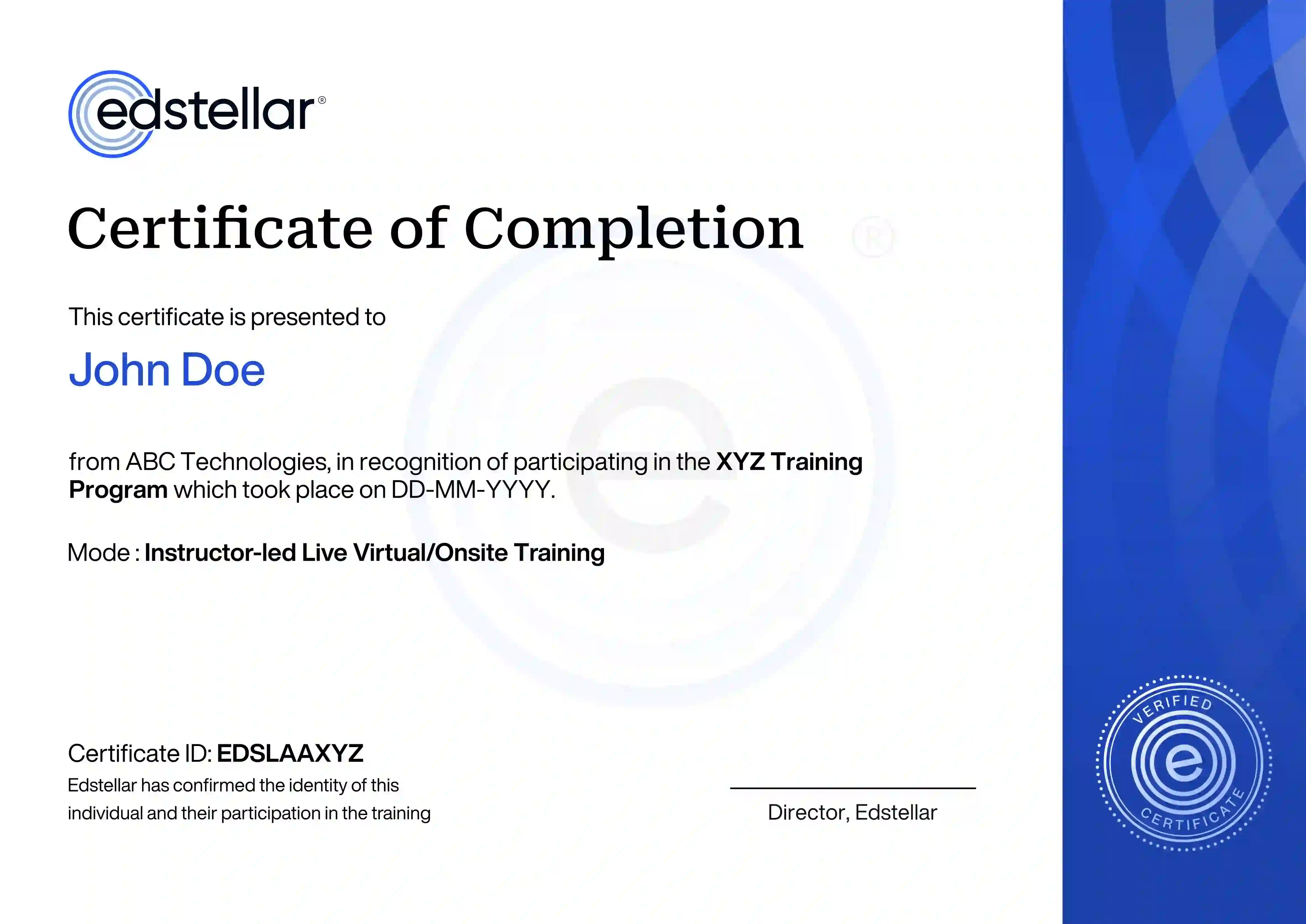
        Get Your Team Members Recognized with Edstellar’s Course Certificate

        Upon successful completion of the training course offered by Edstellar, employees receive a course completion certificate, symbolizing their dedication to ongoing learning and professional development.

        This certificate validates the employee's acquired skills and is a powerful motivator, inspiring them to enhance their expertise further and contribute effectively to organizational success.

        Certificate of Excellence

        Other Related Corporate Training Courses